semi合集-English.pdf - 第3136页
SEMI E125-0305 © SEMI 2003, 2005 44 RELATED INFORMATION 2 SQL WHERE CLAUSE NOTICE : This rel ated infor mation is not an official part of SEMI E125 and was derived from the wo rk of the originating committee. Th is relat…
SEMI E125-0305 © SEMI 2003, 2005 43
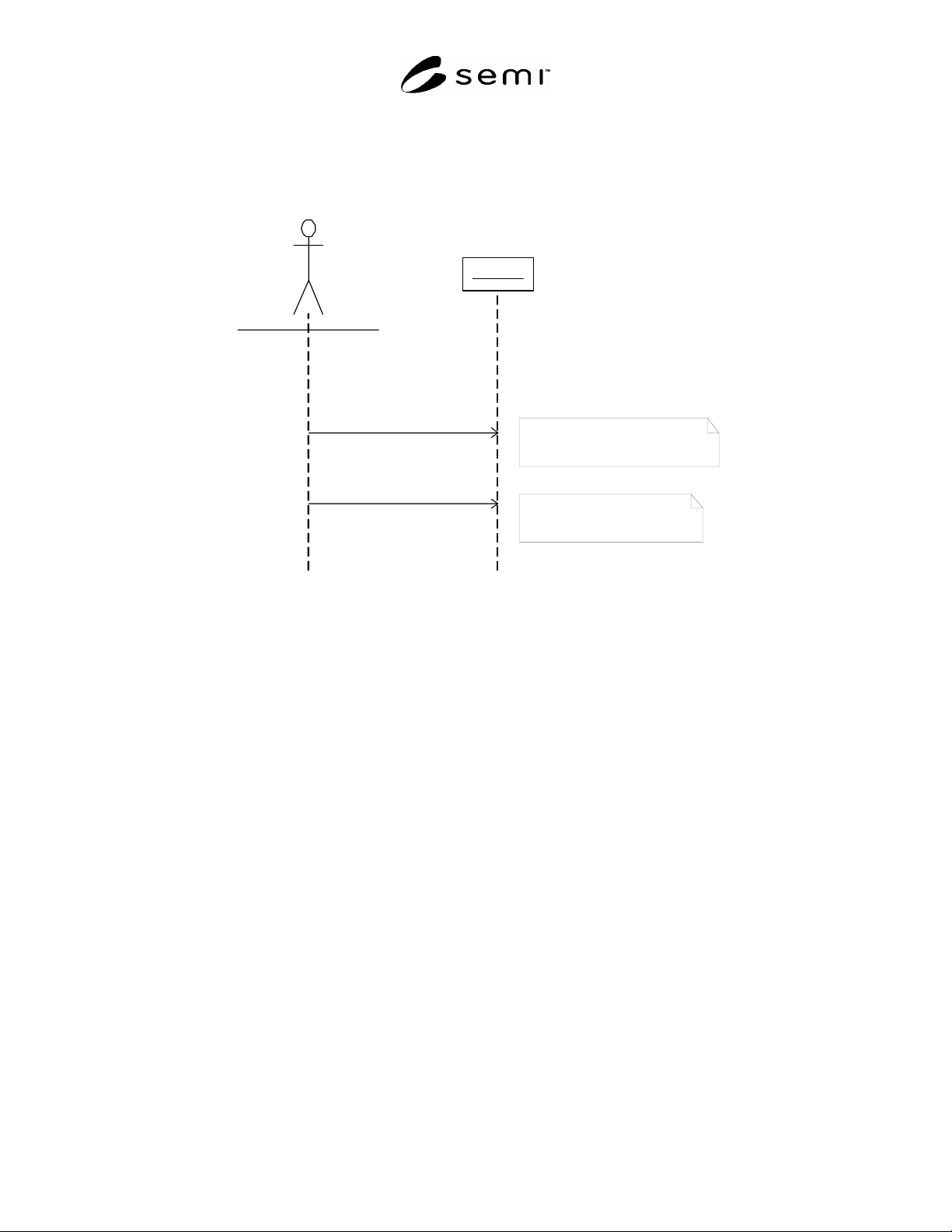
R1-3.5 Retrieve Equipment Configuration — This use case is directly supported by this specification, and provides
a way for an application to request a description of the physical and logical equipment configuration. Figure R1-6
shows one example of how this use case can be realized using messages from the interface defined in this
specification (see Section 9).
: EquipmentD iagnosticsC lient
Equipment
GetEquipment NodeDes criptions()
GetEquipment Struc ture()
Get all equipment nod es, det ermine
nodes that refer to softw are modules
of interest
Get the equipment st ructure to
understand t he role of each node
in the o verall equ ipme nt
Figure R1-6
Use Case Realization for “Retrieve Equipment Configuration”

SEMI E125-0305 © SEMI 2003, 2005 44
RELATED INFORMATION 2
SQL WHERE CLAUSE
NOTICE: This related information is not an official part of SEMI E125 and was derived from the work of the
originating committee. This related information was approved for publication by full letter ballot procedures.
R2-1 Syntax
R2-1.1 The WHERE clause of the SQL SELECT statement is a propositional-expression that consists of one or
more comparisons of values with constants. It has the following form.
WHERE propositional-expression [nested-propositional-expression];
R2-1.2 Syntax
R2-1.2.1 propositional-expression — Specifies a comparison. It takes one of the following forms:
[NOT] term operator term
parameter [NOT] IN (constant
1
,… constant
n
)
parameter [NOT] BETWEEN ( term
1
AND term
2
) (inclusive)
term IS [NOT] NULL | TRUE | FALSE
parameter [NOT] LIKE “string%”
R2-1.2.2 [ ] — An optional equation item.
R2-1.2.3 term — Specifies a parameter, a constant or an arithmetic expression of parameters and constants. The
allowed arithmetic operations are addition (+), subtraction (-), multiplication (*) and division (/).
R2-1.2.4 parameter — Specifies the name of the parameter value to use in the comparison operation.
R2-1.2.5 Constant
1) Specifies a number or a string enclosed by quotation marks.
2) Specifies a conditional. A conditional has the following form.
DECODE( term, constant
1
, return
1
, … constant
n
, return
n
, default )
return
i
The value of the conditional if term equals constant
i
.
default
The value of the conditional if parameter does not equal any constant
i
.
R2-1.2.6 operator — Specifies the operator to use in the comparison. It can be one of the following operators.
Operator Description Operator Description
= Equal <> Not equal
> Greater than < Less than
>= Greater than or equal to <= Less than or equal to
R2-1.3 IN — List Inclusion test (enumeration comparison).
R2-1.4 BETWEEN — Bounds test (limits comparison).
R2-1.5 IS — Equality test.
R2-1.6 LIKE — Pattern matching (string comparison) test. (LIKE only works with ASCII data types).
R2-1.6.1 A | B | … N — One of the listed items is required.

SEMI E125-0305 © SEMI 2003, 2005 45
R2-1.6.2 String% — String constant followed by the “%” or “*” wild character. A wildcard character can also be
used by itself to match everything. Use a wildcard character only at the end of the string constant.
R2-1.6.3 nested-propositional-expression — AND|OR propositional-formula [nested-propositional-formula]
NOTE 1: A semicolon is required at the end of SQL statements. The ‘;’ indicates the SQL statement is complete.
NOTE 2: Parentheses can be used in the usual way to group expressions and establish precedence.
NOTE 3: Floating-point comparisons are approximate. Testing for equality with floating point values is not recommended.