semi合集-English.pdf - 第2746页
SEMI E98-1102 © SEMI 2000, 2002 11 internal subsystems, subassemblies, and i/o devices used in moving material with in the equipment, such as robots, loc ation sensors, proxim ity sensors, m otors, centering and alignmen…
SEMI E98-1102 © SEMI 2000, 2002 10
Equipment
Control
Facilities
Interface
Material
I/O
Management
Recipe
Management
Operations
Management
Recipe
Execution
Exception
Management
Material
Management
Process
Execution
Performance
Management
Access
Management
Event
Management
Object
Management
Date/Time
Management
Environment
Control
Communications
Link
Job
Management
Information
Management
Material
Movement
Control
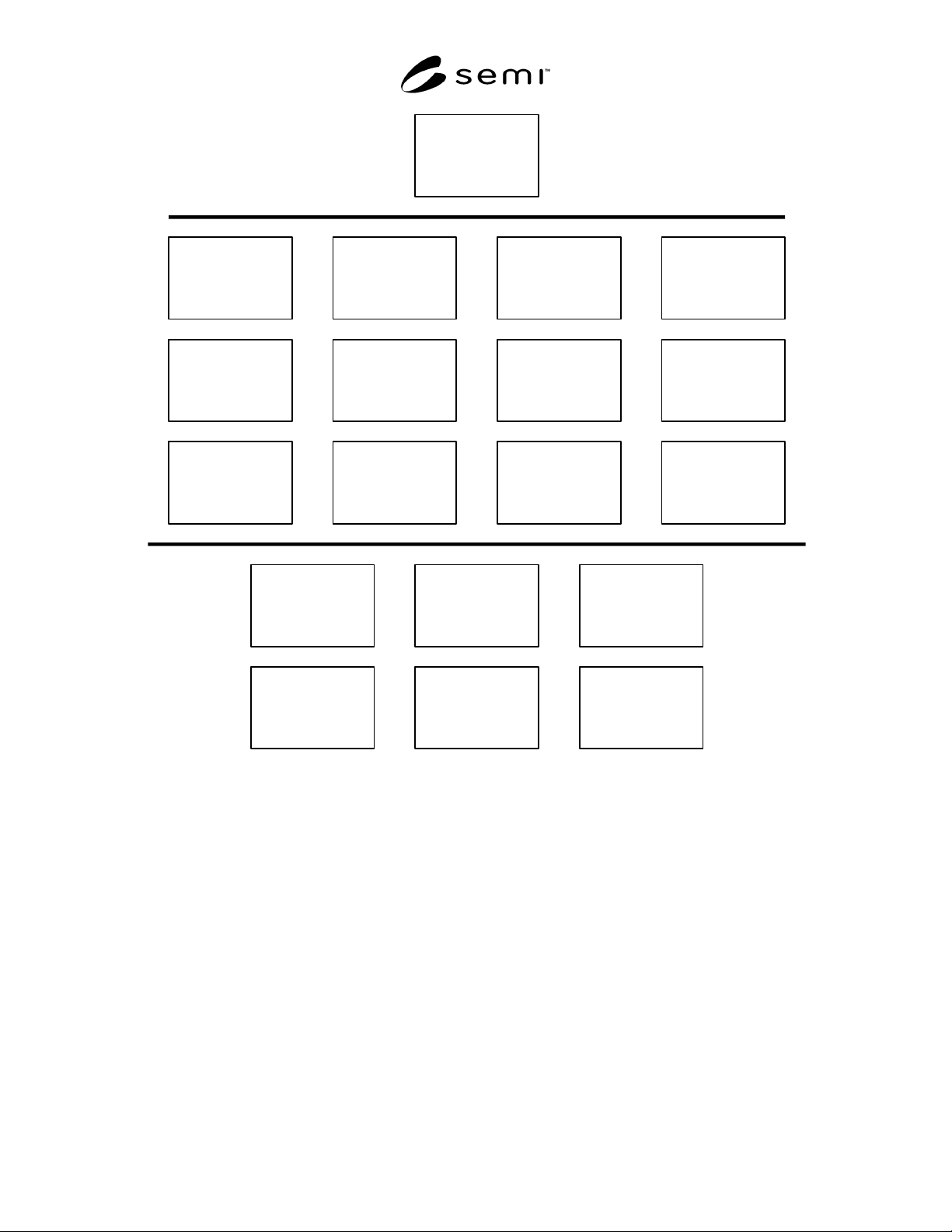
Figure 1
Functional View of Equipment
8.3.9 Facilities Interface — The Facilities Interface is
responsible for managing the physical interfaces
(hookups) to the factory. This includes bulk fill,
continuous chemical services, factory vacuum, factory
exhaust, and the electrical environment of the
equipment.
8.3.10 Information Management — Information
Management is responsible for the information and data
stored by the equipment, including information required
for the user as well as various internal event and data
logs.
8.3.11 Job Management — Job Management is
responsible for all jobs, including process jobs, job
queues, and job execution.
8.3.12 Material I/O Management — The Material
Input/Output (I/O) Management is responsible for
loading and unloading material to and from the factory.
This includes the AMHS interface (parallel I/O), pod
interface, carrier management, and carrier-related
services such as reading, writing, and slot mapping
(identifying unoccupied, correctly occupied, and
incorrectly occupied slots in a carrier).
8.3.13 Material Management — Material Management
is responsible for tracking all material, including
carriers, product, and consumables, within or used by
the equipment. This includes providing historical
information required for product history.
8.3.14 Material Movement Control — Material
Movement Control consists of low-level control of

SEMI E98-1102 © SEMI 2000, 2002 11
internal subsystems, subassemblies, and i/o devices
used in moving material within the equipment, such as
robots, location sensors, proximity sensors, motors,
centering and alignment systems, and material identifier
readers.
8.3.15 Object Management
8.3.15.1 Object Management consists of management
of OBEM objects, their attributes, and internal
communications. It includes all elements of
configuration definition, both fixed and user-
configurable, that pertain to the equipment.
Configuration settings consist of those attributes that
affect the global behavior of the equipment and are
generally static and change only on request. They are
in effect at all times regardless of the current recipe(s)
and/or processing states. They control activities that
maintain the environment when “not processing”.
8.3.15.2 Configuration settings shall be retained in
non-volatile storage. Some elements of configuration
may be distributed. For example, individual process
chambers may have their own configuration elements.
8.3.15.3 Elements of configuration management
include:
• configuration of individual physical chambers, and
• configuration of individual logical objects.
8.3.16 Operations Management — Operations
Management is responsible for the overall operation of
the equipment in all operational modes: automatic,
semi-automatic, and manual.
8.3.17 Performance Management — Performance
Management is responsible for managing information
and operations related to the performance of the
equipment and equipment modules. This includes
oversight for manual mode operations performed when
the equipment and equipment modules are out of
service. For implementations of ARAMS, this also
includes ARAMS state changes and data as well as
oversight for manual mode operations performed during
downtime and non-scheduled time.
8.3.18 Process Execution — Process Execution covers
those fixed algorithms and procedures that are not
reachable or changeable by the user. This includes any
embedded control and sequence algorithms not
contained in recipes. It consists of low-level control of
subsystems, sensors, and actuators not covered by
Material Management Control, such as, chemical
control (valves, exhaust), motion control (rotational,
acceleration, positional) and the control of the
environment during processing of the product
(temperature, etc.). It also includes product
environment control and any fixed embedded fault
detection classification, and/or fixed low-level in-situ
run-to-run control for advanced process control.
8.3.19 Recipe Execution
8.3.19.1 A recipe represents the pre-planned and
reusable set of instructions, algorithms, and settings that
are used by process execution to control process,
including variable in situ process control algorithms.
Recipes are created by the user, and in some cases by
the equipment as well. Recipes may be of a variety of
types, such as flow sequence, metrology, models, abort,
and load maps, as well as etch, clean, etc.
8.3.19.2 Recipe Execution is responsible for the proper
and safe execution of recipes, including loading the
recipe into the execution area, verification of the recipe,
validation of recipes (ensuring the recipe does not
conflict with the current equipment configuration), and
initiation of process execution based on recipe
instructions (SEMI E42).
8.3.20 Recipe Management — Recipe Management
consists of the management of stored recipes. This is
differentiated from short-term storage of recipes and the
selection and execution of recipes performed by Recipe
Execution (SEMI E42). Recipes are classified
(organized) according to their primary application
function: process, environment, service (maintenance),
etc.
8.4 Relationships with Other Standards
8.4.1 Only those functional areas in the middle in
Figure 1 are of interest to the host. The top level of
Equipment Control represents all of the functionality
below it, while the functional areas at the bottom are
considered to be low level and proprietary to the
equipment supplier.
8.4.2 Table 1 shows those functional areas that are
defined by OBEM and those that are defined by other
SEMI standards. In some cases, OBEM may extend or
limit the functionality defined elsewhere.
SEMI E98-1102 © SEMI 2000, 2002 12
Table 1 Functional Area Definition
Functional Area Where Defined Comments
Access Management SEMI E98 (OBEM) Defines different kinds of user control.
Date/Time Management SEMI E98 (OBEM) Addresses timestamp, date/time synchronization.
Event Management SEMI E53 (ERS) SEMI E53 may be required for SECS-II implementations.
Exception Management SEMI E41 (EMS) Required for reporting alarms and exceptions.
Material I/O Management SEMI E87 (CMS) Required for Carrier Management.
Material Management SEMI E90 (STS) Required for Substrate Tracking.
Object Management SEMI E39 (OSS) Required
Operations Management SEMI E98 (OBEM) Overall coordination.
Performance Management SEMI E58 (ARAMS) Optional for EquipmentModule and Equipment. Not used
for lower level components.
Job Management SEMI E40 (PM),
SEMI E94 (CJM)
Process Managment and Control Job Management
Recipe Execution SEMI E42 (RMS) Required for processing by EquipmentModule.
Recipe Management SEMI E42 (RMS) Required for long-term storage by Equipment.
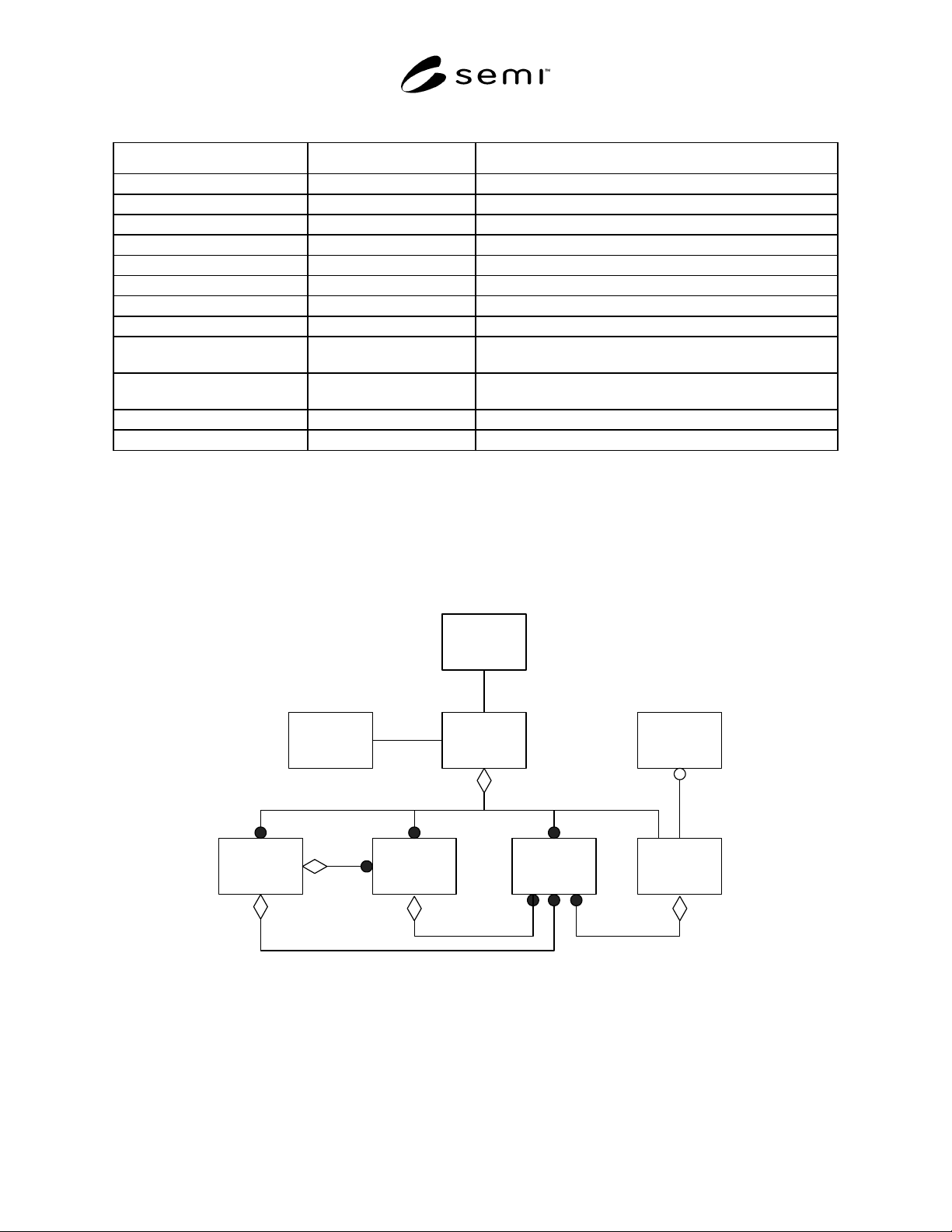
8.5 Internal Composition View of the Equipment — The physical makeup of equipment is of interest to the factory,
particularly for equipment that is complex, multi-module, and/or multi-process. Productivity and maintenance
tracking, for example, requires that the factory be able to specify individual subsystems and/or modules for
maintenance activities, where it is possible to do so without removing the entire equipment from manufacturing
scheduling. For example, one or more baths in a wet bench may be down for maintenance even though the wet
bench itself continues to process.
1+
1+
held at
interacts with
EquipmentClock
Process
Module
Material
Handling
Subsystem
I/O Device
User
Carrier
LoadPort
1+
Figure 2
An Example of Equipment Internal Composition
9 OBEM Object Model
9.1 OBEM defines generic component objects of Equipment, and the Equipment object itself. Equipment is made
up of elements (units or parts) of different levels of intelligence and complexity, such as modules, subsystems, and
I/O devices. Each of these elements may itself be made up of several smaller elements, some of which may also be
intelligent, and this allows the complexity of the equipment to be distributed to smaller functional units. Many of