semi合集-English.pdf - 第1590页
SEMI E37-0303 © SEMI 1995, 2003 12 Value Description 4– 127 Reserved for subsidiary st andard-specific reasons for select failure. 128– 255 Reserved for local entity-specific reas ons for select failure. PType = 0 SType …
SEMI E37-0303 © SEM 1995, 2003 11
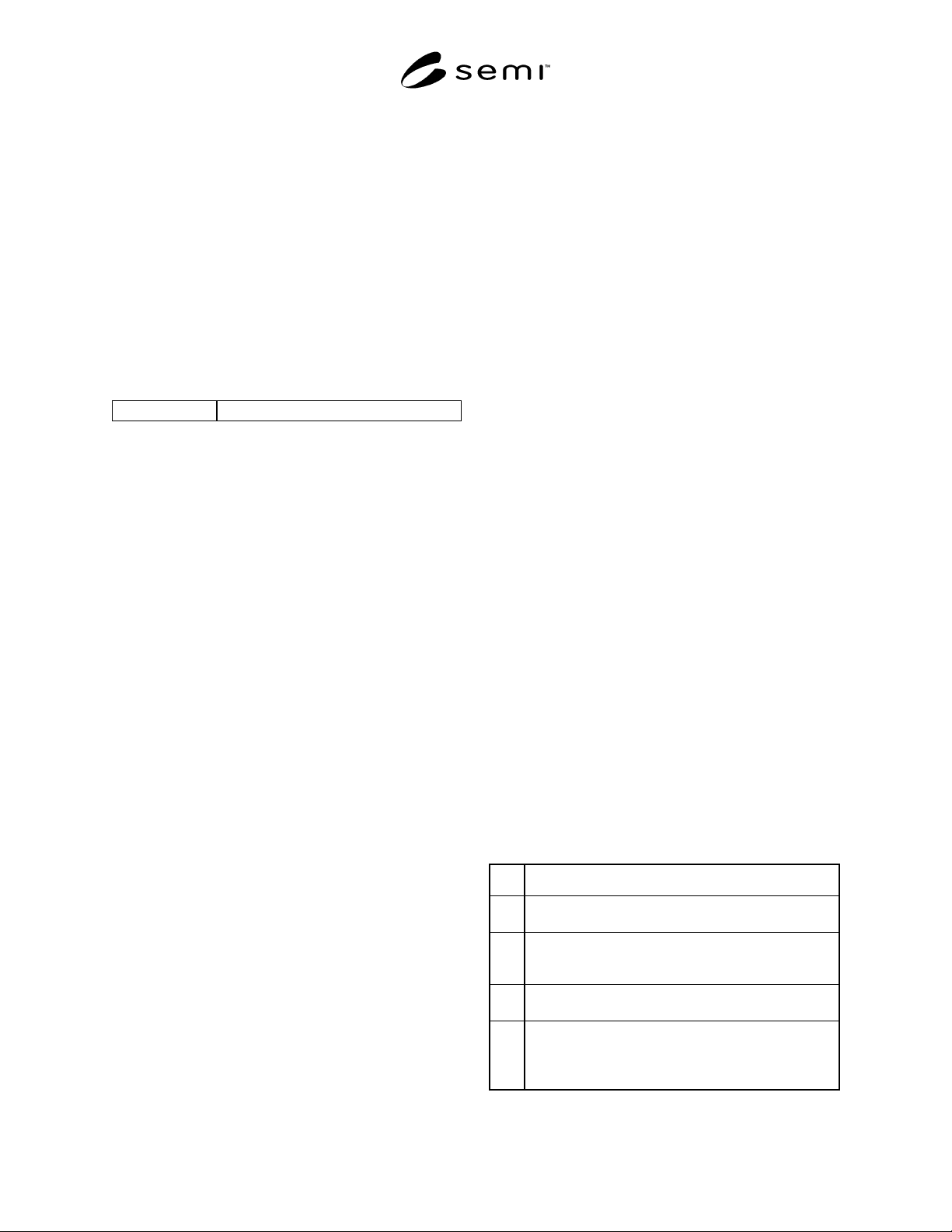
8.2.1 SType=0: Data Message — An HSMS message
with SType = 0 is used by the HSMS Data procedure to
send a Data message, either Primary or Reply. The
message format is as follows:
HSMS Message Length is always 10 (the length of the
header alone) or greater.
The HSMS Message Header is as follows:
Session ID — As described above. Specific value
subject to subsidiary standards.
Header Byte 2 — For messages with PType value =
0 (SECS-II), header byte 2 is formatted as shown
below.
7 6 0
W-Bit Stream
The most significant bit (bit 7) of Header Byte 2 is
the W-Bit. In a Primary Message, the W-Bit
indicates whether the Primary Message expects a
Reply message. A Primary Message which expects
a Reply should set the W-Bit to 1. A Primary
Message which does not expect a Reply should set
the W-Bit to 0. A Reply Message should always set
the W-Bit to 0. The low-order 7 bits (bits 6-0) of
Header Byte 2 contain the SECS Stream for the
message. The Stream is a 7-bit unsigned integer
value, which identifies a major topic of the
message, and its use is defined within SEMI E5
(SECS-II).
Header Byte 3 — For messages whose PType
value=0, header Byte 3 contains the SECS
Function for the message. The Function is an 8-bit
unsigned integer value which identifies a minor
topic of the message (within the Stream), and its
use is defined within SEMI E5 (SECS-II). The
least significant bit (bit 0) of the Function defines
whether the Data Message is Primary or Reply; the
value 1 indicates Primary and the value 0 indicates
Reply.
PType — Set PType = 0 for SECS-II messages.
SType = 0
System Bytes — For PType=0 (SECS-II), the
following definition applies. For a Primary
Message, System Bytes contain a value uniquely
identifying this transaction from all other open
transactions initiated from the same end of the
Connection. For a Reply Message, System Bytes
contain the same value as the corresponding
Primary Message.
The HSMS Message Text contains the text of the Data
Message (if any), formatted as specified by the PType
field. For PType = 0, the text will be formatted as
SECS-II messages.
NOTE 4: Some Data Messages consist of header only, with
no text.
8.2.2 SType=1: Select.req — An HSMS message with
SType 1 is a “Select Request” Control Message, which
is used by the initiator of the procedure for establishing
HSMS communications. The message format is as
follows:
Message Length is always 10 (Header only).
The HSMS Message Header is as follows:
SessionID — As described above. Specific value
subject to subsidiary standards.
Header Byte 2 = 0
Header Byte 3 = 0
PType = 0.
SType = 1
System Bytes — A unique value among open
transactions.
8.2.3 SType=2: Select.rsp — An HSMS message with
SType 2 is a “Select Response” Control Message, used
as the response to a Select.req Control message in the
procedure for establishing HSMS communications.
The message format is as follows:
Message Length is always 10 (Header only).
The HSMS Message Header is as follows:
SessionID — must be equal to the value of the
session ID in the corresponding Select.req.
Header Byte 2 =0
Header Byte 3 — SelectStatus. A code of zero
indicates success of the Select operation. A non-
zero code indicates failure.
Table 7 SelectStatus
Value Description
0 Communication Established. Select was successfully
completed.
1 Communication Already Active. A previous select has
already established communications to the entity being
selected in this select.
2 Connection Not Ready. The Connection is not yet
ready to accept select requests.
3 Connect Exhaust. The connection was accepted, but
the entity is already servicing a separate TCP/IP
connection and is unable to service more than one at
any given time.
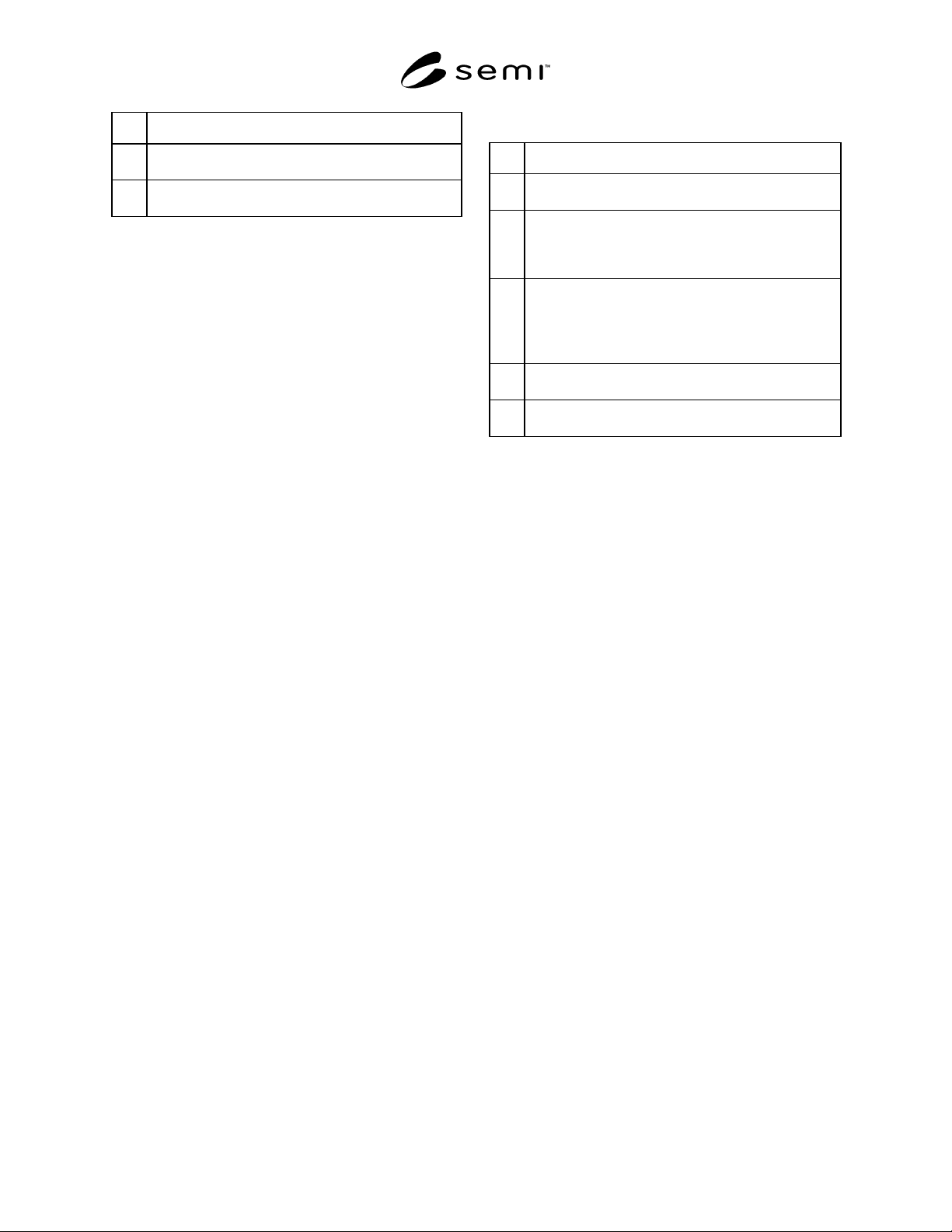
SEMI E37-0303 © SEMI 1995, 2003 12
Value Description
4–
127
Reserved for subsidiary standard-specific reasons for
select failure.
128–
255
Reserved for local entity-specific reasons for select
failure.
PType = 0
SType = 2
System Bytes — Equal to value of System Bytes in
the corresponding Select.req.
8.2.4 SType=3: Deselect.req — An HSMS message
with SType 3 is a “Deselect Request” Control Message,
used by the initiator of the Select procedure for ending
HSMS communication. The message format is as
follows:
Message Length is always 10 (Header only).
The HSMS Message Header is as follows:
SessionID — The SessionID must match the value
of the SessionID of a previously sent Select.req to
indicate the particular HSMS session that is
ending. Subject to further specification by
subsidiary standards.
Header Byte 2 = 0
Header Byte 3 = 0
PType = 0
SType = 3
System Bytes — A unique value among open
transactions.
8.2.5 SType=4: Deselect.rsp — An HSMS message
with SType 4 is a “Deselect Response” Control
Message, used as the response to a Deselect.req Control
message in the Deselect procedure for ending HSMS
communications. The message format is as follows:
Message Length is always 10 (Header only).
The HSMS Message Header is as follows:
SessionID — must equal the session ID in the
corresponding Deselect.req
Header Byte 2 = 0
Header Byte 3 — DeselectStatus. A code of zero
indicates success of the Deselect operation. A non-
zero code indicates failure.
Table 8
Value Description
0 Communication Ended. The Deselect completed
successfully.
1 Communication Not Established. HSMS
communications has not yet been established with a
select, or has already been ended with a previous
Deselect.
2 Communication Busy. The session is still in use by the
responding entity and so it cannot yet relinquish it
gracefully. In this case, if the original requester must
terminate communications, the separate procedure
should be used as a last resort.
3–
127
Reserved for subsidiary standard-specific reasons for
Deselect failure.
128–
255
Reserved for local entity-specific reasons for Deselect
failure.
PType = 0
SType = 4
System Bytes — Equal to System Bytes in
corresponding Deselect.req.
8.2.6 SType=5: Linktest.req — An HSMS message
with SType 5 is a “Linktest Request” Control Message.
It is used to verify the integrity of the HSMS
Connection, or as a periodic heartbeat. The message
format is as follows:
Message Length is always 10 (Header only).
The HSMS Message Header is as follows:
SessionID = 0xFFFF (in binary, all ones)
Header Byte 2 = 0
Header Byte 3 = 0
PType = 0
SType = 5
System Bytes — A unique value among open
transactions.
8.2.7 SType=6: Linktest.rsp — An HSMS message
with SType 6 is a “Linktest Response” Control
Message, used as the response to a Linktest.req Control
message in the Linktest Procedure. The message format
is as follows:
Message Length is always 10 (Header only).
The HSMS Message Header is as follows:
SessionID = 0xFFFF (binary, all ones)
Header Byte 2 = 0
Header Byte 3 = 0
SEMI E37-0303 © SEM 1995, 2003 13
PType = 0
SType = 6
System Bytes — Equal to System Bytes in
corresponding Linktest.req.
8.2.8 SType=7: Reject.req — An HSMS message with
SType 7 is used in response to any valid HSMS
message received which is not supported by the
receiver of the message or which is not valid at the
time. It is intended for dealing with attempts to use
subsidiary standards or user-defined extensions which
are not supported by the receiver (for example, SType
equal to any value not defined in this standard). It must
be used when an entity receives a control message
which is a response (even numbered SType) for which
there was no corresponding open transaction.
The HSMS Message Header is as follows:
SessionID — equal to the value of the Session ID
in the message being rejected.
Header Byte 2 — For ReasonCode = PType Not
Supported, equal to the PType in the message
being rejected. Otherwise equal to the value of the
SType in the message being rejected.
Header Byte 3 — reason code (always non-zero)
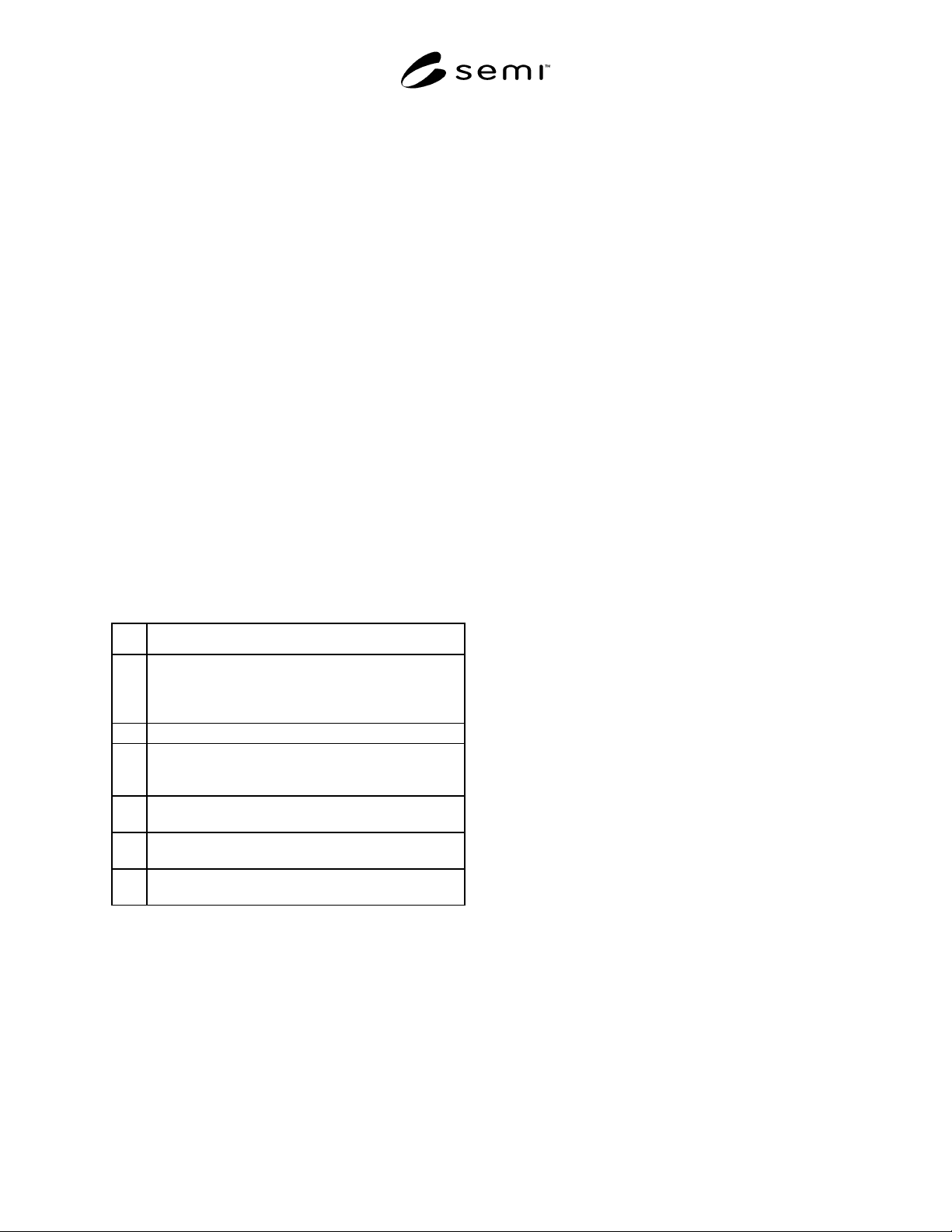
Table 9 ReasonCode
Value Description
1 SType Not Supported. A message was received whose
SType value not defined in the HSMS standard or the
particular subsidiary standard(s) supported by the
entity.
2 PType Not Supported. As above, but for PType.
3 Transaction Not Open. A Response control message
was received when there was no outstanding request
message which corresponded to it.
4 Entity Not Selected. A data message was received when
not in the SELECTED state.
4–
127
Reserved for subsidiary standard-specific reasons for
reject.
128–
255
Reserved for local entity-specific reasons for reject.
PType = 0
SType = 7
System Bytes — Equal to System Bytes in
corresponding message being rejected.
8.2.9 SType=9: Separate.req — An HSMS message
with SType = 9 is used to terminate HSMS
communications immediately. With the exception of
the SType value, it is identical to the Deselect.req
message. Its purpose is to end HSMS communications
immediately and without exception. No response is
defined.
9 Special Considerations
9.1 General Considerations
9.1.1 Communications Failures — If a
communications failure is detected, the entity should
terminate the TCP/IP connection. Upon termination of
the connection, the entity may, at this point, attempt to
reestablish communications.
9.2 TCP/IP Considerations
9.2.1 Connect Separation Time (T5) — The connect
procedures initiate some network activity. Frequent use
of the active mode connect procedure to the IP Address
and Port Number of an entity not yet ready to accept
connections can be hostile to TCP/IP operations. The
passive mode does not generate network activity and is
not considered hostile to the network, although it may
affect local application performance. An Entity
initiating a connection in the active mode should limit
its use of the connect procedure in a manner that is
equivalent to the procedure described here.
After an active connect procedure terminates by any
means (successfully or unsuccessfully), the Entity
should not initiate another active connect procedure (for
the same Remote Entity) until the T5 Connect
Separation Time has elapsed. The separation of connect
operations will be the sum of the T5 Connect
Separation Time interval, plus the duration of the
connect operation itself.
9.2.2 NOT SELECTED Timeout (T7) — Entry into the
NOT SELECTED state is achieved either by state
transition #2 (establishment of a TCP/IP connection).
There is a time limit on how long an entity is required
to remain in the NOT SELECTED state before either
entering the SELECTED state or by returning to the
NOT CONNECTED state.
Some entities, particularly those unable to accept more
than a single TCP/IP connection, may be impaired in
their operation by remaining in their NOT SELECTED
state as they will be unavailable for communications
with other entities. Such entities shall disconnect the
TCP/IP connection (State Transition Event #3) if
communication remains in the NOT SELECTED state
for longer than the T7 timeout period.
9.2.3 Network Intercharacter Timeout (T8) — Because
TCP/IP is a stream rather than a message protocol, it is
possible that bytes which are all part of a single HSMS
message may be transmitted in separate TCP/IP
messages without any violation of the TCP/IP protocol.
Since it is possible that these separate messages may be