semi合集-English.pdf - 第2454页
SEMI E87-0705 © SEMI 1999, 2005 23 12.4 Load P ort Reservation State Def initions 12.4.1 LOAD PORT RESER VATION — The super state of the substates NOT RESERVED and RESERVED. 12.4.2 NOT RESERVED — A substate of LOAD PORT …
SEMI E87-0705 © SEMI 1999, 2005 22
knows that the operator expects to use that port for something the host did not request for AMHS based
delivery.
3. They enable internal buffer equipment to inform the host that it is physically initiating a carrier out operation
(this carrier has a known or specified ID) and that no AMHS delivery should be scheduled.
4. The Bind and CancelBind services also trigger changes in the Load Port Reservation State Model. If the Load
Port Reservation state model is in the NOT RESERVED state, the Bind service triggers a transition to the
RESERVED state. If the Load Port Reservation is in the RESERVED State, the CancelBind service triggers a
transition to NOT RESERVED.
12.1.2 For internal buffer equipment, the Reservation State Model, the ReserveAtPort service, the
CancelReservationAtPort service, and all other associated functionality are necessary for fundamental compliance to
this standard.
12.1.3 For fixed buffer equipment, the Reservation State Model, the ReserveAtPort service, the
CancelReserveAtPort service, and all other associated functionality is a user option and not necessary for
fundamental compliance.
12.1.4 For equipment implementing the reservation state model, the equipment shall provide a load port reservation
state model for each load port.
12.2 Reservation Visible Signal
12.2.1 When a port reservation has taken place, the equipment shall display a visible signal indicating that the
designated load port is in the Reserved State. Examples of visible signals for the associated load port are: Blinking
LEDs, flags, color indicators, or other methods that allow easy recognition that the load port is reserved; proximity
to or location on the load port is recommended. The visible signal shall remain present as long as the load port state
remains RESERVED. When the state changes to NOT RESERVED the visible indicator shall cease. This
capability is not required for fundamental compliance to CMS.
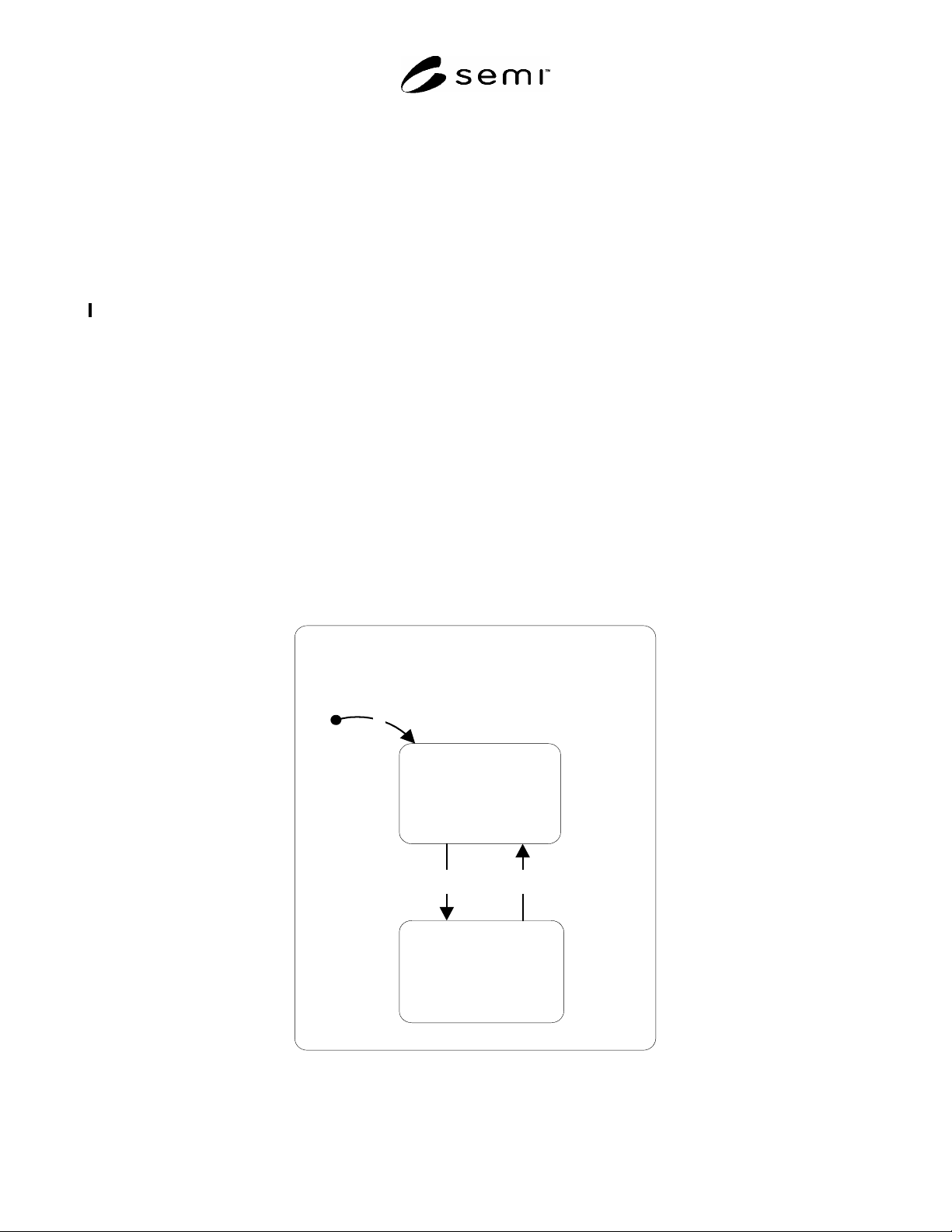
12.3 Reservation State Model Diagram
NOT
RESERVED
RESERVED
2 3
1
Load Port
Reservation
Figure 5
Reservation State Model Diagram
SEMI E87-0705 © SEMI 1999, 2005 23
12.4 Load Port Reservation State Definitions
12.4.1 LOAD PORT RESERVATION — The super state of the substates NOT RESERVED and RESERVED.
12.4.2 NOT RESERVED — A substate of LOAD PORT RESERVATION, this state is active when there is no
reservation existing at the load port.
12.4.3 RESERVED — A substate of LOADPORT RESERVATION, this state is active when there is a reservation
for future activity at the load port. When in this state, the access mode for a load port may not be changed.
12.5 Load Port Reservation State Transition Table
Table 10 Load Port Reservation State Transition Table
# Previous State Trigger New State Actions Comments
1 (no state) System reset. NOT
RESERVED
No event report is required
for this transition.
2 NOT
RESERVED
Service: If reserved by service,
the host or operator sends a
ReserveAtPort or a Bind service
to the production equipment.
CarrierOut: This happens when
the equipment physically initiates
a CarrierOut operation.
RESERVED If the user has configured
the equipment to use the
reservation visible signal
indicator, it is activated for
this load port.
Data required to be
available for this event
report:
PortID
LoadPortReservationState
CarrierID may be included
when a carrier out or a
bind service triggers this
transition.
3 RESERVED Service: If a reservation is
cancelled by service, the host or
operator sends a CancelBind or a
CancelReservationAtPort.
Carrier arrival: A carrier arrives
at the reserved port.
NOT
RESERVED
If the user has configured
the equipment to use the
reservation visible signal,
the indicator is deactivated
for this load port.
Data required to be
available for this event
report:
PortID
LoadPortReservationState
12.6 Relation of Reservation to Association
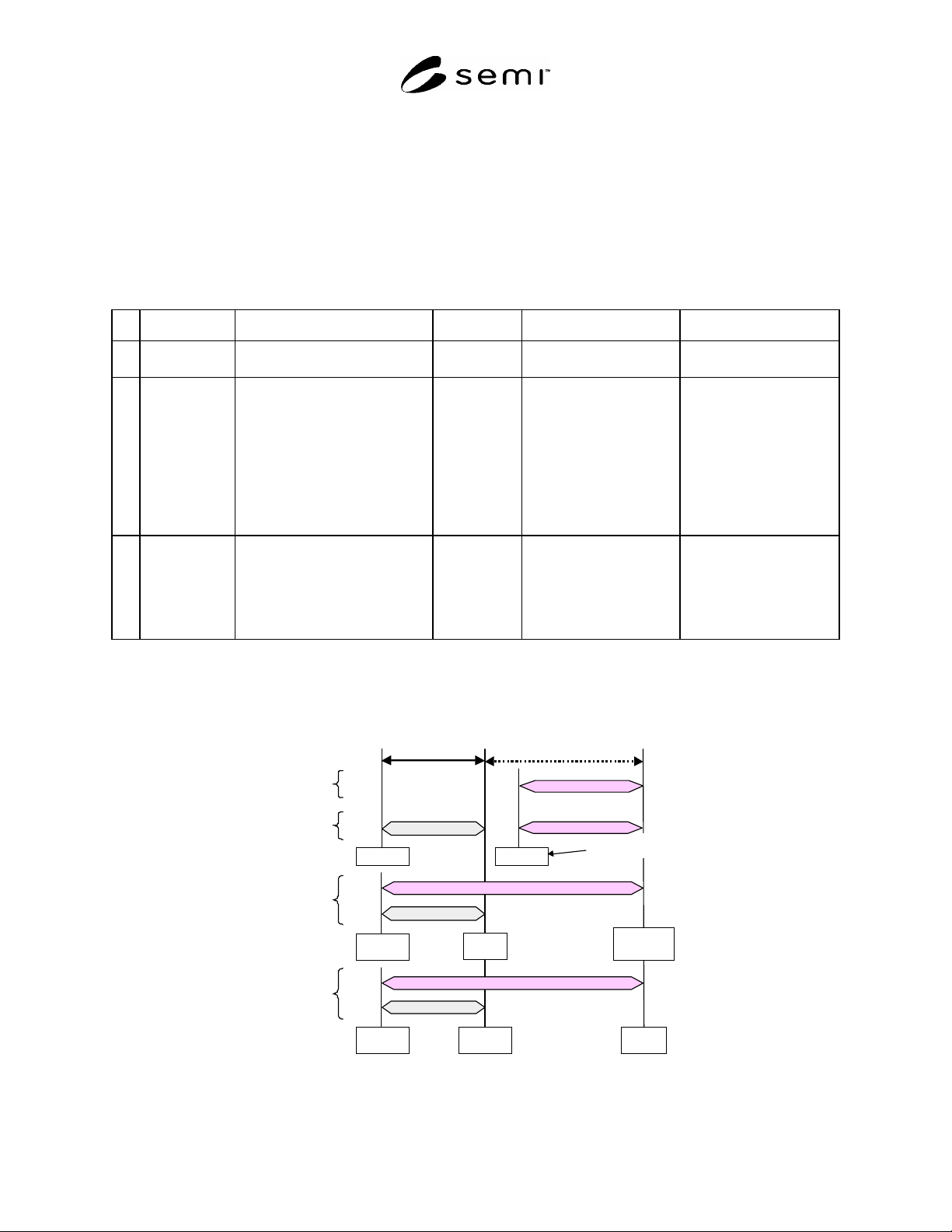
12.6.1 The following figure indicates the relationship of Association to Reservation.
Reservation / Association
ASSOCIATED
ID Read
Unload or
carrier in
Complete
Load
Complete
ASSOCIATED
RESERVED
Bind
Carrier Presence
Load
w/o Bind
w/o Reserve
Load
w/ Bind
If fails, then PWC/CC
is received
RESERVED
Reserve
Load
w/ Reserve
ASSOCIATED
Visible Signal
Carrier Out
Complete
Unload
Complete
Carrier Out
St art
RESERVED
ASSOCIATED
Carrier Out
Figure 6
Relation of Reservation to Association
SEMI E87-0705 © SEMI 1999, 2005 24
13 Load Port/Carrier Association State Model
13.1 The purpose of the Carrier Association State Model is to define the host view of carrier to load port association
of the production equipment, as well as the host interactions with the production equipment necessary to associate a
carrier to load port, and to perform equipment based carrier verification. Each load port shall maintain an
independent instance of the Carrier Association State Model. Each instance of this state model must not influence
the state of the same state model for a different load port.
13.1.1 This state model provides the ability to perform carrierID verification with two different methods. If the
CarrierID is provided before the equipment reads the CarrierID, the CarrierID that becomes associated with the load
port can be used later for equipment based carrier verification. If the association happens by CarrierID read (not by a
service execution), then the production equipment shall report the CarrierID information in a data collection event.
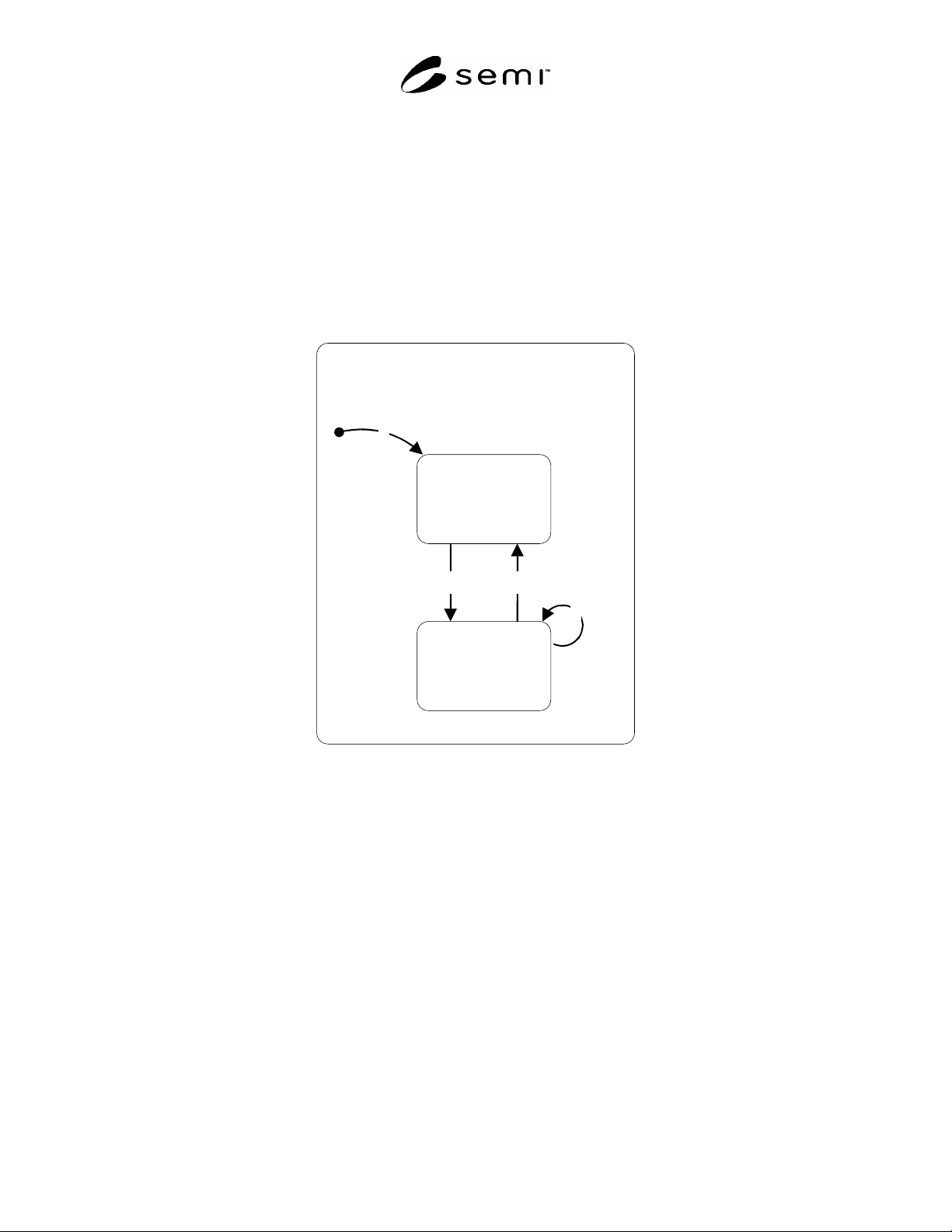
13.2 Load Port/Carrier Association State Model Diagram
NOT
ASSOCIATED
ASSOCIATED
2 3
1
LOAD PORT/CARRIER
ASSOCIATION
4
Figure 6
Load Port/Carrier Association State Model Diagram
13.2.1 Load Port/Carrier Association State Definitions
13.2.1.1 LOAD PORT/CARRIER ASSOCIATION — The parent state of the NOT ASSOCIATED and
ASSOCIATED sub-states.
13.2.1.2 NOT ASSOCIATED — A sub-state of LOAD PORT/CARRIER ASSOCIATION. There is no carrier
association present for this load port.
13.2.1.3 ASSOCIATED — A sub-state of LOAD PORT/CARRIER ASSOCIATION. A CarrierID has been
associated with this load port. The load port is not available for a new carrier association.
13.2.2 Load Port/Carrier Association State Transition Table
13.2.2.1 Table 11 defines the transitions of the Load Port/Carrier Association State Model.