semi合集-English.pdf - 第2313页
SEMI E82-0705 © SEMI 1999, 2005 9 Transition # Previous State Trigger New State Actions Comments 11 ACTIVE The TRANSFER command has completed by th e transport system and TSC (either succ essfully or unsuccessfully). Non…

SEMI E82-0705 © SEMI 1999, 2005 8
7.3.4 TRANSFER Command State Transition Table
Table 2 Transfer Command State Transition Table
Transition # Previous State Trigger New State Actions Comments
1 None The Host generated
TRANSFER command
is successfully
acknowledged by the
TSC.
QUEUED
2 QUEUED The TRANSFER
command has been
initiated by the TSC.
WAITING S6F11 Transfer-
Initiated
Transport vehicle is
dispatched to acquire the
transfer unit.
3 WAITING The acquire of the first
carrier of the transfer
unit begins.
TRANSFERRING S6F11
Transferring
4 NOT ACTIVE Host issued cancel for
the TRANSFER
command is accepted by
the TSC.
CANCELING S6F11
TransferCancel-
Initiated
A CANCEL remote
command was issued to
terminate a TRANSFER
command that has not
entered the physical aspect o
f
the command.
5 CANCELING Transport system is
unable to cancel the
TRANSFER command.
Previous NOT
ACTIVE sub-state
S6F11
TransferCancel-
Failed
The ability of the equipment
to successfully complete a
cancel of the TRANSFER
command is specific to the
IBSEM equipment supplier.
6 CANCELING The cancel procedure
for the TRANSFER
command has
completed by the
transport system and
TSC.
None S6F11
TransferCancel-
Completed
The transfer unit will still be
situated at the transfer source
location. The carriers in the
transfer unit may now be
included in a future transfer
(either AMHS or PGV
based).
7 TRANSFERRING The TSC pauses
execution of the
TRANSFER command
due to an anomaly
condition.
PAUSED S6F11
TransferPaused
It is an important distinction
to make that the TRANSFER
command is paused even
though the vehicle may not
be.
8 PAUSED The TSC resumes
execution of the
TRANSFER command
since the anomaly
condition has been
cleared.
TRANSFERRING S6F11
Transfer-Resumed
9 ACTIVE Host initiates an abort
of a TRANSFER
command.
ABORTING S6F11
TransferAbort-
Initiated
An ABORT remote
command was issued to
terminate a TRANSFER
command.
10 ABORTING The abort procedure for
the TRANSFER
command has
completed by the
transport system and
TSC.
None S6F11
TransferAbort-
Completed
Transfer unit could be
located at any location or
p
ort located along the path of
the ACTIVE transfer. The
location of the carrier(s)
associated with the aborted
transfer command must be
legal SourcePort(s) for
issuing a new TRANSFER
command.
SEMI E82-0705 © SEMI 1999, 2005 9
Transition # Previous State Trigger New State Actions Comments
11 ACTIVE The TRANSFER
command has
completed by the
transport system and
TSC (either successfully
or unsuccessfully).
None S6F11
TransferComplete
d sent to Host with
appropriate
ResultCode
ResultCode = 0 if
successful
ResultCode Not =
0 if unsuccessful
Carrier(s) could be located at
any location or port located
along the path of the transfer
if the TRANSFER command
completed unsuccessfully.
The location of the carrier(s)
associated with an
unsuccessful transfer
command must be legal
SourcePort(s) for a new
TRANSFER command.
12 ABORTING Transport system is
physically unable to
abort the TRANSFER
command.
Previous ACTIVE
sub-state
S6F11
TransferAbort-
Failed
The ability of the equipment
to successfully complete an
ABORT of the TRANSFER
command is specific to the
IBSEM equipment supplier.
13 CANCELING Transport system is
unable to cancel the
TRANSFER command
because the transfer is
now ACTIVE.
TRANSFERRING S6F11
Transferring
The ability of the equipment
to successfully complete a
cancel of the TRANSFER
command is specific to the
IBSEM equipment supplier.
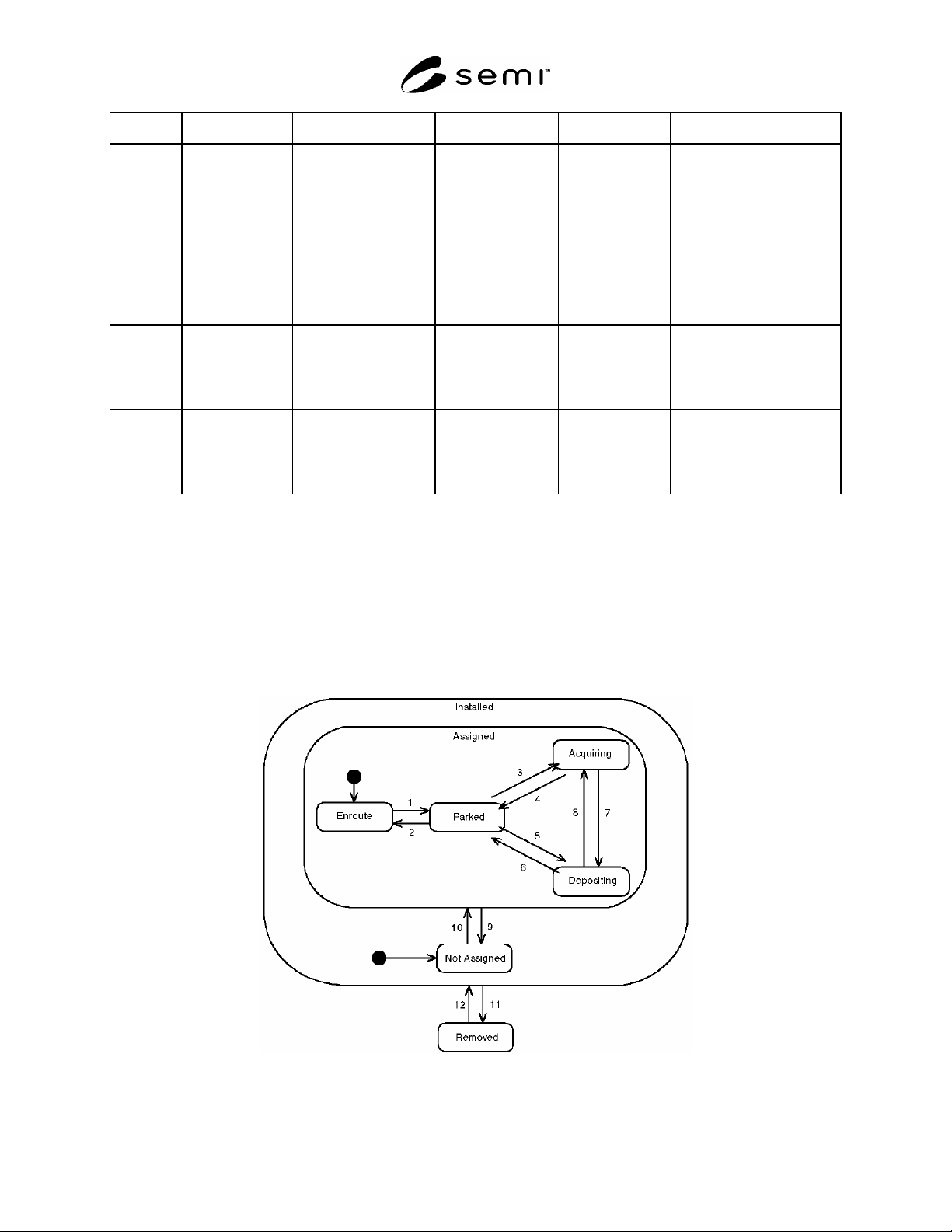
7.4 Vehicle State Model
7.4.1 Vehicle State Model Requirements
7.4.1.1 The purpose of the vehicle state model is to provide information to the host for use of transport vehicle
information and metric tracking (i.e., the Host will not control vehicles). Each vehicle must individually comply
with the vehicle state model. Implementation of this state model, along with associated events and variables, is not a
requirement for Transport Systems which do not have vehicles. An example of such a Transport System is a DWC.
The Host should not be dependent on any events from the vehicle state model.
7.4.2 Vehicle State Model
Figure 4
Generic IBSEM Vehicle State Model Diagram

SEMI E82-0705 © SEMI 1999, 2005 10
7.4.3 Vehicle State Definitions
7.4.3.1 INSTALLED — The vehicle is available or being used for TRANSFER commands. All enabled collection
events and alarms will be sent to the Host for vehicles in this state.
7.4.3.2 REMOVED — The vehicle is not available for Host initiated TRANSFER commands. No collection events
or alarms will be sent to the Host for vehicles in this state.
7.4.3.3 ASSIGNED (INSTALLED sub-state) — Vehicle is allocated to a TRANSFER command.
7.4.3.4 NOT ASSIGNED (INSTALLED sub-state) — Vehicle is not allocated to a TRANSFER command. The
vehicle may contain a carrier as the result of a command being aborted.
7.4.3.5 ENROUTE (ASSIGNED sub-state) — The vehicle is on its way to a transfer port. This is the default entry
into the ASSIGNED state since it must be entered for the host to track vehicle metrics completely and adequately.
7.4.3.6 PARKED (ASSIGNED sub-state) — This state occurs when the vehicle is in the following conditions:
After the arrival of the vehicle is completed and before the action of the transfer agent is started.
After the action of the transfer agent has completed and before the departure of the vehicle.
After continuous actions of the transfer agent (e.g., acquire/acquire and deposit/deposit) are completed.
7.4.3.7 ACQUIRING (ASSIGNED sub-state) — The vehicle is currently involved in carrier acquire (one or more
carriers possible depending on vehicle limitations).
7.4.3.8 DEPOSITING (ASSIGNED sub-state) — The vehicle is currently involved in carrier deposit (one or more
carriers possible depending on vehicle limitations).
7.4.4 Vehicle State Transition Table
Table 3 Vehicle State Transition Table
Transition # Previous State Trigger New State Actions Comment
1 ENROUTE Vehicle arrives at a
transfer port associated
with an ACTIVE transfer
command.
PARKED S6F11
VehicleArrived
TransferPort may be an
internal transfer port.
2 PARKED Vehicle departs a transfer
port associated with an
ACTIVE transfer
command.
ENROUTE S6F11
VehicleDeparted
TransferPort may be an
internal transfer port.
3 PARKED The carrier handoff
parallel I/O starts for the
vehicle to acquire (load)
the transfer unit.
ACQUIRING S6F11
VehicleAcquire-
Started
If the vehicle is a passive
type then the acquire
occurs by the robot on the
other equipment loading
the transfer unit to the
vehicle.
4 ACQUIRING The carrier handoff
parallel I/O completes for
the vehicle to acquire
(load) the transfer unit.
PARKED S6F11
VehicleAcquire-
Completed
5 PARKED The carrier handoff
parallel I/O starts for the
vehicle to deposit (unload)
the transfer unit.
DEPOSITING S6F11
VehicleDeposit-
Started
If the vehicle is a passive
type then the deposit
occurs by the robot on the
other equipment unloading
the transfer unit from the
vehicle.
6 DEPOSITING The carrier handoff
parallel I/O completes for
the vehicle to deposit
(unload) the transfer unit.
PARKED S6F11
VehicleDeposit-
Completed