semi合集-English.pdf - 第7851页
SEMI T13-1104 © SEMI 2004 11 has not m ounted any other Circuit Modul es yet or it is on the way of fabricatio n. 9.5.3.1 Moth er Substrate Class Definition — Mother Substrate inherits Circuit Module. Class defin ition o…
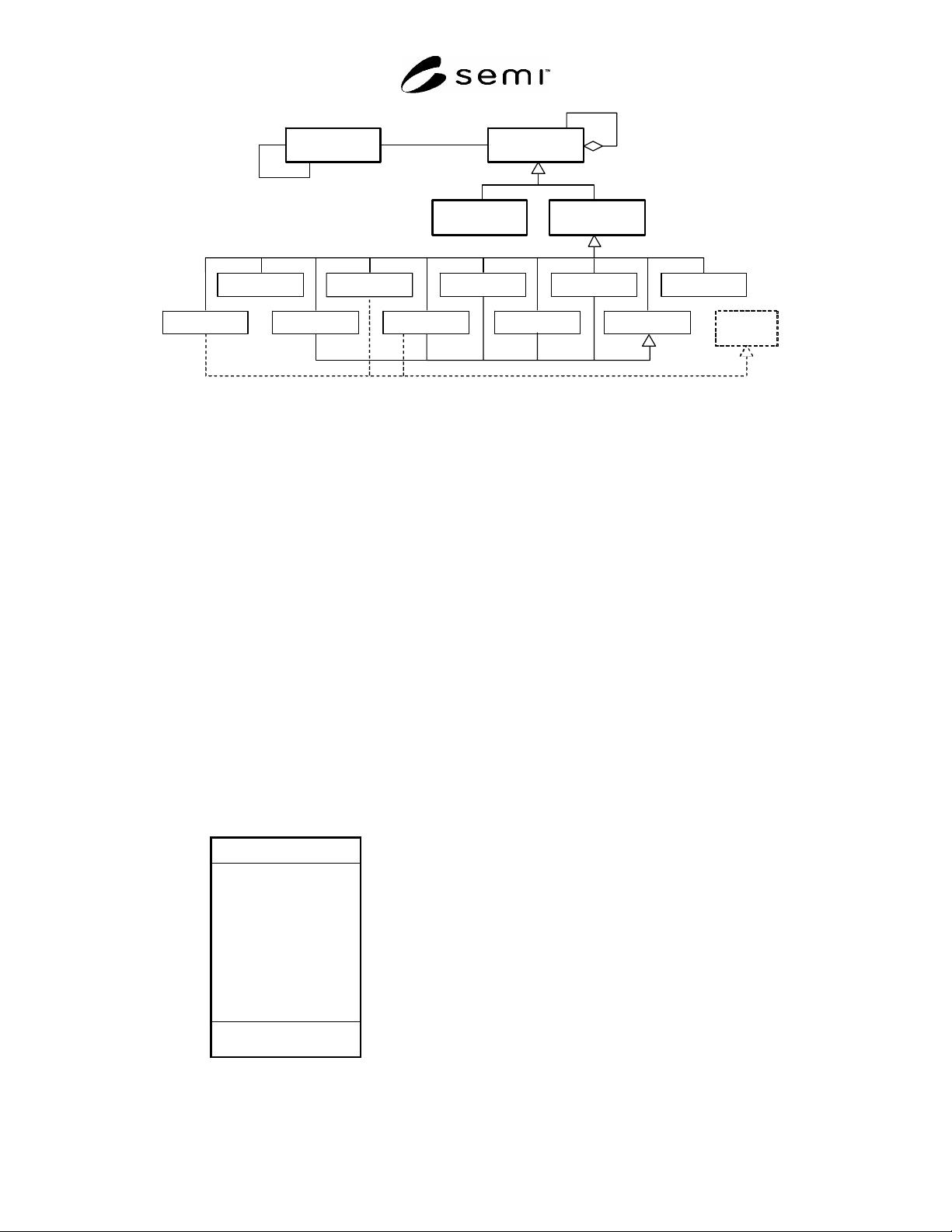
SEMI T13-1104 © SEMI 2004 10
Circuit Module
Die
Mother
Substrate
Dicing FrameWafer Lead Frame PCB Cabinet
0..*
Glass Plate Tray Ta pe Strip
Die Trace Data
(DTD)
characterizes
0
..*
refers
links
0
..*
Cassette
Reusable
Container
Figure 7
Physical Substrate Model for Die Tracing
9.5.1.1 Circuit Module Class Definition — Circuit
Module has such attribute as ID, Type and etc. as
depicted on Figure 8. These attributes cannot be
changed because they are proper for a specific Circuit
Module and not all attributes are illustrated on the
figure. Because this document doesn’t intend these
attributes to be accessed directly but just for reference
to specify services to access or make use of these
attributes. This class is used to discuss and handle
generic issues of any subclasses.
9.5.1.2 Responsibility of Circuit Module — Because
Circuit Module class is to be material label or material
property sheet, responsibility of this class is to play the
role.
9.5.1.3 Services of Circuit Module — To complete the
responsibility, this class provides the following
services.
9.5.1.3.1 showProperty — This service returns all or a
part of attributes of this object.
CircuitModule
showProperty
showDaughter
ID
Type
ProductName
Manufacturer
Plant
Location
ProductionStage
LatestProcessTime
Lot
… … ..
Figure 8
Circuit Module Class
9.5.1.3.2 showDaughter — This service is to get
smaller grain Circuit Modules which this Circuit
Module has on it.
9.5.1.4 Behavior of Circuit Module — Behavior is
defined to complete responsibility of the Circuit
Module. The behavior is often specified through
collaboration with outside of this class and state model.
Because this class has services to access internal
attributes, it defines no collaboration. Also this class
defines no state model for it is stateless.
9.5.2 Die — This class represents a semiconductor die
fabricated on wafer. It doesn’t matter how it appears: on
the way of fabrication on a wafer, diced and mounted
on some substrate or it is packaged. As long as it is
fabricated through semiconductor process or equivalent
process, it must be a die regardless of base material. Die
doesn’t aggregate the other Circuit Modules and it is
not aggregated by the other Die. In these senses, dice
for gallium arsenide devices, linear image sensors and
flat panel display (FPD) devices are examples of the
die.
9.5.2.1 Die Class Definition — Die inherits Circuit
Module. Class definition of the Die is almost same as
one for Circuit Module except it may not have a service
showDaughter. Even if the service is implemented, it
returns error or no daughter Circuit Modules.
9.5.3 Mother Substrate — This class is a Circuit
Module which may consist of one or more the other
Circuit Modules. Silicon wafers, lead flames, IC trays
and print circuit boards (PCBs) are examples of Mother
Substrate. Because it is a derived class of Circuit
Module to exclude the Die class, it must be the Mother
Substrate as long as it is used for the purpose, even if it

SEMI T13-1104 © SEMI 2004 11
has not mounted any other Circuit Modules yet or it is
on the way of fabrication.
9.5.3.1 Mother Substrate Class Definition — Mother
Substrate inherits Circuit Module. Class definition of
the Mother Substrate is completely same as one for
Circuit Module. This class is redefined to separate class
Die from the other Circuit Module classes for
convenience.
9.5.4 Wafer — This is a type of Mother Substrates
which represents thin disc shape semiconductor
material to fabricate semiconductor devices on it.
Examples are 300 mm diameter silicon wafers and 3
inches diameter gallium arsenide wafers. Some case a
few hundreds of microprocessor dice may be fabricated
on it.
9.5.5 Glass Plate — This is a type of Mother Substrats
which represents thin transparent rectangular glass plate
to fabricate flat panel display devices on it. However it
is usually rectangle, sometimes it may be such other
shape as circle. Some case length of one of ridge is
beyond one meter.
9.5.6 Dicing Frame — This is a type of Mother
Substrates which represents thin rectangular flame
which centers a piece of elastic sticky film to keep a
wafer for dicing. Dicing frame is usually reusable.
9.5.7 Cassette — This is a type of Mother Substrates
which represents one of reusable container to store and
carry Circuit Modules. Contained Circuit Modules are
positioned. Examples are wafer carriers, wafer shipping
boxes, dicing frame magazines and IC trays.
9.5.8 Tray — This is a type of Mother Substrates
which represents a kind of cassettes which holds dice
on two dimensional surface of it. It is often used to
move dice to next process, ship or test.
9.5.9 Lead Frame — This is a type of Mother
Substrates which represents base of a die to package as
a semiconductor device. It has many electrodes to
connect with electrode pads of the die. A few Lead
Frames are often physically linked together before
packaging is completed for convenience of production.
In this sense Lead Frames are a kind of Strip described
later.
9.5.10 Tape — This is a type of Mother Substrates
which represents very long narrow strip flexible
substrate made of plastic film, cloth, paper or hybrid
material to hold electronics elements or small parts for
carrying, feeding or shipping. Usually it is rolled on a
magazine for handling.
9.5.11 PCB — Print Circuit Board. Hard or flexible
substrate with one or multiple layered circuit wiring
conductor patterns an active/passive electronics
elements on one of or both surfaces. This is also a type
of Mother Substrates.
9.5.12 Strip — Usually rectangular or tape shaped
substrate to mount electronics parts. This is also a type
of Mother Substrates.
9.5.13 Cabinet — An enclosure for electronics to keep
from exposure of electrode and/or subcomponents,
and/or to give some means of human operation. Often it
contains PCBs and power supply module with switches
and such display devices as light emission diodes and
flat display panel on it. This is also a type of Mother
Substrates.
10 Detail Concepts
10.1 System Wide Concept — Previous section
describes basic concepts of Die Tracing. Based on
these, this section describes more detailed concepts to
trace dice practically.
10.2
Die Trace System — A system for die tracing
ranges over any entity related to Die Trace Data of the
target Die. From the system point view, there must be
some managing objects to coordinate ensembles in the
system to achieve expected responsibility.
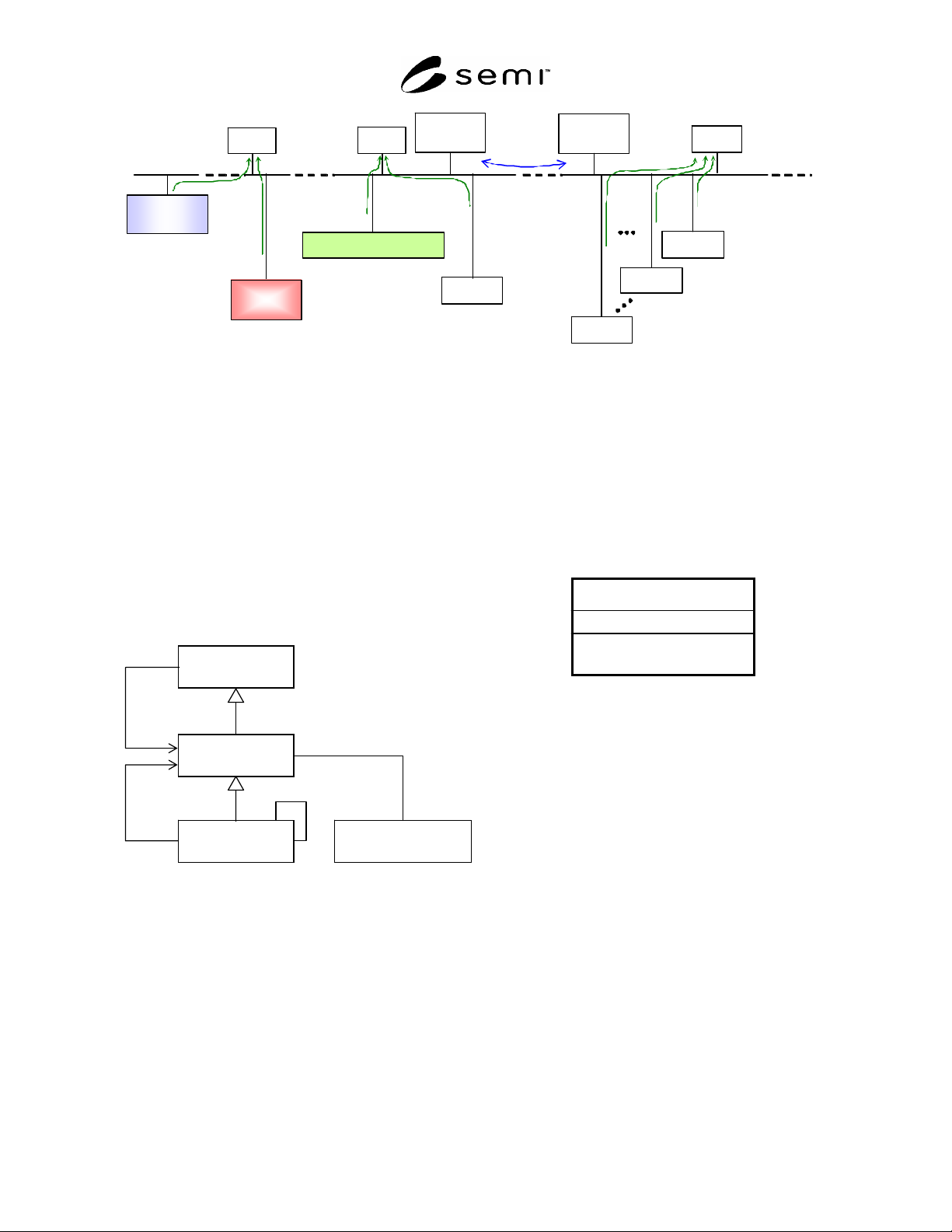
10.3 Die Trace System Linkage — Also it is difficult to
manage a lot of objects and data by just one manager. It
is expected to have more than one manager to
coordinate and manage data and such objects as
Machines and Tracers. They link together to organize a
kind of network as illustrated in the following figure.
SEMI T13-1104 © SEMI 2004 12
collaborate
Xyz
Database
Die Tr ace
Data (DTD)
WIP
Computer
Machine
Die Trace Data
Tracer
Abc Analysis System
Tracer
Tracer
Die Trace
Data (DTD)
Die Trace
Data (DTD)
Machine
Die Trace
Manager
Machine
Machine
Die Trace
Manager
DTD
DTD
DTD
Figure 9
An Example of Die Tracing Manager Network
10.4 Upgraded Ensemble Model — The following
diagram shows practical ensemble model with
managing objects. A Die Trace Manager (DTM)
coordinates, configures and does other managing
responsibility to make whole the system work. For the
other practical update is extensibility of Die Trace
Systems. This model allows consolidation or
connectivity of separated Die Trace Systems easily.
Network of Die Trace Managers makes it possible to
exchange die trace information widely and it gives
scalability of Die Trace System.
collects
1..*
1
..*
asks
Die Trace
Manager (DTM)
Die Tracer
(Tracer)
1..*
manages
Die Trace Machine
(Machine)
Die Trace Client
(Client)
0..*
reports
0..*
networks
Figure 10
Die Trace System Model
10.5 Class Definitions in the Model — Classes appears
in the Die Trace System Model are defined in the
following subsections. Most classes have inheritance
associations and inheriting classes has services of
inherited classes.
10.5.1 Die Trace Client (Client) — This class
represents client to ask something related to Die
Tracing. Also this class represent system user so that
the system may know problematic phenomena or notify
alert about specific Circuit Modules.
10.5.1.1 Responsibility of Die Trace Client — Because
this represents user end of Die Tracing System, it uses
the other part of the system and it is also interface to the
user. This class realizes the following things to
complete the responsibility.
DieTraceClient
showPhenomena
setAlert
Figure 11
Die Trace Client Class
10.5.1.2 Services of Die Trace Client — This class
provides the following services to complete its
responsibility.
10.5.1.2.1 showPhenomena — This optional service
returns problematic phenomena possibly happen on
suspicious Circuit Modules registered on users system.
The phenomena could be a part of Die Trace Data for a
Die Tracer. The phenomena is given by any property to
specify the suspicious Circuit Module or group of those
and the other information about the phenomena.
10.5.1.2.2 setAlert — This optional service sets alert
for a group of Circuit modules. The phenomena must be
a kind of Die Trace Data and it may give information
for the other part of Die Tracing System.
10.5.1.3 Behavior of Die Trace Client — Behavior is
defined to complete responsibility of the Die Trace
Client. The behavior is often specified through
collaboration with outside of this class and state model.