semi合集-English.pdf - 第225页
SEMI E33-94 © SEMI 19 94, 1996 3 5.1 Immunity Tests Table 1 Enclosure P orts Test Type Specificati on Basic Standar d Remarks Perfor mance Criteria 1.1 ESD immunity 4 kV Conta ct 8 kV Ai r discharge IEC 80 1-2 (1 991) Se…
SEMI E33-94 © SEMI 1994 2
3.4 electrostatic discharge (ESD) — The transfer of
electrostatic charge between bodies at different
electrostatic potentials.
3.5 ELF — Extremely low frequen cy (about 1 Hz to 1
kHz) magnetic fields generated by current flow (most
commonly 60 Hz in the U.S. and 50 Hz in Europe)
within equipment and facilities.
3.6 ELF sensitive equipment — Any equipment whose
performance is adversely affected by ELF, such as a
scanning electron microscope (SEM).
3.7 EUT — Equipment under test.
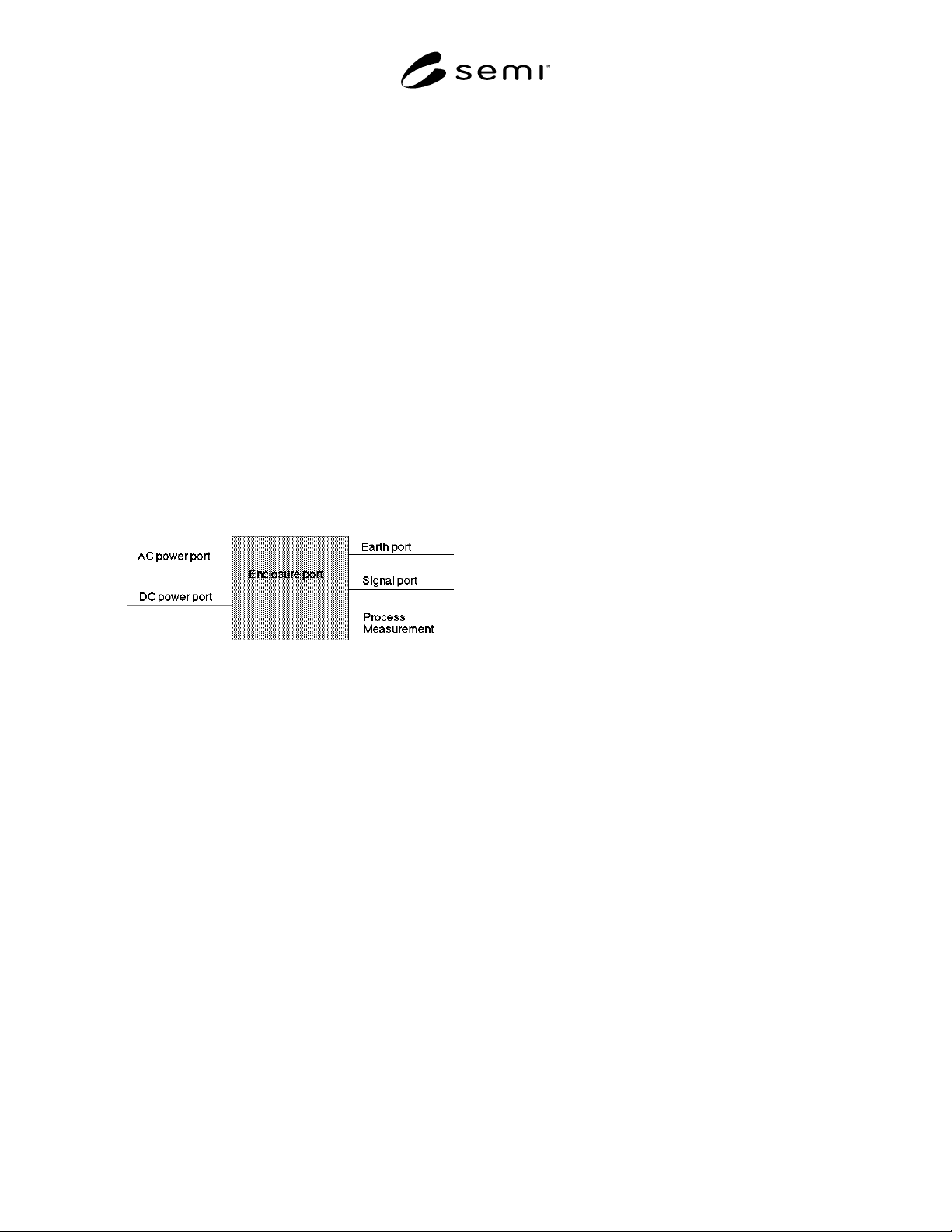
3.8 port — (For purposes of this specification), a
particular interface of the specified equipment with the
external electromagnetic environment, (see Figure 1).
3.9 enclosure port — (For purpose s of this
specification), the physical boundary of the apparatus
through which electromagnetic fields may radiate or
impinge.
Figure 1
4 Requirements
4.1 Performance Criteria — The following are
generic failure criteria for the various classes of
equipment and electronic systems used in
semiconductor manufacturing. However, any kind of
failure or aberration during EMC testing shall be noted
in the test report.
4.1.1 Performance Criteria A — The equipment
operates as intended during and after the test. In the
case of process equipment, all process results are within
specifications. No safety hazards nor false alarms are
present. In some cases, the performance level may be
replaced by a documented permissible loss of
performance if such loss is minor and agreeable to the
concerned parties.
4.1.2 Performance Criteria B — The equipment
operates as intended after the test, but experiences a
loss of function or degradation of performance during
the test to a level specified by the manufacturer. No
change of operating state or loss of stored data is
allowed. Restoration of performance or function does
not require human intervention.
4.1.3 Performance Criteria C — Te mporary loss of
function is allowed, provided the loss of function is
recoverable, either automatically or through operation
of the controls. Any failure of control or alarm systems
is in a fail-safe mode, such as a false alarm or
equipment shutdown.
4.1.4 Safety Criteria — Equipment will automatically
fail if testing results in an unsafe or potentially unsafe
condition, such as threat to life or property. Examples
would be failure of an emergency machine off (EMO)
button to operate or faulty opening of a toxic gas valve.
4.1.5 Conditions during Testing — All EMC testing is
to be done with the equipment installed and operational.
As much as possible, the test installation should be
identical to the final production installation. Substitutes
may be used for hazardous gases and chemicals, and
other modifications may be made as deemed reasonable
to ensure testing can be performed in a completely safe
and environmentally acceptable manner. Special EMC
facilities are not required by this standard.
5 Test Methods
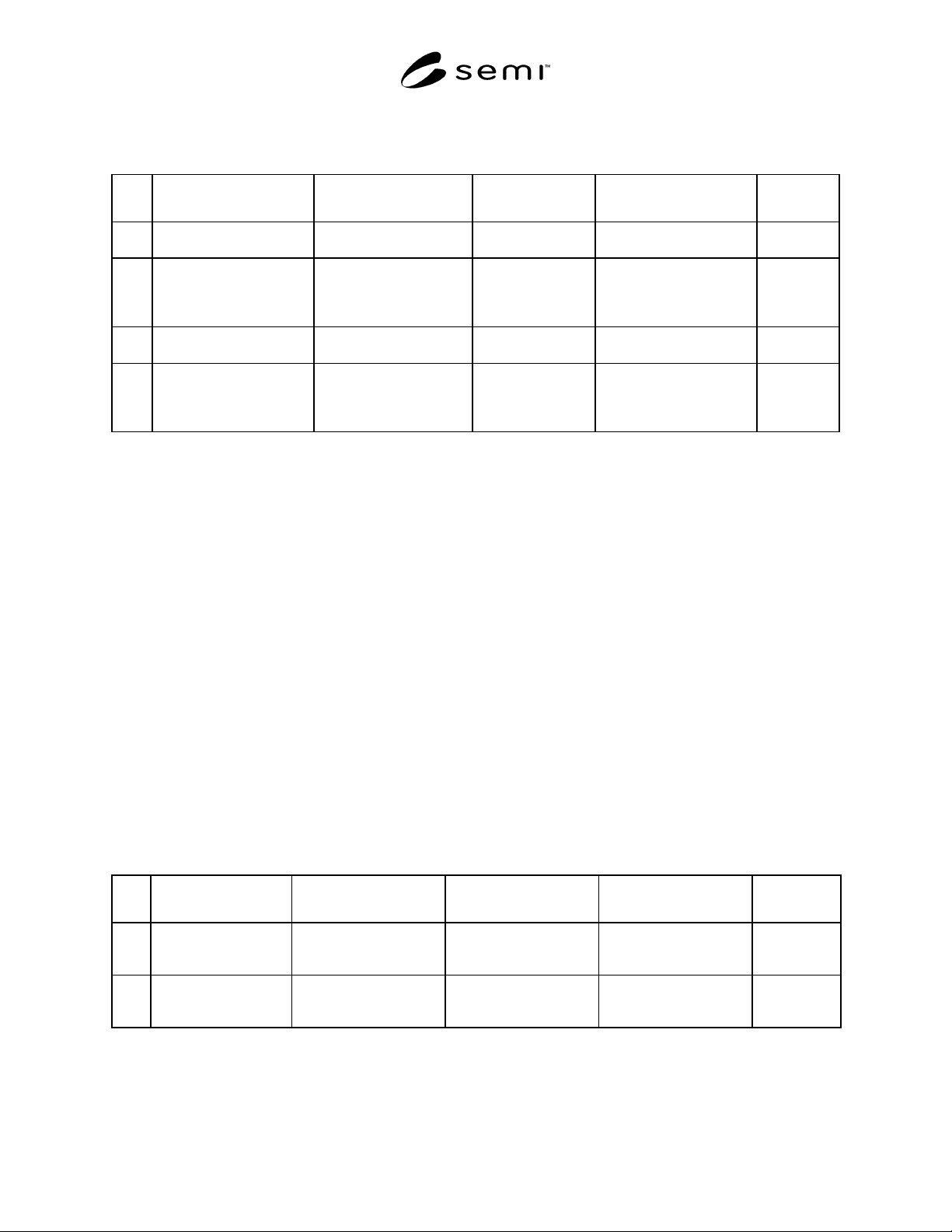
The tables below are organized by ports to which the
tests apply, as defined above. The basic standards
provide the test setup and procedures to be followed,
except as noted. In all events, EMC testing is intended
to prevent EMC problems when the equipment is
installed and operating in a semiconductor
manufacturing facility. Any modification or
interpretation of the test setup and procedure should be
judged by this overriding goal.
SEMI E33-94 © SEMI 1994, 19963
5.1 Immunity Tests
Table 1 Enclosure Ports
Test Type Specification Basic Standard Remarks
Performance
Criteria
1.1 ESD immunity 4 kV Contact
8 kV Air discharge
IEC 801-2 (1991) See Appendices A and B A
1.2 Radiated immunity
Amplitude modulated
10 V/m
450-520 MHz
800-950 mHz
80% AM (1 kHz)
IEC 801-3 See facilities requirements
(See Section 5.1.1)
A
1.3 ELF immunity Level A - E as required ELF testing
(See Section 5.1.2)
Required only of ELF-
sensitive equipment
A
1.4 Radiated immunity
Pulse modulated
3 V/m
1.89 GHz
50% Duty cycle
100 Hz rep freq.
TC 65 (Sec.) 136
Draft
Europe only
Cellular phone band
A
5.1.1 Facilities Requirements — Due to the size and complexity of much semiconductor factory equipment, testing
in a shielded enclosure, anechoic chamber, or other special facility is not required. If such facilities can be used, the
results will be more reproducible and accurate.
Note that radiated immunity testing is required only at frequencies used for mobile communications. As shown in Table 1, Row
1.2. Testing should be conducted in conformance with national and local emission requirements at the frequencies specified (see
Appendix D).
5.1.2 ELF Testing — The following sensitivity levels are defined:
Level A — ELF of less than 0.25 milliGauss rms
Level B — ELF of less than 0.50 milliGauss rms
Level C — ELF of less than 1.00 milliGauss rms
Level D — ELF of less than 2.00 milliGauss rms
Level E — ELF of 2.00 milliGauss rms and greater
ELF sensitivity is to be determined by applying ELF through a coil or set of coils designed to produce a uniform
magnetic field at or near the power-line frequency at the position of maximum ELF sensitivity of the EUT. The
direction of the applied field shall be set to produce the maximum disturbance to the EUT. The field level shall be
determined using a calibrated ELF meter.
If allowable performance degradation is permitted at the higher ELF levels, the performance shall be specified at
each level.
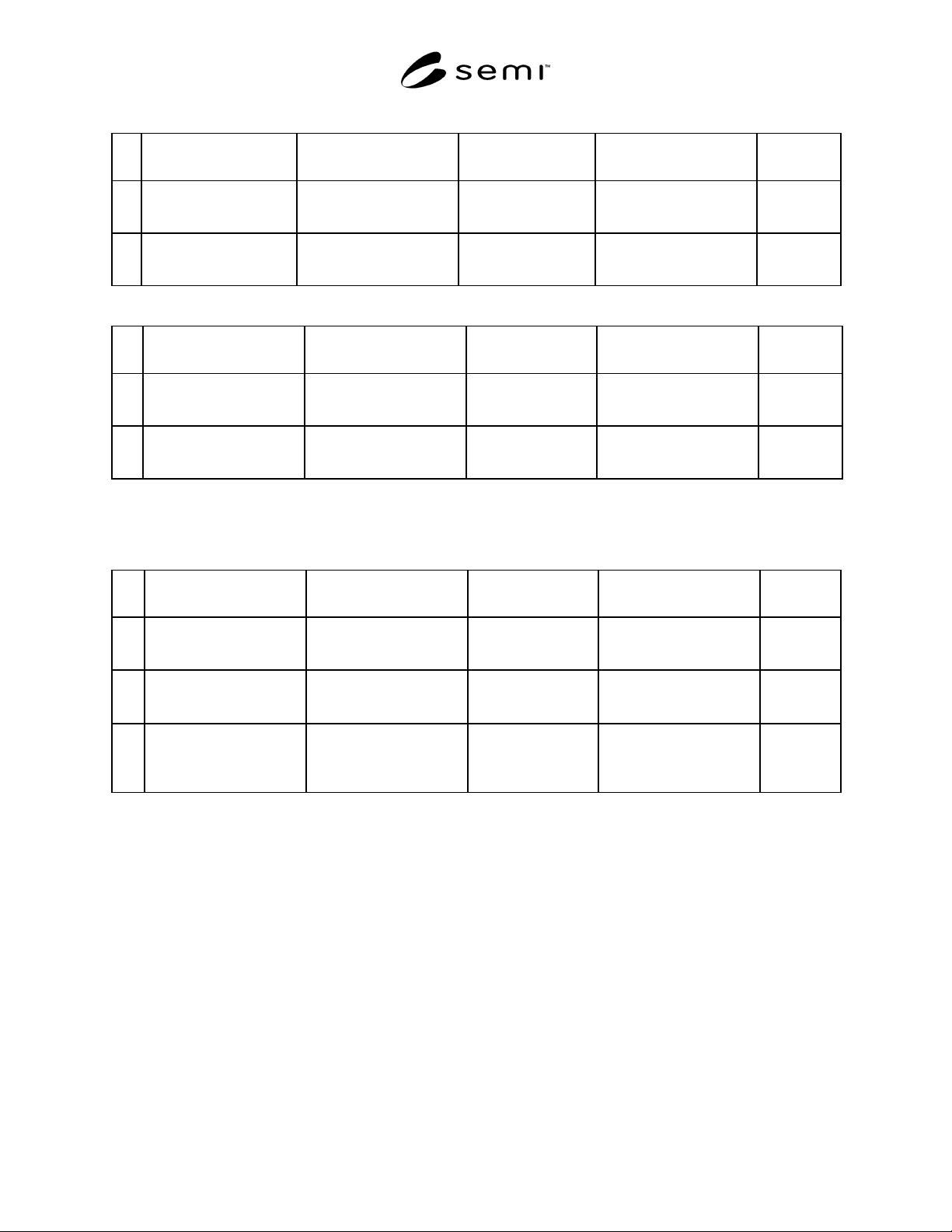
Table 2 Ports for Signal Lines and Short Distance (< 30 m) Data Buses Not Involved in Process Control
Test Type Specification Basic Standard Remarks
Performance
Criteria
2.1 Fast transients
common mode
1 kV (peak)
5/50 Tr/Th ns
5 kHz rep. frequency
IEC 801-4
Capacitive clamp
Applicable to cables
whose length can exceed 3
m
B
2.2 Radio Frequency
common mode 1 kHz
80% AM
0.15-100 MHz
3 V (rms) (unmod)
150 Ω source impedance
IEC TC 65 (Sec.)
144
Applicable to cables
whose length can exceed 1
m
A
SEMI E33-94 © SEMI 1994 4
Table 3 Ports for Process, Measurement and Control Lines, and Long Bus and Control Lines
Test Type Specification Basic Standard Remarks
Performance
Criteria
3.1 Fast transients common
mode
2 kV (peak)
5/50 Tr/Th ns
5 kHz rep. frequency
IEC 801-4
Capacitive clamp
B
3.2 Radio Frequency
common mode 1 kHz 80%
AM
0.15-100 MHz
3 V (rms) (unmod)
150 Ω source impedance
IEC TC 65 (Sec.) 144 Applicable to cables whose
length can exceed 1m
A
Table 4 Input and Output DC Power Ports
Test Type Specification Basic Standard Remarks
Performance
Criteria
4.1 Fast transients common
mode
2 KV (peak)
5/50 Tr/Th ns
2.5 kHz rep. frequency
IEC 801-4 4 kV (peak) when coupling
with capacitive clamp
B
4.2 Radio Frequency common
mode 1 kHz 80% AM
0.15-100 MHz
3 V (rms) (unmod)
150 Ω source impedance
IEC TC 65 (Sec.) 144 Applicable to cables whose
length can exceed 1 m
A
Note: Direct injection method shall be used if current consumption is less than 100 A. This test is not applicable to input ports
intended for connection to dedicated non-rechargeable power supplies.
Table 5 Input and Output AC Power Ports
Test Type Specification Basic Standard Remarks
Performance
Criteria
5.1 Fast transients common
mode
4 kV (Peak)
5/50 Tr/Th ns
5 kHz rep. frequency
IEC 801-4 4 kV (peak) when coupling
with capacitive clamp
B
5.2 Radio Frequency common
mode 1 kHz 80% AM
0.15-100 MHz
150 Ω source impedance
IEC TC 65 (Sec.) 144 Applicable to cables whose
length can exceed1 m
A
5.3 Surge 4.0 kV IEC TC 65 (Sec.) 137 Use combination wave test
generator:1.2/50 µs open
circuit, 8/20 µs short circuit
wave form
C
5.2 Emissions Test
5.2.1 EMI Testing Required — Equi pment shall be tested in accordance with CISPR 22 and EN 55 022. Test limits
are Class A, which is generally limited to non-residential use.
As noted above for radiated immunity testing, the size and complexity of semiconductor factory equipment may rule
out the use of special facilities. Thus, the tests in CISPR 22 may be adapted as required due to test site limitations.
Again, use of such facilities will yield more reproducible and accurate data, and is recommended whenever possible.
In any event, emissions greater than 6 dB above the Class A limits are not allowed.
5.2.2 ELF Testing Required — ELF emission testing is required for all ELF-sensitive equipment, since such
equipment is commonly grouped together. ELF emission testing for other types of equipment is required on request
of a purchaser intending installation of ELF-sensitive equipment in the immediate vicinity.