semi合集-English.pdf - 第3127页
SEMI E125-0305 © SEMI 2003, 2005 35 10.8.6.9 Event Attribute Definition Table Table 61 Ev ent A ttribute Definition Attribute Name Definition Form name A human-readable name for the event. Text. id A unique identifier fo…
SEMI E125-0305 © SEMI 2003, 2005 34
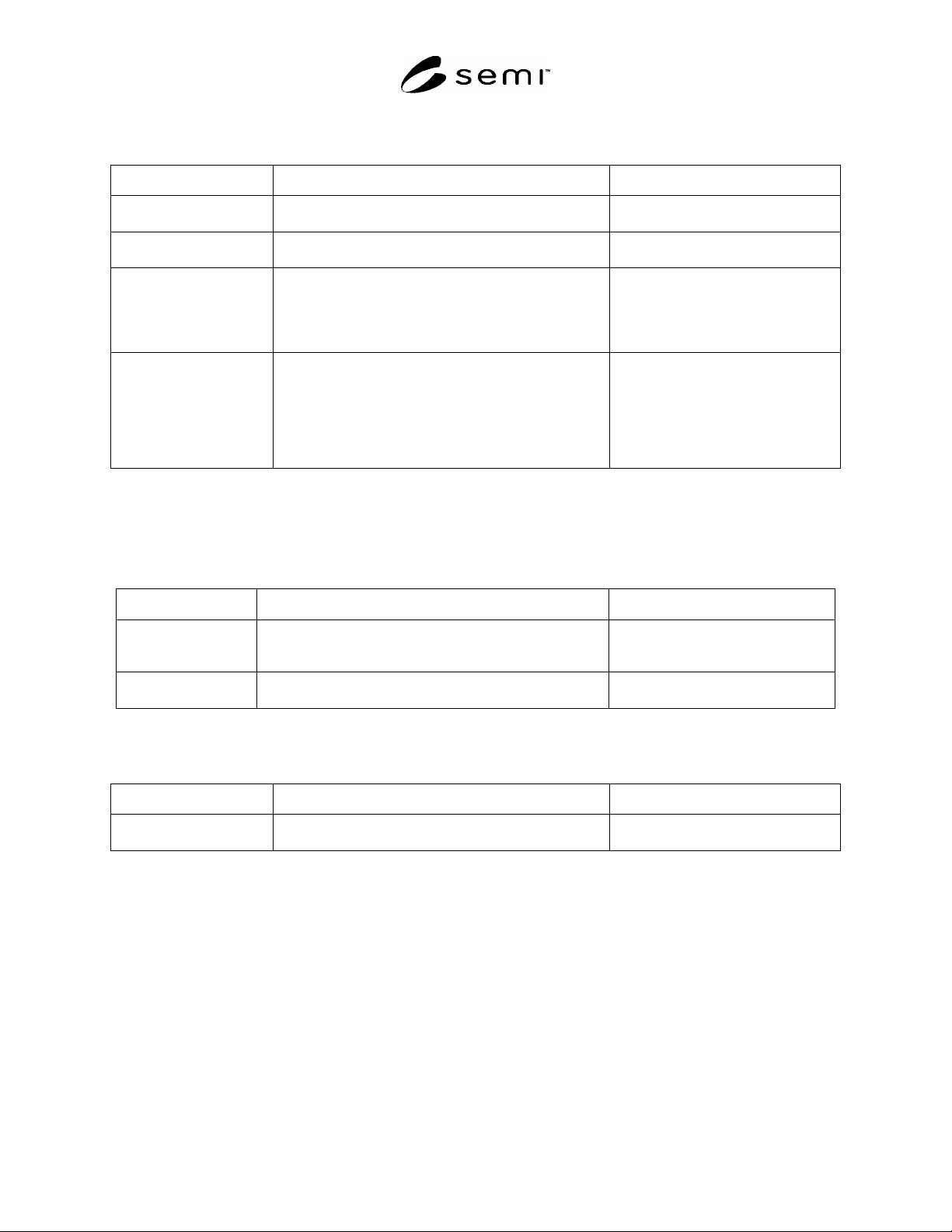
10.8.6.4 StateMachineInstance Association Definition Table
Table 58 StateMachineInstance Association Definition
Association Role Name Definition Comments
currentStateName The Parameter, if any, that can be accessed to determine
the current state within the identified StateMachine.
Zero or one element of type Parameter,
described in Section 10.4 .
previousStateName The Parameter, if any, that can be accessed to determine
the previous state within the identified StateMachine.
Zero or one element of type Parameter,
described in Section 10.4 .
eventMaps The events defined by this StateMachine, and the
Parameters that are available for reporting with those
events.
One or more elements of type
EventToParameterMap, described in
Section 10.8.6.5 . There shall be one
such map for each event defined in the
identified StateMachine.
nestedStateMachines Any nested state machines defined within the identified
StateMachine.
One or more elements of type
StateMachineInstance. Although it is
possible to create more, only one level
of nesting of the StateMachineInstance
class is required to describe arbitrary
levels of nesting described by the
referenced top-level StateMachine.
10.8.6.5 EventToParameterMap — This class is used to provide a list of the Parameters available for a specific
event from a given StateMachine.
10.8.6.6 EventToParameterMap Attribute Definition Table
Table 59 EventToParameterMap Attribute Definition
Attribute Name Definition Form
eventId The StateMachine Event for which Parameters are available Text, must be equal to a valid ‘id’
attribute of the Event class within a
StateMachine.
description Provides any description necessary for humans to understand
the parameters that are available for reporting with the event.
Text.
10.8.6.7 EventToParameterMap Association Definition Table
Table 60 EventToParameterMap Association Definition
Association Role Name Definition Comments
availableParameters The Parameters that are available for reporting with this
event.
Structured data of type Parameter,
described in Section 10.4.
10.8.6.7.1 availableParameters — All transient Parameters (see Section 10.4.11) that are available for reporting
with an event generated by the entity providing the EventToParameter map shall be provided in this list. It is not
necessary to list any non-transient Parameters via this association. Non-transient Parameters are implicitly available
for reporting with any event.
10.8.6.8 Events may only be defined within the context of a Transition between two States within a StateMachine.
All events that the equipment can generate must have a StateMachine defined for them. It is not necessary to define
multiple StateMachines for a situation in which the same kind of events are generated by multiple sources.
SEMI E125-0305 © SEMI 2003, 2005 35
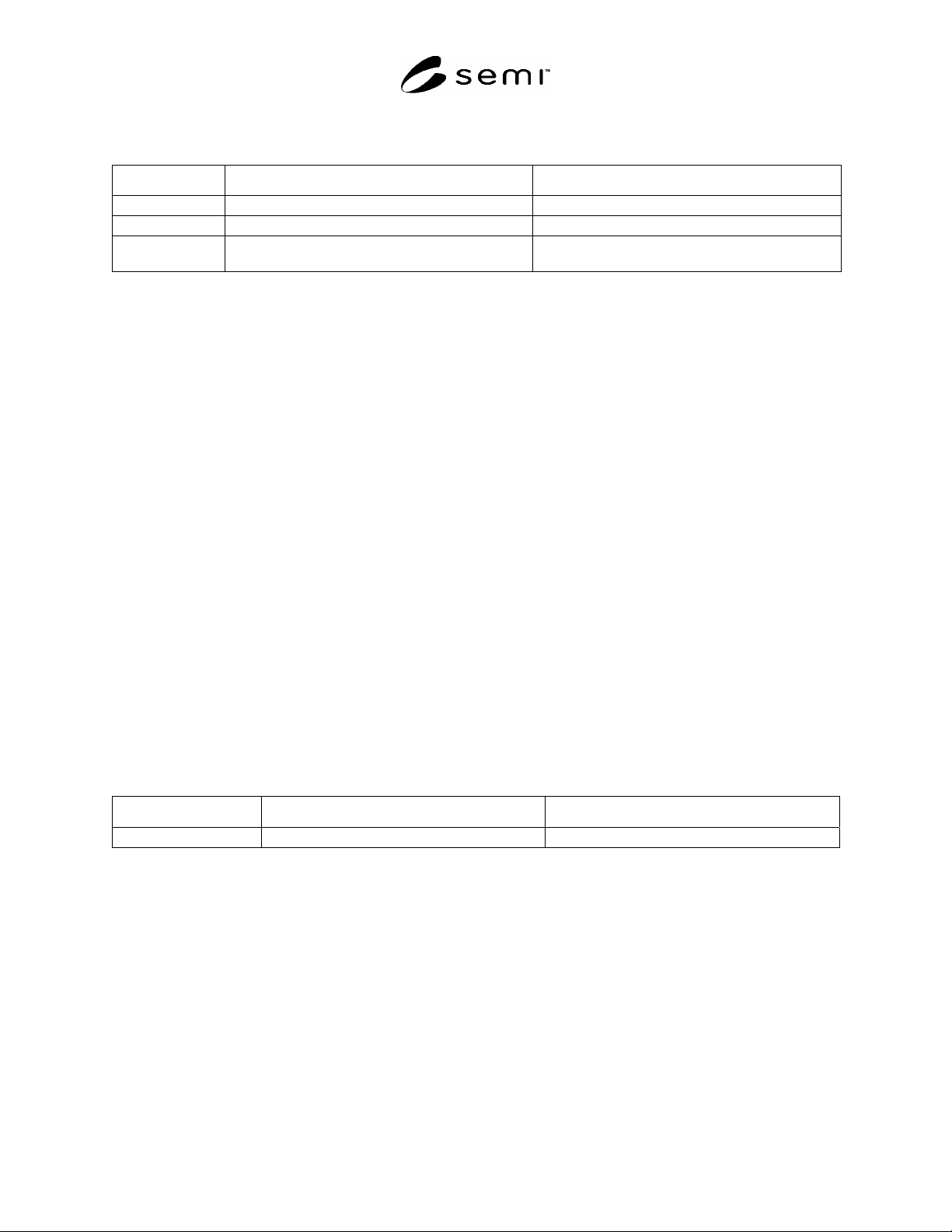
10.8.6.9 Event Attribute Definition Table
Table 61 Event Attribute Definition
Attribute Name Definition Form
name A human-readable name for the event. Text.
id A unique identifier for the event. Text, unique across all events in all StateMachines.
description A human-readable description of the meaning or
purpose of the event.
Text.
10.8.6.10 SEMI Standard Events
10.8.6.10.1 name — If the Event represents a SEMI standard event, the value of this attribute shall be a URN of the
form: “urn:semi-org:event:<standard id>:<state machine>:<transition number>:<event name>”.
10.8.6.10.1.1 <standard id> shall be a string formatted according to the SEMI standard form for representing a
specific version of a standard document (for example, “E87-1101”), no spaces, upper-case alphanumeric characters
and hyphens only.
10.8.6.10.1.2 <state machine> shall be the name of the state machine in which the event is defined. If no such state
machine is defined, this field shall be equal to the text “None”. If there is a defined state machine, the name shall be
equal to the state machine name as it appears in the standard, with each word in the name concatenated. The state
machine name shall use the camel case capitalization convention (that is, only the first letter of each word in the
state machine name is capitalized). For example, the state machine name for the SEMI E87 LOAD PORT
TRANSFER state machine would be “LoadPortTransfer”.
10.8.6.10.1.3 <transition number> shall be a string representation of the transition number as it appears in the state
machine definition. If no state machine or transition number is defined in the standard, this field shall be equal to
the text “None”.
10.8.6.10.1.4 <event name> shall be the name of the event as it appears in the standard with no spaces,
alphanumeric characters only, using camel case capitalization. If no event name is defined, this field shall be
formed by concatenating the names of the source and target states for the <transition id>, separated by a hyphen.
The state names shall have no spaces, alphanumeric characters only, and use camel case capitalization. If either of
these states is an “initial” or “final” state, the words “Initial” or “Final”, respectively, shall be used for the state
name. For example, the event name for the E87 load port transfer history transition from the initial state to “OUT
OF SERVICE” would be “Initial-OutOfService”.
10.8.6.11 Event Association Definition Table
Table 62 Event Association Definition
Association Role Name Definition Comments
transitions The transitions to which this event is mapped. One or more elements of type Transition.
10.9 ObjTypes
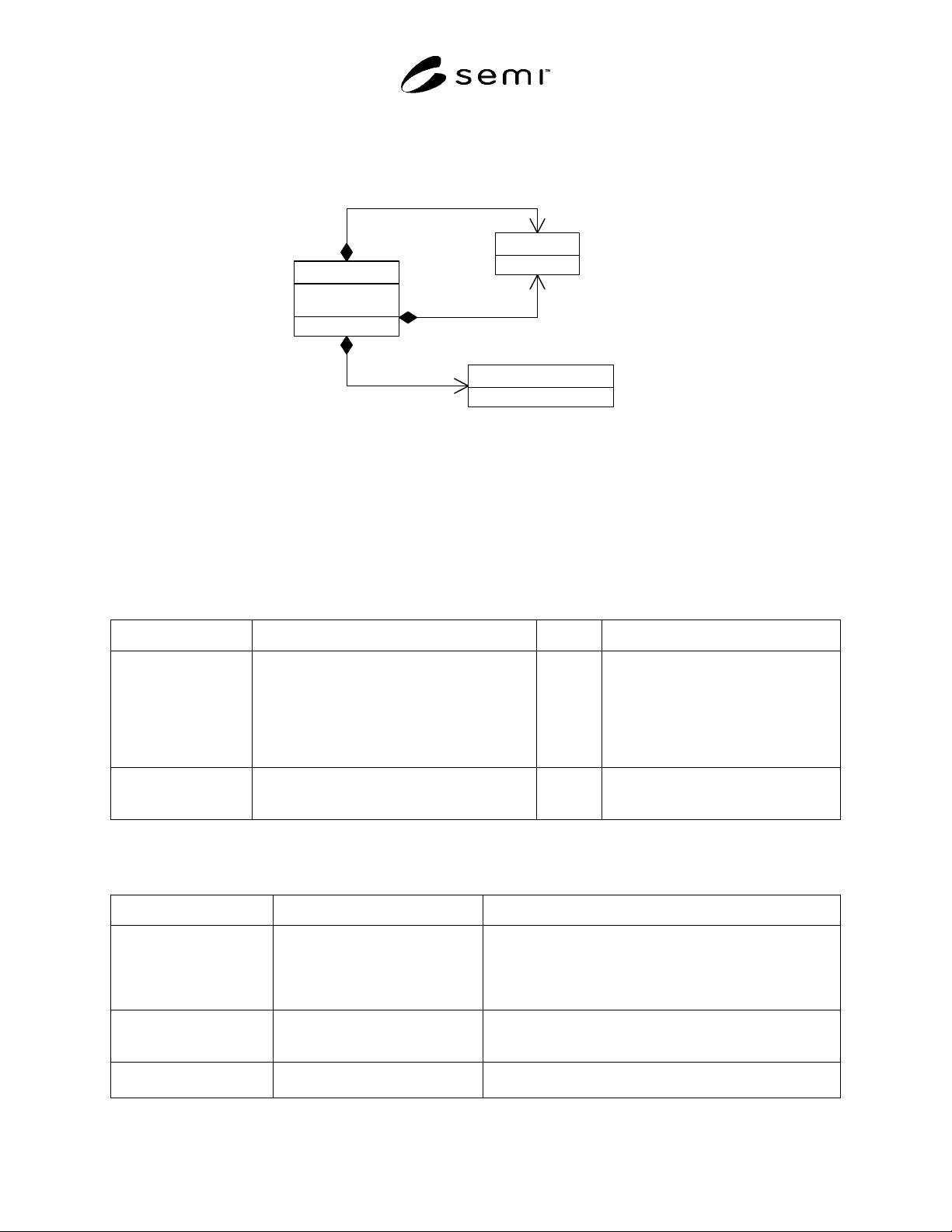
10.9.1 Figure 21 shows how to describe SEMI ObjTypes (for example, the “Carrier” ObjType from SEMI E87) that
have been implemented by the equipment. An ObjType is similar to a class in that it describes attributes and state
machines that are common to all instances of the ObjType. Each ObjType instance maintains its attributes and state
machines independently of all other instances of the same ObjType. See Related Information 6 for examples using
the SEMIObjType class.
SEMI E125-0305 © SEMI 2003, 2005 36
standardVersion
objType
SEMIObjType
1
attributes2..*
Parameter
1
stateMachine
0..1
StateMachineInstance
1
eventData 0..*
Figure 21
Describing Implemented SEMI ObjTypes
10.9.1.1 SEMIObjType — This class describes the attributes and events for a SEMI ObjType that has been
implemented by the equipment. If it is a SEMI standard ObjType then it is identified by the name of the SEMI
standard within which it was defined, and the name of the ObjType specified in that standard. Each ObjType
includes at least two attributes, corresponding to its type name and its instance id (see SEMI E39).
10.9.1.2 SEMIObjType Attribute Definition Table
Table 63 SEMIObjType Attribute Definition
Attribute Name Definition Required Form
standardVersion The complete SEMI standard version number for
the document where the ObjType is defined, if
applicable.
Y Text, using the SEMI standard form for
representing a specific version of a
standard document (for example, “E87-
1101”), no spaces, upper-case
alphanumeric characters and hyphens
only. If not a SEMI standard ObjType,
then this attribute shall be empty.
objType The name of the SEMI objType. Y Text. Named using identical spelling and
case as the documented objType in the
corresponding standard.
10.9.1.3 SEMIObjType Association Definition Table
Table 64 SEMIObjType Association Definition
Association Role Name Definition Comments
attributes Attributes defined for this ObjType. Unordered list of elements of type Parameter, described in
Section 10.4 . Each Parameter shall be typed and named
according to Sections 10.5.4 and 10.4.10 . All attributes
b
elonging to an ObjType are maintained independently in each
ObjType instance.
eventData Parameters that are not formal
attributes that this ObjType provides
with generated events.
List of zero or more elements of type Parameter, described in
Section 10.4 .
stateMachine The state machine (if any)
supported by this ObjType.
Zero or one element of type StateMachineInstance, described
in Section 10.8.6 .