semi合集-English.pdf - 第2360页
SEMI E84-0305 © SEMI 1999, 2005 4 which the passive e quipment knows whi ch AMHS equipment (i.e., OHS a nd stockers equi pped with t ransfer devices) is per mitted to m ake a material handoff. 5.1.2 active equipment — eq…
SEMI E84-0305 © SEMI 1999, 2005 3
Ceiling
Raised Floor
Production
Equipment
(side view)
Floor
running
AGV/RGV
A
utomated or Rail
Guided Vehicle (AGV/RGV)
AMHS Controller
HOST
Host/equipment
interface is outside the
scope of this standard.
Overhead Hoist Transports (OHT)
Parallel I/O Interface
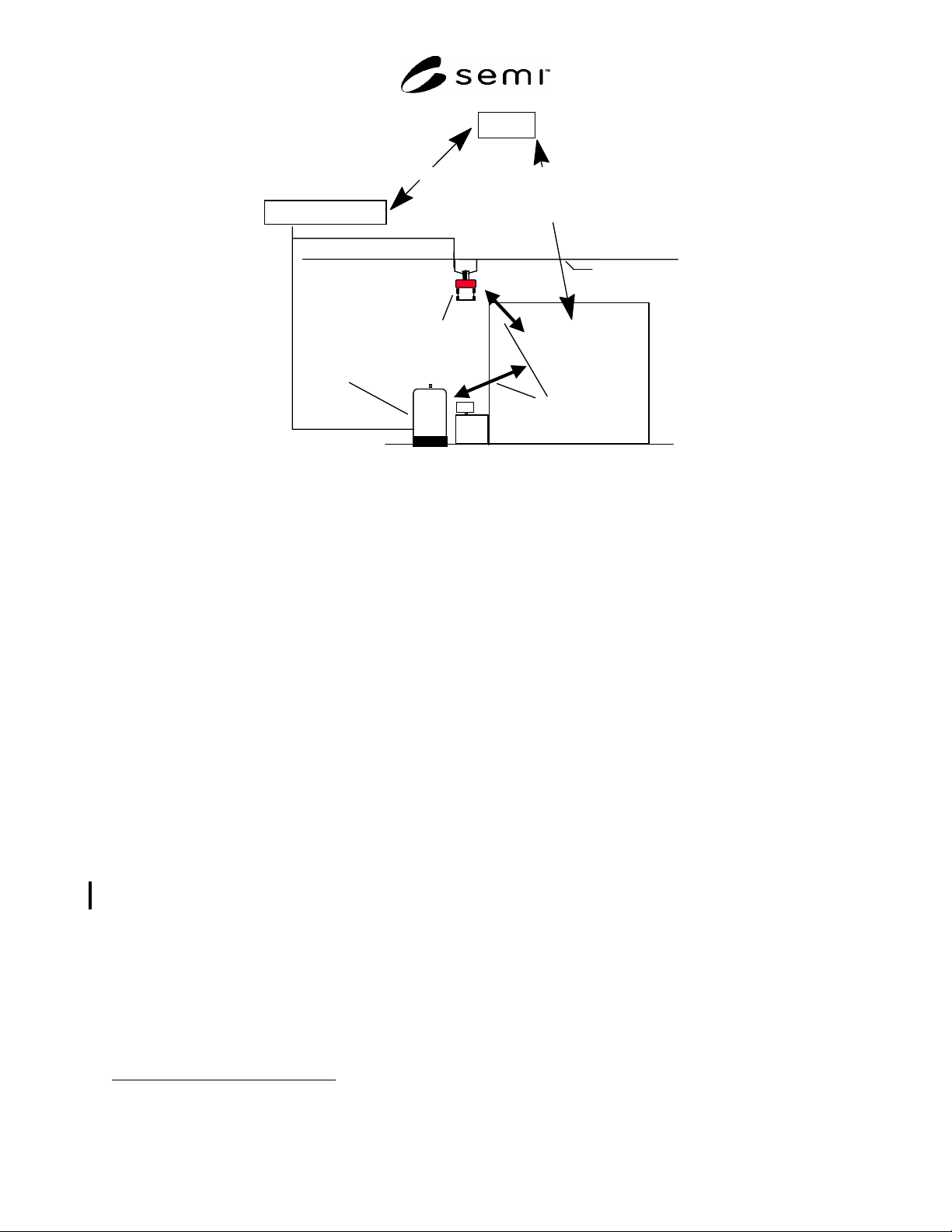
Figure 3
Examples of Enhanced Carrier Handoff Parallel I/O Interface Applications
3.5 The installation positions of the parallel I/O interface and the connector on the active and passive equipment are
not defined.
3.6 The swap handoff will be considered beyond the scope of the standard for interbay AMHS equipment (i.e.,
OHS, stockers). During a swap handoff, loading and unloading occur simultaneously on the same loadport.
4 Referenced Standards
4.1 SEMI Standards
SEMI E1.9 — Mechanical Specification for Cassettes Used to Transport and Store 300 mm Wafers
SEMI E15.1 — Specification for 300 mm Tool Load Port
SEMI E23 — Specification for Cassette Transfer Parallel I/O Interface
SEMI E30 — Generic Model for Communications and Control of Manufacturing Equipment (GEM)
SEMI E47.1 — Provisional Mechanical Specification for Boxes and Pods Used to Transport and Store 300 mm
Wafers
SEMI E87 — Specification for Carrier Management (CMS)
4.2 ISO Standard
1
ISO 2110:1989 — Information technology — Data communication — 25-pole DTE/DCE interface connector and
contact number assignments
NOTICE: Unless otherwise indicated, all documents cited shall be the latest published versions.
5 Terminology
5.1 Definitions
5.1.1 access mode — a mode in which passive equipment knows which AMHS equipment (i.e. RGV, AGV, and
OHT/OHV) or operator is permitted to make a material handoff. In the case of interbay AMHS, this is a mode in
1 International Organization for Standardization, ISO Central Secretariat, 1, rue de Varembé, Case postale 56, CH-1211 Geneva 20, Switzerland.
Telephone: 41.22.749.01.11; Fax: 41.22.733.34.30 Website: www.iso.ch

SEMI E84-0305 © SEMI 1999, 2005 4
which the passive equipment knows which AMHS equipment (i.e., OHS and stockers equipped with transfer
devices) is permitted to make a material handoff.
5.1.2 active equipment — equipment that loads a cassette onto the cassette stage of another piece of equipment or
unloads a cassette from the cassette stage of another piece of equipment [SEMI E23].
5.1.3 active OHS vehicle — an active OHS vehicle that contains a device that loads or unloads the carrier from one
piece of equipment to another.
5.1.4 automated material handling system (AMHS) equipment — a piece of equipment which has a carrier transfer
robot that transfers carriers from and to passive equipment. It includes rail guided vehicles (RGV), automated
guided vehicles (AGV), overhead hoist transports (OHT), overhead shuttles (OHS), and stockers.
5.1.5 automatic access mode — a mode in which AMHS equipment performs a material handoff rather than an
operator.
5.1.6 boundary — a change in the timing single state.
5.1.7 carrier — any cassette, box, pod, or FOUP that contains wafers [SEMI E1.9]. Also known as wafer carrier.
5.1.8 cassette — an open structure that holds one or more substrates [SEMI E1.9]. Also known as open cassette
(OC).
5.1.9 continuous handoff — successive handoffs of two carriers. Continuous handoff is in series, meaning one
carrier transfer occurs and is then immediately followed by another. The continuous handoff may involve: load and
load, unload and unload, or unload and load operations.
5.1.10 front opening unified pod (FOUP) — a box (that complies with SEMI E47.1) with a non-removable cassette
(so that its interior complies with SEMI E1.9) and with a front-opening interface (FIMS) [SEMI E47.1].
5.1.11 handoff — is the operation in which a carrier is transferred (loaded or unloaded) from one piece of
equipment to another.
5.1.12 handoff conflict area — an area where the active equipment resource could interfere with the passive
equipment resource during the handoff operation.
5.1.13 handoff interlock abnormal — the state, which indicates the passive equipment, has detected abnormal
conditions in the handoff operation. It may indicate the possibility that the interference of the active equipment
resource with the passive equipment resource has occurred in the handoff conflict area.
5.1.14 handoff unavailable — the state, which indicates the passive equipment, is not available for material handoff
operation.
5.1.15 load port — the interface location on a tool where wafer carriers are placed to allow the tool to process
wafers [SEMI E15].
5.1.16 manual access mode — an access mode in which an operator performs a material handoff of a carrier rather
than the AMHS equipment.
5.1.17 overhead shuttle (OHS) — an AMHS vehicle that does not use a vertical hoist mechanism to transfer the
carrier from one piece of equipment to another. An OHS is typically supported on top of transport rail while
overhead hoist transport (OHT) vehicles hang from underneath the transport rail.
5.1.18 passive equipment — equipment that is loaded or unloaded by active equipment [SEMI E23]. Passive
equipment includes process equipment, metrology equipment, stockers, etc.
5.1.19 passive OHS vehicle — An active OHS vehicle that does not contain a device that loads or unloads the
carrier from one piece of equipment to another.
5.1.20 simultaneous handoff — concurrent handoff operations of two carriers. Simultaneous handoff is in parallel,
meaning two carriers are transferred at the same time.
5.1.21 single arm/double hand AMHS equipment — AMHS equipment which hands off two carriers using a single
arm mechanism with two hands (dual end effectors).

SEMI E84-0305 © SEMI 1999, 2005 5
5.1.22 single arm/single hand AMHS equipment — AMHS equipment which hands off a carrier using a single arm
mechanism with a single hand (single end effector).
5.1.23 single handoff — the transfer of a single carrier in a handoff operation.
5.1.24 zone — term used for describing the intervals during PIO communication.
6 Enhanced Carrier Handoff Parallel I/O Interface Requirements
6.1 Signal Definitions
6.1.1 Table 1 shows the signals required for the enhanced carrier handoff parallel I/O interface. The table defines
signal name, the direction of the information (P/A: P represents passive equipment and A represents active
equipment), and the description. In the description, the meaning of the signal and the indication of the signal level,
and comments. Signals defined in Table 1 are:
VALID Indicates that the signal transition is active and selected.
CS_0 Carrier Stage 0
CS_1 Carrier Stage 1
TR_REQ Transfer Request
L_REQ Load Request
U_REQ Unload Request
READY READY for Transfer
BUSY BUSY for Transfer
COMPT Complete Transfer
CONT Continuous Handoff
HO_AVBL Handoff Available
ES Emergency Stop
VA Vehicle arrived
AM_AVBL Transfer Arm Available
VS_0 Carrier Stage 0 from Passive OHS Vehicle
VS_1 Carrier Stage 1 from Passive OHS Vehicle
The VA, AM_AVBL, VS_0,1 signals are intended only for use with interbay AMHS equipment (passive OHS
vehicles).
The VALID, CS_0, CS_1 signals are not intended for use with interbay AMHS equipment (passive OHS vehicles).
6.1.2 Load Port Assignment Signals
6.1.2.1 The signals CS_0 and CS_1 are used to select load ports to be used for the handoff. For the parallel I/O
interface which is dedicated to a single load port, the signals must be set:
CS_0 ON
CS_1 OFF
See Figures 4 and 5.
6.1.2.2 The capability to control two load ports by a common parallel I/O interface is required; therefore, it is
assumed in this specification that a common parallel I/O interface can be used to control handoffs of two load ports.