semi合集-English.pdf - 第4037页
SEMI F51-0200 © SEMI 2000 3 7 Consider ations for U se in U l t ra Pure De- ionized Water (UPDI) NOTE 2: S ee Figu re 1. 7.1 De-ionized water is used in ma n y wafer processing steps and shall not co ntribute any contami…

SEMI F51-0200 © SEMI 2000 2
5.2.3 cation a positively charged ion; an ion that is
attracted to the cathode in electrolysis. These are
typically ions of metallic elements.
5.2.4 chemical/mechanical wear injury to the
surface of an object or partial obliteration of or altering
caused by rubbing, stress or chemical/mechanical use.
5.2.5 chemical breakdown the degradation of a seal
as the result of a chemical reaction.
5.2.6 chemical property
chemical durability is a
measure of corrosion or attack of a glass surface when
subjected to a specific reagent, such as acid, base, or
water at a specific concentration for a specific time and
temperature (SEMI D9).
5.2.7 chemical reaction a process that involves
change in the structure of ions or molecules.
5.2.8 compatibility the ability of the molecules of a
seal to coexist with process chemistries without the
degradation of either.
5.2.9 corrosives a chemical that c auses visible
destruction of, or irreversible alterations in, living tissue
by chemical action at the site of contact. A chemical is
considered to be corrosive if, when tested on the intact
skin of albino rabbits by the method described in the
U.S. Department of Transportation in Appendix A to 49
CFR 173, it destroys or changes irreversibly the
structure of the tissue at the site of contact following an
exposure period of four hours. This term shall not refer
to action on inanimate surfaces (SEMI S4).
5.2.10 de-ionized water
(specified with specific
resistivity ≥ 18 MΩcm, cations: Na, Fe, Ca ≤ 0.2 µg/l)
(SEMI E45).
5.2.11 degradation a chemical reaction leading to
the reduction to a simpler molecular structure. See also
chemical breakdown.
5.2.12 ion an atom or group of ato ms that has lost
or gained one or more electrons.
5.2.13 leachables atoms or molecules which escape
from the body of a material under vacuum, heat or
chemical attack.
5.2.14 leak rate rate at which an e nvironment loses
a vacuum (Millitorr litres/second).
5.2.15 outgassing process whereby molecules of air
or other gases adhere to the surface of the vacuum
vessel or component therein and become liberated
under vacuum conditions. Sometimes known as
degassing.
5.2.16 oxidizer gas a gas which will support
combustion or increase the burning rate of a
combustible material with which it may come in contact
(SEMI S4).
5.2.17 particle materials which can be
distinguished from the film whether on the film surface
or embedded in the film (SEMI P5).
5.2.18 particle generation molecu les of material
generated due to degradation of a material.
5.2.19 permeation the tendency for a gas or liquid
to pass through a seal structure by osmosis or diffusion.
5.2.20 silica silicon dioxide, occur ring as quartz,
etc.
5.2.21 swell resistance the ability of a material to
resist increasing its volume when it has been immersed
in a liquid or exposed to vapor.
5.2.22 temperature a measure of h eat usually
expressed in degrees Celsius or Fahrenheit.
Temperature values shall be expressed in degrees
Celsius (SEMI C3).
5.2.23 weight loss reduction in ma ss of a sealing
compound through the result of a chemical or physical
reaction.
5.2.24 vacuum integrity a subjecti ve measure of the
efficiency of a vacuum vessel.
6 Related Documents
6.1 SEMI Standard
SEMI E49 Guide for Standard Performance,
Practices, and Sub-Assembly for High Purity Piping
Systems and Final Assembly for Semiconductor
Manufacturing Equipment
SEMI F40 Practice for Preparing Liquid Chemical
Distribution Components for Chemical Testing
6.2 Other Documents
Millipore 9
th
Annual Microelectronics Technical
Symposium, May 20, 1991, “Contamination Derived
from O-Rings”, Robert Matthews
1
RTP’97 5
th
International Conference on Advanced
Thermal Processing of Semiconductors, “Sealing
Technology for the Semiconductor Industry”, Dalia
Vernikovsky
2
1 Millipore Corporation, 80 Ashby Road, Bedford, MA, USA, 01730-
2271
2 Greene, Tweed & Co., 2157D O’Toole Avenue, San Jose, CA,
USA, 95131

SEMI F51-0200 © SEMI 20003
7 Considerations for Use in Ultra Pure De-
ionized Water (UPDI)
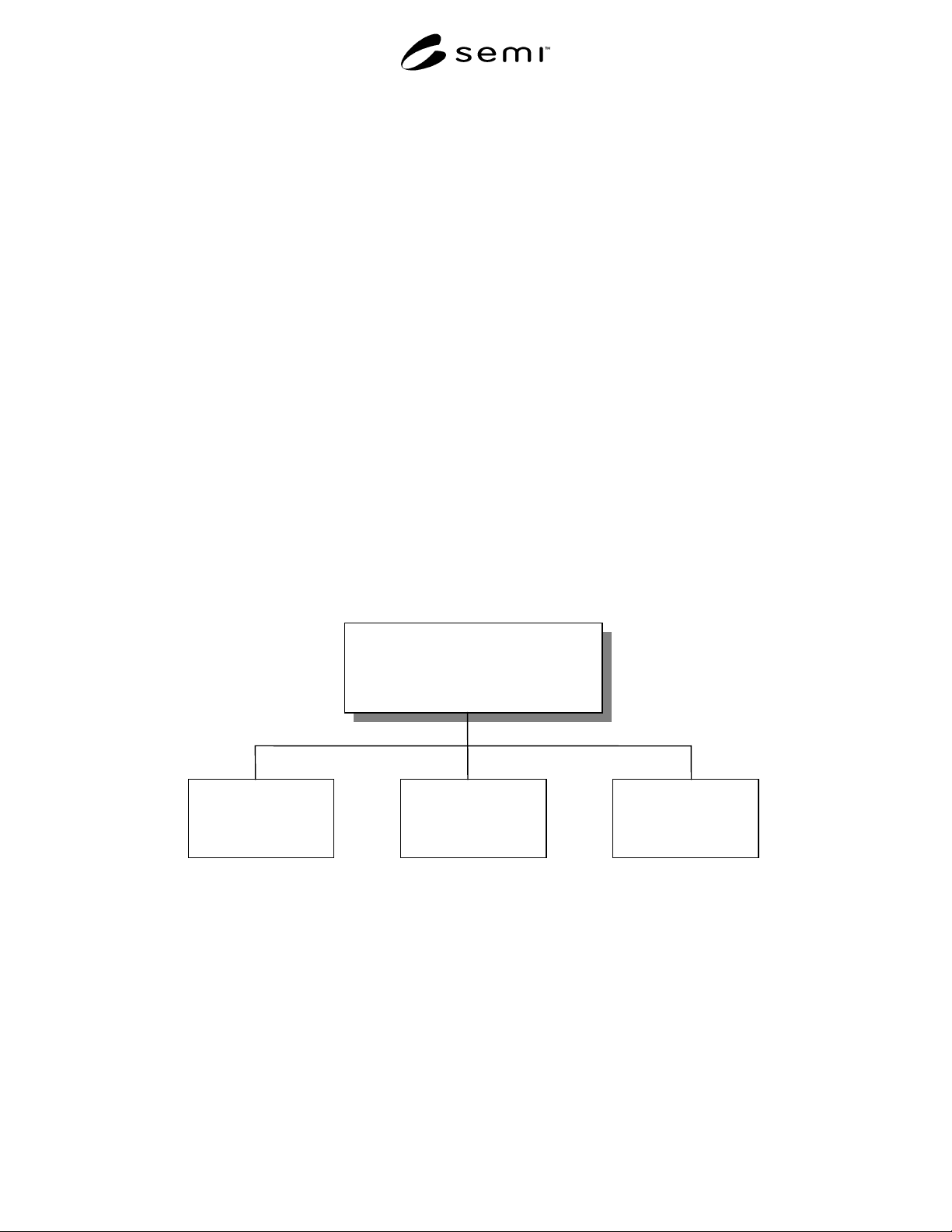
NOTE 2: See Figure 1.
7.1 De-ionized water is used in ma ny wafer processing
steps and shall not contribute any contaminants to the
processes. The most common sealing requirements in
DI water systems are filters, valves, flow and pressure
regulators, and fittings.
7.2 Contaminants in DI water fall primarily into three
categories. They are ion contamination, T.O.C.’s and
bacterial growth. Contaminant levels are usually
measured in parts per billion (PPB).
7.3 Ion contamination problems are caused by anionic
and cationic elements in DI water such as fluorides,
chlorides, sulfates, etc. These can be leached from
seals as well as the DI plumbing.
7.4 Cations (mostly metallic ions) are leached from
seals as well as the plumbing that delivers the DI water.
In order to kill bacteria which have a propensity to
grow in DI water, the water is either heated (80°C+),
ozonated, or bombarded with UV light, or possibly a
combination of these three elements. This poses unique
problems for seals used in the DI system and can cause
the following problems: Contamination of the DI water
caused by T.O.C.’s being leached from the seals and
plumbing.
7.5 Seal breakdown caused by ozone attack, or seal
deterioration due to UV exposure. T.O.C.’s are of great
concern since they can adhere to wafers and result in
degraded oxide quality and hazy films. Ozone and UV
deterioration of the seals usually leads to particulate
contamination. These can be as small as single atoms
or molecules to gross particle size contamination.
7.6 Considerations:
• What method of sterilization (i.e., chemical,
thermal or radiation)?
• Concerns for cations, anions, or T.O.C.’s?
• Seal life expectation?
8 Considerations for Use in Corrosives
(Acids, Bases), Oxidizers, and Solvents
NOTE 3: See Figure 2.
8.1 Inorganic wet chemicals at hig h concentration
levels and in some cases at elevated temperatures are
readily used in front-end semiconductor processing in
the fabrication of semiconductor devices. Most
common sealing requirements are in acid recirculation
and chemical distribution systems (mostly BCD’s).
Component systems include pumps, filters, megasonic
seals, gaskets for pipeline interfaces and valves.
8.2 Of primary concern when spec ifying a specific
seal for an application are issues relating to resistance
to chemical reaction. Design considerations should
include resistance to chemical breakdown, static vs.
dynamic environments, pressure, temperature,
leachables, particle generation.
8.3 Chemical and Thermal Degrad ation involves the
incompatibility of the seals to the process chemistries.
An example is Hydroflouric Acid (HF) dissolves
silicone elastomers. The same is true of temperature
degradation (i.e., Piranha or Phosphoric Acids) where
the process temperature causes thermally and
chemically induced effects on the seal. That also
contributes to the mechanical failure of the seal.
8.4 Leaching is most commonly a ssociated with metal
filler systems of the seal, which usually introduce
metallic ions. This is a continuous occurrence as long
as the seal is in the system.
8.4.1 Particles Particles can be th e result of
mechanical damage of the seal or as a result of leaching
or chemical degradation or foreign material present on
the seal surface. Particles can end up on the wafer and
cause defects.
8.4.2 Summary All cases of the above
contamination can create electrical shorts, voids, and
unwanted doping.
8.4.3 Solvents Incompatibility of elastomers or
seals with solvent chemistries may cause
contamination.
8.4.3.1 For example, there are degrees of
incompatibility:
8.4.3.1.1 If the seal is dissolved by the solvent, then a
catastrophic failure occurs where the solvent leaks out
of the liquid process loop. This is associated with mis-
processed wafers.
8.4.3.1.2 Another type of solvent seal interaction is the
swelling of the elastomer or the leaching of small
amounts of elastomer. Excessive swelling of the
elastomer can result in premature seal failures and a
higher cost of ownership caused by increased frequency
of seal change outs.
9 Considerations for Use In Thermal
Processes
NOTE 4: See Figure 3.
9.1 Diffusion processes are used p rimarily for growth
of oxide layers and to anneal crystal damage caused by
implant. Diffusion furnaces are usually batch process
equipment where the process atmosphere is constrained
within quartz tubes. The seals of these tubes are
exposed to temperatures of 250–300°C. This requires
SEMI F51-0200 © SEMI 2000 4
that the seals not only be capable of withstanding these
high temperatures but also that they not out-gas or
permeate adversely affecting the purity of the process.
Also of concern is the possible particle generation
caused by the seals as they expand and contract due to
temperature cycling (see Section 8.4.1).
9.1.1 Factors include:
• Temperature capability of material and process
temperature.
• Static or dynamic state of seal.
• Proper sizing and fit of seal to gland.
10 Considerations for Use in Plasma Systems
(Etch, CVD, and PVD)
NOTE 5: See Figure 4.
10.1 Considerations for sealing components for use in
plasma applications shall include proximity to plasma,
plasma reactor temperature, chemical composition of
plasma, plasma energy, and chemical leaching by the
plasma.
10.2 Contamination from the inhere nt seal
components and particle generation is directly related to
other considerations mentioned above.
10.2.1 Factors include:
• Seal composition and resistance to chemical attack.
• Proximity to source and intensity of RF.
• Temperature capability of material and process
temperature.
• Static or dynamic state of seal.
• Proper sizing and fit of seal to gland.
Categories for Consideration
UPDI
Chemical Thermal Radiation
Figure 1
UPDI Chart