semi合集-English.pdf - 第1749页
SEMI E42-0704 © SEMI 1995, 2004 18 Figure 3.3 Wire-Bonder Recipe Classes The text form of a recipe class shall conform to the convention for text (Section 1.5.1). Within th e text form of a recipe identifier , a class is…

SEMI E42-0704 © SEMI 1995, 2004 17
performance by reducing the demand for recipe
checking by the recipe executor.
The final responsibility for determining the correctness
of a recipe shall belong to the recipe executor.
3.2.2.1.2 Object Form — Recipes that cannot be
translated into a meaningful source form include
datasets derived from vision systems or mechanical
systems through a special hardware-dependent "teach"
operation. Such recipes may remain in a proprietary
object form and may or may not be applicable to other
recipe executors because of their hardware
dependencies.
For greater efficiency, recipe executors may rewrite
(e.g., tokenize) a source recipe to generate a
proprietary object form of the recipe. This is called the
derived object form, to distinguish it from object form
recipes that never exist in source form. The agent's
manufacturer may choose to make this form available
for transfer as well. From the point of view of the
supervisor, the body of a recipe that is in object form is
an unstructured binary vector or string. In general, it
cannot be edited on a supervisor, and the source form
of the recipe is still required. Derived object form
recipes that cannot be used by multiple recipe executors
should not be stored in recipe namespaces that are
shared.
Where both the source form and the derived object form
exist, the identifier for the object form of the recipe
shall be different from that of the source form in some
recognizable way. The supplier of the recipe executor
shall provide a documented method for distinguishing
one from the other within the identifier. This method
must be such that the relationship of the derived object
form recipe from the original source recipe is obvious
to the user. (See Section 3.2.3.4 for examples.) An
attribute of the recipe, SrcRcpID, is provided to retain
the relationship between the source form recipe and the
derived object form recipe.
3.2.3 Recipe Identification — The ability to properly
and unambiguously identify a recipe is critical to both
recipe management and processing. It is also important
for the user that identification be logical. RMS defines
three elements used to uniquely identify a recipe within
any recipe namespace. These three elements are the
recipe's class, name, and version. Each element is
expressed as a text string, and they are concatenated
together to form the recipe identifier (see Section
3.2.3.4).
3.2.3.1 Recipe Name — The recipe name is a user-
defined text string that may be used to encode the
technology, layer, manufacturing area, and other
characteristics. The recipe name alone is not necessarily
unique within either a given class or a given
namespace.
The recipe name is subject to the conventions for text
as defined in Section 1.5.1.
3.2.3.2 Recipe Class — A recipe class is a formal
grouping of recipes that have a common syntax. A class
may contain subclasses where the recipes within the
subclasses operate in different environments or have
different syntaxes from the parent class and/or from one
another. A subclass is itself a class and may contain
further subclasses.
The overall model for recipes is a set of class
hierarchies or "class trees" defined by the supplier of
the recipe executor. The major classes of recipes are the
PROCESS class, the SERVICE class, and possibly
other agent-specific classes. These are called primary
classes. A primary class is a class that is not a subclass
of another class.
The PROCESS class is a required primary class and is
composed of recipes whose primary purpose is to
increase the manufactured value of the production
material
6
.
The SERVICE class is an optional primary class used
for recipes whose purpose is to maintain, prepare,
calibrate, or test the operation of equipment. Typical
subclasses of the SERVICE class might be
CALIBRATION and CLEANING. SERVICE recipes
that use the same recipe language as normal process
recipes are not required to be placed into a separate
primary class. The SERVICE class allows separation
and use of a different syntax for special non-process
purposes.
Other primary classes that do not fit the PROCESS or
SERVICE may be provided by the supplier of the
recipe executor. Such additional classes, and their
function, shall be documented.
Recipes that are not in the PROCESS class or one of its
subclasses shall not be used for production purposes.
However, recipes within the PROCESS class may be
used for purposes other than production.
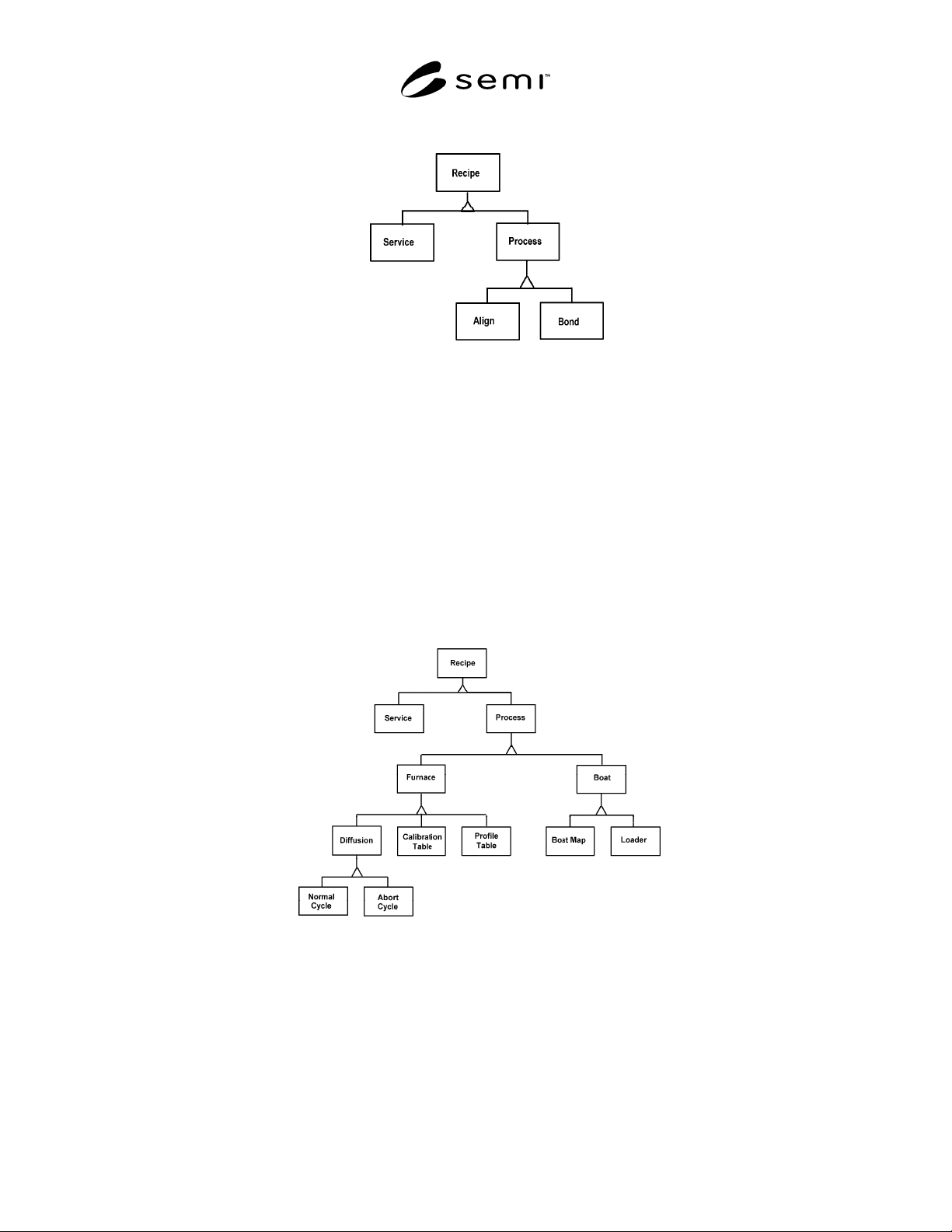
Figures 3.3 and 3.4 show examples of object models of
possible classes and subclasses for a wire-bonder and
for a furnace with an automatic boat-loader subsystem.
6 Material handling systems, wafer metrology, wafer measurement,
wafer inspection systems, as well as process equipment which
directly changes the characteristics of the material, increase the value
of the material in some way.
SEMI E42-0704 © SEMI 1995, 2004 18
Figure 3.3
Wire-Bonder Recipe Classes
The text form of a recipe class shall conform to the convention for text (Section 1.5.1). Within the text form of a
recipe identifier, a class is delimited on both ends by the forward slash character "/". The complete class
specification within recipe identifier is formed by the concatenation of classes and subclasses, starting with the
primary class and ending with the particular class of the recipe in question:
“/PRIMARY CLASS/SUBCLASS
1
/SUBCLASS
2
/…”.
For example, a recipe named DryOx, version 4, within the NORMAL CYCLE class in Figure 3.4., has an identifier
of
“/PROCESS/FURNACE/DIFFUSION/NORMAL CYCLE/DryOx;4”.
Figure 3.4
Recipe Classes for Furnace
The complete class specification, which always starts with the primary class, shall always be accepted. If class
names within a namespace are all unique, however, the service provider may also accept a class designator
consisting of a single class. The identifier in the example above then becomes
“/NORMAL CYCLE/DryOx;4”.

SEMI E42-0704 © SEMI 1995, 2004 19
3.2.3.3 Version — A recipe may evolve over time and
exist in several versions. This allows the user to retain a
recipe name over multiple versions and show the
recipe's heritage. Different versions are identified by
the version portion of the recipe's identifier. NOTE:
More than one version of a recipe may be in use for
production at the same time, not only within the
factory, but also within a single equipment.
A version is a text string consisting of at least one
character. A new version is either generated
automatically by the recipe namespace or is assigned
by the user. A user may assign any combination of text
characters and punctuation marks to the version, except
for:
• the characters prohibited by the convention for text
usage and the object identifier (Section 1.5.1),
• whitespace characters.
It is recommended, but not required, that only upper
case be used.
Numeric versions (version numbers) consist only of
the digits "0" through "9" and one decimal point
character "." and can be translated to a pure number. To
avoid confusion and multiple versions with the same
numeric value, numeric versions are further restricted
as follows:
• whole numbers (with no decimal point) may not
start with a zero "0" followed by another digit, and
• decimal numbers (with a decimal point) may not
start or end with the decimal point or end with a
zero following the decimal point.
For example, version numbers "09", "1.", ".5", and
"1.670" are prohibited. The proper forms with the same
numeric values are "9", "1", "0.5", and "1.67". The user
may assign a version of "0" but not of "00".
Versions that are assigned automatically have additional
restrictions:
• They shall be numeric versions, excluding the
decimal point and with a minimum value of "1".
• Versions shall be assigned incrementally. When
assigning a version for a recipe with a given class
and name, if no other recipe exists within the
namespace with that class and name, then a version
of "1" is assigned. Otherwise, the highest existing
version already in use for that class and name is
determined, and the new version is assigned a
value equal to that value plus 1. For example, if the
highest version in use has a numeric value of 5,
then the next version assigned would be "6". To
compare two versions, they are converted to
upper-case and compared character by character.
3.2.3.4 Recipe Identifiers — The recipe identifier is
formed from the concatenation of the recipe's class,
name, and version, in that order:
“/CLASS
1
/CLASS
2
/…/CLASS
n
/NAME;VERSION”
where CLASS
1
is a primary class and CLASS
i+1
is a
subclass of CLASS
i
. The recipe name follows class.
Name and version are always separated by a semicolon
";" (3B
16
).
Where CLASS
n
is a unique class name, the form
becomes
“/CLASS/NAME;VERSION”.
The recipe identifier is used for the OSS-required
attribute ObjID
and shall conform to restrictions
imposed on ObjID
(see SEMI E39). The total length of
ObjID
may have additional restrictions imposed by the
protocol.
NOTE: There is no necessary relationship between a
recipe's identifier or name and any file name(s) under
which the body and attributes may be stored internally.
The recipe identifier is a logical reference to the recipe
that is independent of specific platforms and
implementations. In particular, file services provided by
operating systems may have naming restrictions, such
as length, that are incompatible with the requirements
of RMS. A recipe may be stored internally in different
ways, such as in a single flat file, a set of related files,
or a database. Actual storage methods shall be invisible
to RMS.
Where suppliers supporting recipes in source form also
rewrite them, as discussed in Section 3.2.2.1.2, a
method based on the recipe identifier (ObjID
) is
required to both distinguish between the two forms and
to recognize the relationship between the original
source form recipe and the derived object form recipe.
The method may use any of the three elements of the
identifier for this purpose. For example, recipes in
object form may be placed in a separate subclass called
"/OBJ/", or a suffix such as ".obj" might be appended to
the user-defined name of the original recipe.
3.2.3.4.1 Default Recipe Identifiers — It is always
possible to reference a recipe by specifying its full
identifier (class, name, and version number). In certain
cases, described in Section 3.2.4.1.1, it may also be
necessary to specify the namespace of a recipe.
However, it is not always necessary to specify all
components of the identifier. Specifically, class and/or
version may be omitted when a recipe is selected for
execution and within an external reference. Namespace
is not normally specified. Rules define default values