semi合集-English.pdf - 第2983页
SEMI E120-0705 © SEMI 2003, 2005 19 11 Related Documents 11.1 Unifi ed Model ing Language (UML) S pecification, Version 1.4, OMG S pecification 01 -09-67, available from http://www.omg .org/technology/docum ents/m odelin…
SEMI E120-0705 © SEMI 2003, 2005 18
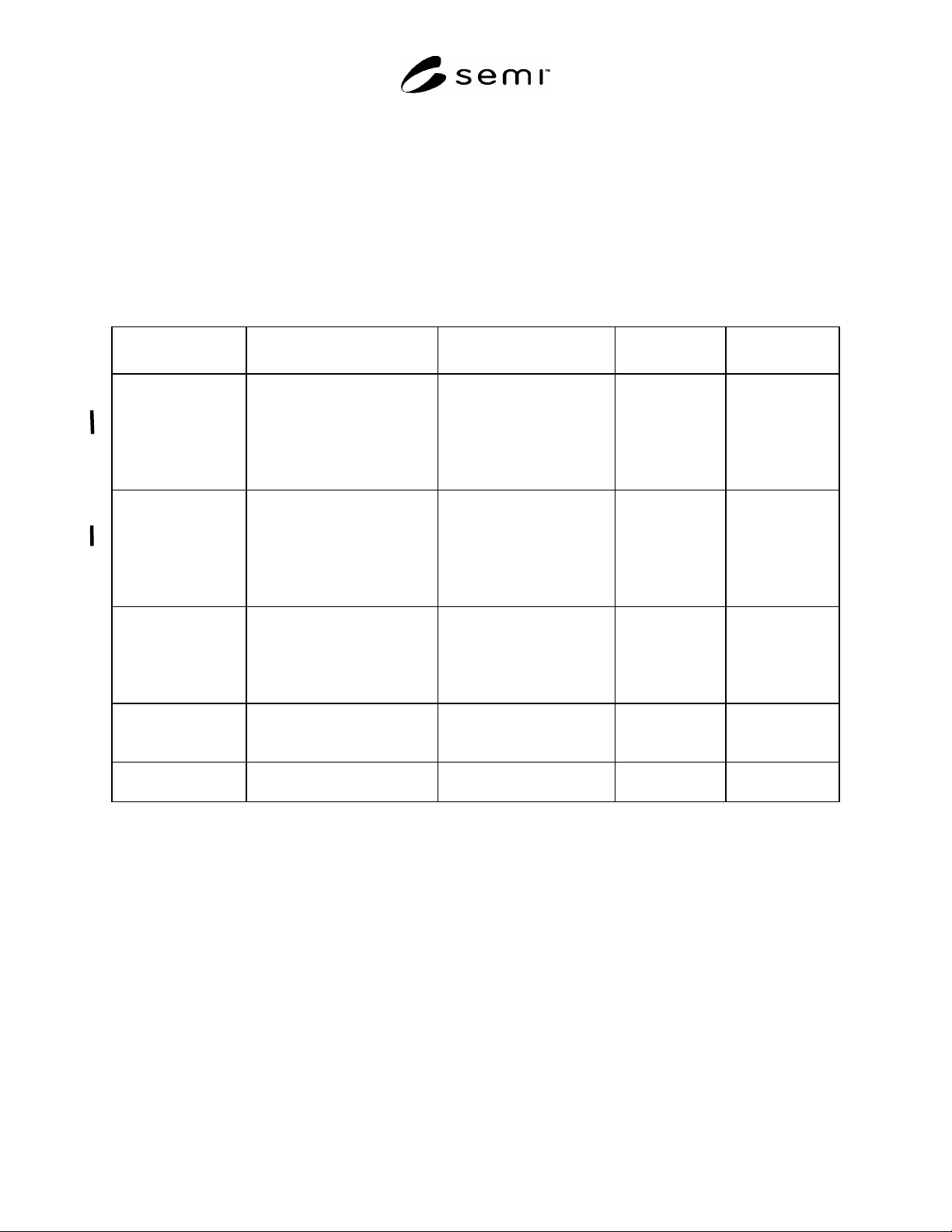
10.3.3 In Table 13, the first column represents a CEM concrete class. “CEM Compliance” in this table indicates (1)
that at least one instance of that class exists and (2) that all instances of that class meet all requirements for the class.
10.3.4 The “Class/Superclass Definition” column gives a section number reference to each class in the inheritance
hierarchy for the concrete class in that row. The requirements for all classes in the inheritance hierarchy apply for
this concrete class.
10.3.5 The “Navigable Via Association” column lists the section number for the definition of each class that may be
associated with the concrete class in that row. When such an association exists, there must be a CEM Compliant
instance of that associated class. If the cardinality of the association may be zero, then the existence of the
association is dependent on the equipment structure.
Table 13 CEM Class Compliance Table
CEM Class
Requirement
Class/Superclass
Definition
Navigable Via Association Implemented CEM Compliant
Equipment 8.5.3.1 Nameable
8.5.3.2 EquipmentElement
8.5.3.3 ExecutionElement
8.5.4.1 Equipment
8.5.3.4 Extension
8.5.4.2 Module
8.5.4.3 Subsystem
8.5.4.4 IODevice
8.5.4.5 MaterialLocation
8.5.4.6 SoftwareModule
Yes No Yes No
Module 8.5.3.1 Nameable
8.5.3.2 EquipmentElement
8.5.3.3 ExecutionElement
8.5.4.2 Module
8.5.3.4 Extension
8.5.4.2 Module
8.5.4.3 Subsystem
8.5.4.4 IODevice
8.5.4.5 MaterialLocation
8.5.4.6 SoftwareModule
Yes No Yes No
Subsystem 8.5.3.1 Nameable
8.5.3.2 EquipmentElement
8.5.4.3 Subsystem
8.5.3.4 Extension
8.5.4.3 Subsystem
8.5.4.4 IODevice
8.5.4.5 MaterialLocation
8.5.4.6 SoftwareModule
Yes No Yes No
IODevice 8.5.3.1 Nameable
8.5.3.2 EquipmentElement
8.5.4.4 IODevice
8.5.3.4 Extension
8.5.4.6 SoftwareModule
Yes No Yes No
MaterialLocation 8.5.3.1 Nameable
8.5.4.5 MaterialLocation
8.5.3.4 Extension Yes No Yes No
10.4 Compliance Verification Approach
10.4.1 Verification of compliance to SEMI E120 may be accomplished by comparing the objects and their
attributes that are reported from the equipment with their class definitions from CEM and with the other
requirements listed in this Table 12.
10.4.2 Electronic verification requires that all CEM related objects be collected directly from the equipment along
with all their attributes. The method for collection will vary depending on the type of electronic communication
available. Since the CEM classes and their attributes are static, the method and time of collection shall not affect the
verification outcome.
10.4.3 Once the objects are collected, the set is checked electronically against the requirements defined in Table 12
and Table 13 above. The process will ensure that the names of all classes and attributes are correct, that any
required objects exist and that each instance provides all defined attributes and appropriate associations.
SEMI E120-0705 © SEMI 2003, 2005 19
11 Related Documents
11.1 Unified Modeling Language (UML) Specification, Version 1.4, OMG Specification 01-09-67, available from
http://www.omg.org/technology/documents/modeling_spec_catalog.htm.
3
3 This specification uses object-modeling terminology consistent with this OMG standard for UML.
SEMI E120-0705 © SEMI 2003, 2005 20
RELATED INFORMATION 1
FURTHER BACKGROUND AND JUSTIFICATION
NOTICE: This Related Information is not an official part of SEMI E120. This Related Information is not intended
to modify or supersede the official standard. Determination of the suitability of the material is solely the
responsibility of the user.
R1-1 UML Terminology
R1-1.1 In order to help with understanding terminology used in conjunction with object technology, this section
shares excerpts from the glossary of the OMG standard for UML—the predominant modeling notation.
Unified Modeling Language (UML) Specification, Version 1.4, OMG Specification 01-09-67, available from
http://www.omg.org/technology/documents/modeling_spec_catalog.htm
R1-1.2 These definitions are taken from B.2 Glossary of Terms of the above document.
R1-1.2.1 abstract class — a class that cannot be directly instantiated. Contrast: concrete class.
R1-1.2.2 aggregate [class] — a class that represents the “whole” in an aggregation (whole-part) relationship. See:
aggregation.
R1-1.2.3 aggregation — a special form of association that specifies a whole-part relationship between the aggregate
(whole) and a component part. See: composition.
R1-1.2.4 association — the semantic relationship between two or more classifiers that specifies connections among
their instances.
R1-1.2.5 attribute — a feature within a classifier that describes a range of values that instances of the classifier may
hold.
R1-1.2.6 cardinality — the number of elements in a set. Contrast: multiplicity.
R1-1.2.7 child — in a generalization relationship, the specialization of another element, the parent. See: subclass,
subtype. Contrast: parent.
R1-1.2.8 class — a description of a set of objects that share the same attributes, operations, methods, relationships,
and semantics. A class may use a set of interfaces to specify collections of operations it provides to its environment.
See: interface.
R1-1.2.9 classifier — a mechanism that describes behavioral and structural features. Classifiers include interfaces,
classes, datatypes, and components.
R1-1.2.10 classification — the assignment of an object to a classifier. See dynamic classification, multiple
classification and static classification.
R1-1.2.11 class diagram
— a diagram that shows a collection of declarative (static) model elements, such as
classes, types, and their contents and relationships.
R1-1.2.12 composition — a form of aggregation which requires that a part instance be included in at most one
composite at a time, and that the composite object is responsible for the creation and destruction of the parts.
Composition may be recursive. Synonym: composite aggregation.
R1-1.2.13 concrete class — a class that can be directly instantiated. Contrast: abstract class.
R1-1.2.14 constraint — a semantic condition or restriction. Certain constraints are predefined in the UML, others
may be user defined.
R1-1.2.14.1 Constraints are one of three extensibility mechanisms in UML. See: tagged value, stereotype.
R1-1.2.15 diagram — a graphical presentation of a collection of model elements, most often rendered as a
connected graph of arcs (relationships) and vertices (other model elements). UML supports the following diagrams:
class diagram, object diagram, use case diagram, sequence diagram, collaboration diagram, state diagram, activity
diagram, component diagram, and deployment diagram.