semi合集-English.pdf - 第6961页
SEMI S8-0705 © SEMI 1995, 2005 58 Section 10: Workstation Design Section Indicator Figure 10.1 Standing station (Note A standing st ation is one where the operator can assume a standing posture or a seated posture in a t…
SEMI S8-0705 © SEMI 1995, 2005 57
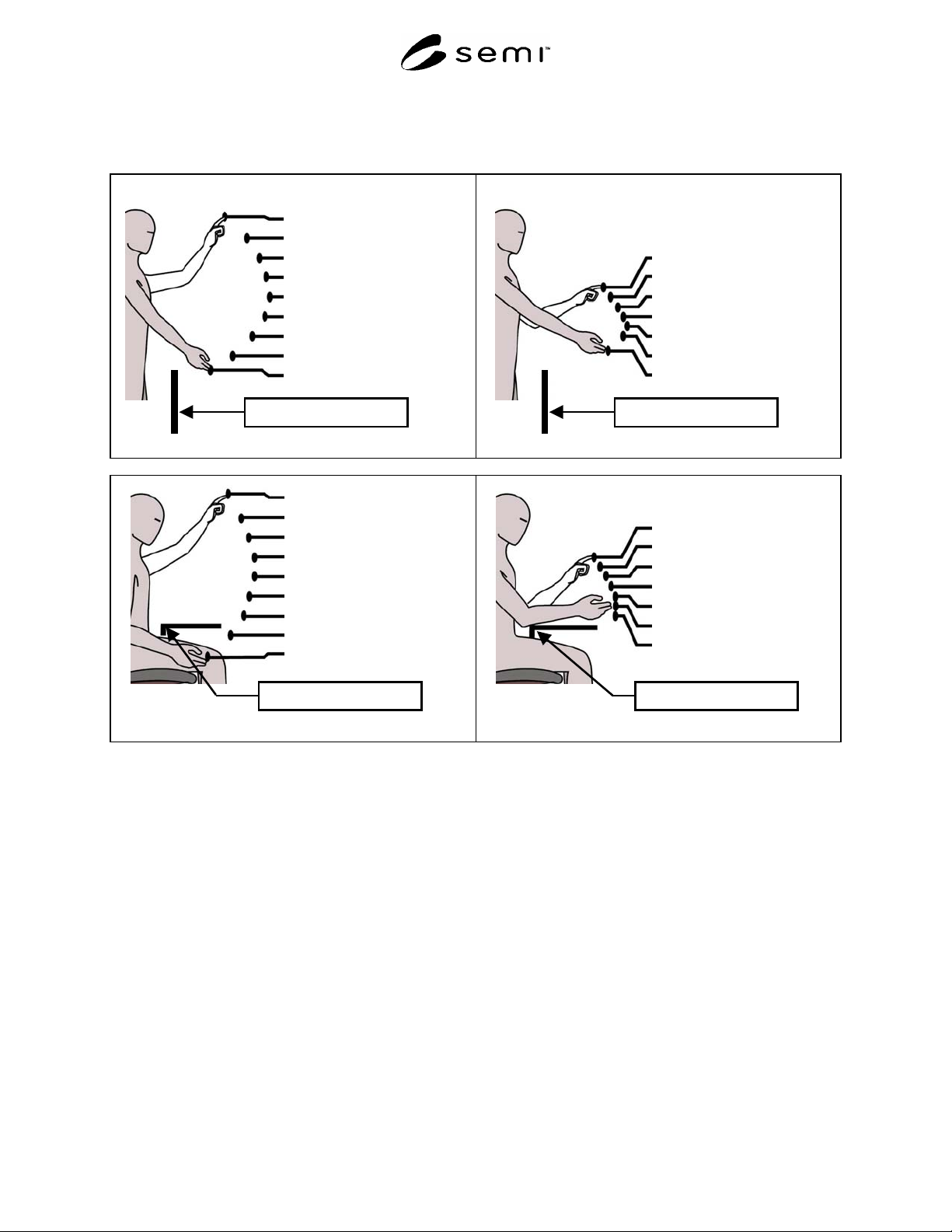
Section 9: Hand Control Location Figures
Coordinates given for hand control locations. Height (vertical measurement from standing surface to center of control), Depth
(horizontal measurement from leading edge of work surface to the center of control)
Height and depth of controls
1638, 254 mm
(64.5, 10.0 in.)
1524, 368 mm
(60, 14.5 in.)
1422, 432 mm
(56, 17.0 in.)
1321, 470 mm
(52, 18.5 in.)
1219, 483 mm
(48, 19.0 in.)
1118, 470 mm
(44, 18.5 in.)
1016, 394 mm
(40, 15.5 in.)
914, 292 mm
(36, 11.5 in.)
838, 178 mm
(33, 7.0 in.)
Leading edge of workstation
Figure 9.1.2 Infrequently used standing control reaches
Height and depth of controls
1270, 292 mm
(50, 11.5 in.)
1219, 330 mm
(48,13.0 in.)
1168, 368 mm
(46, 14.5 in.)
1118, 394 mm
(44, 15.5 in.)
1067, 406 mm
(42, 16.0 in.)
1016, 394 mm
(40, 15.5 in.)
940, 318 mm
(37, 12.5 in.)
Leading edge of workstation
Figure 9.1.3 Frequently used standing control reaches
1397, 356 mm
(55, 14.5 in.)
1270, 432 mm
(50, 17.0 in.)
1168, 470 mm
(46, 18.5 in.)
1067, 483 mm
(42, 19.0 in.)
965, 483 mm
(38, 19.0 in.)
864, 470 mm
(34, 18.5 in.)
762, 445 mm
(30, 17.5 in.)
660, 381 mm
(26, 15.0 in.)
533, 254 mm
(21, 10.0 in.)
Leading edge of workstation
Figure 9.2.1 Infrequently used seated control reaches
1067, 330 mm
(42, 13.0 in.)
1016, 368 mm
(40, 14.5 in.)
965, 394 mm
(38, 15.5 in.)
914, 406 mm
(36, 16.0 in.)
864, 419 mm
(34, 16.5 in.)
813, 419 mm
(32, 16.5 in.)
762, 419 mm
(30, 16.5 in.)
Leading edge of workstation
Figure 9.2.2 Frequently used seated control reaches
SEMI S8-0705 © SEMI 1995, 2005 58
Section 10: Workstation Design
Section Indicator Figure
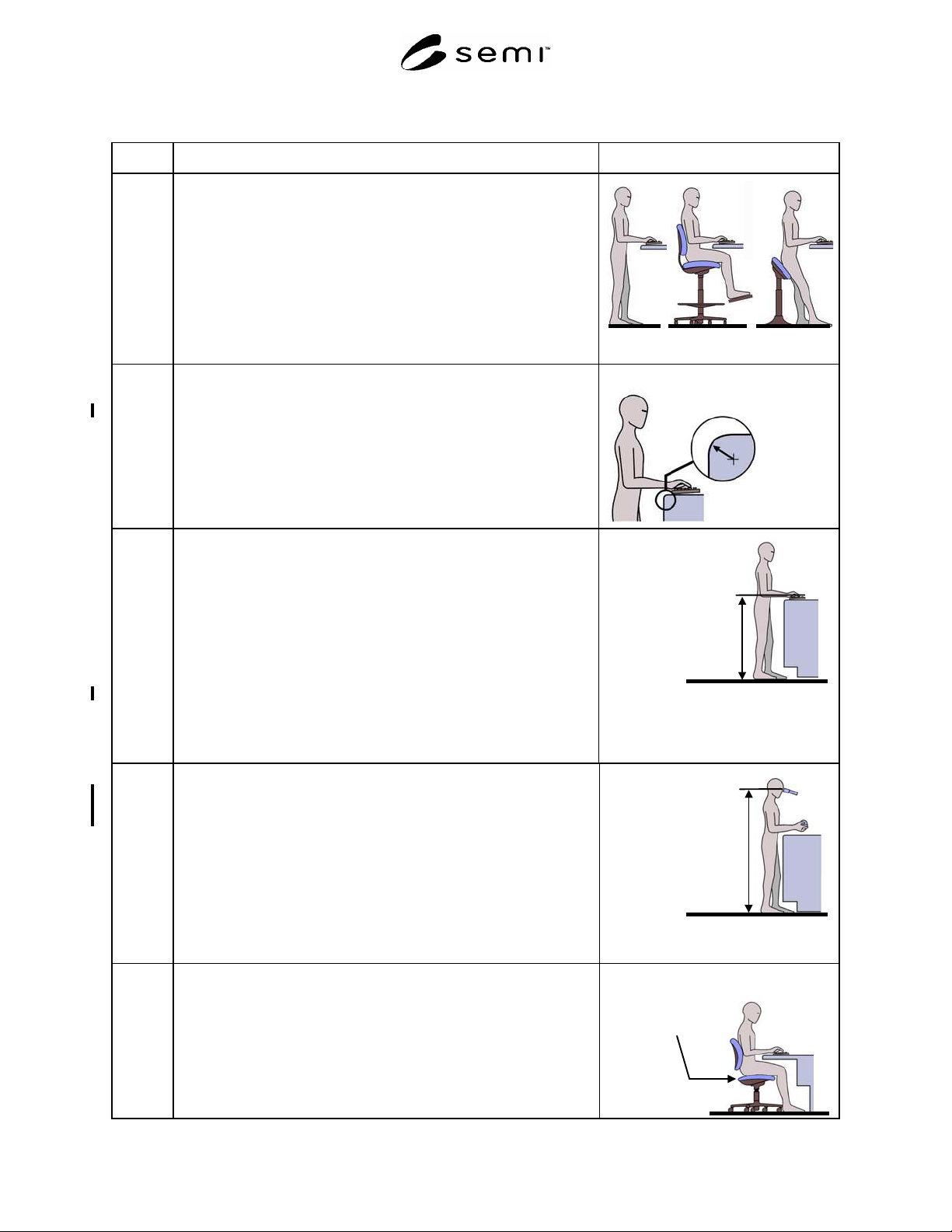
10.1 Standing station (Note A standing station is one where the operator can
assume a standing posture or a seated posture in a tall stool, which places
the operator at approximately the same stature.)
NOTE: If a tall stool, chair or sit/lean stool is used, it is assumed that
the seat is user height-adjustable.
Stand Sit Sit/Lean
10.1.1 Work surface edge radius where the operator can assume a static posture
in contact with the edge.
Acceptance criterion: minimum 6.4 mm (0.25 in.) radius
NOTE: This recommendation applies to both horizontal and vertical
surfaces where the equipment operator can assume a static
posture.
Work surface edge radius
Minimum 6.4 mm
(0.25 in.)
10.1.2 Height of keyboard, trackball, or mouse (to home row, top of ball/mouse).
NOTE: In applications where input devices (keyboard, trackball, or
mouse) are used more like machine controls (intermittent one finger entry
on the keyboard, intermittent short term use of the mouse or trackball)
than for standard typing (continuous use of keyboard for entry of long
character strings, extended use of trackball or mouse in graphical
environment), it is appropriate to use the height and reach locations
described in Section 9, Hand Control Location (standing station).
Acceptance criteria: maximum 1020 mm (40 in.)
minimum 970 mm (38 in.)
NOTE: The home row of a keyboard is the row with the “F” and “J”
typing home keys.
Keyboard, mouse
and trackball height
Maximum 1020 mm
(40 in.)
Minimum 970 mm
(
38 in.
)
10.1.3 Height of microscope eyepieces. Must be adjustable.
Acceptance criterion: Range includes 1270 mm (50 in.) to 1730 mm
(68 in.)
NOTE A: Measured from standing surface to center of the eyepiece.
NOTE B: Both height-adjustable eyepieces and adjustable tables may
be used to meet this recommendation. If a height-adjustable
table is used, the SESC checklist should be used to determine
the appropriate machine load port heights and locations for
displays and controls at the maximum and minimum table
heights.
Maximum 1730 mm
(68 in.)
Minimum 1270 mm
(50 in.)
10.2 Seated station (A seated station where a short cylinder office-style chair is
used.)
NOTE: A height-adjustable chair is assumed.
Height-adjustable,
office style chair
SEMI S8-0705 © SEMI 1995, 2005 59
Section 10: Workstation Design
Section Indicator Figure
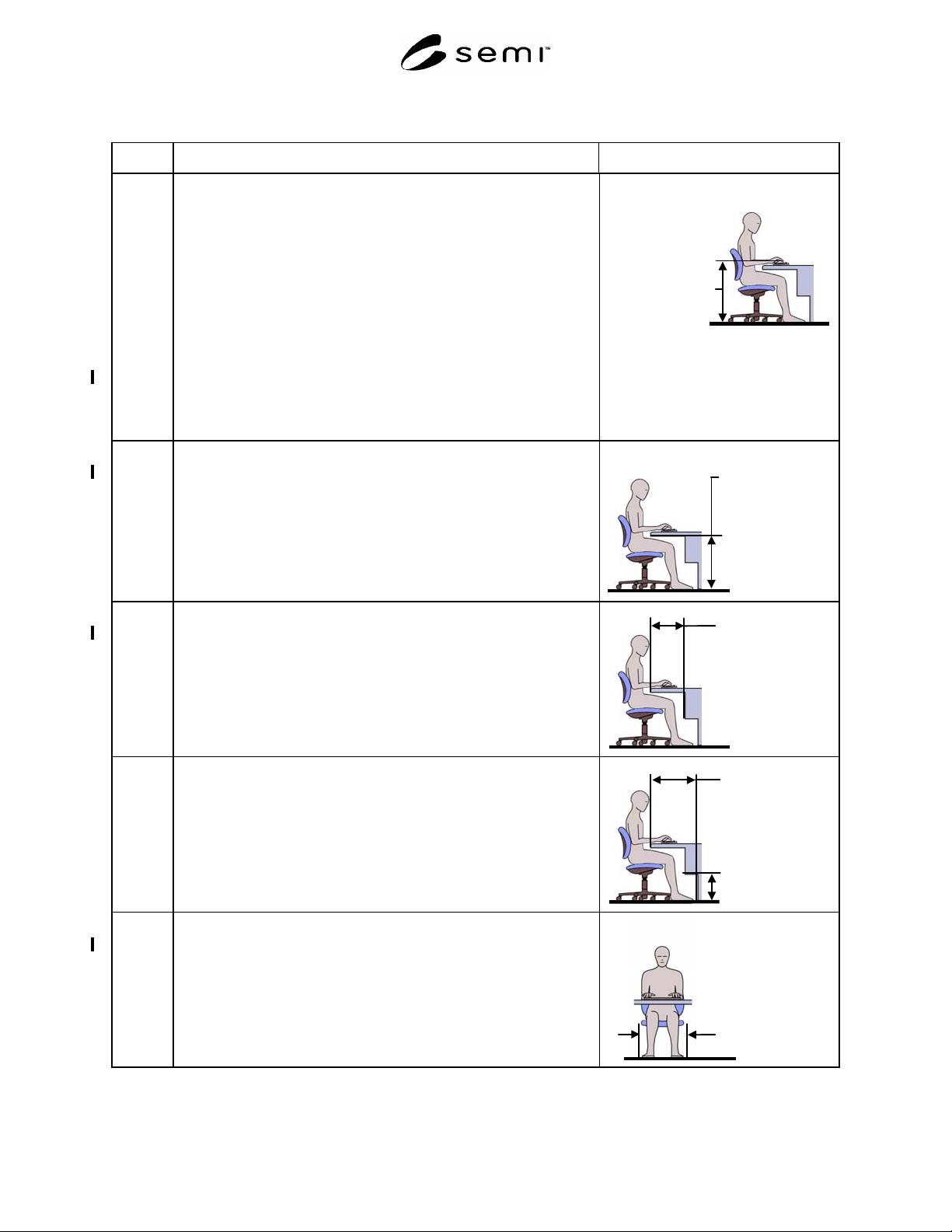
10.2.1 Height of keyboard, trackball, or mouse. (measured to home row and top
of ball/mouse).
NOTE: In applications where input devices (keyboard, trackball, or
mouse) are used more like machine controls (intermittent one finger entry
on the keyboard, intermittent short term use of the mouse or trackball)
than for standard typing (continuous use of keyboard for entry of long
character strings, extended use of trackball or mouse in graphical
environment), it is appropriate to use the height and reach locations
described in Section 9, Hand Control Location (seated station).
Acceptance criteria: maximum 760 mm (30 in.)
minimum 710 mm (28 in.)
NOTE: The home row of a keyboard is the row with the “F” and “J”
keys.
Height of key-
board, track-ball
and mouse
Maximum
760mm
(30 in.)
Minimum
710 mm
(28 in.)
10.2.2 Vertical leg clearance.
Acceptance criterion: minimum 673 mm (26.5 in.)
Vertical leg
clearance
Minimum 673 mm
(
26.5 in.
)
10.2.3 Horizontal leg clearance, depth at knee level.
Acceptance criterion: minimum 508 mm (20 in.)
Horizontal knee
clearance
Minimum 508 mm
(20 in.)
10.2.4 Horizontal leg clearance, depth at foot level.
Acceptance criteria: minimum 660 mm (26 in.) depth × 254 mm (10 in.)
vertical foot clearance.
Horizontal foot
clearance
Minimum 660 mm
(26 in.)
Vertical foot
clearance
Minimum 254 mm
(10 in.)
10.2.5 Horizontal leg clearance: width.
Acceptance criterion: minimum 610 mm (24 in.)
Horizontal leg
clearance, width
Minimum 610 mm
(24 in.)