semi合集-English.pdf - 第4499页
SEMI D20-1000 © SEMI 1993, 2000 2 Figure 1 Image of Defects for FPD Mask NOTICE: The user’s attention is called to the possibilit y that compliance with this standard may require use of cop yrigh ted material or of an in…

SEMI D20-1000 © SEMI 1993, 20001
SEMI D20-1000
DEFECT TERMINOLOGY FOR FLAT PANEL DISPLAY MASKS
This terminology was technically approved by the Global Flat Panel Display Committee and is the direct
responsibility of the Japanese Flat Panel Display Materials and Components Committee. Current edition
approved by the Japanese Regional Standards Committee on July 28, 2000. Initially available on SEMI
OnLine September 2000; to be published October 2000. Originally published in 1993.
1 Purpose
1.1 This document defines defect terminology for FPD
masks. By this standard, it is intended that the concepts
of terms which should be used at the technical
conferences, business discussion, etc are clarified and
that standardization as to masks will be promoted.
2 Scope
2.1 These terms apply to photomasks that are
principally used in fabricating flat panel display.
2.2 These definitions do not purport to address safety
issues, if any, associated with their use. It is the
responsibility of the user of these definitions to
establish appropriate safety and health practices and
determine the applicability of regulatory limitations
prior to use. SEMI makes no warranties or
representations as to the suitability of the definitions set
forth herein for any particular application. The
determination of the suitability of the definitions is
solely the responsibility of the user. Users are cautioned
to refer to manufacturer’s instructions, product labels,
product data sheets, and other relevant literature
respecting any materials mentioned herein. These
definitions are subject to change without notice.
3 Referenced Documents
None.
4 Terminology
4.1 pin hole — a small hole-shaped opening defect on
the chrome-pattern.
4.2 intrusion — an absence of chrome extending
inward from boundary.
4.3 pattern disconnect — an intrusion which
completely separates the continuity of the chrome-
pattern.
4.4 missing pattern image — comp lete disappearance
of the designed chrome-pattern.
4.5 spot — isolated chrome residue on the etched area.
4.6 protrusion — an extension of chrome beyond the
desired boundary.
4.7 bridge — an extension of chrome which connects
completely and continuously from an edge to another
edge.
4.8 edge roughness — subtle roughness and/or jagged
zone on the pattern edge.
4.9 round of corner — unintended round on the
pattern corner.
4.10 flaw
4.10.1 scratch — relatively thick and deep linear
friction defect on the surface of the glass.
4.10.2 sleek — extremely thin and light linear friction
defect on the surface of the glass.
4.10.3 pit — small dot-shaped depression on the
surface of the glass.
4.11 chipping — chipping of edge of the glass caused
by cutting or treatment.
4.12 bubble — void in the interior of the glass
substrate.
4.13 foreign substance
4.13.1 particle — relatively high foreign substance
attached on the surface of the substrate.
4.13.2 contamination — cluster of relatively small
substances attached on the surface of the substrate in
the shape of thin film.
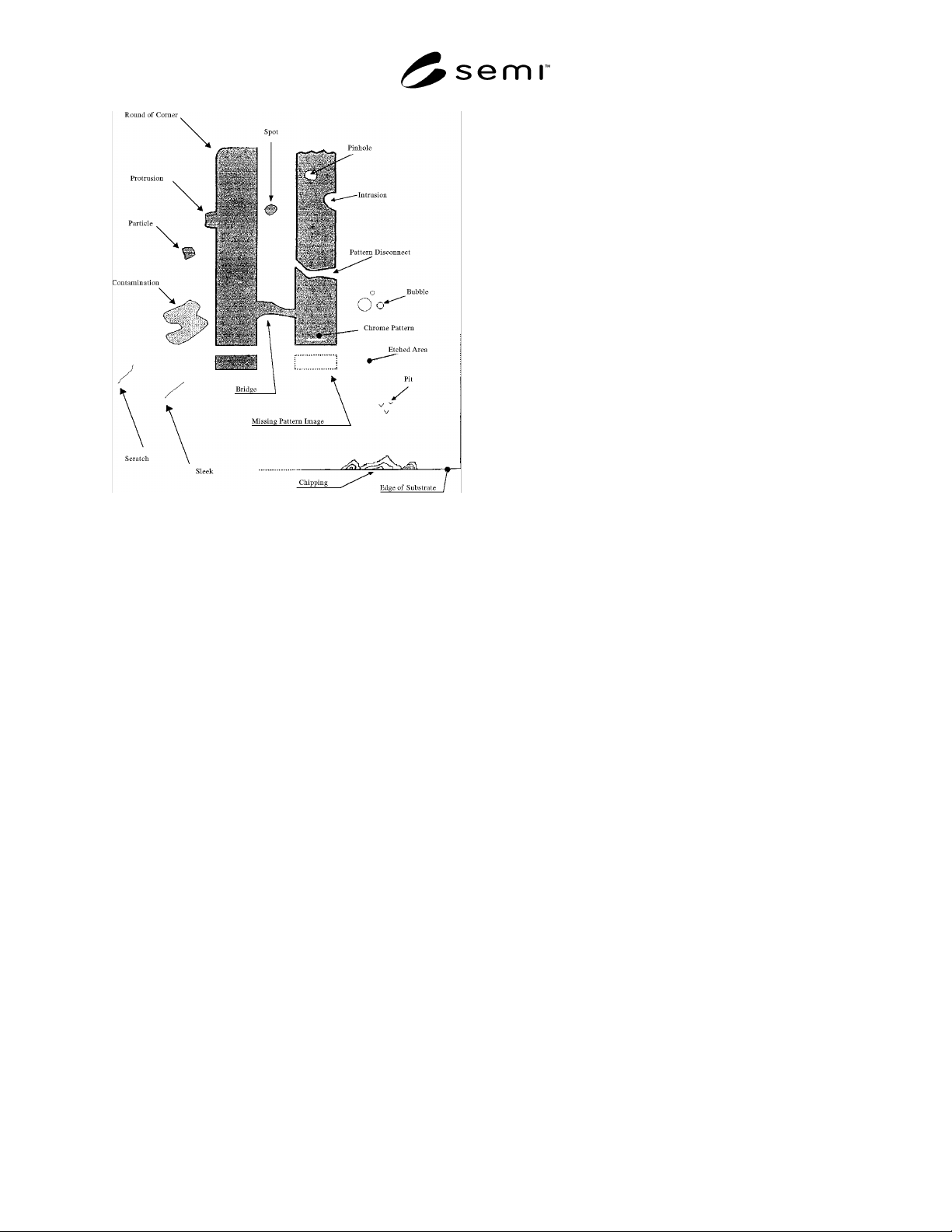
SEMI D20-1000 © SEMI 1993, 2000 2
Figure 1
Image of Defects for FPD Mask
NOTICE: The user’s attention is called to the
possibility that compliance with this standard may
require use of copyrighted material or of an invention
covered by patent rights. By publication of this
standard, SEMI takes no position respecting the validity
of any patent rights or copyrights asserted in connection
with any item mentioned in this standard. Users of this
standard are expressly advised that determination of
any such patent rights or copyrights, and the risk of
infringement of such rights, are entirely their own
responsibility.
Copyright by SEMI® (Semiconductor Equipment and Materials
International), 3081 Zanker Road, San Jose, CA 95134. Reproduction o
f
the contents in whole or in part is forbidden without express written
consent of SEMI.
SEMI D21-1000 © SEMI 1992, 20001
SEMI D21-1000
TERMINOLOGY FOR FLAT PANEL DISPLAY MASKS
This terminology was technically approved by the Global Flat Panel Display Committee and is the direct
responsibility of the Japanese Flat Panel Display Materials and Components Committee. Current edition
approved by the Japanese Regional Standards Committee on July 28, 2000. Initially available on SEMI
OnLine September 2000; to be published October 2000. Originally published in 1992.
1 Purpose
1.1 This document defines termino logy for FPD
masks. By this standard, it is intended that the concepts
of terms which should be used at the technical
conferences, business discussion, etc are clarified and
that standardization as to masks will be promoted.
2 Scope
2.1 These terms apply to photomasks that are
principally used in fabricating flat panel display.
2.2 These definitions do not purpo rt to address safety
issues, if any, associated with their use. It is the
responsibility of the user of these definitions to
establish appropriate safety and health practices and
determine the applicability of regulatory limitations
prior to use. SEMI makes no warranties or
representations as to the suitability of the definitions set
forth herein for any particular application. The
determination of the suitability of the definitions is
solely the responsibility of the user. Users are cautioned
to refer to manufacturer’s instructions, product labels,
product data sheets, and other relevant literature
respecting any materials mentioned herein. These
definitions are subject to change without notice.
3 Referenced Documents
None.
4 Pattern Dimension
4.1 Long Dimension Accuracy
4.1.1 Long Dimension — The distances in the X and Y
directions between the outermost elements of a pattern
on the mask.
4.1.1.1 Long Dimension Error — The difference (∆D)
between the measured value (DM) and designed value
(DD) of the long distance.
∆D = DM - DD
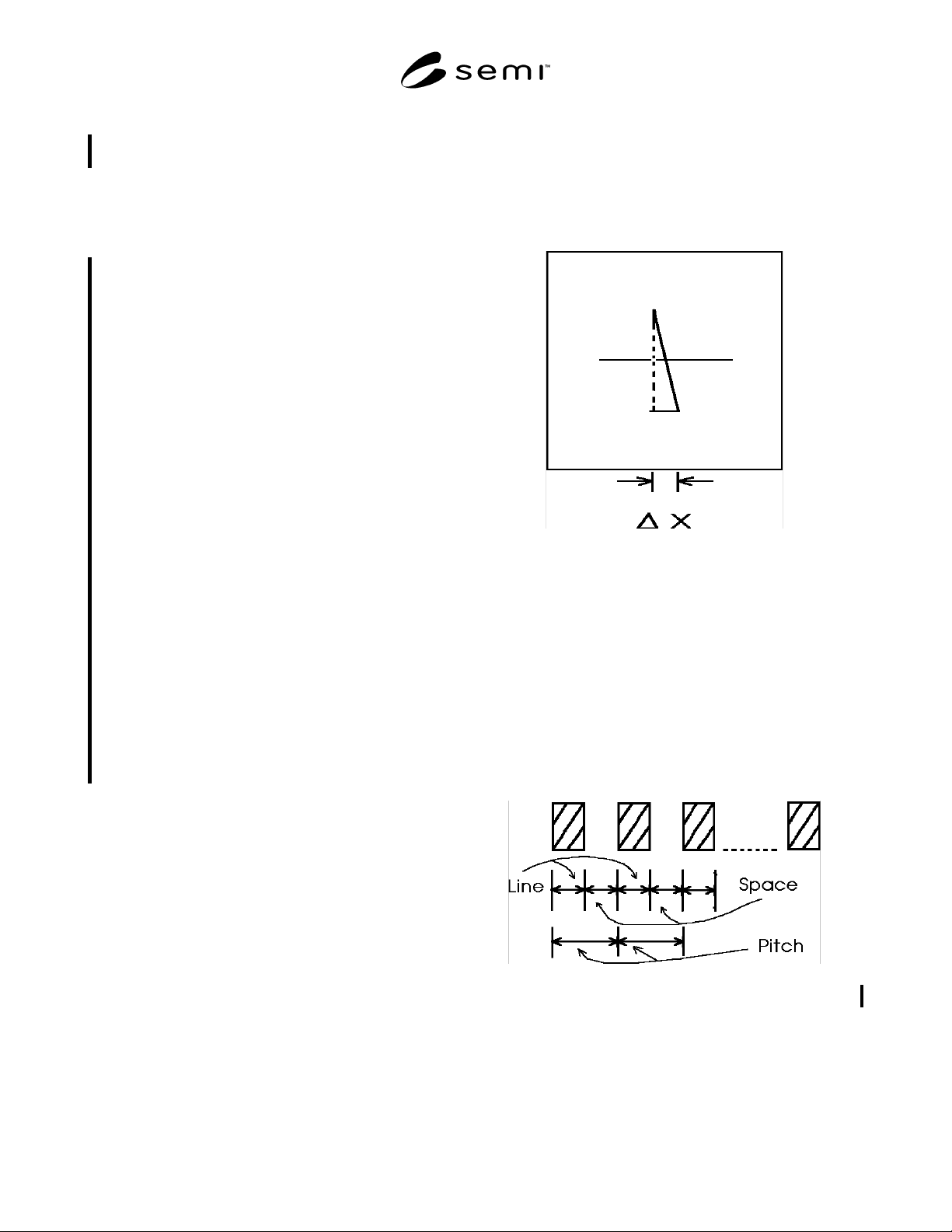
4.1.2 Rectangularity — Rectangular ity of array
pattern. Generally, it is indicated as deviation between
X coordinate 3 and 4 , when Y coordinate of 1 and 2 are
coincident.
3
21
4
Figure 1
Rectangularity
4.2 Overlay Accuracy — Deviatio n between two or
more masks in the direction of the long dimension X,
Y. Generally, the two methods are as follows:
• Deviation is measured by comparing the two
masks.
• Deviation is measured by comparing measured
data of each long dimension of the two masks.
4.3 Element Dimension Accuracy — Dimension
accuracy of element (line or space).
Figure 2
Element Dimension Accuracy
4.4 Repeat Pitch Accuracy — Deviation of measured
pitch length from designed value.
4.5 Stitching Error — Joint accura cy of a pattern
when a pattern is composed in a mask (e.g., pattern