semi合集-English.pdf - 第2566页
SEMI E90-0705 © SEMI 1999, 2005 6 Substrate Lot belongs to Equipm ent Proces ses 1+ Substrate Location 1+ held Substrate Carrier 1+ Batch Location held provides provides Figure 1 Overview of Substrate Trac king Ca r r i …

SEMI E90-0705 © SEMI 1999, 2005 5
7 Overview
7.1 Purpose of Substrate Tracking
7.1.1 Substrate tracking consists of the following capabilities, as described below:
7.1.2 Substrate Location Tracking — Substrate Location Tracking provides the capability to determine the current
location of substrates in the equipment. The indication of the substrate location will help the user to understand the
environment to which the substrate is exposed in the equipment.
7.1.3 Batch Location Tracking — Batch Location Tracking provides the capability to determine the current location
of a group of substrates in the equipment. Typical example of a substrates group is a batch in batch process
equipment.
7.1.4 Substrate History Record — Substrate History Record provides the capability to read the history of substrates
in the equipment. The user can inquire about the history of a particular substrate, substrate location, or batch location
with substrate position in a batch. A history includes the series of locations that the substrate has visited in the
equipment.
7.1.5 Substrate Process Tracking — Substrate Process Tracking provides the capability of tracking current
substrate processing state. For example, the user may determine whether a substrate is processed or not by
requesting its state when the process has been completed abnormally. The user may use the state transitions to
trigger wafer level data collection.
7.2 View of Substrate Tracking
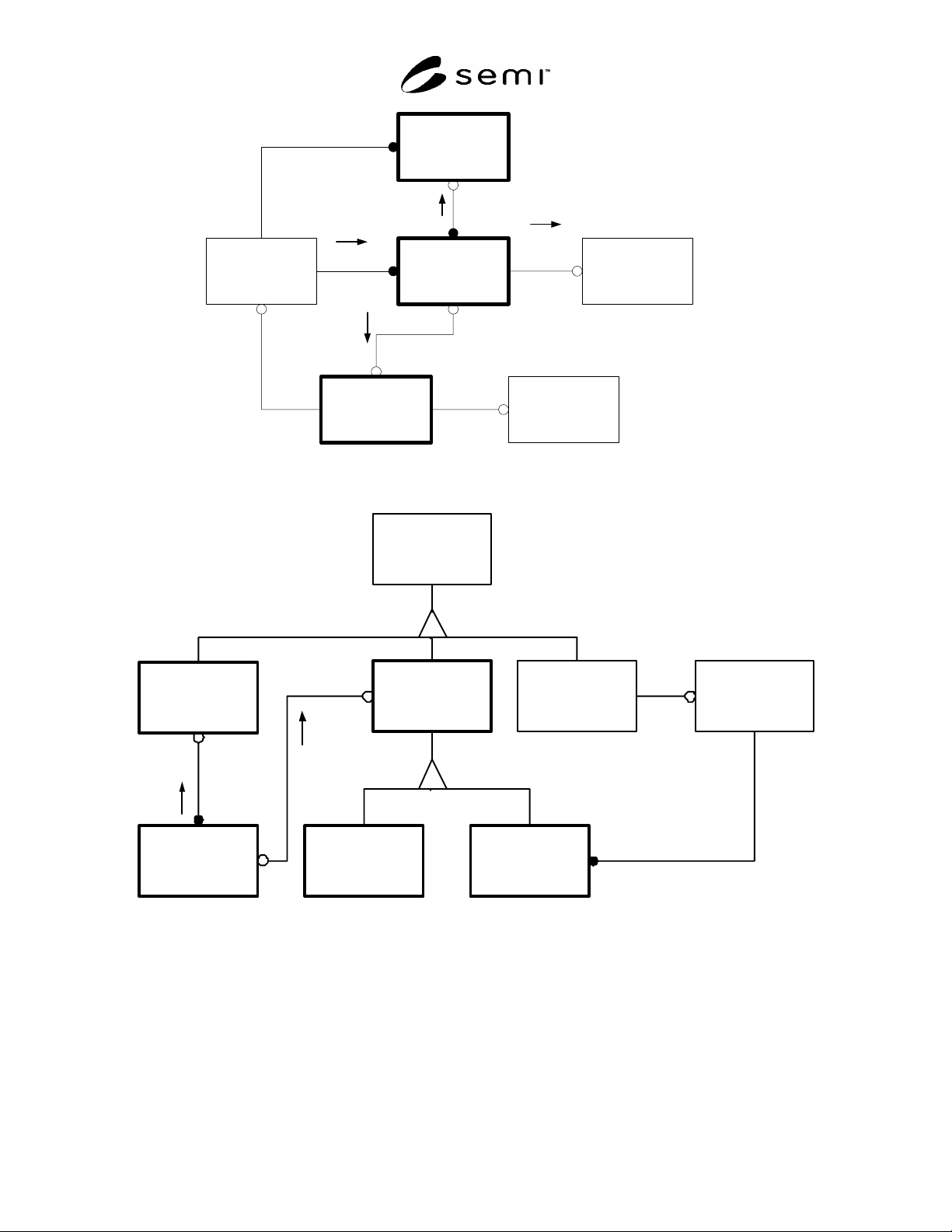
7.2.1 Figure 1 shows the view of Substrate Tracking using the OMT representation. It is assumed that substrates are
available before usage of the services. Substrate carriers may or may not be used to load the substrates to the
equipment. Substrates are loaded into the equipment and travel through substrate locations and batch locations. The
equipment must maintain all information necessary to track substrates in the equipment.
7.3 Substrate Location and Batch Location
7.3.1 A substrate location is a discrete position that can hold a substrate in the equipment. This document will not
define where the substrate location exists. Substrate locations shall be determined by the design of equipment and
the applications. For example, to track the order of process chambers that is applied to a substrate process in a multi-
chamber single wafer process equipment, it is appropriate to designate process chambers for substrate locations. On
the other hand, in batch process equipment, process chambers are designated for batch locations and substrate
locations are not used to track the order of process chambers that is applied to the substrates of a batch. All substrate
locations shall be documented by the equipment supplier.
7.3.2 Batch Location indicates the physical location of a group of substrates (e.g., batch) on the equipment.
Generally in batch process equipment, Batch Location is assigned to a process chamber and changed when a batch is
transferred from one chamber to another. Individual substrate positions in a batch (e.g., slot positions of a batch
container or a process carrier) might be informed with Batch Location. Batch Locations and notation of the
substrate positions in a batch are defined and documented by the equipment supplier.
7.3.3 Figure 2 shows the concept of the substrate location using OMT representation. This figure is provided to
clarify the definition of locations.
SEMI E90-0705 © SEMI 1999, 2005 6
Substrate Lot
belongs
to
Equipment
Processes
1+
Substrate
Location
1+
held
Substrate
Carrier
1+
Batch
Location
held
provides
provides
Figure 1
Overview of Substrate Tracking
Car r ier
Location
Carrier
holds
Substrate
Location
Equipment
Substrate
Location
Car rier
Substrate
Location
Mater ial
Location
Substrate
has
Batch
Location
held
held
Figure 2
Concept of Substrate Location
7.3.4 Material Location is classified into Substrate Location, Batch Location, and Carrier Location. A Carrier
Location may hold a carrier, a Substrate Location may hold a substrate, and a Batch Location may hold a group of
substrates. Typical example of a substrates group is a batch in batch process equipment.
7.3.5 Substrate Location is classified into Equipment Substrate Location and Carrier Substrate Location. Carrier has
Carrier Substrate Locations. A Carrier Substrate Location is the location which can hold a substrate in a carrier. An
Equipment Substrate Location is the location which can hold a substrate on the equipment resource.
7.3.6 Substrate travels on substrate locations and/or batch locations.

SEMI E90-0705 © SEMI 1999, 2005 7
7.4 Identification of Substrate
7.4.1 Substrate shall be identified by substrate ID. There are options for assigning substrate ID to a substrate.
When a carrier is used for loading substrates and the carrier is given its carrier ID, substrate IDs can be obtained
by utilizing the carrier ID and carrier substrate location. This standard will define the requirement for the
substrate ID assignment to the substrates in a carrier.
Substrate ID may be read from the substrate directly by a substrate ID reader. The substrate ID read from the
substrate can be used for the identification.
Substrate ID may be assigned by the user (i.e., host or operator). The substrate ID can be used for the
identification. This standard will define the service for registering substrates.
7.4.2 The recommendation of a particular option for assigning substrate IDs is not within the scope of this standard.
It must be selected based on the equipment design and applications.
8 Substrate Tracking Requirement
8.1 Compliance to Substrate Tracking Service (STS) requires that an implementation also provide certain
capabilities that are defined in other standards.
STS requires compliance to SEMI E39 (OSS) for Substrate objects. The attributes of these objects may be
accessed through use of the GetAttr and SetAttr services.
STS requires an event reporting capability. This capability may be satisfied by the Event Reporting capability in
SEMI E30 (GEM) or by SEMI E53 (ERS).
8.2 STS compliant equipment must implement capabilities defined in the following sections of this document:
§9, Substrate Object Definition,
§10, Substrate Location Object Definition,
§12, Substrate Tracking Services,
§13, Variable Data, if SEMI E53 is not implemented, and
§11, Batch Location Object Definition, is an optional requirement.
8.3 When the equipment provides a substrate reader, the equipment shall implement an equipment constant to allow
the host to choose between using or not using this capability. The equipment constant: “SubstrateReaderEnabled” is
used to choose whether or not the equipment performs the reading of the substrate and use the Substrate Reading
Status state model. The equipment is responsible for creating the substrate objects. The substrate ID assigned to the
substrate object is the same as the one provided by the host in the ContentMap attribute or created by the equipment
using the following rule when the SubstID in the content map is not provided. The default substrate ID shall be
represented in text as the carrierID, a period and the substrate slot location. For example, if CarrierID = “xyz” and
substrate slot location = “5”, then the substrate ID would be = “xyz.05”.
8.4 All state transitions defined for the three state models specified in this document must be reportable via discrete
collection events as defined in ¶6.1, Harel State Model. The three state models are the Substrate Object State Model
(Figure 3), the Substrate Location State Model (Figure 4) and the Batch Location State Model (Figure 5).
8.4.1
The data in Table 15 (Variables Required for Substrate Object State Model Transitions) is required to be
available for the Substrate Object State Model transition collection events. Fixed buffer equipment must support
discrete state transitions for Substrate. Internal buffer equipment must support related state transitions that occur for
a group of Substrate objects. An equipment may support both discrete and related state transitions for Substrate.
8.4.2 The data in Table 16 (Variables Required for Substrate Location Object State Model Transitions) is required
to be available for the Substrate Location Object State Model transition collection events.
8.4.3 The data in Table 17 (Variables Required for Batch Location Object State Model Transitions) is required to be
available for the Batch Location Object State Model transition collection events.