semi合集-English.pdf - 第3226页
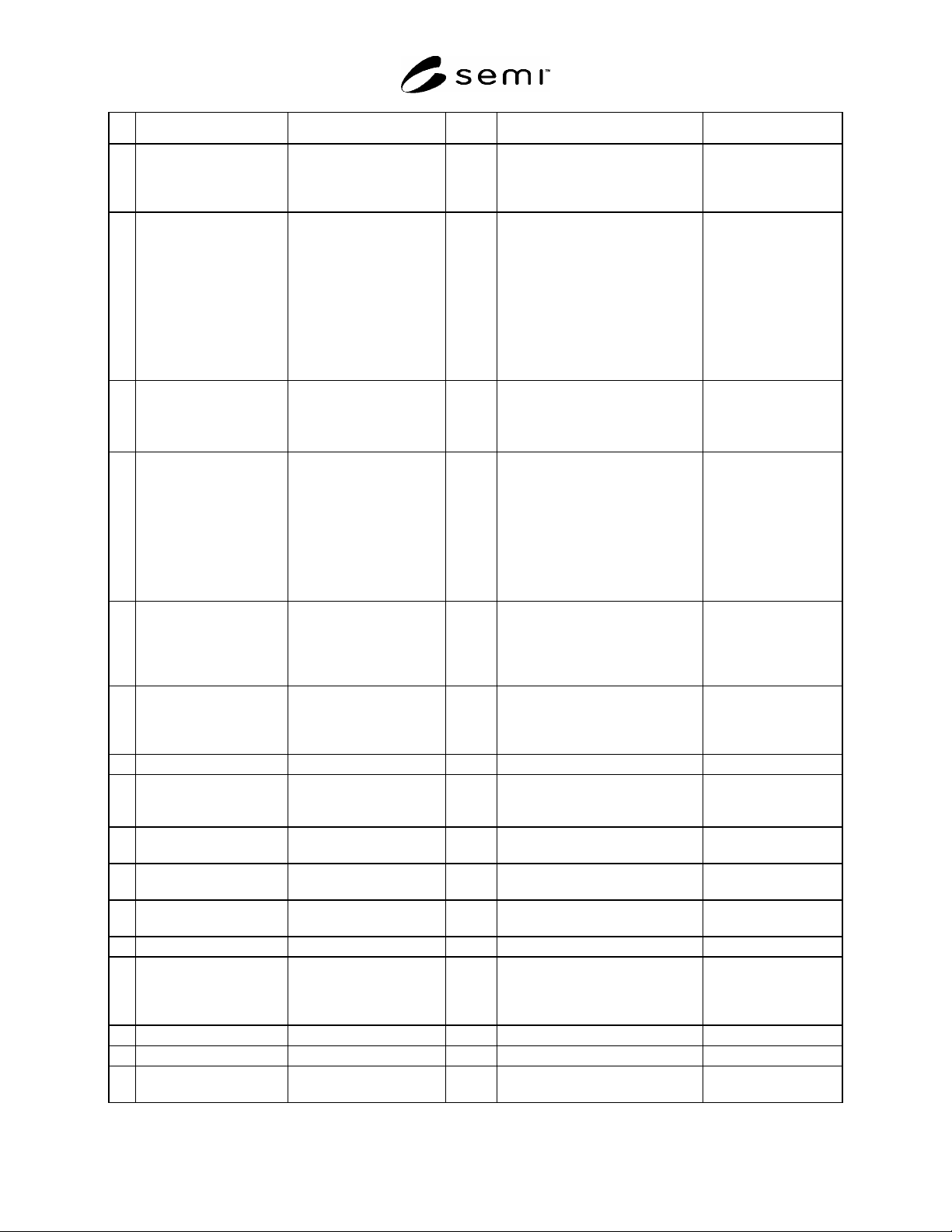
SEMI E127-0705 © SEMI 2003, 2005 27 Comments Control Client (CC) Msg Dir STPO Comments Substrate Handler lowers substrate onto pins. 6a XfrCommand.req This XfrCmdName is requi red and shal l be sent prior to XfrVerify.…
SEMI E127-0705 © SEMI 2003, 2005 26
Comments Control Client (CC) Msg Dir STPO Comments
List of micro commands in the
order in which they must be
executed.
Example: Open door,
raise pins, substrate
confirm presence,
lower pins, close door.
2a This is a required
message but may occur
immediately after the
transfer.
This message must be
sent before any
processing can occur.
Multiple messages might
be sent for the same
substrate.
UpdateSubstrateObject.req
Whenever the CC sends
this request, the IMM
can assume that it is in
conjunction with a
substrate transfer that
either has occurred or is
about to occur.
These are required fields.
Not all integrated
metrology tools can
identify orientation.
SubstID = “xyz”
OrientationIn =
If substrate orientation
can not be detected,
then OrientationOut =
OrientationIn.
2b
UpdateSubstrateObject.rsp Check for existing
Substrate Object for
this ID. If it does not
already exist, then it is
created here with the
attributes as sent.
Otherwise, the
attributes are updated
with the new values.
3 Ready to place. The
number of XfrCommand
transactions that occur
depends on the
implementation.
XfrCommand.req
Indicated which fields are
required. The values for
XfrCmdName depend on
the implementation.
ObjID = “STPO1”,
XfrLink = 1,
XfrCmdName = “Open
door”
Note: this is an
example only.
Opens door.
3b
XfrCommand.rsp Note: if command fails,
transfer should be
aborted.
XfrStatus = successful completion,
no errors.
4
Event.nfy STPOSM T5: READY
TO LOAD -> Assigned
Substrate Handler extends
arm into IMM.
5a XfrCommand.req
ObjID = “STPO1”,
XfrLink = 1,
XfrCmdName = “Raise
pins”
STPO raises pins.
5b
XfrCommand.rsp
XfrStatus = normal completion, no
error.
SEMI E127-0705 © SEMI 2003, 2005 27
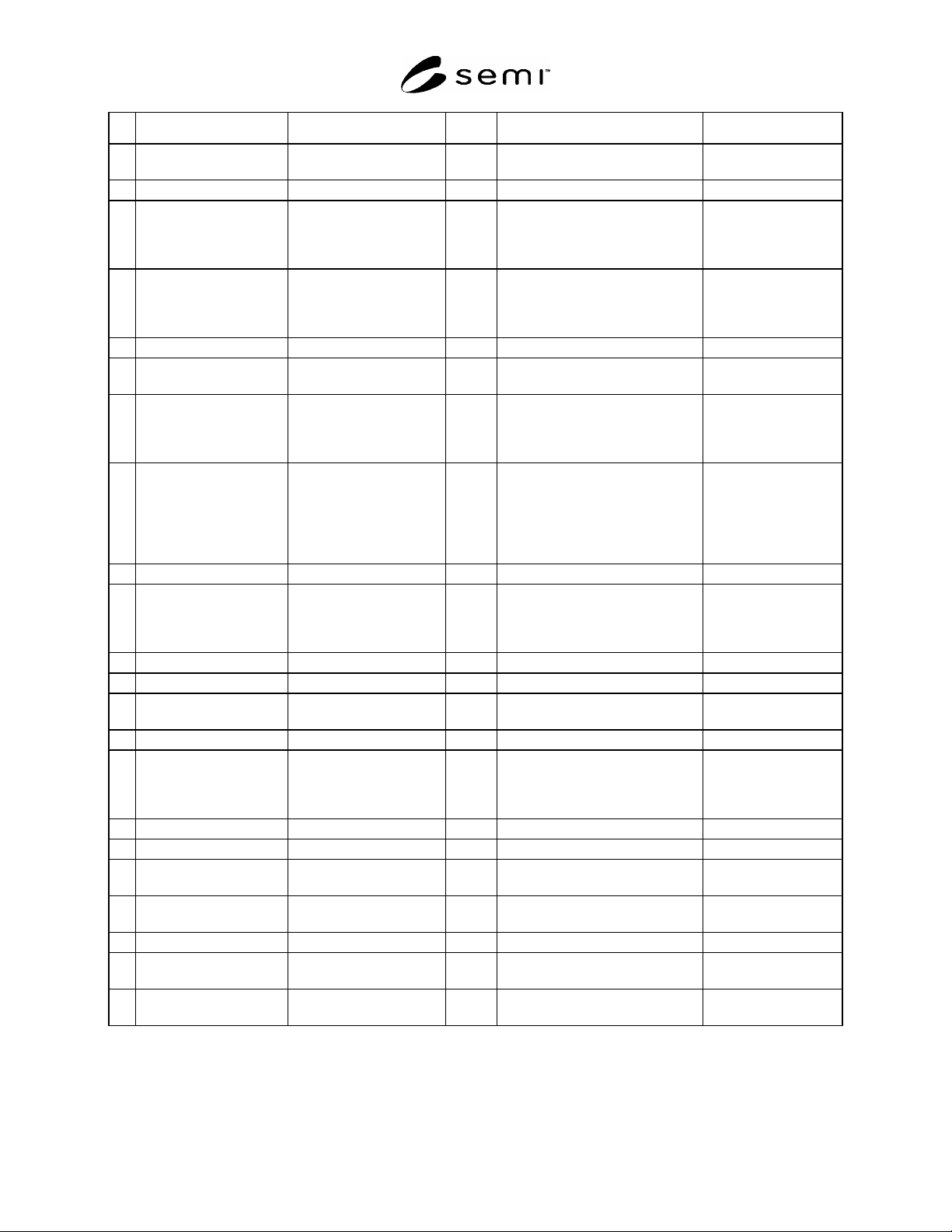
Comments Control Client (CC) Msg Dir STPO Comments
Substrate Handler lowers
substrate onto pins.
6a XfrCommand.req
This XfrCmdName is
required and shall be sent
prior to XfrVerify.
ObjID = “STPO1”,
XfrLink = 1,
XfrCmdName = “Confirm
presence”
If substrate presence is
not confirmed, then the
transfer shall either be
retried or aborted.
STPO verifies that the
substrate is detected.
6b
XfrCommand.rsp
XfrStatus = normal completion, no
error.
Substrate Handler
releases substrate, raises
its arm, retracts arm from
IMM.
Event.nfy The Substrate Location
where substrates are
loaded changes from
UNOCCUPIED to
OCCUPIED (SLOSM
T1).
7a XfrCommand.req
ObjID = “STPO1”,
XfrLink = 1,
XfrCmdName = “Lower
pins”
STPO lowers pins.
7b
XfrCommand.rsp
XfrStatus = normal completion, no
error.
8a XfrCommand.req
ObjID = “STPO1”,
XfrLink = 1,
XfrCmdName = “Close
door”
Door closed.
8b
XfrCommand.rsp
XfrStatus = normal completion, no
error.
9a Confirm transfer is
complete.
XfrVerify.req
XfrLink = 1
9b
XfrVerify.rsp Acknowledge transfer
is complete.
XfrStatus = normal completion, no
errors.
12.11.3 Unload Scenario With No Errors
12.11.3.1 Overview — The Unload Scenario in Table 11 illustrates a typical flow of messages related to unloading
a substrate. Other messages may occur between the Control Client and the IMM objects that are not related.
SEMI E127-0705 © SEMI 2003, 2005 28
12.11.3.2 Assumptions — The following assumptions about the status of the IMM and the STPO at the start of this
scenario:
The IMM has completed its system initialization and is in the IN SERVICE state,
The Control Client has been established and is in control of the substrate handler,
The STPO is in the READY TO UNLOAD state,
The Substrate Location used for unloading is in the OCCUPIED state, and
The ObjID of the STPO object is “STPO1”.
12.11.3.3 Requirements — The following requirements for loading are illustrated in Table 11.
All services listed in Table 8 except for TransferPathCalibration,
Support for micro command “Confirm absence”, and
Support for state model and events associated with state model transitions.
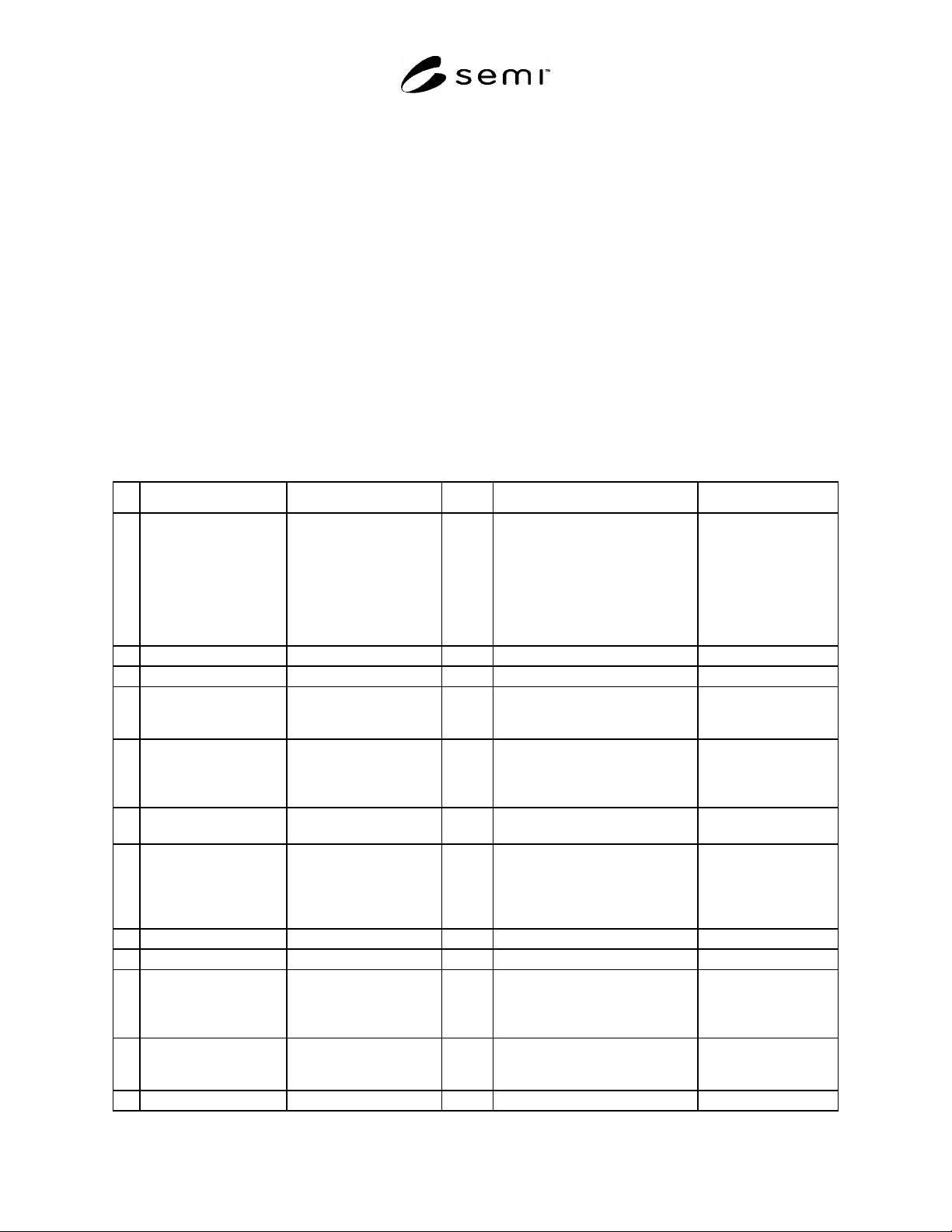
12.11.3.4 Message Flow — Table 11 shows an example of the typical flow of messages used to unload a substrate
from the IMM. Note that any particular STPO can only unload one substrate at a time.
Table 11 Substrate Transfer Path Unload Scenario
Comments Control Client (CC) Msg Dir STPO Comments
1 The CC must obtain this
list in order to unload a
substrate from the IMM.
Typically it is one of the
first thing following the
establishment of the
control client and status
synchronization.
XfrCmdList-Request.req
Required field. XfrType = “Unload”
XfrCmdList-Request.req
List of micro commands shall
always include, at a minimum, the
command “Confirm Absence”.
Required.
List of micro commands in the
order in which they must be
executed.
Example: Open door,
raise pins, confirm
absence, lower pins,
close door.
2a
UpdateSubstrateObject.req Updated information on
substrate.
Check for other required
fields. The CC needs to
accept attribute names
and values defined in this
standard.
SubstID = “xyz”
OrientationOut = xxx
These are required
fields.
2b UpdateSubstrateObject.rsp
3 Ready to pick up. XfrCommand.req
Indicate which fields are
required.
ObjID = “STPO1”,
XfrLink = 1,
XfrCmdName = “Open
door”
Note: this is an example
only.
4
Event.nfy STPOSM T5: READY
TO UNLOAD ->
Assigned
Opens door.