semi合集-English.pdf - 第7575页
SEMI MF1982-1103 © SEMI 2003 6 (phosphorus selective detect or) chrom atogram of the sample wafer. Obtain total area of the blank wafer ( A b ) by summi ng up all the peak areas inte grated from GC- (phosphorus selective…

SEMI MF1982-1103 © SEMI 2003 5
summing up all the peak areas integrated from GC-
(phosphorus selective detector) chromatogram of the
sample wafer. Obtain total area of the blank wafer (A
b
)
by summing up all the peak areas integrated from GC-
(phosphorus selective detector) chromatogram of the
blank wafer. Obtain the area of the standard peak (A
p
)
integrated from GC-(phosphorus selective detector)
chromatogram of the standard sample.
7.1.4.3 Before starting analysis, weigh and get the total
weight of each sample wafer to be tested, and also the
weight of unused part of each wafer. These weights are
used for the calculation of total organic contaminants
and total organophosphorus (TP).
7.2 Method B
7.2.1 Sample Handling and Preparation
7.2.1.1 At all times, avoid manual handling of samples
for analysis to prevent any secondary contamination of
samples. Use stainless steel tweezers for sample
preparation. Use a propane torch to flame stainless
steel tweezers and other accessories that come into
direct contact with the sample before their usage.
7.2.1.2 Thermally desorb any organics from blank
wafers in the quartz chamber unit. Recommended
conditions for preparing blank wafers are to heat them
for 30 min in the quartz chamber kept at 700°C.
Usually, helium is used as purge gas. Heating under air
or oxygen will make a consistent organic-free SiO
2
surface.
7.2.2 Wafer Desorption
7.2.2.1 Enter the analytical information into the quarts
chamber unit, cold trap and GC. Wait for the system to
be stabilized. Place the sample wafer into the quartz
chamber unit and start it. Supply helium gas into the
quartz chamber and heat the chamber from initial
temperature (40°C or lower) to 400°C at a rate of 10 to
30°C/min, and hold the temperature for 15 min. Sweep
out the volatiles contained in the sample to a glass TD
tube where they are adsorbed.
7.2.2.2 Analyze a blank wafer at least daily. Report
blank data with the sample data.
7.2.3 GC Analysis
7.2.3.1 Heat the glass TD tube and sweep out the target
organics adsorbed in the tube to a cold trap where they
are preconcentrated. Two recommended conditions for
heating the glass TD tube are as follows:
• When graphitized carbon is used as adsorbent
material, heat the tube to 400°C and hold at 400°C
for 15 min.
• When poly (2,6-diphenyl-p-phenylene oxide) is
used as adsorbent material, heat the tube to 270°C
and hold for 15 min.
7.2.3.2 Select cold trap parameters, that is, sorbent,
cold temperature, etc., such that all target analytes are
quantitatively retained throughout the tube desorption
process, for example using a cold trap temperature of
–130°C. Refer to ASTM Practice D 6196 for a method
for testing desorption efficiency and analyte recovery.
At the end of this period, heat the cold trap rapidly to
300°C to release the target organics to the GC column
head.
7.2.3.3 Separate volatile organics desorbed from the
glass TD tube by an appropriate column temperature
program. Two recommended temperature programs are
as follows. For high resolution analysis, use
polydimethylsiloxane coated column (60 m by 0.25 mm
by 0.25-µm film thickness), heat the column from 40 to
280°C at a rate of 10°C/min and hold the temperature at
280°C for 16 min. For rapid analysis, use
polydimethylsiloxane coated column (25 m by 0.32 mm
by 0.52-µm film thickness), heat the column from 30 to
265°C at a rate of 12.5°C/min and hold the temperature
at 265°C for 16 min.
7.2.3.4 Use n-Hexadecane, n-C
16
H
34
(C
16
), as a standard
for total organic analysis (see Note 4). Use tris (2–
chloroethyl) phosphate, (ClCH
2
CH
2
O)
3
PO (TCEP) or
tributyl phosphate, (C
4
H
9
O)
3
PO (TBP), as a standard
for organophosphorus analysis (see Section 6.1.1).
These standards are introduced into the GC system
from a precleaned wafer. A two-point calibration
method is recommended for checking the instrument
performance. Recommended standards are two
different concentrations of n-C
16
H
34
(C
16
) for total
organic analysis; and two different concentrations of
tris (2-chloroethyl) phosphate (TCEP) for total
organophosphorus analysis. Recommended frequency
of these measurements is at least once a week.
7.2.4 Quantification
7.2.4.1 Obtain each area below for the calculation of
total organic contaminants. Obtain total area of organic
contaminants of the sample wafer (A
s
) by summing up
all the peak areas integrated from GC-AED, FID, or
MS chromatogram of the sample wafer. Obtain total
area of the blank wafer (A
b
) by summing up all the peak
areas integrated from GC-AED, FID, or MS
chromatogram of the blank wafer. Obtain the area of
the standard peak (A
c
) integrated from GC-AED, FID,
or MS chromatogram of the standard sample.
7.2.4.2 Obtain each area below for the calculation of
total organophosphorus (TP). Obtain total area of
phosphorus compounds of the sample wafer (A
s
) by
summing up all the peak areas integrated from GC-

SEMI MF1982-1103 © SEMI 2003 6
(phosphorus selective detector) chromatogram of the
sample wafer. Obtain total area of the blank wafer (A
b
)
by summing up all the peak areas integrated from GC-
(phosphorus selective detector) chromatogram of the
blank wafer. Obtain the area of the standard peak (A
p
)
integrated from GC-(phosphorus selective detector)
chromatogram of the standard sample.
8 Calculation
8.1 Method A
8.1.1 Calculation of Total Organic Contaminants
8.1.1.1 When AED or FID is used:
16
1
1002.6
10
23
9
×
×
×××
×
×
−
=
−
FSMW
W
A
AA
TC
wc
c
c
bs
(1)
where:
TC = total organic carbon, C atoms/cm
2
,
A
s
= total area integrated from GC-AED or FID
chromatogram of the sample wafer for carbon
compounds,
A
b
= total area integrated from GC-AED or FID
chromatogram of the blank wafer,
A
c
= total area integrated from GC-AED or FID
chromatogram of the standard peak,
W
c
= weight of C
16
standard injected onto the stan-
dard tube, ng,
MW
c
= molecular weight of n-C
16
H
34
= 226.45,
S
w
= total area of the wafer sample, cm
2
,
F =
conversion factor = (W
T
− W
U
)/W
T
,
W
T
= total weight of the wafer, g, and
W
U
= weight of unused part of the wafer, g.
NOTE 5: In this calculation, blank subtraction (−A
b
) is
optional.
8.1.1.2 When MS is used:
FS
W
A
AA
TO
w
c
c
bs
×
××
−
=
1
(2)
where:
TO = total organic contaminants, ng C
16
(n-C
16
H
34
)
equivalent/cm
2
,
A
s
= total area integrated from GC-MS chromato-
gram of the sample wafer,
A
b
= total area integrated from GC-MS chromato-
gram of the blank wafer,
A
c
= total area integrated from GC-MS chroma-
togram of the standard peak,
W
c
= weight of C
16
standard injected onto the stan-
dard tube, ng,
S
w
= total area of the wafer sample, cm
2
,
F =
conversion factor = (W
T
− W
U
)/W
T
,
W
T
= total weight of wafer, g, and
W
U
= weight of unused part of the wafer, g.
See Note 5.
NOTE 6: Recommended mass range to be scanned is 33 to
700 amu.
8.1.2 Calculation of Total Organophosphorus (TP):
FSMW
W
A
AA
TP
wp
p
p
bs
×
×××
×
×
−
=
−
1
1002.6
10
23
9
(3)
where:
TP = total organophosphorus, P atoms/cm
2
,
A
s
= total area integrated from GC-(phosphorus
selective detector) chromatogram of the sample
wafer for phosphorus compounds only,
A
b
= total area integrated from GC-(phosphorus
selective detector) chromatogram of the blan
k
wafer,
A
p
= total area integrated from GC-(phosphorus
selective detector) chromatogram of the
standard peak,
W
p
= weight of phosphorus standard (TCEP or TBP)
injected onto the standard tube, ng,
MW
p
= molecular weight of phosphorus standard
(TCEP = 285.49, or TBP = 266.3),
S
W
= total area of the wafer sample, cm
2
,
F =
conversion factor = (W
T
− W
U
)/W
T,
W
T
= total weight of the wafer, g, and
W
U
= weight of unused part of the wafer, g.
See Note 5.
8.2 Method B
8.2.1 Calculation of Total Organic Contaminants
8.2.1.1 When AED or FID is used:
16
1
1002.6
10
23
9
××××
×
×
−
=
−
wc
c
c
bs
SMW
W
A
AA
TC
(4)
where:
TC = total organic carbon, C atoms/cm
2
,
A
s
= total area integrated from GC-AED or FID,
chromatogram of the sample wafer for carbon
compounds,
A
b
= total area integrated from GC-AED or FID
chromatogram of the blank wafer,
A
c
= total area integrated from GC-AED or FID
chromatogram of the standard peak,
W
c
= weight of C
16
standard injected onto the
standard wafer, ng,
MW
c
= molecular weight of n-C
16
H
34
= 226.45,
S
w
= one side area of the wafer sample, cm
2
.
See Note 5.
8.2.1.2 When MS is used:
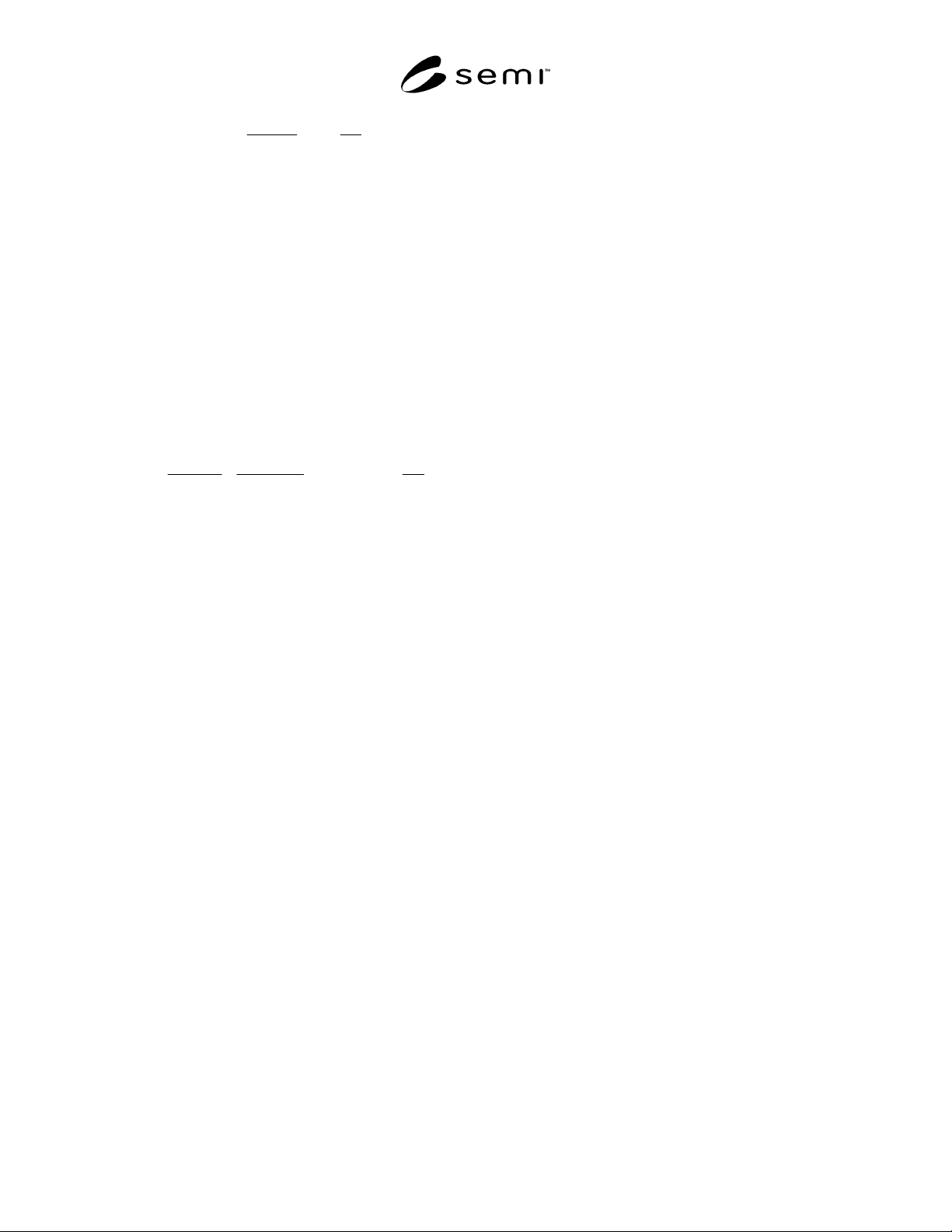
SEMI MF1982-1103 © SEMI 2003 7
w
c
c
bs
S
W
A
AA
TO
1
××
−
= (5)
where:
TO = total organic contaminants, ng C
16
(n-C
16
H
34
)
equivalent/cm
2
,
A
s
= total area integrated from GC-MS chromato-
gram of the sample wafer,
A
b
= total area integrated from GC-MS chromato-
gram of the blank wafer,
A
c
= total area integrated from GC-MS chromato-
gram of the standard peak,
W
c
= weight of C
16
standard injected onto the wafer,
ng,
S
w
= one side area of the wafer sample, cm
2
.
See Notes 5 and 6.
8.2.2 Calculation of Total Organophosphorus (TP):
wp
p
p
bs
SMW
W
A
AA
TP
1
1002.6
10
23
9
×××
×
×
−
=
−
(6)
where:
TP = total organophosphorus, P atoms/cm
2
,
A
s
= total area integrated from GC-(phosphorus
selective detector) chromatogram of the sample
wafer for phosphorus compounds only,
A
b
= total area integrated from GC-(phosphorus
selective detector) chromatogram of the blan
k
wafer,
A
p
= total area integrated from GC-(phosphorus
selective detector) chromatogram of the
standard peak,
W
p
= weight of phosphorus standard (TCEP or TBP)
injected onto the wafer, ng,
MW
p
= molecular weight of phosphorus standard
(TCEP = 285.49 or TBP = 266.3),
S
W
= area of one surface of the wafer sample, cm
2
.
See Note 5.
9 Report
9.1 Report the following information:
9.1.1 Sample identification, sample size, sample
history including how received or packaged if it has
been shipped, side of wafer desorbed (front, back, or
both). (Shipping often can add or remove organic
compounds). If the wafer is a witness wafer, report
how prepared and exposure conditions, location
whether horizontal or vertical, time, flow, etc.
9.1.2 Analysis date, analysis method, wafer desorption
time and temperature, purge gas used.
9.1.3 Manufacturer, types, and models of instruments.
9.1.4 Identification of operator.
9.1.5 Testing laboratory.
9.1.6 Software version of instrument.
9.1.7 Analysis results.
9.1.7.1 Total organic contaminants, C atoms/cm
2
(when AED or FID is used), or ng C
16
(n-C
16
H
34
)
equivalent/cm
2
(when MS is used).
9.1.7.2 Total organophosphorus, P atoms/cm
2
.
9.1.8 Blank wafer data. The blank wafer should be
treated with the same desorption procedure as the
sample wafers.
9.1.9 Calibration data.
10 Precision and Bias
10.1 Precision — The precision of these test methods
can be determined from the reproducibility measure-
ment of standards. The accuracy of these test methods
can be measured from the recoveries of standards.
10.2 Bias — Bias for these test methods has not been
determined.
11 Keywords
11.1 atomic emission detector (AED); flame ionization
detector (FID); flame photometric detector (FPD); gas
chromatography; mass spectrometer (MS);
nitrogen/phosphorus thermionic ionization detector
(NPD); organic contamination; organophosphorus
compounds; phosphorus selective detector; silicon
wafer surfaces; thermal desorption