semi合集-English.pdf - 第1697页
SEMI E40-0705 © SEMI 1995, 2005 9 7.8 Consecutive P rocess Jobs — Consecutive process job s is a situation where multiple process jobs are applied to material while it is in the processing resource. The pro cess jobs req…
SEMI E40-0705 © SEMI 1995, 2005 8
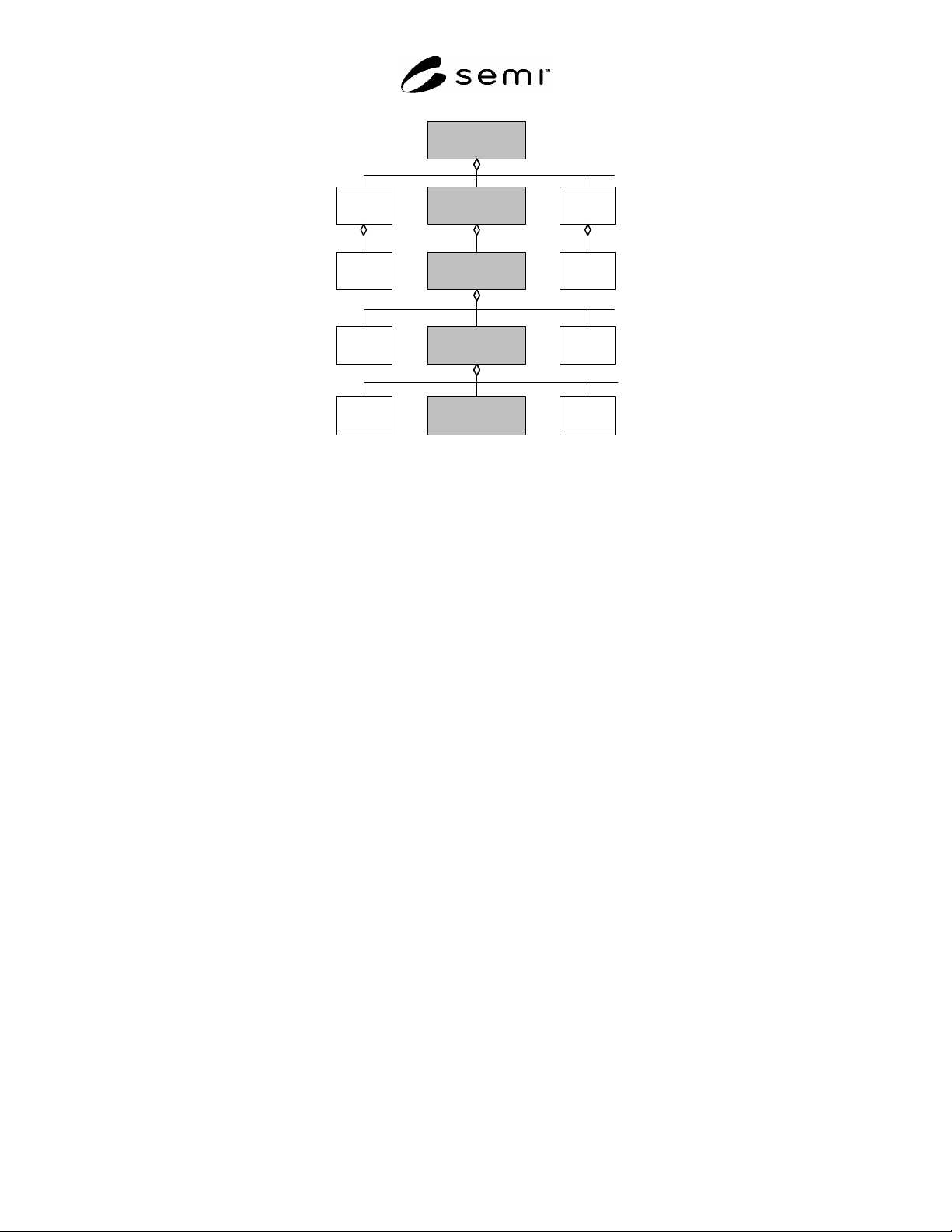
Sequence
Erma
SS
AA
Sequence Step
(SS)
AB
SS
AC
PR
BA
Process Recipe
(PR)
BB
PR
BC
PS
CA
Process Step
(PS)
CB
PS
CC
PP
DA
Process Parameter
(PP)
DB
PP
DC
Figure 1
Cluster Tool Sequence Recipe Hierarchical Relationships
7.6 Processing Material Groups — Many equipment architectures require concurrent processing of groups of
material. A single process job can control a group of material, with certain restrictions. All material in the group
needs to be of the same type and processed identically. The processing of each material should be dependent on the
arrival of the group. That is, the full material group shall be received by the equipment before processing begins and
may not depart until all processing is complete. This ensures that the process job remains a simple logical control
mechanism while maintaining robust control, good coordination with material movement, and effective material
data tracking.
7.6.1 Two common examples of allowable material group processing are:
a) an equipment receiving a cassette of wafers to be processed identically. All the wafers in the group are received
together, in the cassette. The processing of the wafers may or may not be simultaneous but can only proceed
once the cassette has arrived. All wafer processing shall complete before the cassette may be removed. Note
that this may alternatively be specified as a simple process job with the cassette as the material; and
b) a cluster tool batch process module processing wafers together. Wafers are received singly. Processing of the
wafer group in the batch chamber begins when all the wafers specified in the process job have arrived. Wafers
are sent after processing is complete.
7.7 Concurrent Process Jobs — Concurrent process jobs is the situation where multiple jobs are active (not queued)
at the same time. A single process job is not always appropriate for concurrent processing of multiple material. In
such cases, multiple concurrent jobs shall be supported by the processing resource. Support of concurrent process
jobs is not a fundamental requirement.
7.7.1 An example of concurrent wafer processing which may not be achieved with a single process job is a carousel
type cluster tool process module. The processing of a single wafer is not dependent on the arrival of the group. In
this case, concurrent process jobs would be created, one for each wafer, even if they were to be processed
identically. This allows effective control and tracking of the process jobs.
7.7.2 Processing management considers concurrent process jobs to be logically independent of one other. They are
distinguished by unique job identifiers. Concurrent jobs may not apply to the same material because the processing
resource may not have more than one active process job associated with a particular material.
7.7.3 There may be interdependencies between concurrent jobs due to resource availability and equipment hardware
architecture.

SEMI E40-0705 © SEMI 1995, 2005 9
7.8 Consecutive Process Jobs — Consecutive process jobs is a situation where multiple process jobs are applied to
material while it is in the processing resource. The process jobs requested on the same material are maintained in the
order received, and a subsequent job becomes active once the previous one has completed material processing.
7.8.1 A process job normally specifies all the processing to be applied to the material during a single visit to the
processing resource. For example, a process job for a cluster tool would specify all the processing in the multiple
sequential steps in the various process modules of the tool. Certain situations may require application of subsequent
process jobs to material without it leaving the processing resource.
7.8.2 Processing management requires that a subsequent process job on the same material does not interrupt the
previous process job processing. The previous process job terminates immediately once it completes active material
processing, even though the material has not left the processing resource, and it is superceded by the subsequent job.
The material becomes associated with the superceding process job. This allows sequential processing and maintains
a single active association between material and process job.
7.9 Process Job without Material — This standard is primarily intended for the management of material processing.
However, it permits application of a process job to a processing resource which contains no processing material.
This may be used to achieve processing resource conditioning which is not related to a specific material.
7.9.1 The process job has the normal control characteristics, except that it has no dependency on material arrival
and terminates at the end of active processing. Support of process jobs without material is not a fundamental
requirement.
8 Behavior
8.1 This section provides a high-level definition of the communications between the supervisor and the processing
resource needed to achieve material processing. It does not define the message detail, concentrating instead on the
concepts. The message detail is addressed in §10, Messaging Services.
8.2 Process Job Communications
8.2.1 Process Job Control Messaging — The control message flow for normal operation is presented in Figure 1.
The arrows represent significant information exchange.
8.2.1.1 A detailed description of each message used in normal operation follows.
8.2.1.2 PR Job Create — The supervisor requests that the processing resource perform the specified process job.
This request may be acted upon immediately, or queued for later execution if the processing resource is busy or the
order of material arrival unknown. If the processing resource does not support queuing or the queue is full, the
request may be rejected. The request shall supply a process specification in which the supervisor supplies such
information as:
identification of the material to be processed,
the recipe defining the processing, and
whether processing will be started manually (optional, normal operation is automatic).
8.2.1.2.1 Upon receipt of the PR Job Create request and before acknowledging, the processing resource checks the
process specifications to ensure that they are valid (i.e., that the specified parameters (recipe, material, manual start)
are sufficient) and have legal values for the capabilities of the processing resource. Depending on its ability to queue
jobs, it may also check such dynamic information as availability of the processing resource to receive the material or
presence of correct material, etc., to determine whether to accept or reject.
8.2.1.2.2 The processing resource sets the process start attribute if automatic start is requested (normal operation).
8.2.1.3 PR Job Create Acknowledge — The processing resource informs the supervisor that the requested job is
accepted or rejected, and if rejected, supplies error codes and textual reasons for the failure.
8.2.1.4
PR Job Setup — The processing resource reports that the process job is active and setting up for process. It
may have been on the queue or have just been created. If the material is not already present, the processing resource
performs any pre-conditioning required then awaits material arrival. Upon arrival of all the material, it prepares for
processing and automatically initiates processing if the process start attribute is set.

SEMI E40-0705 © SEMI 1995, 2005 10
PROCESSING AGENT
SUPERVISOR
PR JOB CREATE
PR JOB CREATE ACK
PR JOB SETUP
PR JOB PROCESSING
PR JOB PROC COMPLETE
PR JOB COMPLETE
pre-conditioning,
material arrival
processing
the material
material departure,
post-conditioning
queued
Figure 2
Process Job Message Flow
8.2.1.5 PR Job Processing — The processing resource reports that material processing has commenced.
8.2.1.6 PR Job Processing Complete — The processing resource reports that material processing is completed and
that the material is available for removal.
8.2.1.7 PR Job Complete — The processing resource declares the process job to be complete once it has completed
processing the material, the material has departed, and any required processing resource post-conditioning has
completed. This message is also used when a process job ends abnormally. The message provides information on the
success or failure of the processing and, if failed, supplies error codes and textual reasons for the failure.
8.2.2 Process Job Informational Events — There are process job related events which may be of significance to the
service-user. These are designated as “collection events” and shall be available for event reporting. This section
describes those collection events and shows how they fit into the chronology of a process job. These collection
events, as specified by the PRJobEvent service, shall be implemented per definition of one of the following
standards, SEMI E30, SEMI E40, SEMI E53 or similar style events, as required by the service-user. The equipment
may also optionally implement the collection events per the remaining standards. However, the service-user shall
only utilize one of the standards for collection event implementations. The selection mechanism by the service-user
is equipment specific. For example, it may be part of an equipment power-on process or via an equipment specific
equipment constant.
8.2.2.1 If SEMI E30, SEMI E53 or similar style collection events are used for PRJobEvent, the equipment may also
implement equivalent events for the process job milestones as defined by the PRJobAlert service.
8.2.2.2 Collection event messages provide valuable information but are not strictly required to perform material
processing. Therefore, it is expected that some message protocol implementations will provide a method by which
the service-user may disable those events which are not needed in a particular implementation. For SEMI E40 style
events, the activation for disabling the events is user specific. For SEMI E30, SEMI E53 or similar style events, the
activation is as defined in those standards.
8.2.2.3 PR Job Waiting for Material — The processing resource reports that all required pre-conditioning has
completed and that it cannot proceed until the process job material arrives. It is considered to be awaiting material
arrival if it is not aware of activities in progress with the aim of receiving all or part of the material. This event may
be generated only during process job setup. This event requires, at a minimum, PRJobID and Timestamp as its data.
8.2.2.4 PR Job State Change — The processing resource reports that it has changed state. All state transitions in the
state model Figure 4 shall trigger this collection event. These events require, at a minimum, variables PRJobID,
PRJobState, and TimeStamp (SEMI E30).
8.2.3 Process Job Extended Messaging — In this section, the extended messaging of Abort/Stop/Cancel,
Pause/Resume and manual Start Process is added to the normal messaging described above. The only extended
functionality required to be supported in processing management is Abort.
8.2.3.1 A detailed description of each message used in extended operation follows.