semi合集-English.pdf - 第6994页
SEMI S12-0298 © SEMI 1998 4 8.4 Visible residues on equi pment s urfaces, including liquids, powders, flakes, or films, potentiall y indicate the pres ence of hazardous materials. A l l visible indicators of hazardous ma…
SEMI S12-0298 © SEMI 19983
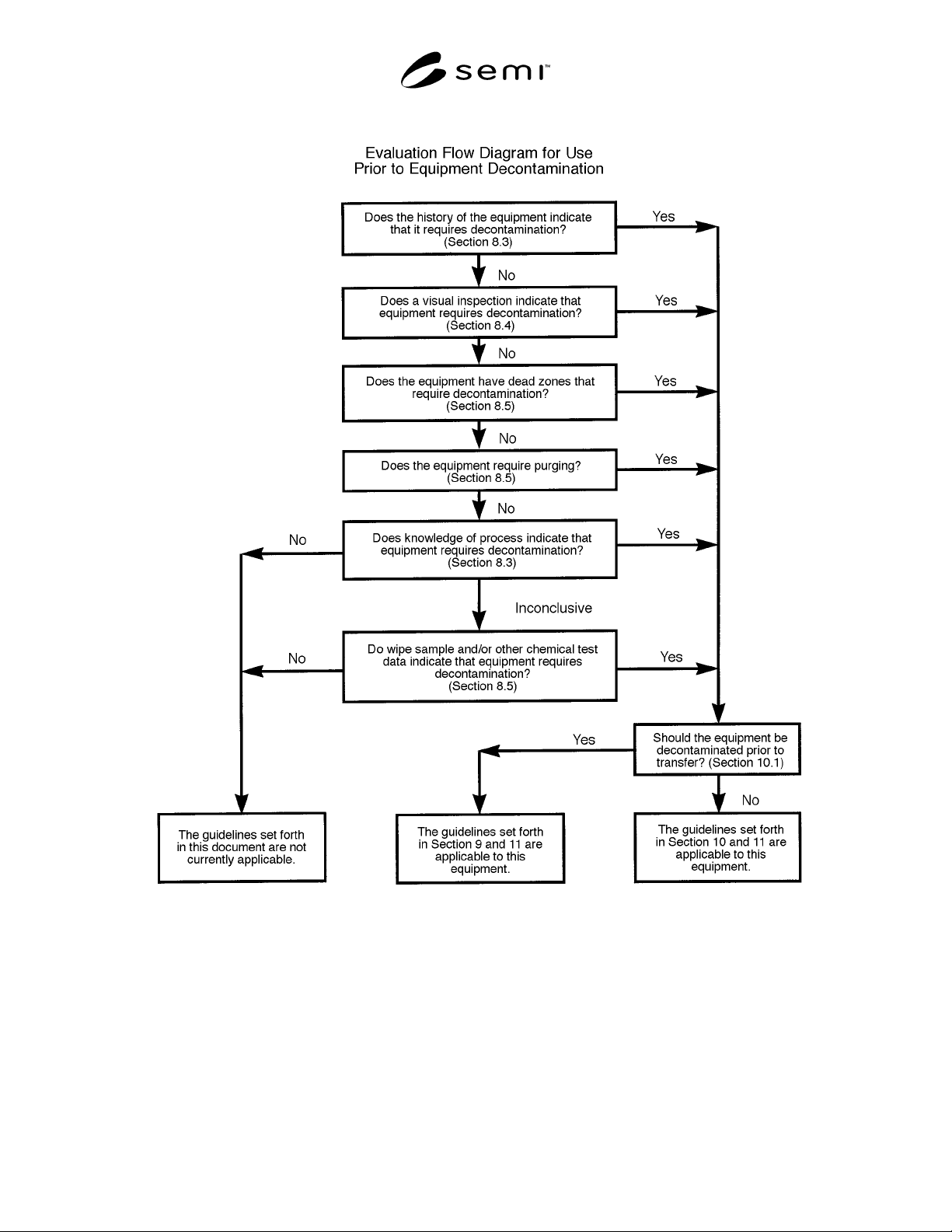
Figure 1
Equipment Assessment Flowchart
8.2 Prior to decontamination, the equipment should be evaluated for abnormalities or non-functionality that may
affect the evaluation and decontamination efforts.
8.3 Decontamination should be performed on all areas of equipment which had potentially contacted hazardous
materials during the life of the equipment, unless the areas are judged non-hazardous by the criteria set forth in this
section. The areas to be decontaminated include external surfaces, internal areas which are accessible without
disassembly, and areas accessible during normal operations. Normally inaccessible areas should be addressed on a
case-by-case basis by the site Environmental, Health, and Safety organization. Normally removable parts may also
require cleaning.

SEMI S12-0298 © SEMI 1998 4
8.4 Visible residues on equipment surfaces, including
liquids, powders, flakes, or films, potentially indicate
the presence of hazardous materials. All visible
indicators of hazardous materials should be assumed to
be hazardous unless otherwise determined and
documented by appropriate test, analysis, or evaluation.
8.5 Wipe sampling and chemical testing verifying the
absence of materials posing physical and health hazards
is recommended for all equipment that has been
exposed to hazardous materials (regardless of the
presence of visible residues).
8.5.1 It is recommended that professional guidance be
used to determine the number, type, and location of
samples that should be taken. General guidance is
available through air sampling strategy methodologies
developed by NIOSH (Occupational Exposures
Sampling Strategies) and through surface sampling
strategies developed by the Nuclear Regulatory
Commission (Manual for Conducting Radiological
Surveys in Support of License Termination).
8.6 If results of activities in Sections 8.2–8.5 indicate
that equipment should be decontaminated prior to
transfer, refer to Section 9 of this document. If results
of activities in Sections 8.2–8.5 indicate that equipment
requires decontamination but will not or cannot be
decontaminated prior to transfer, see Section 10. If
results of activities in Sections 8.2–8.5 indicate that
equipment does not require decontamination prior to
transfer, this guideline is not currently applicable to the
equipment in its present state.
9 General Guidelines for De contamination
9.1 All activity-specific safety and health procedures,
including, but not limited to, hazardous energy control
procedures, must be followed.
9.2 Equipment should be decontaminated before
movement. If movement of the equipment is required
prior to decontamination, precautions should be taken
to remove potential sources of leakage, spillage,
offgassing, or hazardous material emissions. These
precautions may include draining, purging, and then the
use of appropriate barriers, covers, or containment
devices.
9.3 Chemical supply sources should be made safe
prior to disconnecting or removal from the equipment
and capped prior to the beginning of the cleaning
process. Exhaust ventilation to control exposures to,
and the spread of, airborne particulate should remain in
service during equipment decontamination, or alternate
exhaust provisions should be made.
9.4 Where equipment parts are routinely removed
from the equipment for cleaning, such as those used in
ion implanters, photoresist spinners/developers, and
metal deposition chambers, these parts should be
cleaned prior to equipment transfer.
9.5 Where equipment parts are routinely removed and
replaced, such as filters, O-rings, or oil traps, these
parts should be removed and replaced with clean parts
or appropriate blanking device prior to equipment
transfer. If any such parts are removed but not replaced,
this fact should be noted on decontamination
documentation (see Section 12 of this guideline).
9.6 All liquid and gas lines on the equipment should
be appropriately purged, drained, protected against
corrosion and process contamination, and securely
sealed with blanking plugs, caps, or similar devices.
9.7 Thorough decontamination may not be achieved
within component systems or equipment due to
inaccessibility (i.e., “dead zone”) or to physical
characteristics of materials. Equipment with such zones
require additional cycle purges and/or disassembly for
access and proper cleaning. If complete
decontamination cannot be achieved, follow the
guidelines outlined in Section 11.
9.8 While disconnecting equipment or removing
components, gas leak monitoring and pH levels should
be measured.
10 Requirements for Equipm ent Transfers
without Complete Decontamination
10.1 It is recognized that, in some cases, complete
chemical decontamination cannot or will not be desired
or achieved for various reasons (e.g., it will destroy the
equipment (i.e., pumps), there is a need for failure
analysis). This section establishes guidelines for the
transfer of equipment intended for further productive
use which cannot or will not be completely
decontaminated prior to transfer.
10.2 If the contaminated equipment is a sub-
component or subassembly of a larger piece of
equipment which will not be otherwise decontaminated,
the contaminated sub-component or subassembly
should be removed and transferred separately under the
requirements of this section.
10.3 Prior to transfer, the transferor must ensure that
any remaining potential hazards are clearly identified to
persons handling, transporting, and receiving this
equipment, as specified in Section 11. All requirements
in Section 11 must be followed, with the exception of
Section 11.3.2.
10.4 Prior approval must be obtained before transfer
of contaminated equipment. Prior approval should
consist of receipt of all documentation and
certifications specified in Section 11 before shipment

SEMI S12-0298 © SEMI 19985
and a signed authorization from the receiver to accept
the equipment.
10.5 Equipment which is not completely
decontaminated is potentially a hazardous material.
Transfer of this equipment, including transportation,
must be in accordance with all applicable local, state,
national, and international regulations and organization
policies.
11 Documentation and Certif ications
11.1 The documentation recommended by this
guideline is in addition to that required by local, state,
national, and international regulations.
11.2 Documentation and certifications should be
securely attached in a clear, weatherproof bag and
transported with the equipment.
11.3 The following documentation and certifications
should be prepared prior to transfer of equipment:
11.3.1 A history of all hazardous materials used in the
equipment and potential by-products, including
concentrations, if known. At a minimum, list the
hazardous materials used in the tool just prior to
decontamination or transfer.
11.3.2 Documentation of the procedure used for
decontaminating the equipment, including:
11.3.2.1 the cleaning procedures used (including
chemicals used for cleaning),
11.3.2.2 liquid or gas purge procedure used,
11.3.2.3 testing procedure used to determine adequacy
of decontamination,
11.3.2.4 results of tests, and
11.3.2.5 other significant information pertinent to the
decontamination activities, including parts removed for
separate decontamination.
11.3.3 When it is likely that hazardous material
residues remain in or on the equipment, a warning must
accompany the equipment. The warning should identify
suspected hazards, state appropriate personal protective
equipment that should be worn, and precautions that
should be taken when handling the equipment.
11.3.4 Documentation should include the name and
phone number of the responsible/knowledgeable parties
in case of emergency or requirements for additional
information.
11.3.5 A certification by a responsible site
environmental, health, and safety representative that
states the equipment has been prepared for transfer
according to this guideline.
12 Related Documents
12.1 SEMI Documents
SEMI S2 — Safety Guidelines for Semiconductor
Manufacturing Equipment
SEMI S4 — Safety Guidelines for the Segregation/
Separation of Gas Cylinders Contained in Cabinets
SEMI S9 — Electrical Test Methods for Semiconductor
Manufacturing Equipment
12.2 EPA Documents
US EPA (Environmental Protection Agency) — EPA’s
“Guide for Decontaminating Buildings, Structures, and
Equipment at Superfund Sites,” EPA/600/2-85/028,
March 1985, Superintendent of Documents, US
Government Printing Office, Washington, D.C. 20402
US EPA — “Chain of Custody Procedures,” EPA/SW-
846, Superintendent of Documents, US Government
Printing Office, Washington, D.C. 20402
US EPA — Asbestos in Air Sampling, 40 CFR 763,
Subpart E, Appendix A, Federal Register
US EPA — TEST METHODS FOR EVALUATING
SOLID WASTES, EPA SW-846, Superintendent of
Documents, US Government Printing Office,
Washington, D.C. 20402
US EPA — INTEGRATED RISK INFORMATION
SYSTEM, 1994, Superintendent of Documents, US
Government Printing Office, Washington, D.C. 20402
US EPA — EXPOSURE FACTORS HANDBOOK,
1989, Superintendent of Documents, US Government
Printing Office, Washington, D.C. 20402
12.3 OSHA Documents
CFR 1910.1200 — Hazard Communication Standard –
Title 29, Federal Register, US Government Printing
Office, Washington, D.C. 20402
OSHA (Occupational Safety and Health
Administration), U.S. Department of Labor — OSHA
TECHNICAL MANUAL, CPL 2 - 2.20B, Chapter 2,
Sampling for Surface Contamination, February 5, 1990,
Superintendent of Documents, US Government Printing
Office, Washington, D.C. 20402
OSHA (Occupational Safety and Health
Administration), U.S. Department of Labor — OSHA’s
CHEMICAL SAMPLING INFORMATION,
Directorate of Technical Support, Salt Lake City
Technical Center, Superintendent of Documents, US
Government Printing Office, Washington, D.C. 20402