semi合集-English.pdf - 第3420页
SEMI E133-0705 © SEMI 2004, 2005 1 SEMI E133-0705 PROVISIONAL SPECIFICATION FOR AUTOMATED PROCESS CONTROL SYSTEMS INTERFACE This provisional specification was technically approved by the global Information & Control …
SEMI E132.1-0305 © SEMI 2005 46
Table 91 Translation Table for SessionClosed Input Parameters
Argument Name Format XML Element or Attribute XML Name/Type
sessionId Text Element SessionID: xsd:string
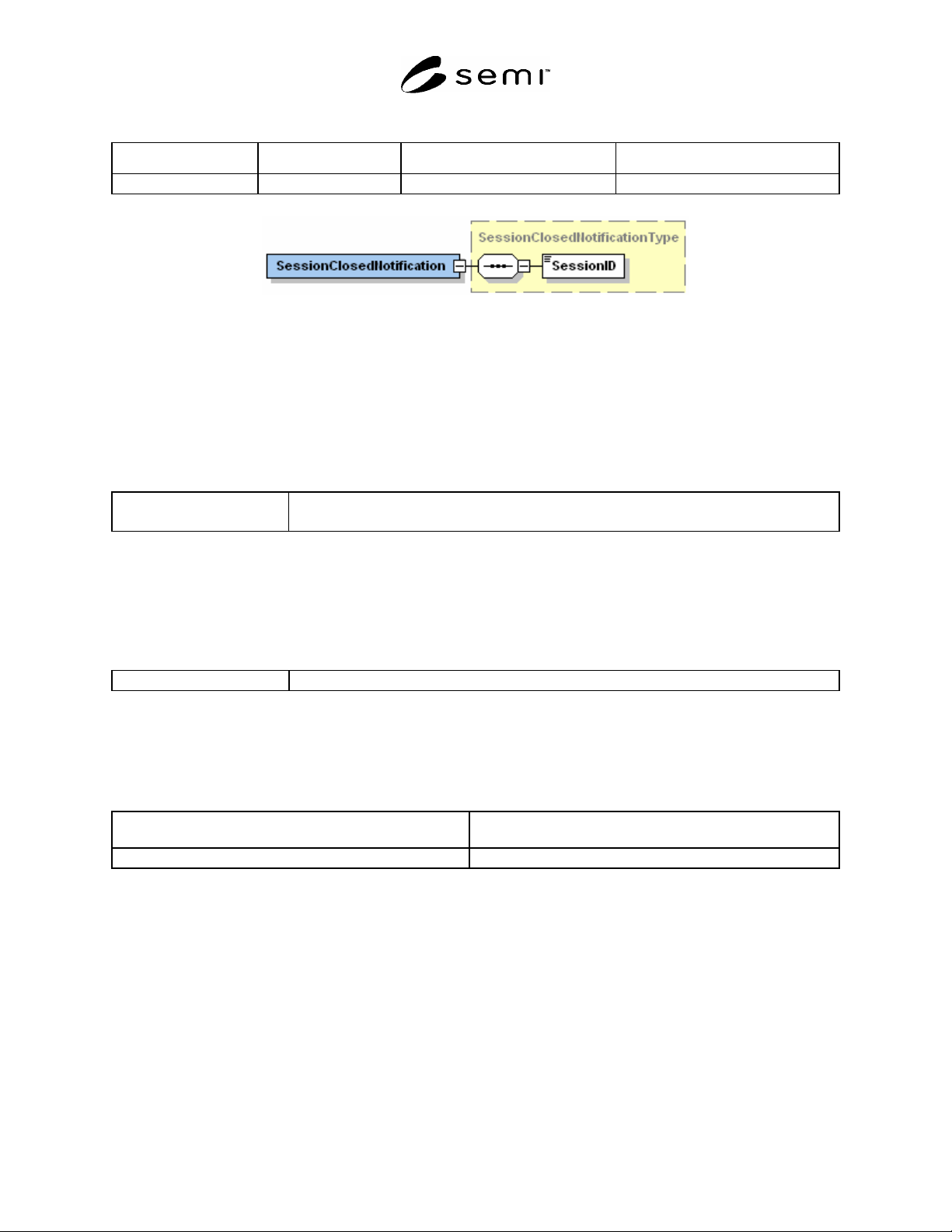
Figure 44
SessionClosedNotification XML Schema Element
8.4.9.2 WSDL Message(s)
8.4.9.2.1 Two messages are defined for this operation corresponding to the SEMI E132 Hash Header, and the
Notification message. See the message definitions for “E132HashHeaderMessage”, and “SessionClosedInMessage”
in E132-1-V0305-SessionClient-PortType.wsdl. Key information is shown for convenience in Table 92.
Table 92 SessionClosed Messages
Message Name
Schema
Element Name
E132HashHeaderMessage auth:E132HashHeader
SessionClosedInMessage auth:SessionClosedNotification
8.4.9.3 WSDL Operation
8.4.9.3.1 See the portType operation definition for “SessionClosed” in E132-1-V0305-SessionClient-
PortType.wsdl. Key information is shown for convenience in Table 93. There is no output message defined for
notifications.
Table 93 SessionClosed PortType Operation
Input Message Name
SessionClosedInMessage
8.4.9.4 WSDL Operation Binding
8.4.9.4.1 See the operation binding for “SessionClosed” in E132-1-V0305-SessionClient-Binding.wsdl. Key
information is shown for convenience in Table 94.
Table 94 SessionClosed Operation Binding
SOAPAction
urn:semi-org:ws.E132-1.V0305.sessClient-
binding:SessionClosed
Input Headers (WSDL Message, Required) E132HashHeaderMessage, required
NOTICE: SEMI makes no warranties or representations as to the suitability of the standards set forth herein for any
particular application. The determination of the suitability of the standard is solely the responsibility of the user.
Users are cautioned to refer to manufacturer's instructions, product labels, product data sheets, and other relevant
literature, respecting any materials or equipment mentioned herein. These standards are subject to change without
notice.
By publication of this standard, Semiconductor Equipment and Materials International (SEMI) takes no position
respecting the validity of any patent rights or copyrights asserted in connection with any items mentioned in this
standard. Users of this standard are expressly advised that determination of any such patent rights or copyrights, and
the risk of infringement of such rights are entirely their own responsibility.
Copyright by SEMI® (Semiconductor Equipment and Materials
International), 3081 Zanker Road, San Jose, CA 95134. Reproduction of
the contents in whole or in part is forbidden without express written
consent of SEMI.

SEMI E133-0705 © SEMI 2004, 2005 1
SEMI E133-0705
PROVISIONAL SPECIFICATION FOR AUTOMATED PROCESS
CONTROL SYSTEMS INTERFACE
This provisional specification was technically approved by the global Information & Control Committee.
This edition was approved for publication by the global Audits and Reviews Subcommittee on April 7, 2005.
It was available at www.semi.org in June 2005 and on CD-ROM in July 2005. Originally published
March 2004; previously published November 2004.
1 Purpose
1.1 In order to more efficiently facilitate the integration of Process Control Systems (PCS) such as run-to-run (R2R)
control, fault detection (FD), fault classification (FC), fault prediction (FP), statistical process control (SPC), etc.
into current and future fabs, there is a need to define interfaces for Process Control Systems that enable them to
interact effectively and share data 1) among themselves and 2) with the other interdependent factory systems
(including equipment data collection). This standard is intended for use by equipment suppliers, semiconductor
manufacturers, equipment subsystem suppliers and control system suppliers who will utilize the PCS standards in
future developed products.
2 Scope
2.1 This standard focuses on defining PCS capabilities, functional groups, and functional group interfaces. The
standard is structured so that new functional groups can be added to the standard through future balloting. The
components in this document include:
Definitions of key terms and concepts pertinent to this domain,
Description of the specification conventions used,
Identification of the major functional groups within the scope of PCS,
Description of the capabilities expected in each functional group (required and optional), and
Definition of interfaces for these functional groups, including:
Data that is available across these interfaces. This includes the interface data descriptions (inputs and
outputs). Future enhancements to this specification will include detailed data structures in the form of
inheritance and aggregation models that are common to all PCS functional groups, as well as specific
models for each,
Services supported and Interface behavior assumed, and
Description of an approach for compliance verification testing.
2.2 The specific format and protocol implementation of these interface specifications, which are technology
specific, will be delineated in supporting “dot” specifications to this standard. As an example a possible format is
XML (which would include data type definitions and metamodel schemas).
2.3 In addition to the information embodied in this standard, the PCS TF will describe a validation process
(prototyping) for the standard to identify and address real implementation issues as early as possible; results of this
work will be included in future versions.
2.4 The provisional status of this specification will be removed when the following enhancements are added:
Interface data structures and services specifications for the R2R, FD, FC, FP and SPC functional groups, and
Additional compliance verification procedures for the R2R, FD, FC, FP and SPC functional groups.
2.5 Note that conformance with this standard as defined in §11 is not enforceable until the complete data structures
have been defined for at least one functional group.

SEMI E133-0705 © SEMI 2004, 2005 2
NOTICE: This standard does not purport to address safety issues, if any, associated with its use. It is the
responsibility of the users of this standard to establish appropriate safety and health practices and determine the
applicability of regulatory or other limitations prior to use.
3 Limitations
3.1 The proposed PCS standards will not focus on:
Low-level communication mechanisms (for example, hardware connection schemes, transport layer software,
etc.) between PCS functional groups,
Methodology for implementing actual equipment or factory level control strategies,
Specifying internal structure or implementation methods of PCS functional groups,
Capabilities of complementary applications (recipe management, data collection, engineering analysis, data
storage, scheduling, change control, …),
The management of information and collaboration between functional groups. This is left to implementation,
Communications within equipment or within factory systems,
Determination of the proper control algorithm, model, or runtime selectable behavior. It is optional for a PCS
function to contain “context matching”,
The creation and management of Process Control System Jobs, or
Defining test procedures required for validating the standard.
4 Referenced Standards and Documents
4.1 SEMI Standards
SEMI E81 — Provisional Specification for CIM Framework Domain Architecture
SEMI E121 — Guide for Style & Usage of XML for Semiconductor Manufacturing Applications
SEMI E125 — Provisional Specification for Equipment Self Description (ESD)
SEMI E134 — Specification for Data Collection Management
4.2 Other Sources
The Unified Modeling Language Reference Manual, James Rumbaugh, Ivar Jacobson, Grady Booch, 1999 / 0-201-
30988-X / Addison Wesley Professional.
The Unified Modeling Language User Guide, Grady Booch, James Rumbaugh, Ivar Jacobson, 1999 / 0-201-57168-4
/ Addison Wesley Professional.
Object-Oriented Modeling and Design, Prentice Hall, Englewood Cliffs, NJ, 1991 by James Rumbaugh, et. al.
Equipment Engineering Capabilities (EEC) Guidelines (Phase 2.0), Version 2.5, International SEMATECH, July
2002.
IEC 61158-5, “Digital data communications for measurement and control – Fieldbus for use in industrial control
systems – Part 5: Application layer service definition,” Final Draft International Standard, 2003.
ISO 8601 — Data elements and interchange formats—Information interchange—Representation of dates and times,
International Organization for Standardization, (December 2000).
NOTICE: Unless otherwise indicated, all documents cited shall be the latest published versions.
5 Terminology
5.1 Abbreviations & Acronyms
5.1.1 XML — eXtensible Markup Language