semi合集-English.pdf - 第7189页
SEMI S24-0705 © SEMI 2005 9 RELATED INFORMATION 1 Observation Check Sheet for the Safety Patrol NOTICE : This related information is not an o fficial part of SEMI S24 and was derived from work of the Task Force. This R e…

SEMI S24-0705 © SEMI 2005 8
9.6 Enrollment in the SSCC
9.6.1 Suppliers planning to conduct installation, startup or service work and facility work should report their work
schedule to the user. Submission of the work schedule to the user automatically enrolls such suppliers to the SSCC if
the SSCC is already set up.
9.6.2 After receiving a work schedule report from a newly enrolling supplier/contractor, the user should report the
name and contact of the new supplier/contractor to the other suppliers and contractors working in the same area.
NOTE 6: EXCEPTION — In case of a resource constraint on site for a supplier/contractor, its attendance in the daily SSCC
meeting should be determined in accordance with the user’s instruction.
9.7 Withdrawal from the SSCC
9.7.1 A supplier or contractor who has completed installation, startup or service work, or facility work should be
automatically withdrawn from the SSCC by reporting the completion of its work to the user.
9.7.2 The user should report the company name and contact of the withdrawn supplier/contractor to the other
suppliers/contractors working in the same area through the SSCC.
9.8 Dissolution of the SSCC
9.8.1 The user should announce the dissolution of the SSCC when the number of suppliers/contractors who are
conducting installation, startup or service work in an area becomes only one.
10 Safety Patrol
10.1 The SSCC should conduct a safety patrol at least once a week. The SSCC should ask the user to participate in
the patrol whenever possible.
10.1.1 Purpose of Safety Patrol — The purpose of the safety patrol is to verify that the workers are complying with
the rules specified by the user or the SSCC, and to eliminate any unsafe condition or behavior through the
interactive job hazard analysis conducted by the suppliers and contractors working at the same area.
10.2 Execution of Safety Patrol
10.2.1 The SSCC should organize the Safety Patrol Team(s), which consist(s) of the members of the SSCC, as the
execution body.
10.2.2 The SSCC should decide the members of the team, the area to be covered, and the frequency of the patrol.
10.2.3 Points to observe during Safety Patrol
10.2.3.1 Warning indications and signs
10.2.3.2 Housekeeping practices around work area
10.2.3.3 Sound execution of the items specified in ¶9.3 and ¶9.4
10.2.3.4 Other points specified by the SSCC
10.2.3.5 Other safety concerns that may affect to multiple suppliers or contractors
10.2.4 If a Safety Patrol Team noticed any unsafe condition or behavior during the patrol, the Team should give an
instruction to the worker(s) concerned on the spot and also report the fact to the SSCC.
10.2.5 The SSCC should take a necessary action or ask the supplier or contractor concerned to take a necessary
action to improve or eliminate the unsafe condition or behavior observed by the Safety Patrol.
SEMI S24-0705 © SEMI 2005 9
RELATED INFORMATION 1
Observation Check Sheet for the Safety Patrol
NOTICE: This related information is not an official part of SEMI S24 and was derived from work of the Task
Force. This Related Information was approved for publication by letter ballot on May 20, 2005.
R1-1 Observation Check Sheet for the Safety Patrol
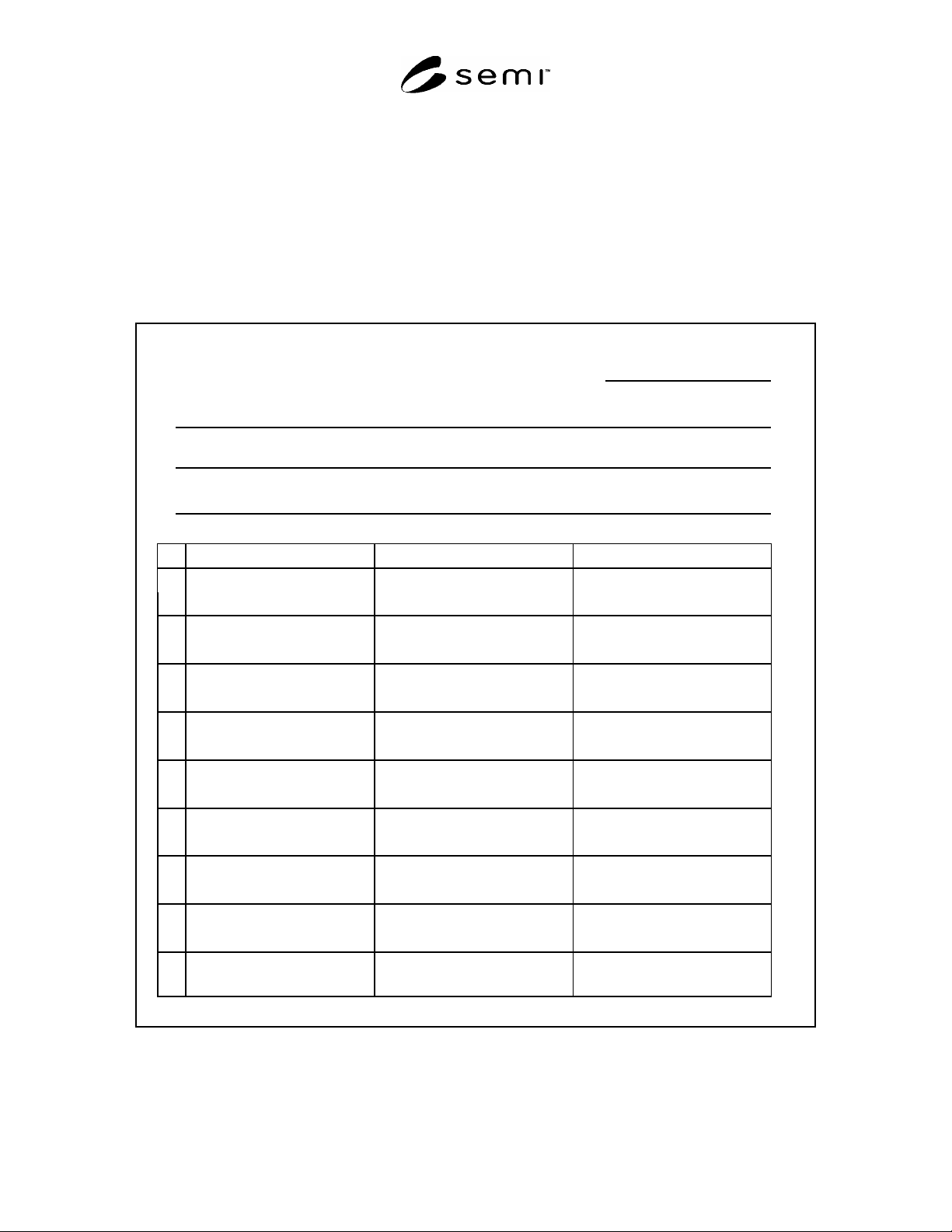
R1-1.1 The following document (Observation Check Sheet) is an example of the check sheet for the safety patrol.
Table R1-1 Observation Check Sheet
Observation Check Sheet
Year/Month/Day
Country
Company Fab. Bldg.
Company
Name Dept. Name
Company
Name Dept. Name
Note: For each category, type or write the items in the blank space under unsafe condition and unsafe behavior
columns.
Items to be observed(*) Unsafe Condition Unsafe Behavior
A
B
C
D
E
F
G
H
I Others
Note: (*) means equipment, facility, smell,
work procedure, alert sign, housekeeping, etc.

SEMI S24-0705 © SEMI 2005 10
NOTICE: SEMI makes no warranties or representations as to the suitability of the standards set forth herein for any
particular application. The determination of the suitability of the standard is solely the responsibility of the user.
Users are cautioned to refer to manufacturer's instructions, product labels, product data sheets, and other relevant
literature, respecting any materials or equipment mentioned herein. These standards are subject to change without
notice.
By publication of this standard, Semiconductor Equipment and Materials International (SEMI) takes no position
respecting the validity of any patent rights or copyrights asserted in connection with any items mentioned in this
standard. Users of this standard are expressly advised that determination of any such patent rights or copyrights, and
the risk of infringement of such rights are entirely their own responsibility.
Copyright by SEMI® (Semiconductor Equipment and Materials
International), 3081 Zanker Road, San Jose, CA 95134. Reproduction of
the contents in whole or in part is forbidden without express written
consent of SEMI.