semi合集-English.pdf - 第231页
SEMI E34-95 © SEM I 1995 3 HEALTH A N D SAFETY DISCLOSURE FORM FOR MASS FLOW DEVICE RET URN 1. Mass Flow Device Infor mation 1.1 Ma nufactur er __________ ________ __________ ________ 1.2 Mo del Nu mber ___ ______ ______…
SEMI E34-95 © SEMI 1995 2
• Attach a copy of the form to the exterior of the
shipping container.
• Enclose another copy inside the package attached
to the protective plastic bag containing the mass
flow device during shipment.
• Retain the original form for your records.
5.2 Purging Prior to Removal — Thoroughly purge
the mass flow device following the applicable purge
procedure. Purge procedures are usually unique to the
equipment and installation. Obtain purging procedures
from your facilities manager, corporate safety
department, and/or the equipment manufacturer. If a
formal purge procedure is available, note on the
disclosure form the purge procedure document number
and source.
5.3 Equipment Removal — WARNING: Do not
remove the mass flow device until it has been properly
purged.
5.3.1 The person removing the mass flow device
should fill out an orange-colored device tag indicating
the process gas(es) or chemicals used, possible exterior
contamination and the purge procedure document
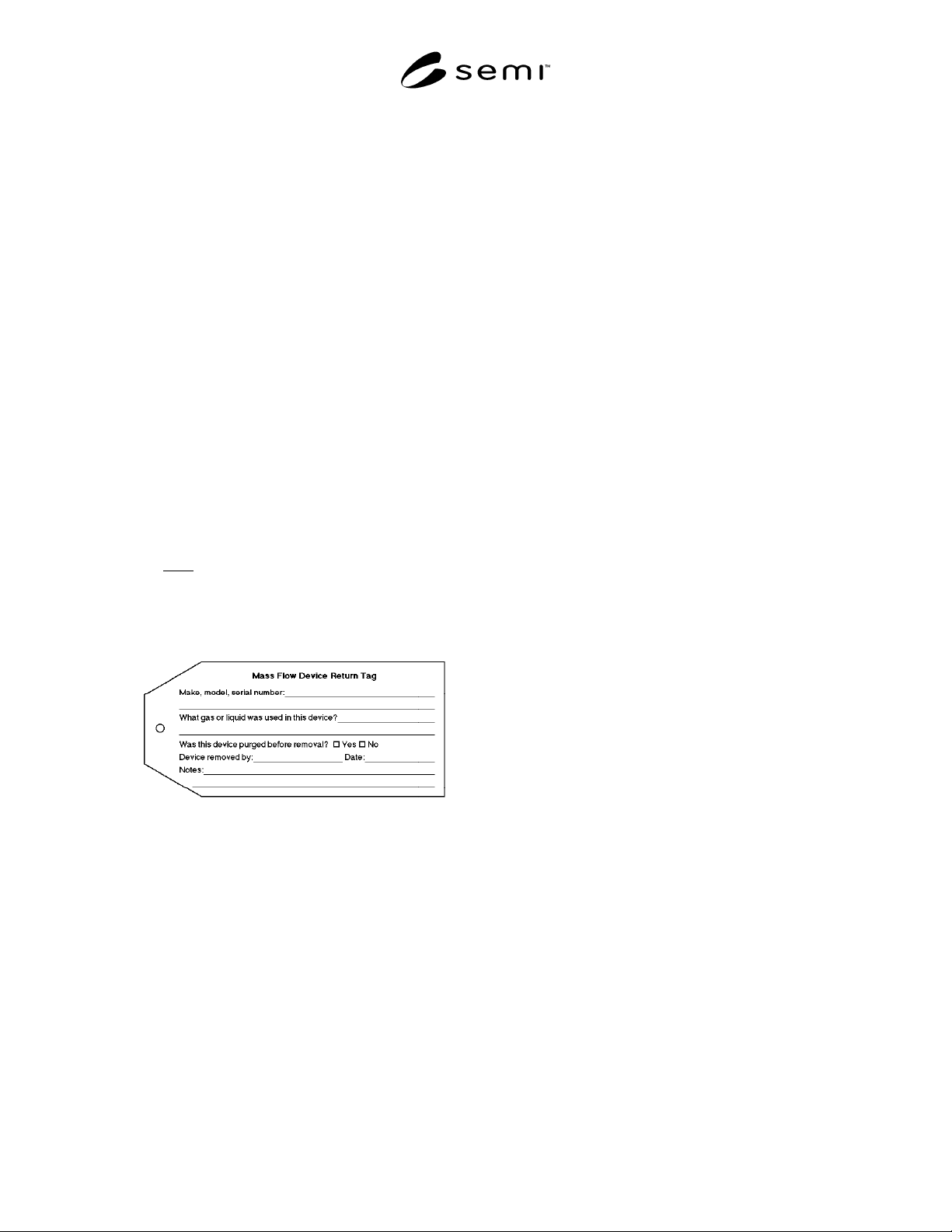
number prior to removal of the device. A sample orange
device tag is shown in Figure 1.
Figure 1
Sample Orange Device Tag
5.3.2 Carefully remove the mass flow device from the
installation or system.
5.3.3 The inlet and outlet ports should be sealed to
prevent any leakage into or out of the mass flow device.
5.3.4 The person removing the mass flow device
should attach the orange tag to the device.
5.4 Equipment Packaging — Package all mass flow
devices for shipment per government regulations
including the following:
5.4.1 Seal the device in a protective container to
prevent the contamination of the shipping package. If
the orange tag is not visible through the container, an
additional tag should be attached to the outside of the
container.
5.4.2 Place the device in a shipping container with
adequate packing to avoid damage to the device and the
protective container during shipment.
5.5 Shipping — Ship the device so that it conforms to
all applicable regulations of the countries of origin,
trans-shipment, and destination governing the shipment
of materials.

SEMI E34-95 © SEMI 19953
HEALTH AND SAFETY DISCLOSURE FORM FOR MASS FLOW DEVICE RETURN
1. Mass Flow Device Information
1.1 Manufacturer ____________________________________
1.2 Model Number ____________________________________
1.3 Serial Number ____________________________________
1.4 Nameplate Gas __________ Nameplate Range ___________
1.5 Details of all substances to which the equipment has been exposed, Interior and Exterior:
Chemical name(s) and attach applicable MSDS(s)
Interior Exterior
a) _________________________________________________ o o
b) _________________________________________________ o o
c) _________________________________________________ o o
d) _________________________________________________ o o
1.6 Was this device purged with an inert gas? o Yes o No
1.7 Any further safety information that you consider to be relevant:
__________________________________________________
__________________________________________________
__________________________________________________
1.8 Document number and source of purge procedure used.
__________________________________________________
__________________________________________________
__________________________________________________
1.9 Person to contact regarding the above information:
Name:_______________________________________________
Company:____________________________________________
Title:________________________________________________
Phone Number: ( _______)__(______)__(__________)_(_____)
Country Code Area Code Number Extension
Address:_____________________________________________
__________________________________________________
__________________________________________________
Signature of Sender:____________________________________
1.10 Carrier to be used
__________________________________________________
Expected Delivery date
__________________________________________________
NOTICE: These standards do not purport to address safety issues, if any, associated with their use. It is the
responsibility of the user of these standards to establish appropriate safety and health practices and determine the
applicability of regulatory limitations prior to use. SEMI makes no warranties or representations as to the suitability
of the standards set forth herein for any particular application. The determination of the suitability of the standard is
solely the responsibility of the user. Users are cautioned to refer to manufacturer’s instructions, product labels,
product data sheets, and other relevant literature respecting any materials mentioned herein. These standards are
subject to change without notice.
The user’s attention is called to the possibility that compliance with this standard may require use of copyrighted
material or of an invention covered by patent rights. By publication of this standard, SEMI takes no position
respecting the validity of any patent rights or copyrights asserted in connection with any item mentioned in this
standard. Users of this standard are expressly advised that determination of any such patent rights or copyrights, and
the risk of infringement of such rights, are entirely their own responsibility.
Copyright by SEMI® (Semiconductor Equipment and Materials
International), 3081 Zanker Road, San Jose, CA 95134. Reproduction o
f
the contents in whole or in part is forbidden without express written
consent of SEMI.

SEMI E35-0305 © SEMI 1995, 2005 1
SEMI E35-0305
GUIDE TO CALCULATE COST OF OWNERSHIP (COO) METRICS FOR
SEMICONDUCTOR MANUFACTURING EQUIPMENT
This guide was technically approved by the Global Metrics Committee and is the direct responsibility of the
North American Metrics Committee. Current edition approved by the North American Regional Standards
Committee on December 10, 2004. Initially available at www.semi.org February 2005; to be published
March 2005. Originally published in 1995; previously published March 2004.
NOTICE: This document was completely rewritten in 2005.
1 Purpose
1.1 The purpose of this guide is to provide standard metrics for evaluating unit production cost effectiveness of
manufacturing equipment in the semiconductor industry.
1.2 This guide establishes a well-defined procedure to facilitate an understanding of equipment-related costs by
providing definitions, classifications, algorithms, methods, and default values necessary to build a full or constrained
cost of ownership (COO) calculator.
NOTE 1: Related Information 1 provides a graphical representation of calculating COO to expand upon the guide text.
2 Scope
2.1 This guide is applicable to any type of equipment for processing semiconductor units, which may be wafers,
devices, flat panels or other material. Some terms are specialized to integrated circuit wafer and device production.
2.2 Effective use of the metric to build a COO model requires identification of constraints and data values. Where
possible, use direct values for inputs rather than deriving them from secondary models or using example values.
NOTE 2: Related Information 2 provides some example data.
2.3 Full calculation of COO often requires data held proprietary and is coupled to the overall factory yield and the
related cost of yield loss. It is envisioned that this guide will be used for internal factory and equipment
optimization, investment evaluation, and equipment design improvements.
NOTICE: This standard does not purport to address safety issues, if any, associated with its use. It is the
responsibility of the users of this standard to establish appropriate safety and health practices and determine the
applicability of regulatory or other limitations prior to use.
3 Limitations
3.1 Certain cost factors are more difficult than others to accurately determine. Figure 1 depicts the relationship of
some of the COO model input factors to ability to collect and validate them. The accuracy of a COO calculation
may be prone to a variety of errors or omissions.
3.2 Line balance considerations are not included in the COO calculation. Line balance considerations are not
included because it is difficult, in an individual COO model, to show the impact of equipment being modeled on the
complete manufacturing facility. A factory-level cost model should be used for this purpose.
3.3 A COO calculation may have more detail than presented explicitly in this guide. The structure of the guide,
however, allows for these situations.