semi合集-English.pdf - 第1063页
SEMI E5-1104 © SEMI 1982, 2004 5 0 1 6 3 6 4 1 2 7 1 6 3 6 4 2 5 5 A v a i l a b l e f o r u s e r d e f i n i t i o n R e s e r v e d f o r t h i s s t a n d a r d Figure 1 Stream and Functi on Allocation 7.3.2 The rese…

SEMI E5-1104 © SEMI 1982, 2004 4
message at its destination and generates a reply when
requested.
6.3 Blocking Requirements — The message transfer
protocol must support the following SECS-II message
blocking requirements.
6.3.1 Single-Block Messages — SECS-II requires that
certain messages be sent in a single block or single
packet by the message transfer protocol. Those
messages defined in this standard as single-block
SECS-II messages must be sent in a single-block or
packet. The method used by the application software to
tell the message transfer protocol that a particular
message must be sent as a single block is not covered as
part of this standard. For compatibility with SECS-I,
the maximum length allowed for a single-block SECS-
II message is 244 bytes. The minimum requirement for
the message transfer protocol is to be able to send
single-block SECS-II messages.
6.3.2 Multi-Block Messages — For compatibility with
SECS-I, SECS-II messages that are longer than 244
bytes are referred to as multi-block messages. Also,
certain SECS-II messages are allowed to be multi-block
messages even if they otherwise meet the single-block
length requirements. Certain older implementations
may impose application-specific requirements on block
sizes for certain incoming messages. Beginning with
the 1988 revision of the standard, new applications may
not impose application-specific requirements on
incoming block sizes. Applications implemented
before 1988 may impose such requirements.
6.4 Message Header — The message transfer protocol
must provide the following information, called the
message header, with every message. Only the content
of the message header is defined by this standard. The
exact format of the message header passed between the
application and the message transfer protocol is not
covered as part of this standard.
NOTE 1: In SECS-I, this information is contained in the 10-
byte header of each block of a message.
6.4.1 Device ID — The message transfer protocol must
be capable of identifying the device ID (0–32767)
which indicates the source or destination of a message.
6.4.2 Stream and Function — The message transfer
protocol must be capable of identifying to SECS-II a
minimum15-bit message identification code. In SECS-
II, messages are identified by a stream code (0–127, 7
bits) and a function code (0–255, 8 bits). Each
combination of stream and function represents a distinct
message identification.
6.4.3 Reply Requested — The message transfer
protocol must be capable of identifying whether a reply
is requested to a primary message.
6.5 Transaction Timeout — It is presumed that the
message transfer protocol will notify SECS-II in the
event of failure to receive an expected reply message
within a specified transaction timeout period.
NOTE 2: In SECS-I, a transaction timeout occurs if either the
reply timeout (T3) is exceeded before the first block of a reply
message is received or if the inter-block timeout (T4) is
exceeded before an expected block of a multi-block message
is received.
6.6 Multiple Open Transactions — This standard
allows, but does not require, the support of more than
one concurrent open transaction.
7 Streams and Functions
7.1 Streams — A stream is a category of messages
intended to support similar or related activities.
7.2 Functions — A function is a specific message for a
specific activity within a stream. All the functions used
in SECS-II will follow a numbering convention
corresponding to primary and secondary message pairs.
All primary messages will be given an odd-numbered
function code. The reply message function code is
determined by adding one to the primary message
function code. The even-numbered function following
a primary message which requests no reply is reserved
and is not to be used. Function code 0 is reserved in all
streams for aborting transactions as described in
Section 10.4.
7.3 Stream and Function Allocation — Some of the
stream and function code combinations are reserved for
this standard, while others are available for user
definition. The stream and function codes reserved for
this standard are as follows:
In Stream 0, Functions 0–255.
In Streams 1–63, Functions 0–63.
In Streams 64–127, Function 0.
The stream and function codes available for user
definition are as follows:
In Streams 1–63, Functions 64–255.
In Streams 64–127, Functions 1–255.
7.3.1 The stream and function code assignment can
also be represented by the diagram shown in Figure 1.
SEMI E5-1104 © SEMI 1982, 2004 5
0
1 6 3 6 4 1 27
1
63
64
25 5
Ava ilable
for use r
definition
Re se rve d
for t his
st a nda rd
Figure 1
Stream and Function Allocation
7.3.2 The reserved codes assigned by this standard are
listed in Section 10. It is recognized that there will be
user needs beyond the specific definitions given in this
standard. In these situations, the streams and functions
reserved for user definition should be used subject to
the guidelines for minimum compliance outlined in
Section 8.
8 Transaction and Conversation Protocols
8.1 Intent — For an implementation to be in
compliance with SECS-II, it must meet the minimum
transaction requirements outlined in this section. The
conversation protocols serve to further define the use
and interaction between transactions.
8.2 Transaction Definition — A transaction forms the
basis for all information exchanges in SECS-II. A
transaction consists of either a primary message for
which no reply is requested, or a primary message
which requests a reply together with its corresponding
secondary message. Secondary messages cannot
request a reply.
8.3 Transaction Level Requirements — The following
are the requirements to comply with the SECS-II
protocol at the transaction level:
1. Respond to S1F1 with S1F2 as described in
Section 10.5.
2. For any received message that cannot be processed
by the equipment, send the appropriate error
message on Stream 9. As described in Section
10.13, S9F1, F3, F5, F7, or F11 are possible.
3. Format any other supported messages according to
Section 10.
4. Upon detection of a transaction timeout at the
equipment, send S9F9 to the host.
5. Upon receipt of function 0 as a reply to a primary
message, terminate the related transaction. No
error message should be sent to the host by the
equipment.
8.4 Conversation Protocols — A conversation is a
series of one or more related transactions used to
complete a specific task. A conversation should
include all transactions necessary to accomplish the
task and leave both the originator and interpreter free of
resource commitments at its conclusion.
8.4.1 Conversation Timeout — A conversation timeout
is used to indicate that a conversation has not
completed properly. A conversation timeout is
application-dependent, and the methods used for
detecting conversation timeouts are not covered as part
of this standard. A conversation timeout will terminate
further action on the conversation, and will allow for
the clearing of any committed resources. Upon
detection of a conversation timeout at the equipment,
S9F13 should be sent to the host.
8.4.2 Types of Conversations — There are seven types
of conversations which characterize all information
exchanges in SECS-II:
1. A primary message with no reply is the simplest
conversation. This message must be a single-block
SECS-II message. The originator must assume that
the interpreter responds to the message. This
conversation is used where the originator can do
nothing if the message is rejected.
2. If the interpreter has data that the originator wants,
the data are requested with a primary message and
the data returned to the originator as a reply
message. It is assumed that the originator
requesting the data is prepared to receive the
amount of data returned. This is the request/data
conversation.
3. If the originator wishes to send data in a single-
block SECS-II message to the interpreter, then the
originator sends the data and expects an
acknowledgment from the interpreter. This is the
send/acknowledge conversation.
4. If the originator has a multi-block SECS-II
message to send for a particular exchange, then the
originator must receive permission from the
interpreter prior to sending the data. The first
transaction requests permission to send, and the
interpreter either grants or denies permission. If
SEMI E5-1104 © SEMI 1982, 2004 6
permission is granted, the originator sends the data
and the interpreter replies appropriately. This is
the inquire/grant/send/acknowledge conversation.
Between the inquire and the send, the interpreter
may commit some resources in preparation for the
data. Consequently, a conversation timeout may be
set by the interpreter at a time dependent upon the
application, at which time the interpreter will free
its resources and send an S9,F13 error message to
the originator. Note that under the definition of
S9,F13 in this standard, only the equipment should
generate an error message to the host under these
conditions.
5. There is a conversation related to the transfer of
unformatted data sets between equipment and host.
This conversation is described in detail in Stream
13. (See Section 10.17)
6. There is a conversation related to the handling of
material between equipment. This conversation is
described in detail in Stream 4. (See Section 10.8)
7. The originator may request information from the
interpreter which requires some time to obtain
(e.g., operator input is required). The first
transaction requests the information and the
interpreter responds in one of three ways: 1) the
information is returned, 2) the interpreter indicates
that the information cannot or will not be obtained,
or 3) the interpreter indicates that the information
will be obtained and returned in a subsequent
transaction, as specified for this conversation. For
case number 3, the interpreter will initiate the
subsequent transaction when the information is
available.
8.4.2.1 Case 3 is the request/acknowledge/send/
acknowledge transaction.
8.4.2.2 The originator of the request/acknowledge/
send/acknowledge conversation may commit some
resources in anticipation of the send/acknowledge
transaction. Consequently, a conversation timeout may
be set by the originator at a time dependent on the
application. On timeout, the originator will free its
resources and restart the conversation with the
‘request’, or send an S9,F13 error message. Note that
under the definition of S9,F13 in this standard, only the
equipment should generate an error message to the host
under these conditions.
8.4.3 The key words, request, data, send, acknowledge,
inquire, and grant are used in the function names as an
aid to understanding the relationship between the
messages and the conversation. Single message trans-
actions do not use these words.
9 Data Structures
9.1 Intent — All information transmitted according to
this standard will be formatted using two data struc-
tures, items and lists. These data structures define the
logical divisions of the message, as distinct from the
physical divisions of the message transfer protocol.
They are intended to provide a self-describing internal
structure to messages passed between equipment and
host.
9.2 Item — An item is an information packet which
has a length and format defined by the first 2, 3, or 4
bytes of the item. These first bytes are called the item
header (IH). The item header consists of the format
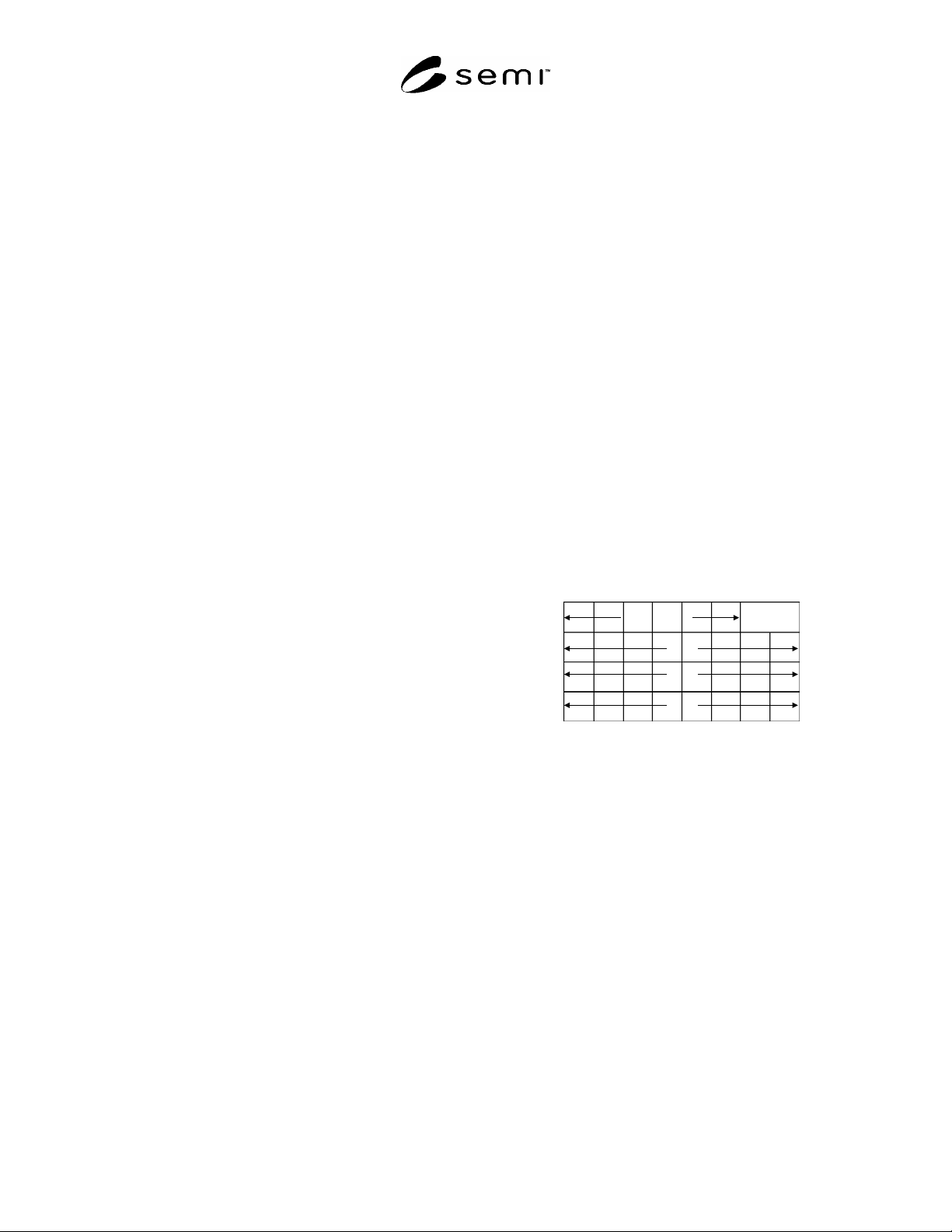
byte and the length byte(s) as shown in Figure 2. Bits
one and two of the item header tell how many of the
following bytes refer to the length of the item. This
feature allows for long items without requiring the byte
overhead for shorter items. The item length refers to
the number of bytes following the item header, called
the item body (IB), which is the actual data of the item.
The item length refers only to the item body not
including the item header, so the actual number of bytes
in the message for one item is the item length plus 2, 3,
or 4 bytes for the item header. All bytes in the item
body are in the format specified in the format byte.
No. of
len
g
th b
y
tes
item format code
len
g
th
len
g
th
length
MSB
MSB
LSB
LSB
8 7 6 5 4 3 2 1 bit
MS b
y
te
LS b
y
te
1
4
3
2
{
Format
b
y
te
Length
b
y
tes
No. of Length bytes
0 = Illegal, data format error
1 = One binary length byte (max = 255)
2 = Two binary length bytes (max = 64k)
3 = Three binary length bytes (max = 7.99M)
Length refers to the number of bytes except in a list format where it
refers to the number of elements
(
items or lists
)
in the list.
Figure 2
Item and List Header
9.2.1 A zero-length in the format byte is illegal and
produces an error. A zero-length in the item length
bytes has a special meaning as defined in the detailed
message definitions.
9.2.2 Bits 3 through 8 of the format byte of the item
header define the format of the data which follows. Of
the 64 possible formats, 16 are defined as shown in
Table 1. Format code 0 is called a list and is defined in
Section 9.3. Format code 22 (octal) is called a localized
string and is defined in Section 9.4. The remaining 14
item formats define unspecified binary, code 10 (octal);
Boolean, code 11 (octal); ASCII character strings, code
20 (octal); JIS-8 character strings, code 21 (octal)