semi合集-English.pdf - 第1515页
SEMI E32-0997 © SEMI 1994 , 1997 10 manner to other types of recipes on the equipment (e.g ., process recipes). 4.1.6 T ransfer Syst em Controller as T ransfer Agent — A transfer agent is an entity to which transfer-rela…

SEMI E32-0997 © SEMI 1994, 19979
commit follows any setup activities and coincides with
entry to the HANDOFF state. For example, an AGV
may not be allowed to commit until it has moved to the
point of transfer. The point at which an equipment may
commit is equipment-specific. There is a separate
commit for each atomic transfer in a job.
Deallocate — The release of allocated resources. In this
document, it refers to the equipment's release of the
resources reserved for a transfer job or an atomic
transfer.
Port Resources — Equipment-controlled mechanisms
that serve a port. An example of a port resource is a
cassette indexer that changes to elevation of the
material location. A port resource is available only to
the atomic transfer that has allocated that port.
Primary Transfer Partner — The partner that controls
the micro level transfer and that would receive the
optional host command to initiate the transfer. The
primary transfer partner shall always be an active
partner for the transfer. For an interactive transfer, the
nature of the transfer partners may determine which
should be primary. Otherwise, the host may choose.
Restore — An operation associated with a transfer job
which causes the resources used by that job to be
returned to the preferred idle conditions (e.g., port
access door closed). When a transfer job involves
multiple ports on an equipment, restore activities are
done on a port-by-port basis as each port is no longer
needed by the transfer job.
Secondary Transfer Partner — The opposite of the
primary transfer partner. This partner is either passive
during the transfer or is controlled by the primary
transfer partner. If active, this partner shall await
communications from the primary partner before acting
(see micro level).
Setup — A process associated with an atomic transfer
that causes the port resources to achieve required pre–
transfer conditions (e.g., port access door open).
Stop — A command available to the host that causes an
orderly termination of a transfer job. Upon receipt of a
stop command, the equipment shall complete all
currently active atomic transfers, execute the “restore”
process, and then terminate.
4.1.2 Atomic Transfer — An atomic transfer is the
handoff of a transfer object from one equipment to
another. This is the fundamental building block of
material movement. An atomic transfer includes the
minimum number of physical participants in the move:
one sender and one receiver. Thus, only one change of
ownership shall occur in an atomic transfer. All
transfers required in practice can be constructed as a
series of atomic transfers. A set of atomic transfers
combined to make a complex but cohesive transfer is
called a compound transfer.
4.1.3 Compound Transfer — On the factory floor,
many material transfer situations will require multiple
atomic transfers. For example, the host may determine
that a material carrier needs to be moved from
equipment “X” to equipment “Y” by transfer agent “T.”
To accomplish the transfer would require two atomic
transfers, first “T” acquires the carrier from “X,” then it
delivers it to “Y.” A compound transfer might involve
several equipment and include parallel as well as
sequential execution of atomic transfers.
4.1.4 Parallel Transfers — Each port on an equipment
is a separate entity. It is possible, within the limitations
of the equipment and transfer agents, to execute parallel
transfers involving separate ports on an equipment.
These parallel transfers may be with the same transfer
partner, or with multiple partners. There are no inherent
restrictions to a transfer job simultaneously executing
multiple atomic transfers on an equipment. If an
equipment's ports are static (i.e., always passive), the
equipment should allow parallel transfers. If the ports
are dynamic, there may be some sharing of resources
which could limit this (e.g., use of the same robot arm).
An equipment is not required to allow parallel transfers.
4.1.5 Transfer Recipe — The transfer recipe is an
element of the transfer specification. The scope of a
transfer recipe is one atomic transfer. A transfer recipe
may contain information defining the following aspects
of a transfer:
• setup/restore operations,
• sequence of handoff operations (see micro level),
• micro level commands to be issued by the primary
partner to the secondary transfer partner,
• parameters relating to the transfer.
Thus, the host may use the transfer recipe to
communicate the details that make it possible to prepare
for and carry out the micro level transfer.
Use of transfer recipes is not a requirement. However,
these recipes provide for dynamically “programming”
an equipment to interact properly with what may be a
completely different type of equipment. For instance, it
may be possible to “teach” one transfer partner the
proprietary commands that the other partner
understands by embedding those commands in a
transfer recipe. During the transfer, the primary partner
could issue those commands at the proper time using
standard micro level messages (see Section 5).
Transfer recipes should be created and managed
according to applicable SEMI standards and in a similar

SEMI E32-0997 © SEMI 1994, 1997 10
manner to other types of recipes on the equipment (e.g.,
process recipes).
4.1.6 Transfer System Controller as Transfer Agent —
A transfer agent is an entity to which transfer-related
commands are given in order to carry out transfer jobs.
A transfer system, which might include several material
transport devices, can be described the same way.
However, there are some important differences.
There are a number of ways that a host could view a
transport system, including:
• as a single transfer agent with numerous ports,
• as a single transfer agent with a single port and
numerous internal locations,
• as multiple logical transfer agents with their own
ports, or
• as the set of real transfer agents that the transfer
system controls.
The transfer system may conceal from the host the
various internal operations (e.g., handoffs, travel paths)
that it uses to complete a transfer. It may even hide the
actual physical location (or series of locations) and
provide a logical location for host reference.
4.1.7 Transfer Job — The host's material transfer
objectives are defined in a transfer job. This transfer job
may be a single atomic transfer or a compound transfer.
A compound transfer job consists of multiple atomic
transfers grouped together to accomplish a more
complex objective. A typical compound transfer may
also be accomplished by creating a separate transfer job
for each required atomic transfer. The decision to group
atomic transfers into a transfer job is application-
dependent.
The key advantages to the use of compound transfer
jobs are the reduction of the communication overhead
to the host and the streamlining of the transfer process.
The communication overhead is reduced by the fact that
the host can define a number of atomic transfer
operations with a single message to the equipment. The
equipment are not required to wait for host commands
between these atomic transfers.
The process is streamlined by virtue of the removal of
redundant physical activities during the transfer job.
Total setup and restore time for a port may be reduced
if the setup for consecutive atomic transfers is similar.
One example of streamlining would be the “exchange”
of carriers between equipment, where a transfer agent
might bring an empty carrier to replace a full carrier on
the “output port” of a machine. If the port has a door
that is opened during transfer preparation and closed
during the restore phase, the door would be better left
open for both atomic transfers. Upon completion of the
removal of the first transfer object, rather than close the
door, the new transfer is begun and the door left open.
The two atomic transfers would thus be executed as one
smooth “swap” transfer without wasted time.
Equipment View of Transfer Job — A transfer job may
involve a number of equipment and ports. Each of the
involved equipment is given a Transfer Job Create
request that specifies only the portion of the overall
transfer job that involves that equipment. Only the host
is guaranteed a complete picture of a compound
transfer. In the example where a transfer job was
created to move a transfer object from “X” to “Y” via
transfer agent “T,”
• “X” would see send material to “T,”
• “Y” would see receive material from “T,” and
• “T” would see get material from “X” and put
material on “Y.”
Atomic Transfer Sequencing Guidelines — When the
transfer job given to an equipment contains multiple
atomic transfers, the guidelines for performing those
transfers are:
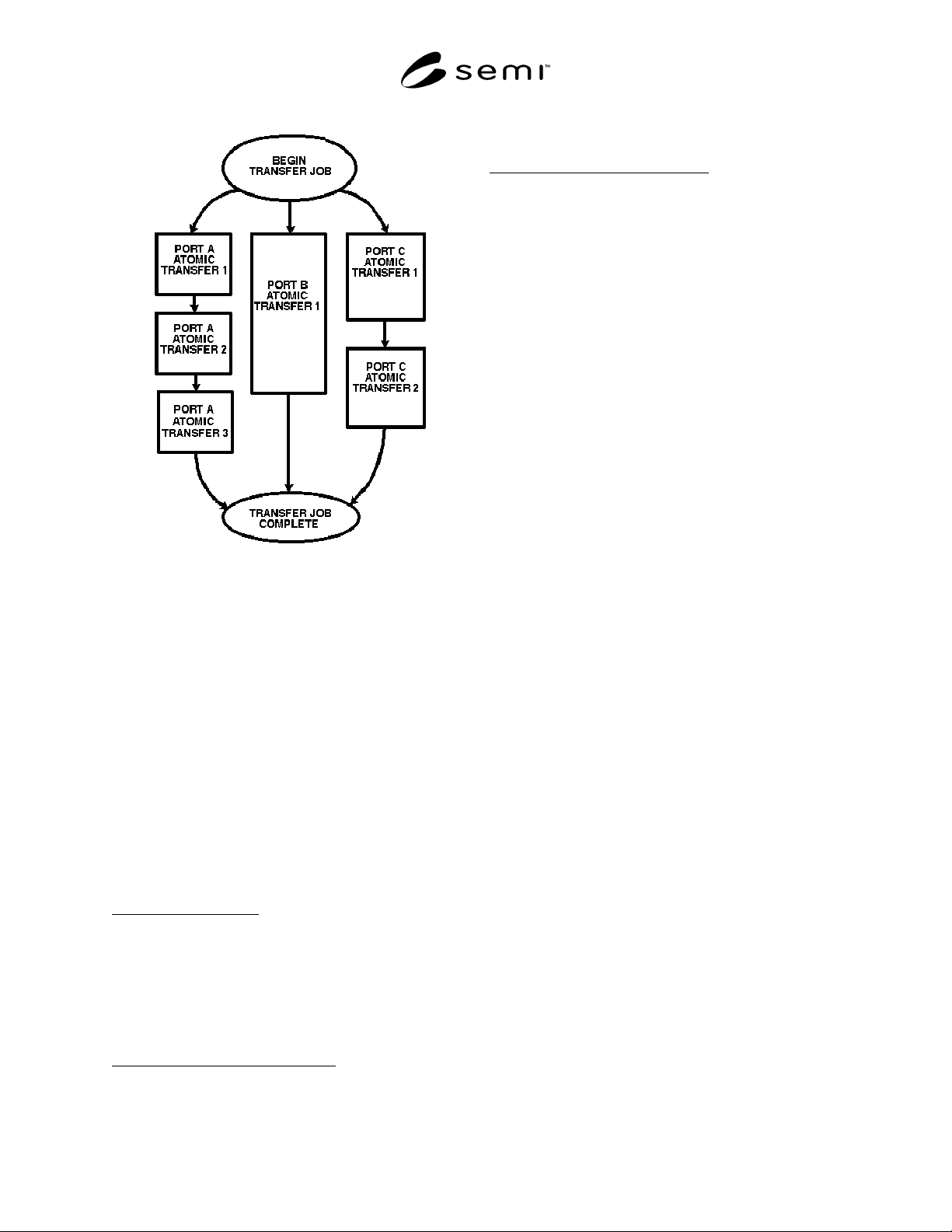
• Atomic transfers for a specified port are performed
in the sequence given.
• When a transfer job references multiple ports on
the equipment, these ports may execute their
atomic job sequences in parallel to the other ports.
See Figure 4.1 for an illustration of the flow of a
complex transfer job from the view of one equipment.
The three parallel paths show a possible chronology for
a transfer job.
SEMI E32-0997 © SEMI 1994, 199711
Figure 4.1
Transfer Job Sequencing
There are exceptions to the sequencing guidelines
above. One case would be a device designed to
simultaneously transfer from multiple ports on one
machine to corresponding ports on another. This would
translate into synchronized parallel atomic transfers on
separate ports. Another case would be two atomic
transfers involving the same port that might happen
concurrently. That is, a transfer object is transferred out
of the port at the same time
4
another is transferred in.
In either of these cases, the equipment is responsible
for:
1. recognizing that such transfers can and should be
combined and
2. synchronizing the execution of the transfers.
Multiple Transfer Jobs — Multiple transfer jobs may
exist simultaneously on an equipment. Although not a
requirement, an equipment may
1. queue transfer jobs for later execution or
2. allow them to execute in parallel with other
transfer jobs.
4 “At The Same Time” in this case means that both atomic transfers
are in progress. It does not imply that both transfer objects must move
simultaneously.
Queued transfer jobs and parallel transfer jobs are
separate concepts, either of which may be supported.
Resource Allocation/Deallocation — Transfer jobs
allocate the needed material locations prior to
beginning. These material locations remain allocated
until the transfer job chooses to release them. In many
cases, a material location is physically linked with a
single port, and the allocation of that location infers
allocation of the port. However, this is not a
requirement.
If the material locations for a transfer job are not
available or are not in the proper state, the job shall be
rejected or queued (if queuing supported and queue not
full). For the transfer job to begin, each location
referenced in the equipment's transfer job must contain
the proper material for the first atomic transfer which
would use that location.
If parallel transfer jobs are supported and the necessary
locations are available, a second (or third, etc.) transfer
job may begin execution.
In some cases a port may provide direct access to
multiple locations. This may be true for the specialized
ports described in Section 3.2 and in cases where the
port serves as a pass–through to internal locations. For
each atomic transfer, the needed port and its resources
are allocated just prior to the start and released
(deallocated) at the end of that atomic transfer.
4.2 Macro Level Behavior
4.2.1 Macro Level Communications — This section
provides a high-level definition of the communications
between the host and each transfer partner needed to
achieve the macro level of material transport. This is
not intended to define the messages, but rather to
describe the concepts. The message detail is addressed
in the Macro Level Services Section (4.4). Section 4.2.2
shows how these messages are integrated into the
transfer job behavior model.
First, the control message flow is presented as Figure
4.2. Then additional informational messaging is
described (see Figure 4.3). The arrows represent
significant information exchange. Some replies that do
not contain significant information may not be shown.
The ordering of the messages between one partner and
host shall be retained. The key synchronization point
between the partners at the macro level is that both
partners shall complete their setup activities before the
“atomic transfer started” event may occur.
4.2.1.1 Macro Level Job Control — Figure 4.2
illustrates the job control-related message flow
expected on a normal transfer as seen by the host.
These messages are used to control the material