semi合集-English.pdf - 第5919页
SEMI P39-0304 E2 © SEMI 2004 22 28 TRAPEZOID Record 28.1 A TRAPEZOID record represents a tr apezoid figure (a polygon with four vertices h aving at least two opposite sides parallel and parallel to either th e x- or the …
SEMI P39-0304
E2
© SEMI 2004 21
27 PATH Record
27.1 A PATH record represents an arbitrary path figure, which may be thought of as a polyline with finite width. It
has the following format:
‘22’ path-info-byte [ layer-number ] [ datatype-number ] [ half-width ]
[ extension-scheme [ start-extension] [ end-extension ] ] [ point-list ] [ x ] [ y ] [ repetition ]
27.2 The path-info-byte contains the bit pattern ‘EWPXYRDL’.
27.3 x and y are signed-integer coordinates representing either the absolute or the relative (x,y) location of the
initial vertex of the path centerline. X is 1 if x is present, and Y is 1 if y is present. When either x or y is unspecified,
the value of modal variable geometry-x or geometry-y, respectively, is used instead. Refer to Section 21 on page 17
for a discussion of how absolute and relative modes affect the interpretation of x and y.
27.4 R is 1 if repetition is present. L is 1 if layer-number is present. D is 1 if datatype-number is present. Both
layer-number and datatype-number are unsigned-integers. When layer-number and/or datatype-number are
unspecified, they assume the value of modal variables layer and datatype, respectively.
27.5 P is 1 if point-list is present. Otherwise, the value of modal variable path-point-list is used. The format of
point-lists is defined in Section 7.7 on page 9.
27.6 W
is 1 if half-width (an unsigned-integer) is present; if absent, the half-width value assumes the value of
modal variable path-halfwidth. The path is formed by expanding the centerline (represented by line segments
connecting the points) by the half-width value to each side.
27.7 E is 1 if extension-scheme is present. Otherwise, extension-scheme, start-extension, and end-extension are
absent, and the values of modal variables path-start-extension, and path-end-extension are used instead.
27.8 When present, extension-scheme (an unsigned-integer) contains bit pattern ‘0000SSEE’. The SS bits govern
the path starting extension, and the EE bits govern the path ending extension. Both start-extension (present only
when SS = ‘11’) and end-extension (present only when EE = ‘11’) are signed-integers, as in GDSII Stream, with
positive values causing the path to extend beyond its starting and/or ending vertices, and negative values causing the
path to retract from its starting and/or ending vertices.
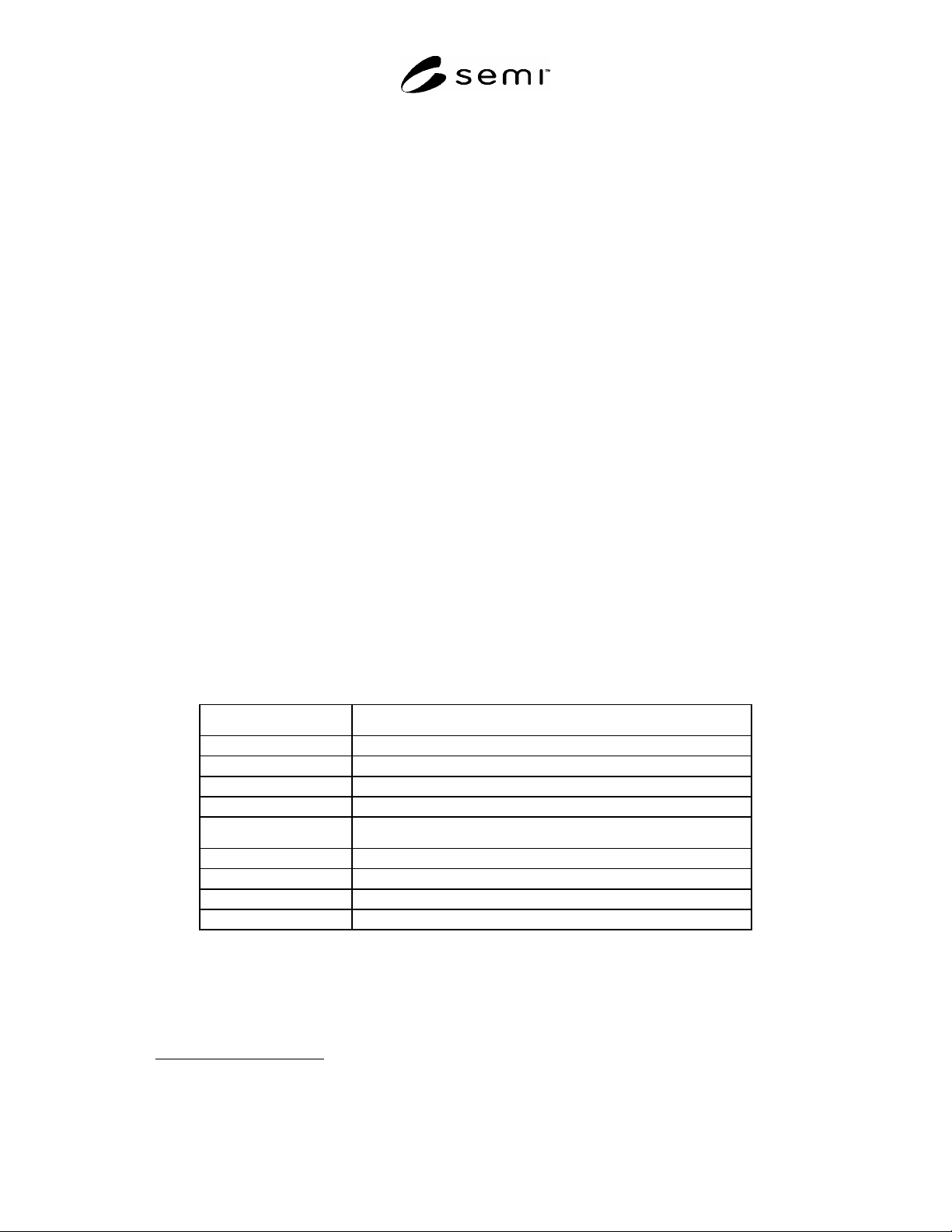
Table 15 Path Extension Schemes
SS Bits Description
00 Use path-start-extension modal variable
01 Use flush (zero-length) extension at starting vertex
10 Use path-halfwidth extension at starting vertex
11 Use explicit start-extension at starting vertex
EE Bits
00 Use path-end-extension modal variable
01 Use flush (zero-length) extension at ending vertex
10 Use path-halfwidth extension at ending vertex
11 Use explicit end-extension at ending vertex
27.9 Each successive PATH record updates all path-related modal variables.
27.10 Various types of degenerate paths, where the half-width = 0, the path traces back on itself, an extension is
negative with magnitude greater than its segment length, etc. are not prohibited; their interpretation is application-
dependent. The path expansion scheme used at the path’s interior vertices or “joints” is also application-dependent.
27.11 EXCEPTION HANDLING
— Implicit use of modal variables path-halfwidth, path-point-list, path-start-
extension, path-end-extension, layer, or datatype when they are in the undefined state should be treated as a fatal
error.
SEMI P39-0304
E2
© SEMI 2004 22
28 TRAPEZOID Record
28.1 A TRAPEZOID record represents a trapezoid figure (a polygon with four vertices having at least two
opposite sides parallel and parallel to either the x- or the y-axis). It has the following format:
‘23’ trap-info-byte [ layer-number ] [ datatype-number ]
[ width ] [ height ] delta-a delta-b [ x ] [ y ] [ repetition ]
‘24’ trap-info-byte [ layer-number ] [ datatype-number ]
[ width ] [ height ] delta-a [ x ] [ y ] [ repetition ]
‘25’ trap-info-byte [ layer-number ] [ datatype-number ]
[ width ] [ height ] delta-b [ x ] [ y ] [ repetition ]
28.2 The trap-info-byte contains bit pattern ‘OWHXYRDL’.
28.3 R is 1 if repetition is present. L is 1 if layer-number is present. D is 1 if datatype-number is present. Both
layer-number and datatype-number are unsigned-integers. When layer-number and/or datatype-number are
unspecified, they assume the value of modal variables layer and datatype, respectively. W is 1 if width is present.
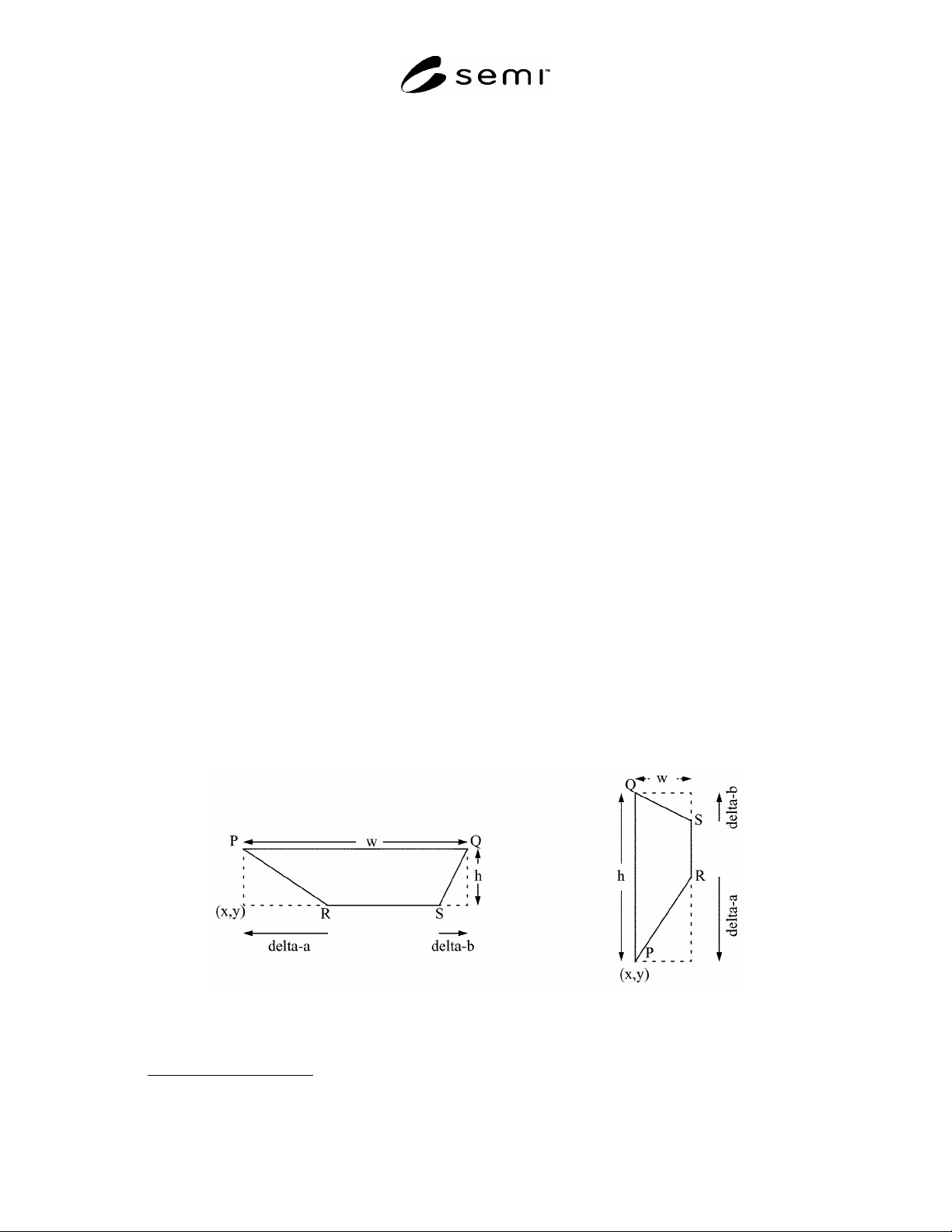
H is 1 if height is present. Width and height are unsigned-integers which describe the overall dimensions of the
bounding box of the trapezoid as shown in Figure 7 on page 22. When width and/or height are unspecified, they
assume the value of modal variables geometry-w and geometry-h, respectively.
28.4 x and y are signed-integer coordinates representing either the absolute or the relative (x,y) location of the
lower-left corner of the trapezoid’s bounding box. X is 1 if x is present, and Y
is 1 if y is present. When either x or y
is unspecified, the value of modal variable geometry-x or geometry-y, respectively, is used instead. Refer to Section
21 on page 17 for a discussion of how absolute and relative modes affect the interpretation of x and y.
28.5 delta-a and delta-b are 1-deltas, and are both present in record type ‘23’. In record type ‘24’ delta-b is
assumed to be 0 and is omitted, and in record type ‘25’ delta-a is assumed to be 0 and is omitted.
28.6 O is 0 if the trapezoid is horizontally-oriented, with top (PQ) and bottom (RS) sides parallel to the x-axis. In
this case, delta-a represents (x
P
- x
R
) and delta-b represents (x
Q
- x
S
).
28.7 O is 1 if the trapezoid is vertically-oriented, with left (PQ) and right (RS) sides parallel to the y-axis. In this
case, delta-a represents (y
P
- y
R
) and delta-b represents (y
Q
- y
S
).
28.8 Each successive TRAPEZOID record updates all trapezoid-related modal variables.
Figure 7
Horizontal and Vertical Trapezoids
28.9 EXCEPTION HANDLING
— For any trapezoid, deltas of sufficient magnitude to cause segments PR and QS
to cross, as well as any delta which causes either segment PR or QS not to fit diagonally within the bounding box,
should be treated as fatal errors. Implicit use of modal variables geometry-w, geometry-h, layer, or datatype when
SEMI P39-0304
E2
© SEMI 2004 23
they are in the undefined state should be treated as a fatal error. The interpretation of zero-area trapezoids is
application-dependent.
29 CTRAPEZOID Record
29.1 A CTRAPEZOID record represents a trapezoid figure in a compact form by assuming that two sides are
parallel to either the x- or the y-axis, and the remaining two sides form either a 45- or 90-degree angle with them. It
has the following format:
‘26’ ctrapezoid-info-byte [ layer-number ] [ datatype-number ]
[ ctrapezoid-type ] [ width ] [ height ] [ x ] [ y ] [ repetition ]
29.2 The ctrapezoid-info-byte contains the bit pattern ‘TWHXYRDL’.
29.3 R is 1 if repetition is present. L is 1 if layer-number is present. D is 1 if datatype-number is present. Both
layer-number and datatype-number are unsigned-integers. When layer-number and/or datatype-number are
unspecified, they assume the value of modal variables layer and datatype, respectively. W is 1 if width is present.
H is 1 if height is present. Both width and height are unsigned-integers, and represent the width (w) and height (h)
of the trapezoid’s bounding box, respectively. When width and/or height are unspecified, they assume the value of
modal variables geometry-w and geometry-h, respectively.
29.4 x and y are signed-integer coordinates representing either the absolute or the relative (x,y) location of the
lower-left corner of the trapezoid’s bounding box. X is 1 if x is present, and Y is 1 if y
is present. When either x or y
is unspecified, the value of modal variable geometry-x or geometry-y, respectively, is used instead. Refer to Section
21 on page 17 for a discussion of how absolute and relative modes affect the interpretation of x and y.
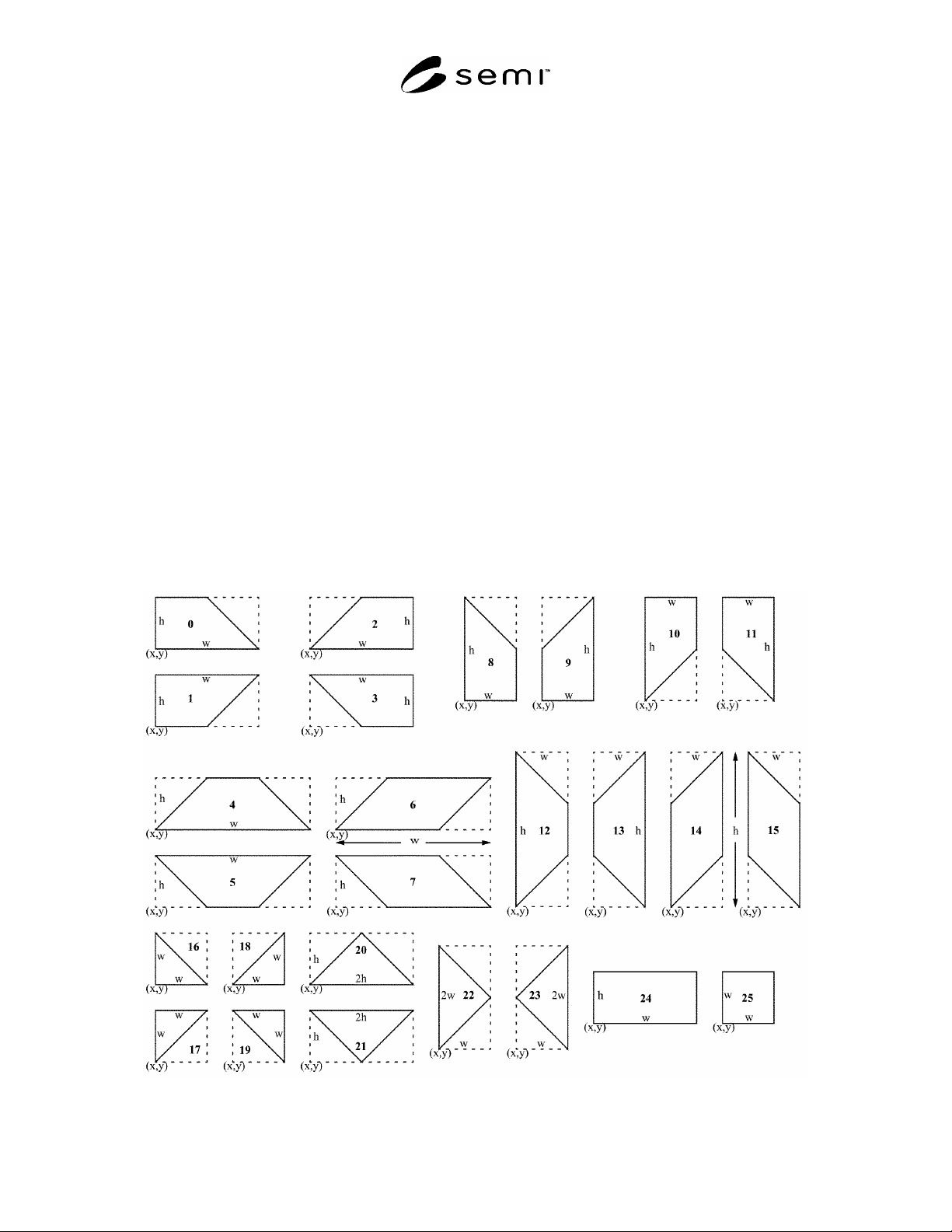
29.5 T is 1 if ctrapezoid-type (an unsigned-integer) is present; otherwise it assumes the value of modal variable
ctrapezoid-type. Types 0-25 are depicted in Figure 8:
Figure 8
The 26 Standard CTRAPEZOID Types