semi合集-English.pdf - 第582页
SEMI E79-0304 © SEMI 1999, 2004 16 A2-2 Additional Productivity Metrics Inv olving Denominators Other Than Total Time A2-2.1 This section presents three productivity metrics for assessing efficiency of the equi pment res…
SEMI E79-0304 © SEMI 1999, 2004 15
A2-1.5.1 Value-added In-Process OEE provides a
measure of equipment productivity assuming the non-
value-added portion of processing cycles is wasted
equipment time. The non-value-added time should be
the focus of efforts by the equipment supplier to reduce
or eliminate it through improved equipment design.
Value-added In-Process theoretical production time per
unit (VTHT) shall be defined to be less than or equal to
engineering theoretical production time per unit (ETHT)
used in calculating engineering E-OEE (OEE).
Value-Added In-Process OEE (VA-OEE)
= [∑
i
(Effective Units of Recipe i × VTHT
i
)]
/(Total Time)
where VTHT
i
= value-added in-process theoretical production
time per unit of recipe i.
A2-1.5.2 Value-added in-process theoretical
production time per unit credits time only for the
objective processing steps. The objective processing
steps for recipes performed by major types of wafer
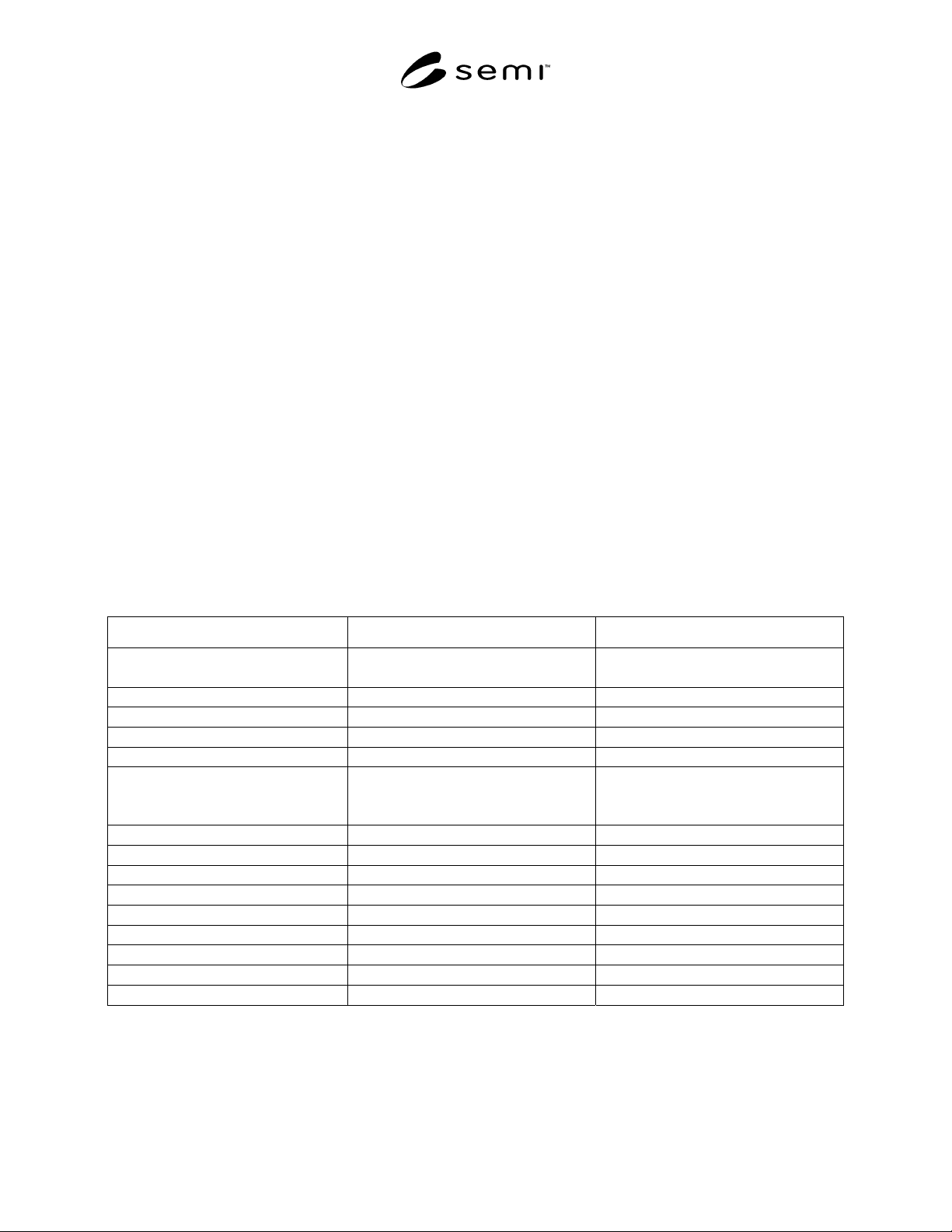
fabrication equipment are indicated in Table A2-1.
A2-1.5.3 Value-added in-process theoretical
production time per unit specifically excludes the
following items (partial list):
• All wafer handling time,
• All load-lock time,
• Pre-etch and pre-deposition time,
• Thermal stabilization time,
• Gas stabilization time,
• Wafer heating and cooling time,
• Time for clean cycles, and
• High-etch and seasoning time.
A2-1.5.4 Sample Value-Added In-Process OEE (VA-
OEE) Calculation
Value-added In-Process OEE (VA-OEE)
= [∑
i
(Effective Units of Recipe i × VTHT
i
)]
/(Total Time)
= [(1500 units × 0.01000 hr/unit)
+ (600 units × 0.00500 hr/unit)
+ (800 units × 0.01000 hr/unit)
+ (480 units × 0.0050 hr/unit)]/(168 hours)
= 0.1690
Table A2-1 Identification of Objective Process Steps for Value-Added In-Process Theoretical Time Per Unit
Equipment Type VTHT
i
Includes VTHT
i
Excludes
Resist Processing Coat, Develop, Bake, Cool Time at
Process Temperature
Temp. Ramp Up/Down
Photolithography Exposure Exposure Time Pre-Alignment, Align, Stepping Time
Etch, Oxide, Metal, Poly Flood Expose Time Chamber Clean Time
Asher, Dry Ashing Time
Clean Wet Processing Station Acid, Rinse and Dry Time Robot Transport Time
Furnace Atmospheric Process,
Furnace LPCVD Process, and
Rapid Thermal Processing
Main Oxidation, Anneal Time at
Defined Fixed Process Temperatures
Resulting in Thermal (Film) Treatment
Ramp Up/Down, Boat Push/Pull
Implanter HC, MC, HE … Implant Time Beam Setup Time
Metal Deposition - PVD, CVD Metal Deposition Time Chambers Clean Time
Dielectric - CVD Dielectric Deposition Time Chambers Clean Time
CMP Planarization Polishing Time Pad Dressing Dedicated Time
Measure CD SEM Measurement Time Pattern Recognition Time
Measure Overlay Measurement Time Pattern Recognition Time
Defect Detection Patterned Wafers Scanning Measurement Time Pattern Recognition Time
Defect Detection Unpatterned Wafers Scanning Measurement Time
Measure Film Thickness Measurement Time Pattern Recognition Time

SEMI E79-0304 © SEMI 1999, 2004 16
A2-2 Additional Productivity Metrics Involving
Denominators Other Than Total Time
A2-2.1 This section presents three productivity metrics
for assessing efficiency of the equipment resource
relative to a time frame less than total time.
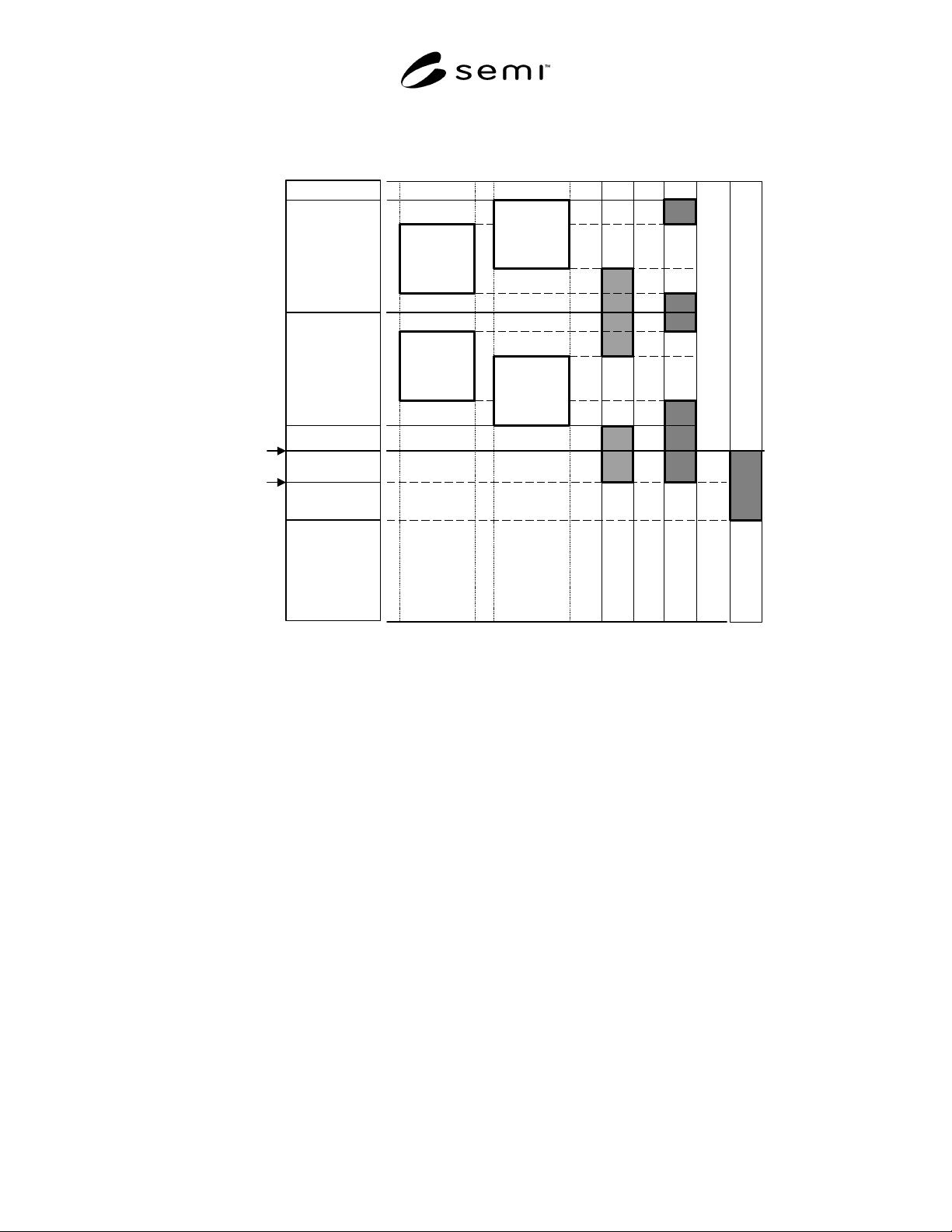
A2-2.2 Production Equipment Efficiency and Demand
Equipment Efficiency exclude portions of no product
time from productivity losses, as depicted in Figure A2-
2. While the idle time due to no product is excluded
from the operational losses in these particular measures
of equipment efficiency, the user should be aware that
the additional productivity losses due to sub-optimal
load or batch sizes may also be present as rate
efficiency losses. Such losses, which result from
fluctuations in product flow or tool loading policies, are
considered in any equipment efficiency calculation that
uses theoretical time per unit.
A2-2.3 Production Equipment Efficiency (PEE)
A
measure of equipment productivity during the time that
work is available to process at the tool. One application
of PEE is to measure the productivity of non-constraint
tools, which are expected to have periods of idle time
due to lack of available work.
Production Equipment Efficiency (PEE)
= (Theoretical Production Time for Effective Units)
/[(Operations Time) - (No Product Time)
- (Equipment Down No Product Time)]
= Overall Equipment Efficiency × Total Time
/[(Operations Time) - (No Product Time)
- (Equipment DownNo Product Time)]
A2-2.3.1 Sample Production Equipment Efficiency
(PEE) Calculation
Production Equipment Efficiency (PEE)
= (146 hours)/[(168 hours) - (6 hours) - (4 hours)]
= 0.9241
A2-2.4 Demand Equipment Efficiency (DEE) A
measure of equipment productivity during the time that
work is planned to be available to process at the
equipment. A factory model or production schedule
that defines the expected or planned idle time at the
equipment is required to calculate Demand Equipment
Efficiency. DEE measures the productivity of the
equipment relative to the requirements of the factory
model or production schedule.
Demand Equipment Efficiency (DEE)
= (Theoretical Production Time for Effective Units)
/[(Operations Time) - (Planned No Product Time)]
= Overall Equipment Efficiency × Total Time
/[(Operations Time) - (Planned No Product Time)]
A2-2.4.1 Sample Demand Equipment Efficiency (DEE)
Calculation
Demand Equipment Efficiency (DEE)
= (146 hours)/[(168 hours) - (8 hours)]
= 0.9125
A2-2.5 Intrinsic Equipment Efficiency (IEE)
A
measure of equipment productivity that compares
value-added, in-process theoretical production time to
the actual production time. IEE measures the combined
productivity losses due to rate efficiency losses, recipe
design, and equipment design.
Intrinsic Equipment Efficiency (IEE)
= [
∑
i
(Actual Units of Recipe i × VTHT
i
)]
/(Production Time)
where VTHT
i
= value-added in-process theoretical production
time per unit for recipe i. See Section A2-1.3.
A2-2.5.1 Sample Intrinsic Equipment Efficiency (IEE)
Calculation
Production Time = 155.00 hours
Intrinsic Equipment Efficiency (IEE)
= [∑
i
(Actual Units of Recipe i × VTHT
i
)]
/(Production Time)
= [(1500 units × 0.01000 hr/unit)
+ (600 units × 0.00500 hr/unit)
+ (800 units × 0.01000 hr/unit)
+ (500 units × 0.0050 hr/unit)]/(155 hours)
= 0.1839
SEMI E79-0304 © SEMI 1999, 2004 17
Non-Scheduled
Scheduled
and
Unscheduled
Downtime
Standby
Engineering
DEE
Losses
Theoretical
Production
Time for
Effective Units
No Product
Time
Equipment
Down
No Product
Time
Planned
No Product
Time
(Downtime)
PEE
Losses
Value-Added
In-Process
Theoretical
Production
Time for
Actual Units
IEE
Losses
Planned
No Product
Time
(Standby)
Production Time
No Product
Time
(Planned)
No Product
Time
(Actual)
Figure A2-2
Productivity Losses Included in PEE and DEE, and IEE Metrics (shaded regions)
NOTICE: SEMI makes no warranties or representations as to the suitability of the standard set forth herein for any
particular application. The determination of the suitability of the standard is solely the responsibility of the user.
Users are cautioned to refer to manufacturer’s instructions, product labels, product data sheets, and other relevant
literature respecting any materials mentioned herein. These standards are subject to change without notice.
The user’s attention is called to the possibility that compliance with this standard may require use of copy-righted
material or of an invention covered by patent rights. By publication of this standard, SEMI takes no position
respecting the validity of any patent rights or copyrights asserted in connection with any item mentioned in this
standard. Users of this standard are expressly advised that determination of any such patent rights or copyrights, and
the risk of infringement of such rights, are entirely their own responsibility.