semi合集-English.pdf - 第1343页
SEMI E30-1103 © SEMI 1992, 2003 17 Table 3.4 Processing State Tran sition Table # Current State Trigger New State Action Comments 1 INIT Equipment initialization complete. IDLE None None 2 IDLE Commit has been made to se…
SEMI E30-1103 © SEMI 1992, 2003
16
3.4 Equipment Processing States — The behavior of
the equipment in the performance of its intended
function must be documented. This processing state
model is highly dependent on the equipment process,
technology, and style. However, there are expected to
be common aspects to these models.
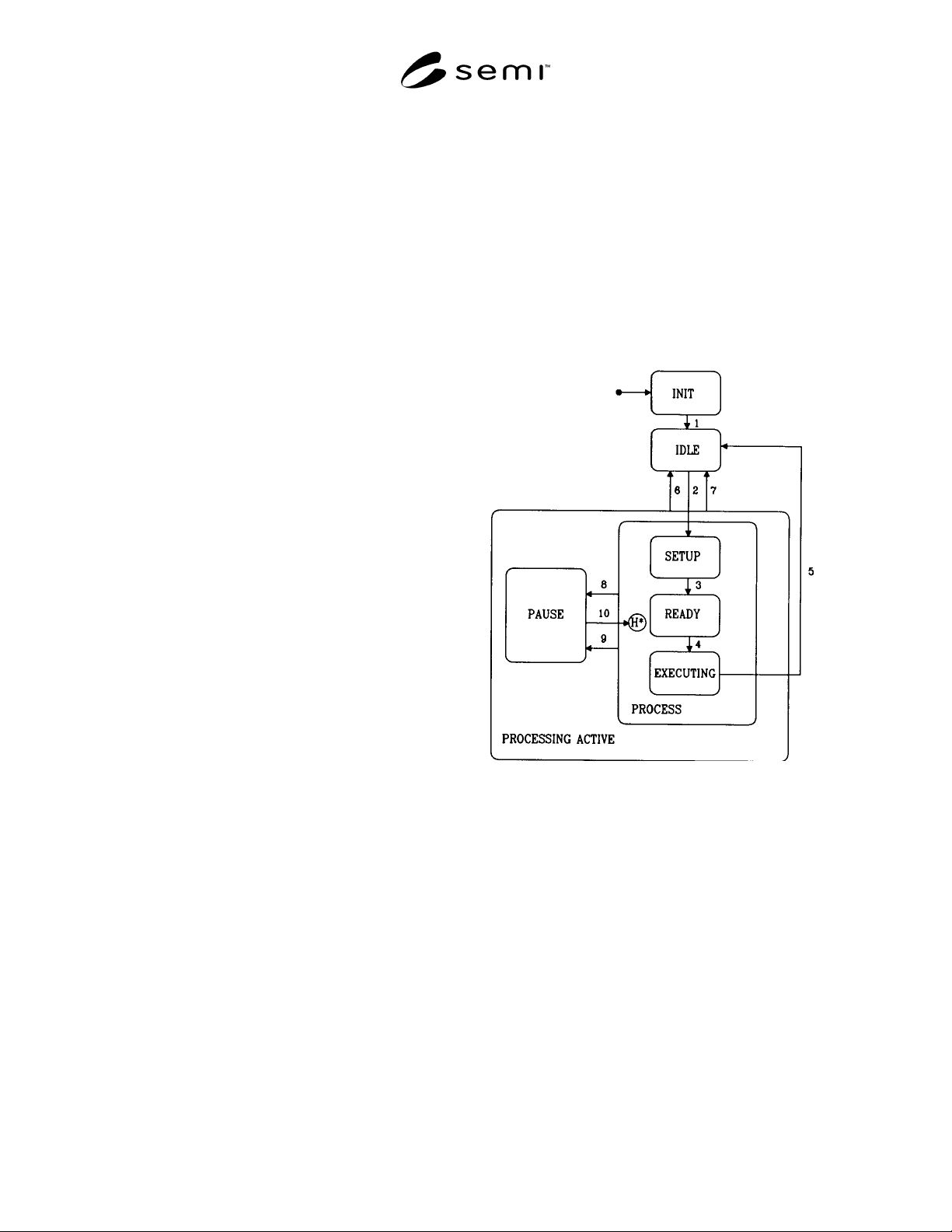
The Processing State Diagram, Figure 3.4, is provided
as an example of an implementation model. This model
demonstrates the expected nature of the processing state
model documentation. There is no requirement that
these specific states be implemented.
The equipment must generate collection events for each
processing state transition, as well as provide status
variables (ProcessState, PreviousProcessState) whose
values are the current processing state and the previous
processing state.
In referring to the Processing State Diagram, note that
the initialization state INIT is not an actual processing
state. It is shown here simply to indicate that the IDLE
processing state is entered upon completion of
equipment system initialization. On the following pages
detailed descriptions are provided for the equipment
processing states and state transitions (numbered) as
shown in the diagram.
3.4.1 Description of Equipment Processing States
IDLE
In this state the equipment is awaiting instructions.
PROCESSING ACTIVE
This state is the parent of all substates where the
context of process program execution exists.
PROCESS
This state is the parent of those substates that refer to
the active preparation and execution of a process
program.
SETUP
In this state all external conditions necessary for
process execution are satisfied, such as ensuring
material is present at the equipment, input/output ports
are in the proper state, parameters such as temperature
and pressure values are within limits, etc. If all setup
operations are already complete, then this becomes a
fall through state and a transition to the next state takes
place.
READY
In this state the equipment is ready for process
execution and is awaiting a START command from the
operator or the host.
EXECUTING
Executing is the state in which the equipment is
executing a process program automatically and can
continue to do so without external intervention.
PAUSE
In this state processing is suspended and the equipment
is awaiting a command.
Each state transition is defined in the following table.
Note that all transitions in this table should be
considered collection events.
Figure 3.4
Processing State Diagram
SEMI E30-1103 © SEMI 1992, 2003
17
Table 3.4 Processing State Transition Table
# Current State Trigger New State Action Comments
1 INIT Equipment initialization
complete.
IDLE None None
2 IDLE Commit has been made to set
up.
SETUP None None
3 SETUP All setup activity has
completed and the equipment
is ready to receive a START
command.
READY This activity is
equipment-
specific.
None
4 READY Equipment has received a
START command from the
host or operator console.
EXECUTING This activity is
equipment-
specific.
None
5 EXECUTING The processing task has been
completed.
IDLE None None
6 PROCESSING
ACTIVE
Equipment has received a
STOP command from host or
operator console.
IDLE None None
7 PROCESSING
ACTIVE
Equipment has received an
ABORT command from host
or operator console.
IDLE This activity is
equipment-
specific.
None
8 PROCESS The equipment decides to
PAUSE due to a condition
such as alarm.
PAUSE This activity is
equipment-
specific.
For this type of
problem, an
operator assist is
usually required.
9 PROCESS Equipment has received a
PAUSE command from host
or operator console.
PAUSE This activity is
equipment-
specific.
None
10 PAUSE Equipment has received a
RESUME command from
host or operator console.
Previous
PROCESS
substate
This activity is
equipment-
specific.
None
4 Equipment Capabilities and Scenarios
This section describes the details of the capabilities
required by GEM and provides scenarios for their use.
Capabilities are operations performed by semiconductor
manufacturing equipment. These operations are
initiated through the communications interface using
SECS-II messages. A scenario is a group of SECS-II
messages arranged in a sequence to perform a
capability. Other information may be included with the
scenario for clarity. For each capability, the reader is
provided with a statement of purpose, pertinent
definitions, a detailed description, requirements, and
scenarios.
The following capabilities are discussed:
Establish Communications
Event Notification
Dynamic Event Report Configuration
Variable Data Collection
Trace Data Collection
Limits Monitoring
Status Data Collection
On-line Identification
Alarm Management
Remote Control
Equipment Constants
Process Program Management
Material Movement
Equipment Terminal Services
Error Messages

SEMI E30-1103 © SEMI 1992, 2003
18
Clock
Spooling
Control
4.1 Establish Communications — The Establish
Communications capability provides a means of
formally establishing communications following system
initialization or any loss of communications between
communicating partners, and thus of notifying the
communication partner that a period of non-
communication has occurred.
4.1.1 Purpose — Communications between host and
equipment are formally established through use of the
Establish Communications Request/Establish
Communications Acknowledge transaction.
The use of S1,F1/F2 for this purpose is ambiguous
since the transaction can be used for other purposes and
may occur at any time.
The S1,F13/F14 transaction, used in conjunction with
the Communications State Model, provides a means for
equipment to notify the host, or the host to notify the
equipment, that there has been a period of inability to
communicate. The successful completion of this
transaction also signals a possible need for
synchronization activities between host and equipment.
4.1.2 Definitions
COMMACK — Acknowledge code returned in the
Establish Communications Acknowledge message. See
the SEMI E5 Standard for a full definition of this data
item.
EstablishCommunicationsTimeout — An equipment
constant used to initialize the interval between attempts
to re-send an Establish Communications Request. This
value specifies the number of seconds for the interval.
See the SEMI E5 Standard for a full definition of this
variable data item.
4.1.3 Description — There are potential problems
when one side of the communications link fails and the
other side does not detect it. From the point of view of
the host, a loss of communications has many possible
causes. In some cases, host-controlled settings on the
equipment may need to be reset. In other cases, the
equipment may have continued an automatic processing
sequence during the period of no communication and
may have changed states. The definition of a formal
protocol for establishing communications alerts the host
to the need to synchronize itself with the equipment’s
current status.
Equipment shall consider communications as formally
established whenever either of the following conditions
have been satisfied:
14
— Communications Request has been sent to the host
and an Establish Communications Acknowledge
has been received within the transaction timeout
period and with an acknowledge code of Accept, or
— Communications Request has been received from
the host, and an Establish Communications
Acknowledge response has been successfully sent
with an acknowledge code of Accept.
When the equipment sends an Establish
Communications Request to the host, this notifies the
host of the possible need to synchronize itself with the
equipment.
When the equipment is attempting to establish
communications, an Establish Communications Request
shall be sent periodically until communications have
been formally established as described above. The
interval between attempts must be user-configurable
and begins as soon as a connection transaction failure is
detected (see Section 3.2).
Attempting to establish communications is not a low-
level connectivity issue, but rather a logical application
issue used by either party to notify its partner that the
host may need to perform synchronization activities
with the equipment.
4.1.4 Requirements
— Equipment must support the Communication State
Model (see Section 3.2).
— Equipment must provide the EstablishCommunica-
tionsTimeout equipment constant described above.
14 Satisfaction of either of these conditions will result in a transition
to the COMMUNICATING substrate. See Section 3.2 for further
detail.