semi合集-English.pdf - 第1099页
SEMI E5-1104 © SEMI 1982, 2004 41 Name Format Description Values Where Used UNFLEN 3(), 5() Unformatted Process Program Length If greater than zero, indicates PPID is available as an unformatted process program and its l…
SEMI E5-1104 © SEMI 1982, 2004 40
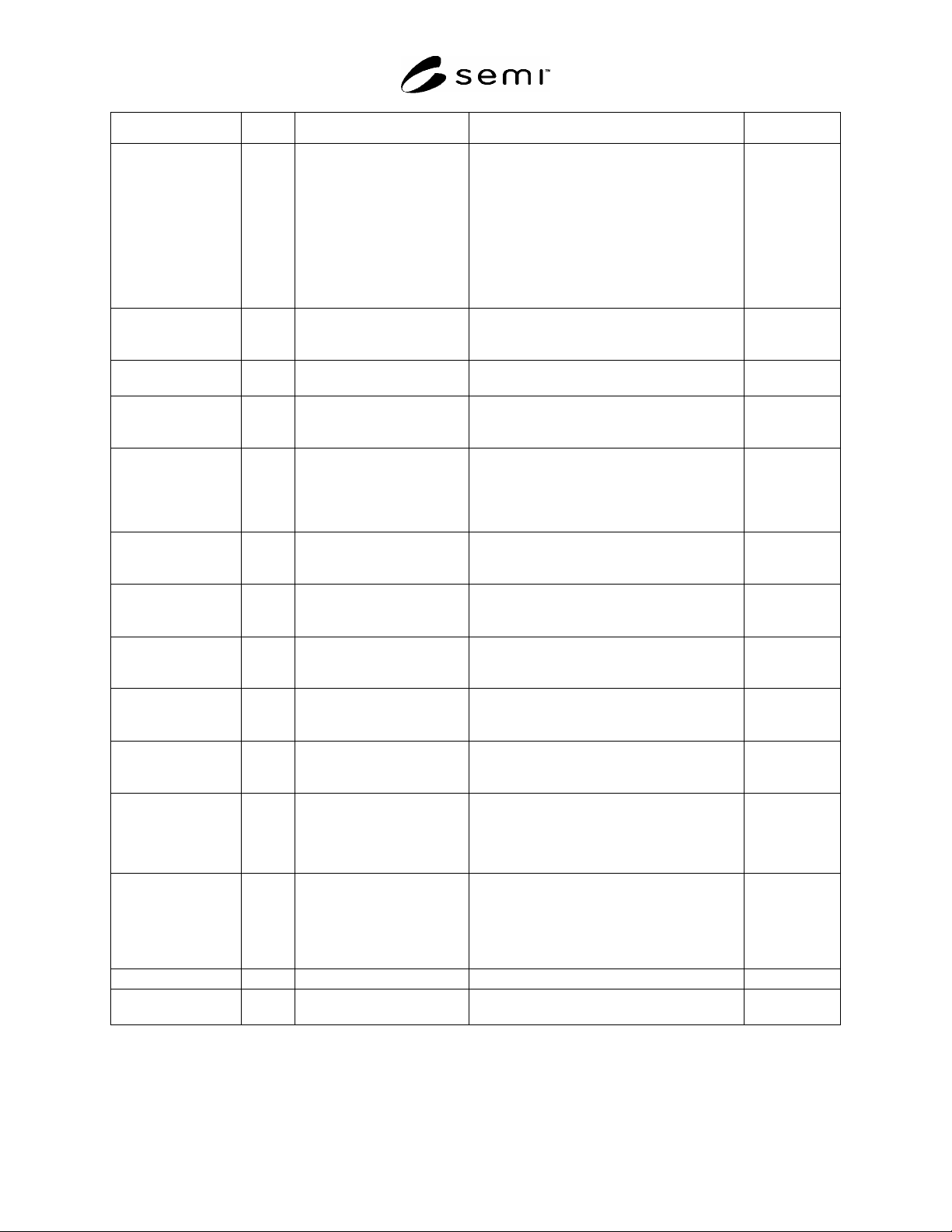
Name Format Description Values Where Used
TRLOCATION 5() Identifier of the material
location involved with the
transfer. For one transfer
p
artner, this will represent the
designated source location for
the material to be sent. For
the other transfer partner, it
will represent the designated
destination location for the
material to be received.
S4F19, F29
TROBJNAME 20 Identifier for the material
(transfer object) to be
transferred
S4F19, F23,
F29
TROBJTYPE 5() Type of object to be
transferred
S4F19, F29
TRPORT 5() Identifier of the equipment
port to be used for the
handoff
S4F19, F29
TRPTNR 20 Name of the equipment
which will serve as the other
transfer partner for this
atomic transfer. This
corresponds to EQNAME.
S4F19, F29
TRPTPORT 5() Identifier of the transfer
partner’s port to be used for
the transfer
S4F19, F29
TRRCP 20 Name of the transfer recipe
for this handoff. Limited to a
maximum of 80 characters.
S4F19
TRROLE 51 Tells whether the equipment
is to be the primary or
secondary transfer partner
1 = Primary Transfer Partner
2 = Secondary Transfer Partner
S4F19, F29
TRSPER 4() A Trace Object attribute
which holds the value for
sampling interval time
S14F1, F2, F3,
F4;
S17F5
TRTYPE 51 Tells whether the equipment
is to be an active or passive
participant in the transfer
1 = Active
2 = Passive
S4F19, F23,
F29
TSIP 10 Transfer status of input port,
1 byte
1 = Idle state
2 = Prep state
3 = Track on state
4 = Stuck in Receiver state
5-63 Reserved
S1F10
TSOP 10 Transfer status of output port,
1 byte
1 = Idle state
2 = Prep state
3 = Track on state
4 = Stuck in Sender state
5 = Completion state
6-63 Reserved
S1F10
TTC 3(), 5() Time to completion
S3F4
ULIM 3(), 4(),
5()
Upper limit for numeric value
S7F22
SEMI E5-1104 © SEMI 1982, 2004 41
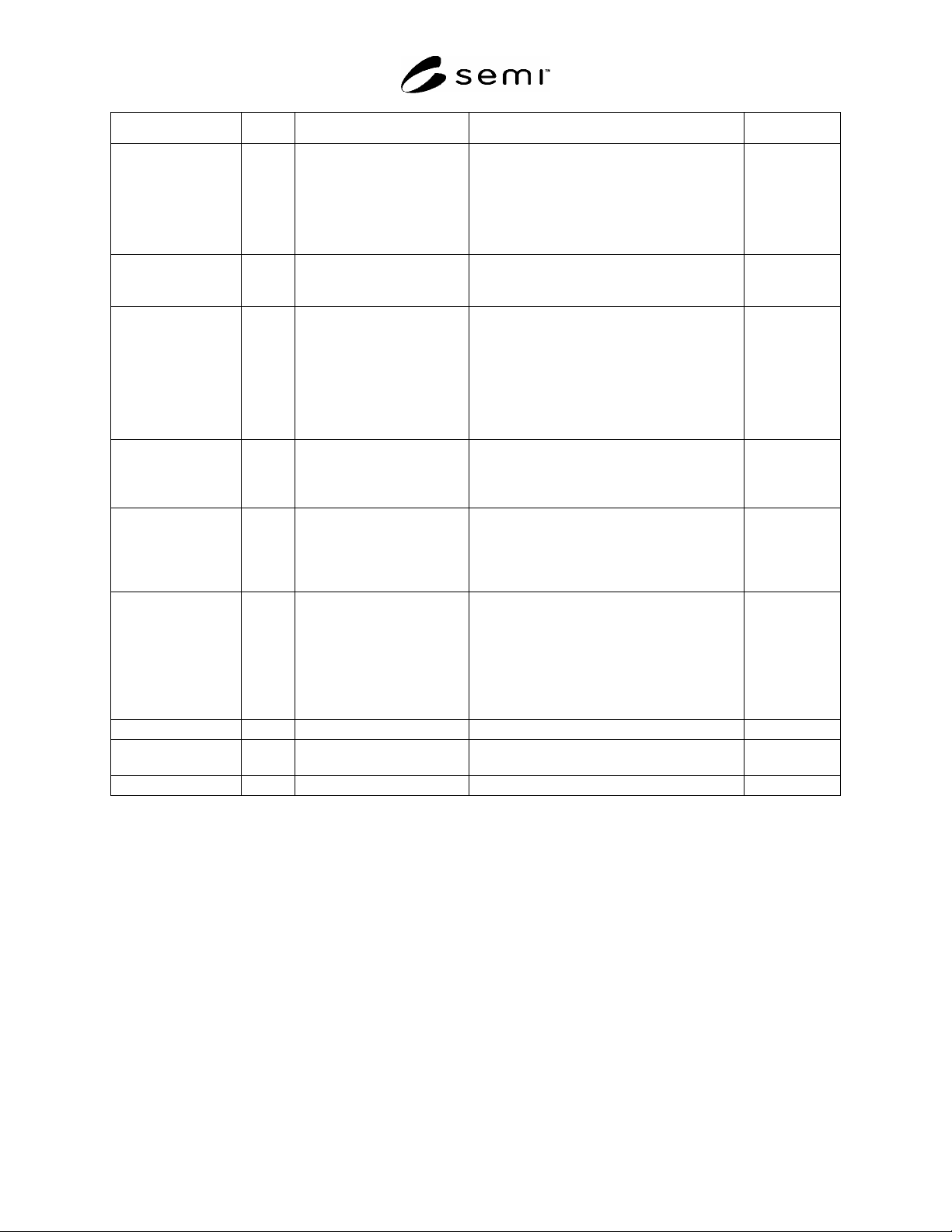
Name Format Description Values Where Used
UNFLEN 3(), 5() Unformatted Process
Program Length
If greater than zero, indicates
PPID is available as an
unformatted process program and
its length in bytes. If zero,
the PPID is not available as an
unformatted process program.
Negative values are invalid.
S7F34
UNITS 20 Units Identifier
As allowed by SEMI E5 Section
12.
S1F12;
S2F30, F48;
S7F22
UPPERDB 11, 20,
3(), 4(),
5()
A variable limit attribute
which defines the upper
boundary of the deadband of
a limit. The value applies to
a single limit (LIMITID) for a
specified VID. Thus,
UPPERDB and LOWERDB
as a pair define a limit.
S2F45, F48
V 0, 10,
11, 20,
21, 3(),
4(), 5()
Variable data
S6F11, F13,
F16, F20, F22
VID 20, 3(),
5()
Variable ID
S2F33, F45,
F46, F47, F48;
S6F13, F18,
F22;
S17F1
VLAACK 10 Variable Limit Attribute
Acknowledge Code, 1 byte
0 = Acknowledge, command will
be performed
1 = Limit attribute definition
error
2 = Cannot perform now
>2 = Other equipment-specific
error
3-63 Reserved
S2F46
XDIES 4(), 5() X-axis die size (index)
S12F1, F4
XYPOS 3() X and Y Coordinate Position.
Must be in (X,Y) order.
S12F11, F18
YDIES 4(), 5() Y-axis die size (index)
S12F1, F4
9.7 Variable Item Dictionary — This section defines variable data items which are available to the Host for data
collection purposes.
Name: A unique mnemonic name for this variable data item. This name is provided for reference only.
Class: The data type classification (SV, ECV, or DVVAL) of the item. Status values (SVs) always contain valid
information, while data values (DVVALs) may only be valid upon the occurrence of a particular event. All
equipment constants (ECVs) are settable by the Host.
Format: The allowable item format codes which can be used for this variable data item. ...as in Data Item
Dictionary...
Description: A description of the variable data item, with the meanings of specific values. Also, specify validity for
item of class DVVAL.
SEMI E5-1104 © SEMI 1982, 2004 42
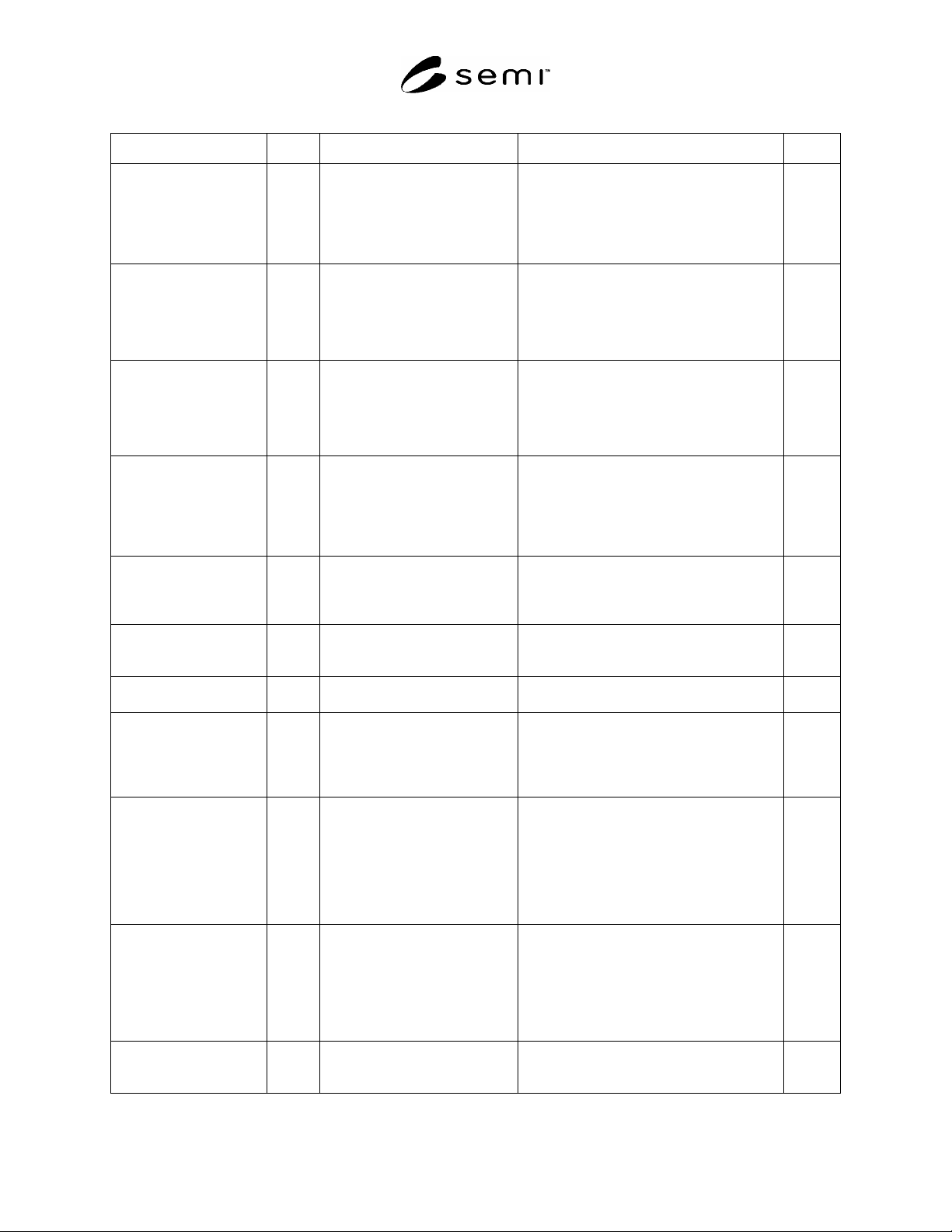
Table 4 Variable Item Dictionary
Name Format Description Values Class
AlarmID 3(), 5() This variable is valid only upon
the setting or clearing of an alarm
condition and contains the current
alarm identification (ALID),
regardless of whether that alarm is
enabled for reporting
DVVAL
AlarmsEnabled 0 Contains the list of alarms
(ALIDs) enabled for reporting
(via Stream 5)
Structure:
L,n n = # of alarms enabled
1.<ALID
1
>
.
.
n.<ALID
n
>
SV
AlarmsSet 0 Contents of this variable is a list
of alarms (ALIDs) currently in the
UNSAFE (alarm set) state,
regardless of whether the alarms
are enabled for reporting
Structure:
L,n n = # of alarms set
1.<ALID
1
>
.
.
n.<ALID
n
>
SV
ARAMSAccumReset 20 The timestamp of when the set of
accumulators EngTime,
InterruptionCtr, PrdTime,
NSTime, SbyTime, SDTime, and
UDTime were reset to zero. Uses
format defined for CLOCK.
SV
ARAMSInfo 20 Text field set by the equipment to
provide additional information
concerning an ARAMS state
change.
SV
ARAMSState 20 The ARAMS code corresponding
to the current state/substate. Four
characters.
SV
ARAMSText 20 Text describing the ARAMSState.
3–80 characters.
SV
ARAMSTimeStamp 20 The timestamp of the last ARAM
state change. This is a format
requirement only and does not
imply precision or accuracy.
Uses format defined for CLOCK.
SV
CLOCK 20 The value of the equipment’s
internal clock. This is a format
requirement only and does not
imply precision or accuracy.
Format: YYYYMMDDhhmmsscc
YYYY = Year 0000 to 9999
MM = Month 01 to 12
DD = Day 01 to 31
hh = Hour 00 to 23
mm = Minute 00 to 59
ss = Second 00 to 59
cc = centisecond 00 to 99
SV
ControlState 10, 51 This status variable contains the
code which identifies the current
control state of the equipment.
When reported related to a control
state transition, its value should
represent the state current after
the transition.
1 = OFF-LINE/EQUIPMENT OFF-
LINE
2 = OFF-LINE/ATTEMPT ON-LINE
3 = OFF-LINE/HOST OFF-LINE
4 = ON-LINE/LOCAL
5 = ON-LINE/REMOTE
6-63 Reserved
SV
CycleCtr 5() The number of machine cycles
during the lifetime of the
equipment. Non-resettable.
SV