semi合集-English.pdf - 第468页
SEMI E67-0304 © SEMI 1997, 2004 3 11 Preparation of Apparatu s 11.1 The setu p for the param eter under test is described in the documen t for that particular parameter (see Section 7.2). 12 Calibration and Referenc e St…
SEMI E67-0304 © SEMI 1997, 2004 2
or a deviation from a user-defined specification that
results in a condition that makes the MFC inadequate
for the user’s process.
5.2.3 parametric test — the test method that deter-
mines the data for which reliability information is
sought (e.g., accuracy test or particle test, SEMI E66).
5.2.4 readpoint — cumulative cycles applied to the
MFC.
5.2.5 reliability — the probability that the equipment
will perform its intended function, within stated
conditions, for a specified period of time.
5.2.6 soft failure — failure that occurs when an MFC
no longer meets the manufacturer' s specification for the
parameter under test.
6 Summary of Test Method
6.1 The MFC is installed in a fixture capable of
applying and recording a number of flow cycles. When
the number of cycles specified in the readpoint schedule
is reached, cycling is suspended, parametric tests are
per-formed, and the cycling is resumed until either the
next readpoint is reached, or the MFC experiences a
hard failure. After the cycling is completed, the
parametric test data is analyzed to determine the
reliability of each parameter.
7 Significance and Use
7.1 This test provides an estimate of the reliability of a
mass flow controller. The results of the test will also be
useful in the comparison of MFCs. The data provided
by this test can help end users determine the reliability
of equipment that uses MFCs.
7.2 The following parameters and associated test
methods should be tested with this test method to obtain
reliability data:
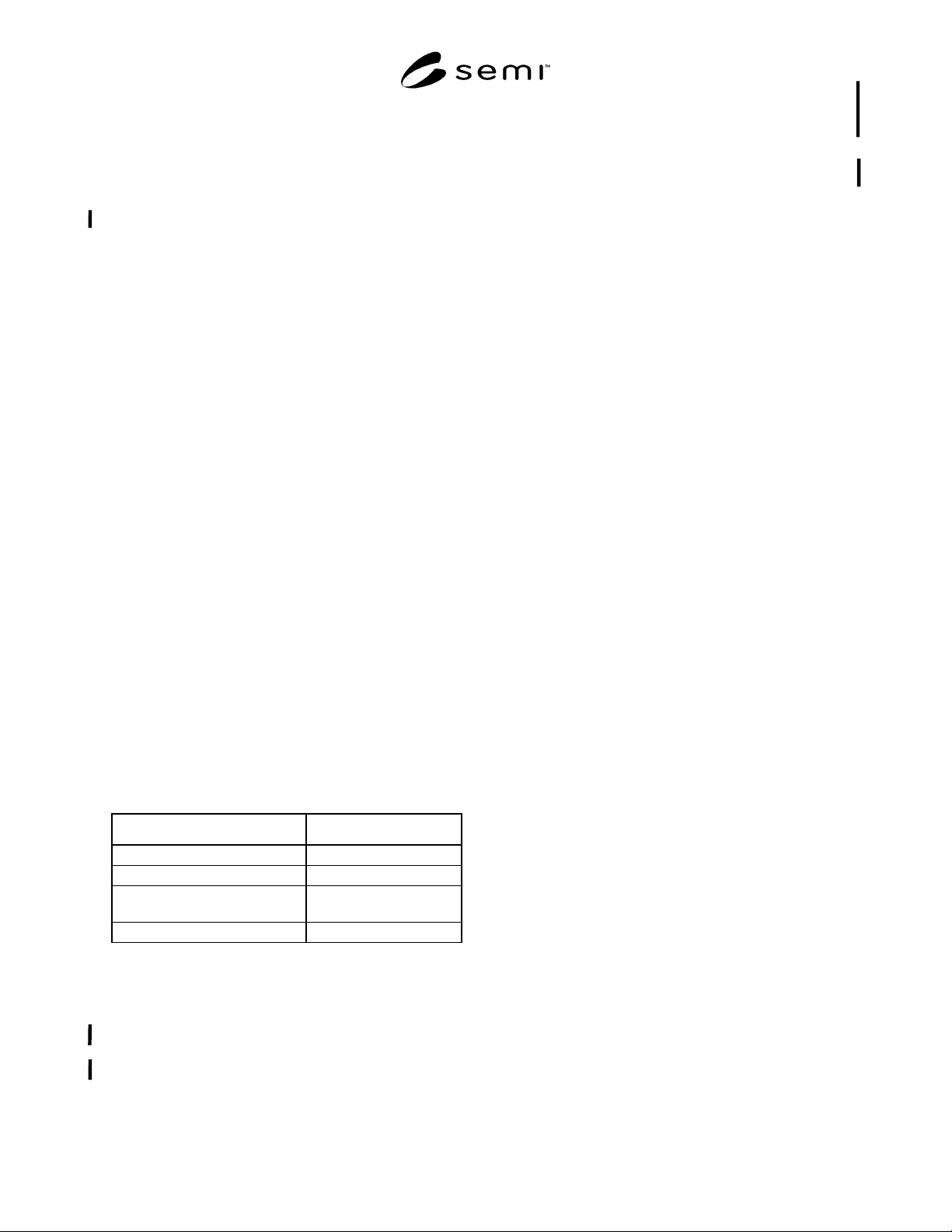
Parameter Test Method
Particle Contribution SEMI E66
Reproducibility & Zero Drift SEMI E69
Helium Leak Rate SEMASPEC
90120391B-STD
Step Response SEMI E17
7.3 The following modifications to the preceding para-
metric test methods are suggested to abbreviate the time
required to complete the reliability test:
7.3.1 SEMI E66 (Particle Contribution) — Abbreviate
this test method to perform only the dynamic control
mode test. Perform Sections 12.1.3 and 12.1.7, and
eliminate Sections 12.1.2, 12.1.4, 12.1.5, 12.1.6, 12.1.8,
12.1.9, and 12.1.10. Refer to Sections 5.2.1
(Background), 5.2.3 (Dynamic), and Figure 5 (Particle
Test Flow Chart).
7.3.2 SEMI E69 (Reproducibility & Zero Drift) —
Omit Sections 12.1 and 12.2.
7.3.3 SEMI F1 (Leak Integrity) — The intent of the
reliability test method is to detect the development of
gross leaks in the DUT due to cycling of the DUT
valve. The inboard component leak test portion of this
standard should be performed.
7.3.4 SEMI E17 (Step Response) — No abbreviation is
necessary for this test. However, perform this test with
the modifications noted in the SEMATECH Guide to
Provisional Test Methods for Mass Flow Controllers,
SEMASPEC 92071220B-STD.
7.4 Change in the performance characteristics of the
MFC, as measured by the above tests, may also be
monitored and analyzed as indicative of drift.
8 Apparatus
8.1 In addition to the apparatus listed below, the user
must also acquire any apparatus required to perform the
parametric test for which reliability data is needed. (See
documents cited in Section 7.2.)
8.1.1 Power supply
8.1.2 NIST (or equivalent recognized standards
agency) — traceable flow calibration system
8.1.3 MFC control cables, as many as required in
Section 8.1.4
8.1.4 Mass flow controllers for controlling test flows in
addition to the DUT MFCs, as many as required for the
test setup
8.1.5 Cycling fixture
9 Materials
9.1 In addition to the materials listed below, the user
must also acquire any materials required to perform the
parametric test for which reliability data is needed. (See
documents cited in Section 7.2.) Since reliability data
for leak integrity is being sought, helium cannot be used
during the cycling procedure.
9.1.1 Source of nitrogen (99.999%)
10 Sampling, Test Specimens, and Test Units
10.1 Three MFCs are required for meaningful data
analysis. However, 20 to 30 MFCs are a recommended
minimum. A larger sample size provides a more precise
estimate of reliability.
SEMI E67-0304 © SEMI 1997, 2004 3
11 Preparation of Apparatus
11.1 The setup for the parameter under test is described
in the document for that particular parameter (see
Section 7.2).
12 Calibration and Reference Standards
12.1 Any required instrument calibration or use of
reference standards must be done in accordance with
the particular parametric test for which reliability data
is needed.
13 Conditioning
13.1 Conditioning requirements are those of the
particular parametric test for which reliability data is
needed.
14 Procedure
14.1 Connect all MFCs under test in parallel.
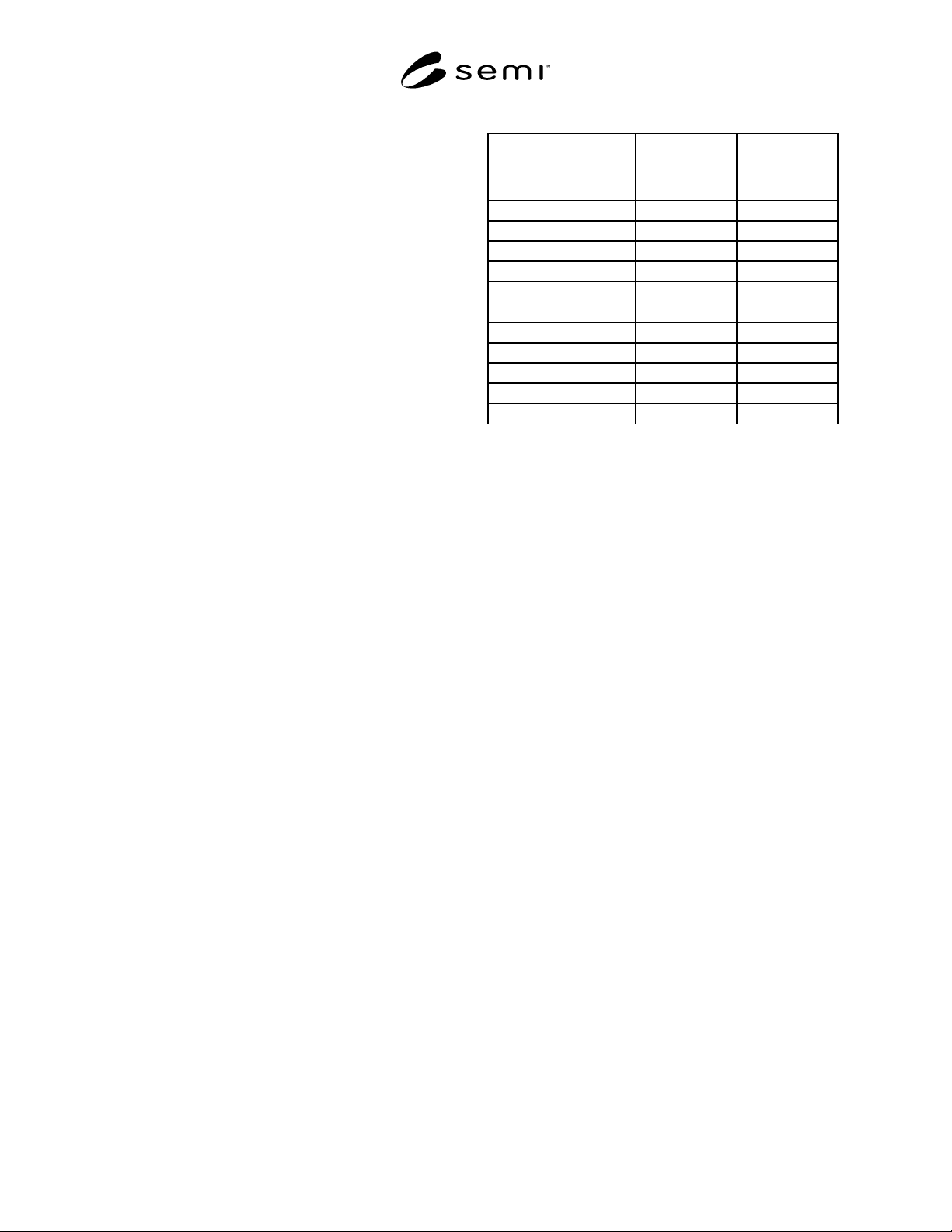
14.2 Perform the parametric test before any cycling is
done and note the resulting data on the data sheet
(Table 1). This is the first readpoint (see Figure 1).
Table 1 Data Sheet for Reliability Testing
READPOINT
(Cumulative cycles
applied to the MFC)
FAILURE
TYPE — SOFT
OR HARD
SOFT
FAILURE
TYPE*
0 (baseline)
10,000
40,000
100,000
200,000
300,000
450,000
600,000
750,000
875,000
1,000,000
*Use the following soft failure types:
A = Accuracy/Repeatability
P = Particles
S = Step Response
L = Leakage
SEMI E67-0304 © SEMI 1997, 2004 4
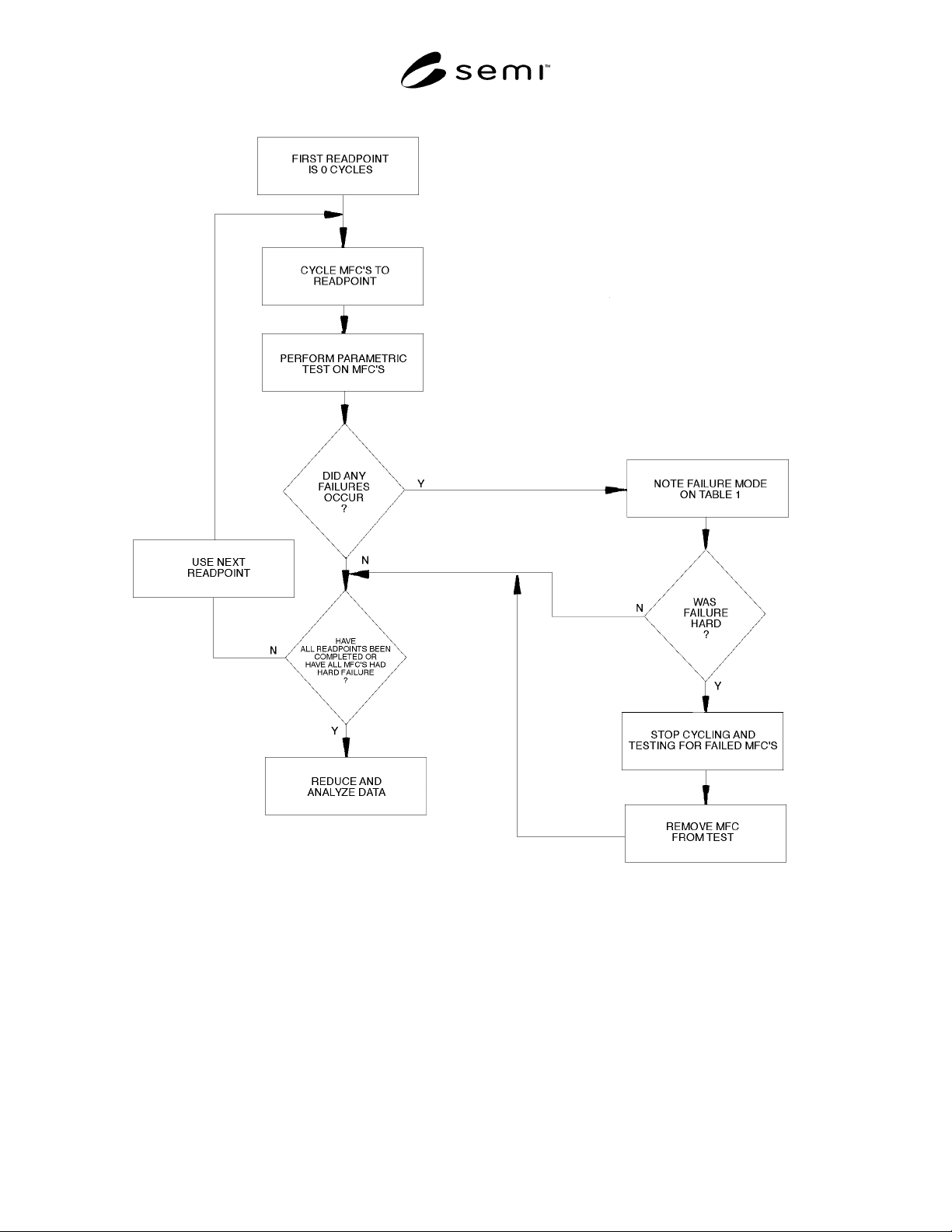
Figure 1
Flowchart for Reliability Test Procedure
NOTE: Do not count the cycles that occur during the parametric test.
14.3 Cycle the MFCs to the next readpoint in Table 1. Two types of cycles are applied to the MFC to simulate more
realistically the MFC’s field environment. Alternate between the two types of cycles as illustrated in Figure 2.
Maintain each setpoint for a fixed period of time. Use one of the following times based upon the settling time of the
slowest DUT. If the settling time is less than or equal to 1.25 seconds, use a time period of 2.5 seconds. If the
settling time is less than or equal to 2.5 seconds and greater than 1.25 seconds, use a time period of 5 seconds. If the
settling time is greater than 2.5 seconds, use a time period of twice the settling time.