semi合集-English.pdf - 第3487页
SEMI E134-0305 © SEMI 2004, 2005 40 12.2.14 DataCollectionPlan-Active Transition Table Table 52 DataColle ctionPlan-Active Transition Definition Num Previous State Trigger New State Actions 18 (no state) DCP is activated…

SEMI E134-0305 © SEMI 2004, 2005 39
for DCPs in the Active state on the equipment. The transitions described in this state model are not to be made
available for event data collection.
12.2.2 While in the Active state, if the equipment experiences internal communication or operational failures that
prevent the collection of event, exception, or trace data requested by the DCP, the equipment shall not de-activate
the DCP. If the values of any requested parameters can’t be obtained or refreshed as a result of such communication
failures, the equipment shall use the “NoValue” class (see Section 14.2.1.4) as the reported ParameterValue for all
such affected parameters. The equipment is not required to take any other actions to notify consumers of such
failures.
12.2.2.1 Consumers should be aware that such failures may temporarily prevent the equipment from reporting
requested events or exceptions altogether, and/or result in reporting “NoValue” (see Section 14.2.1.4) for requested
parameters affected by the failure. In the event that the equipment recovers from such failures and any affected
DCPs are still active, the equipment shall resume reporting all event, exception, and trace data whose reporting had
been affected by the failure.
12.2.3 DCPBuffering — This is the top level state for describing the event, exception, and trace buffering behavior
of the DCP
12.2.4 NotBuffering — The DCP is immediately sending DataCollectionReports for each requested event and
exception as they are detected. TraceReports may be individually buffered, according to the ‘groupSize’ setting of
the DCP’s TraceRequests (see Section 11.1.5), but are also sent in the DataCollectionReport format (see Section
14.1 ). This state is only active if the DataCollectionPlan attribute ‘intervalInMinutes’ attribute is set to 0.
12.2.5 Buffering — The DCP is storing all events, exceptions, and trace data in an internal buffer in the order in
which they occur. Buffered data is sent in a single DataCollectionReport (see Section 14.1) when
‘intervalInMinutes’ expires, or when the equipment’s DCP buffering capacity has been reached, whichever occurs
first. The equipment continues buffering new data for the next interval, sending a single DataCollectionReport
when ‘intervalInMinutes’ expires. Each DataCollectionReport sent at the end of each interval contains only the data
collected during that interval. The equipment continues this buffering/sending cycle as long as the DCP is active.
This state is only active if the DataCollectionPlan attribute ‘intervalInMinutes’ attribute is > 0.
12.2.6 NotSending — The DCP is waiting for a DataCollectionReport to become ready for sending to the consumer
who activated the plan.
12.2.7 Sending — The DCP is sending a DataCollectionReport to the consumer that activated this DCP (see Section
14.1).
12.2.8 MonitoringEventRequests — The DCP is actively tracking and reporting any event requests provided with
the DCP. This is the top level state for the WaitingForEvent state.
12.2.9 WaitingForEvent — The DCP is waiting for the occurrence of any of the requested events defined in the
DCP.
12.2.10 MonitoringExceptionRequests — The DCP is actively tracking and reporting any exception requests
provided with the DCP. This is the top level state for the WaitingForException state.
12.2.11 WaitingForException — The DCP is waiting for the occurrence of any of the requested exceptions
specified in the DCP.
12.2.12 MonitoringTraceRequests — The DCP is actively tracking and reporting the results from any trace requests
provided with the DCP. This is the top level state for the TraceRequestMonitor-i states.
12.2.13 TraceRequestMonitor-i — For each trace request provided with the DCP, there is an independently-
executing TraceRequestMonitor-i (i = 0 up to the number of trace requests included in the DCP) that defines the
DCP reporting behavior for trace requests. This state contains substates that are described in Section 12.3.

SEMI E134-0305 © SEMI 2004, 2005 40
12.2.14 DataCollectionPlan-Active Transition Table
Table 52 DataCollectionPlan-Active Transition Definition
Num Previous State Trigger New State Actions
18 (no state) DCP is activated NotBuffering The DCP’s ‘intervalInMinutes attribute
is inspected to determine whether or
not the DCP should be buffering event,
exception, and trace data results. If set
to 0, the DCP shall immediately send
event, exception, and trace results as
they occur. See Section 12.2.4 for
further explanation.
19 NotBuffering DCP
‘intervalInMinutes’
attribute is > 0.
Buffering The DCP begins buffering all event,
exception, and trace results in the order
that they occur. See Section 12.2.5 for
further explanation.
20 (no state) DCP is activated. NotSending The DCP begins waiting for a
DataCollectionReport to be made
available for sending to the consumer.
21 NotSending A new
DataCollectionReport is
ready to be sent to the
consumer.
Sending The DCP sends the
DataCollectionReport to the consumer.
22 Sending A DataCollectionReport
has been sent to the
consumer.
NotSending The DCP waits for a
DataCollectionReport to be made
available for sending to the consumer.
23 (no state) DCP is activated. WaitingForEvent The DCP begins waiting for the
occurrence of any requested events.
24 WaitingForEvent A requested event has
been detected.
WaitingForEvent The DCP creates an EventReport
containing the parameters requested
for that event (see Section 14.1.3). If
the DCP is not buffered, a new
DataCollectionReport (see Section
14.1 ) is created containing the Event
Report and made available for sending.
If the DCP is buffered, the
EventReport is added to the DCP
buffer in the order in which it was
detected. The equipment continues
waiting for the occurrence of any
requested events.
25 (no state) DCP is activated. WaitingForException The DCP begins waiting for the
occurrence of any requested
exceptions. Any exceptions in the DCP
whose state the equipment tracks and
that have been detected at the time the
DCP is activated are immediately
buffered or sent to the consumer in a
single DataCollectionReport, formatted
according to Section 14.1. The current
state of each exception shall be
provided in their individual
ExceptionReports (see Section 14.1.4).
SEMI E134-0305 © SEMI 2004, 2005 41
Num Previous State Trigger New State Actions
26 WaitingForException An exception matching
the criteria specified in
an exception request has
occurred.
WaitingForException The DCP creates an ExceptionReport
for the exception (see Section 14.1.4).
If the DCP is not buffered, a new
DataCollectionReport (see Section
14.1) is created containing the
ExceptionReport and made available
for sending. If the DCP is buffered,
the ExceptionReport is added to the
DCP buffer in the order in which the
exception was detected.
27 (no state) DCP is activated. TraceRequestMonitor-i The DCP begins monitoring any trace
requests. See Section 12.3 for further
explanation.
12.3 Trace Request State Model
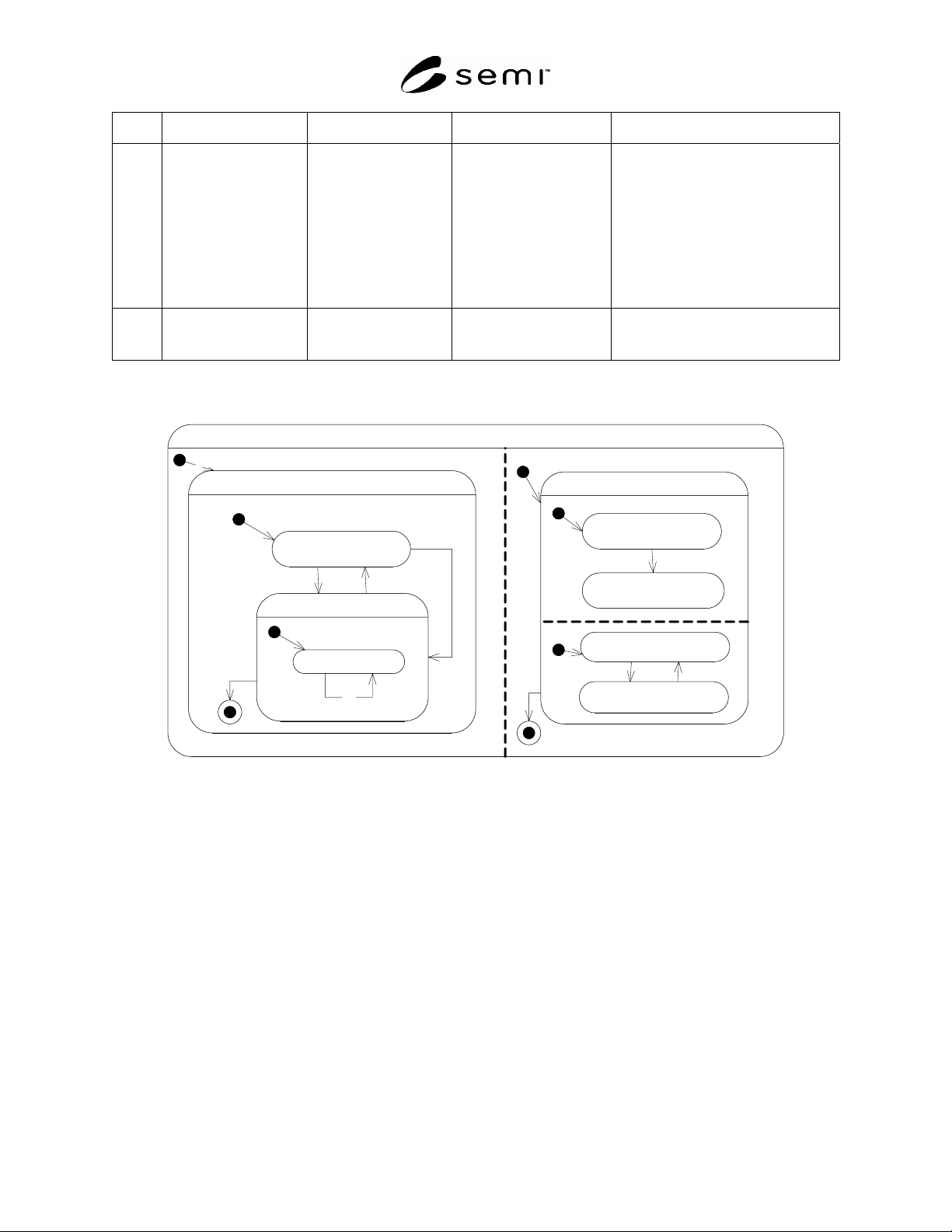
Figure 22
TraceRequest State Model
12.3.1 The purpose of the trace request state model is to define a consumer’s view of DCP trace behavior while in
the Active state of the DataCollectionPlan state model. Each trace request within each active DCP shall execute
independently, as described in this state model. The equipment supplier is not required to provide a direct, literal
implementation of this state model. It is documented here to provide a precise definition of the required behavior
for DCP trace activity on the equipment. The transitions described in this state model are not to be made available
for event data collection.
12.3.2 TraceRequestMonitor-i — This is the top level state for describing the behavior of a single trace request
within a single DCP in the Active state. Each trace request within each active DCP executes this state model
independently.
12.3.3 Tracing — This is the top level state for trace activity for a single trace request.
12.3.4 Disabled — The DCP is not performing trace data collection. The DCP is waiting for the occurrence of a
start trigger defined for this trace request.
35
TraceRequestMonitor-i
H
28
Tracing
29
H
Disabled
3130
Enabled
H
WaitingForInterval33
34
H
36
H
TraceRequestBuffering
37
H
NotBufferingTraceResults
38
BufferingTraceResults
39
H
NotSendingTraceResults
41
40
SendingTraceResults
42
H
32