semi合集-English.pdf - 第3207页
SEMI E127-0705 © SEMI 2003, 2005 8 Parameter Name Description Format: Possible Value 6.3.4 Service Message Definition — A service message definition table de fines the parameters used in a service, as shown in the follow…
SEMI E127-0705 © SEMI 2003, 2005 7
6.1.6 Lists of Data — Lists of data shall be identified as 0+ when a null list is permitted. Otherwise, they shall be
identified as 1+.
6.2 State Model Conventions
6.2.1 This document uses the Harel state chart convention for describing dynamic operation of defined objects. The
outline of this convention is described in an attachment of SEMI E30. The official definition of this convention is
described in “State charts: A Visual Formalism for Complex Systems” written by D. Harel in Science of Computer
Programming 8, 1987.
6.2.2 The Harel convention has no concepts of “creation” and “extinction” for expressing the state model of a
temporary entity. The “job” described in this document is such an entity, and a copy of the same state model is used
for an independent job newly created. In this document, a circle with a black circle inside is used for expressing
extinction of an entity. A filled black circle denotes the entry to the state model (the entity creation). This is the
convention used in the OMT notation as well.
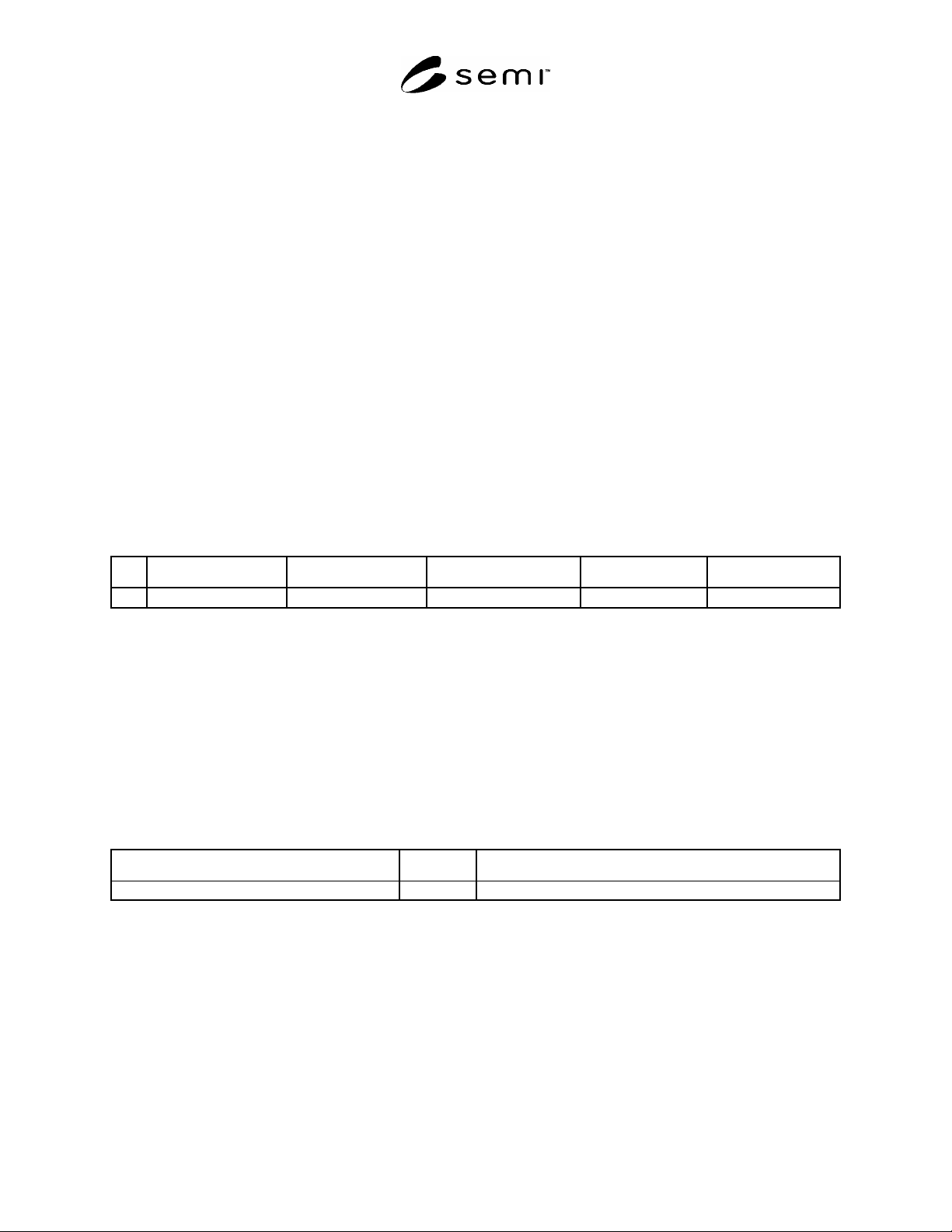
6.2.3 Transition tables are provided in conjunction with the state diagrams to explicitly describe the nature of each
state transition as shown in the state model diagram. A transition table contains columns for Transition number,
Previous State, Trigger, New State, Actions, and Comments. The “trigger” (column 3) for the transition occurs
while in the “previous” state. The “actions” (column 5) includes a combination of:
1. Actions taken upon exit of the previous state.
2. Actions taken upon entry of the new state.
3. Actions taken which are most closely associated with the transition.
No differentiation is made between these cases.
# Previous State Trigger New State Actions Comments
6.2.4 State models are referred to in the Event Variables tables as an acronym consisting of the first letters of the
state model name, ending in “SM” for State Model. Specific transitions with the state model are represented with
the state model acronym plus “-Tn”, where n represents the number of the transition. State model transitions
without numbers are not expected to be reported.
6.3 Service Message Representation
6.3.1 Services are functions or methods that may be provided by either the equipment or the host. A service
message may be either a request message, which always requires a response, or a notification message, which does
not require a response.
6.3.2 Service Definition Table — A service definition table defines the specific set of messages for a given service
resource, as shown in the following table:
Message Service Name Type Description
6.3.2.1 Type can be either “N” = Notification or “R” = Request & Response.
6.3.2.2 Notification type messages are initiated by the service provider (e.g., the equipment) and the provider does
not expect to get a response from the service user. Request messages are initiated by a service user (e.g., the host).
Request messages ask for data or an activity from the provider. Request messages expect a specific response
message (no presumption on the message content).
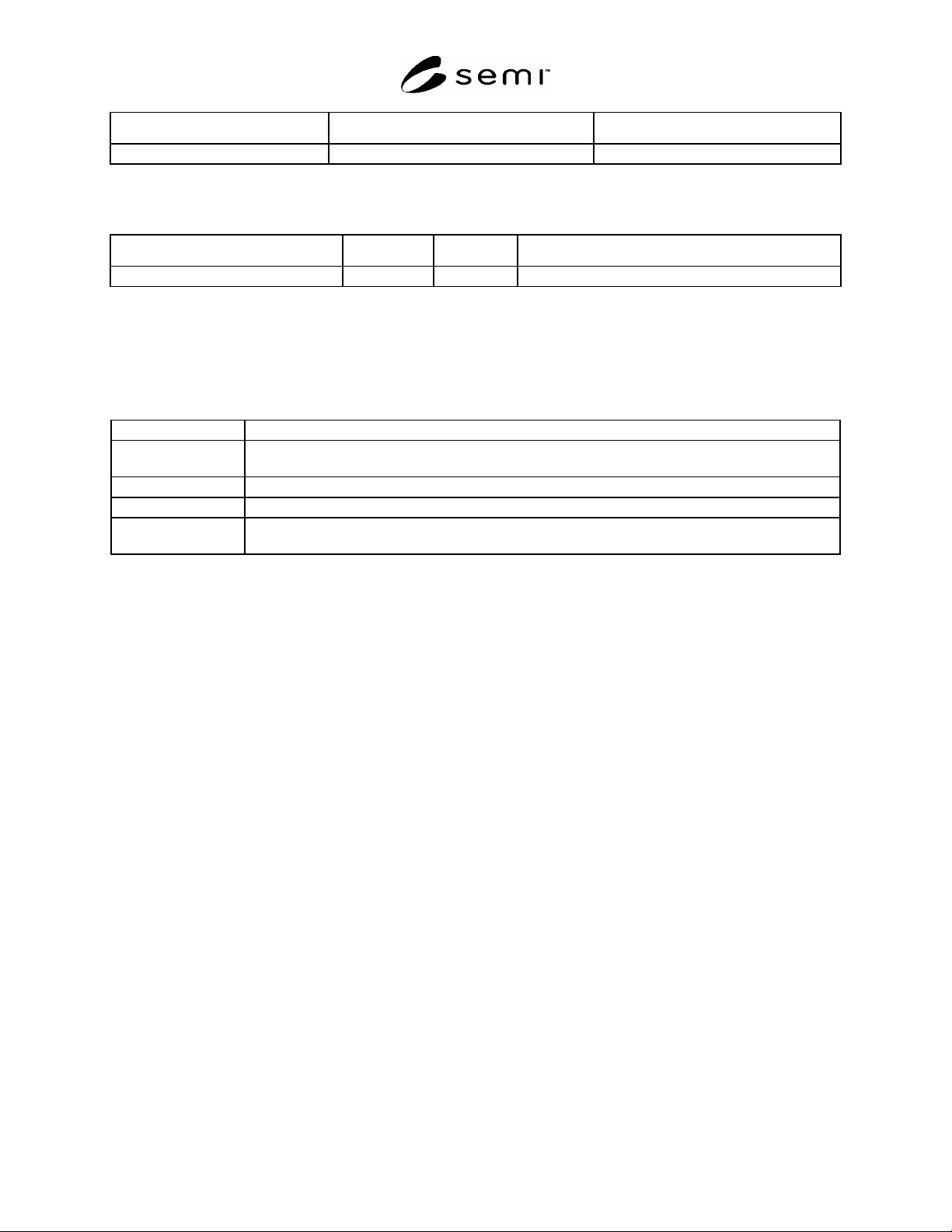
6.3.3 Service Parameter Dictionary — A service parameter dictionary table defines the description, format and its
possible value for parameters used by services, as shown in the table below. A row is provided in the table for each
parameter of a service. See SEMI Compilation of Terms for the definition of “form” for both the list of valid data
type formats and for the different types of these formats.
SEMI E127-0705 © SEMI 2003, 2005 8
Parameter Name Description Format: Possible Value
6.3.4 Service Message Definition — A service message definition table defines the parameters used in a service, as
shown in the following table:
Parameter Req/Ind Res/Cnf Comment
6.3.4.1 The columns labeled REQ/IND and RSP/CNF link the parameters to the direction of the message. The
message sent by the initiator is called the “Request”. The receiver terms this message the “Indication” or the
request. The receiver may then send a “Response” which the original sender terms the “Confirmation”.
6.3.4.2 The following codes appear in the REQ/IND and RSP/CNF columns and are used in the definition of the
parameters (e.g., how each parameter is used in each direction):
M Mandatory Parameter — Must be given a valid value.
C Conditional Parameter — May be defined in some circumstances and undefined in others. Whether a
value is given may be completely optional or may depend on the value of the other parameter.
U User-Defined Parameter.
- The parameter is not used.
= ( For response only ) Indicates that the value of this parameter in the response must match that in the
primary (if defined ).
7 General Requirements
7.1 Protocol Requirements
7.1.1 The communication protocol used must support use of all data types, including lists, structures, and arrays.
7.2 Required Standards
7.2.1 This section discusses specific SEMI standards that have been assumed for the proper operation of an
integrated measurement module (IMM) as specified in this document.
7.2.2 SEMI E40 — Fundamental compliance to SEMI E40 for Processing Management is required. A process job
queue is not required unless the IMM is capable of holding multiple substrates.
7.2.3 SEMI E90 — Fundamental compliance to SEMI E90 for Substrate Objects and Substrate Location Objects is
required.
7.2.4 SEMI E116 — Fundamental compliance to SEMI E116 (Equipment Performance Tracking) is required. The
IMM is to be considered an EPT Module. Guidance for implementing EPT for the IMM is provided in Related
Information 2.
7.3 Required Basic Capabilities
7.3.1 The requirements in this section are concerned with basic capabilities that may be satisfied in different ways.
Because of this flexibility, the method supported must be clearly documented by the IMM supplier. The IMM
Control Client should allow on-line configuration by a user to achieve seamless “plug and play” integration.
NOTE 2: New standards are evolving and may become the required method for satisfying these basic capabilities in the future.
7.3.1.1 These capabilities are specified between the IMM and its control client. If, as expected for integrated
measurement modules, the client is located within or near the process tool, it is up to the client to have the ability to
communicate the appropriate information (alarm reporting, recipe upload/download) to the host.

SEMI E127-0705 © SEMI 2003, 2005 9
7.3.2 Clock Management — The ability to provide accurate time/date information for reporting purposes is
required. In addition, standard methods for clock synchronization are mandatory. This requirement shall be
satisfied by compliance to the Clock object specification in SEMI E98.
7.3.3 Event Management — The ability for the IMM to report events and associated data of interest to its client is
required. Data provided with these events shall be configurable and shall be valid at the time of the event. Each
event report shall contain the date and time that the event occurred (and not the time that the report was sent). This
requirement may be satisfied through compliance to a standard event mechanism, such as the event reporting
capability defined in SEMI E30 or SEMI E53.
7.3.4 Alarm Management — The ability to report any change in its alarm conditions is required. An alarm
condition is either set or cleared. A set alarm represents danger to the factory, the module, the equipment, the
substrates, or the process. This capability may be satisfied through compliance to a standard alarm mechanism such
as is defined in SEMI E30 or SEMI E41.
7.3.5 Exception Management — An exception is an error. Exceptions may or may not be alarms, either because
they do not represent danger or because they represent occurrences that do not have a set or clear state. Exceptions
shall be reported and time-stamped at the time the exception occurs. This capability may be satisfied through
compliance a standard for exception management such to SEMI E41 or through reporting exceptions as events.
7.3.6 Recipe Management — Compliance to this standard requires the support of recipe upload and download and
directory functions as specified in one of the SEMI standards defining these methods, such as SEMI E30 for process
programs or SEMI E42 recipes.
NOTE 3: New standards for recipe management may be used for these purposes in the future, as they become available.
7.4 State Models
7.4.1 State Model Transitions — All numbered transitions in all state models defined in this standard represent
uniquely identifiable and reportable events unless otherwise noted.
7.4.2 State models in this specification represent behavior as it appears to the client and are used to provide events
to the communications partner. Actual state models implemented may differ. For example, a certain state model
transition in this document may combine multiple transitions as implemented. It is critical that event representation
of state model transitions as specified in the state models defined in this document be followed for reporting.
7.5 Objects
7.5.1 SEMI E39 — Fundamental compliance to SEMI E39 is required for all objects defined in, or required by, this
standard. In addition, the Integrated Measurement Module is considered an owner of all objects that it uses,
manages, or that are components. If the IMM supports all object types specified in this standard, then it is not
necessary to support the GetType service in SEMI E39. If all object types implemented have only those attributes
specified by name in this standard, then the service GetAttrName is not required. Filtering for GetAttr and SetAttr is
not required. Otherwise, to provide for a self-configuring interface, owner objects shall conform to the following
additional services defined in SEMI E39:
GetType
GetAttrName
GetServiceNames
GetServiceParameters
7.5.2 All objects defined in this standard shall satisfy the fundamental requirements of SEMI E39. It shall be
possible for the client to inquire about the attributes of one or more objects through the service GetAttr. It shall be
possible for the client to change the value of attributes designated as read/write (RW) using the service SetAttr.
7.5.3 For purposes of communicating using SEMI E39, all objects other than the IMM object itself shall be owned
directly by the IMM. The IMM itself is considered to be owned by its Client. For purposes of normal operations
during manufacturing, the factory host considers the Control Client as the IMM owner.