semi合集-English.pdf - 第6545页
SEMI G83-0301 © SE MI 2001 1 SEMI G83-0301 SPECIFIC A TI ON FOR BAR CODE MA RKI NG OF PRODUCT PA CKA GES This specif ication was technic ally approved by the Global A ssembly & P ackaging Committee and is the direct …

SEMI G82-0301
E
© SEMI 2001 6
NOTICE: SEMI makes no warranties or representations as to the suitability of the standard set forth herein for any
particular application. The determination of the suitability of the standard is solely the responsibility of the user.
Users are cautioned to refer to manufacturer’s instructions, product labels, product data sheets, and other relevant
literature respecting any materials or equipment mentioned herein. These standards are subject to change without
notice.
The user’s attention is called to the possibility that compliance with this standard may require use of copy-righted
material or of an invention covered by patent rights. By publication of this standard, SEMI takes no position
respecting the validity of any patent rights or copyrights asserted in connection with any item mentioned in this
standard. Users of this standard are expressly advised that determination of any such patent rights or copyrights, and
the risk of infringement of such rights, are entirely their own responsibility.
Copyright by SEMI® (Semiconductor Equipment and Materials
International), 3081 Zanker Road, San Jose, CA 95134. Reproduction o
f
the contents in whole or in part is forbidden without express writte
n
consent of SEMI.

SEMI G83-0301 © SEMI 20011
SEMI G83-0301
SPECIFICATION FOR BAR CODE MARKING OF PRODUCT
PACKAGES
This specification was technically approved by the Global Assembly & Packaging Committee and is the
direct responsibility of the Japanese Packaging Committee. Current edition approved by the Japanese
Regional Standards Committee on December 1, 2000. Initially available at www.semi.org January 2001; to
be published March 2001.
1 Purpose
1.1 This specification describes the area needed for
adding bar codes, the bar code specifications, and the
code notation format for direct and indirect material
product packages (unit packs) for semiconductor
packaging.
1.2 The following are the goals of this specification:
• Quality control using computers
• Prevention of mistakes created by human error
• Material control at the manufacturing site
1.3 The following is not a goal of this specification:
• Purchasing control
2 Scope
2.1 This specification is to be used for direct and
indirect materials relating to packaging materials.
2.2 This specification is to be used for product
packages only.
2.3 This standard does not purport to address safety
issues, if any, associated with its use. It is the
responsibility of the users of this standard to establish
appropriate and safety health practices and determine
the applicability of regulatory limitations prior to use.
3 Referenced Standards
3.1 SEMI Standards
SEMI G71 — Specification for Barcode Marking of
Intermediate Containers for Packaging Materials
3.2 AIM Specifications
1
USS-39 — Universal Symbol Specification code 39
USS-128 — Universal Symbol Specification code 128
3.3 ANSI Specifications
2
ANSI X3.182 — Bar code Print Quality - Guideline
1 AIM International Inc., 11860 Sunrise Valley Drive, Suite 100,
Reston, VA 20191, tel 703.391.7621, fax 703.391.7624
2 American National Standards Institute, 11 West 42nd Street, New
York, NY 10036, tel 212.642.4900, fax 212.398.0023
NOTE 1: As listed or revised, all documents cited shall be the
latest publications of adopted standards.
4 Terminology
4.1 Many of the items relating to b ar code technology
are defined in the AIM Glossary of Terms, ANSI
X3.182 (Bar code Print Quality Guidelines).
4.1.1 data field
— field (area) for ad ding a bar code to
a product package.
4.1.2 direct material
— components and parts that
make up a semiconductor package. Examples include
lead frames, molding compounds, bonding wires, die
bonding materials, etc.
4.1.3 HRI (Human Readable Identification)
—
characters that can be read by a human.
4.1.4 indirect material — suppleme ntary materials and
parts used during processing but that do not make up a
semiconductor package. Examples include bonding
capillaries, dicing blades, etc.
4.1.5 intermediate container
— con tainer that holds
one or more product packages for product/order
separation in a shipping container or final container.
4.1.6 product package
— the smalle st package format,
made by a single material. Also called a unit pack.
4.1.7 shipping pack — package or s hipping
container/final container (see Figure 1) that is strong
enough for industrial use for product packaging,
storage, and shipping.
Shipping Pack Intermediate container
Product package (unit pack)
Figure 1
Package Form Regulations
SEMI G83-0301 © SEMI 2001 2
5 Requirements
5.1 Data Field
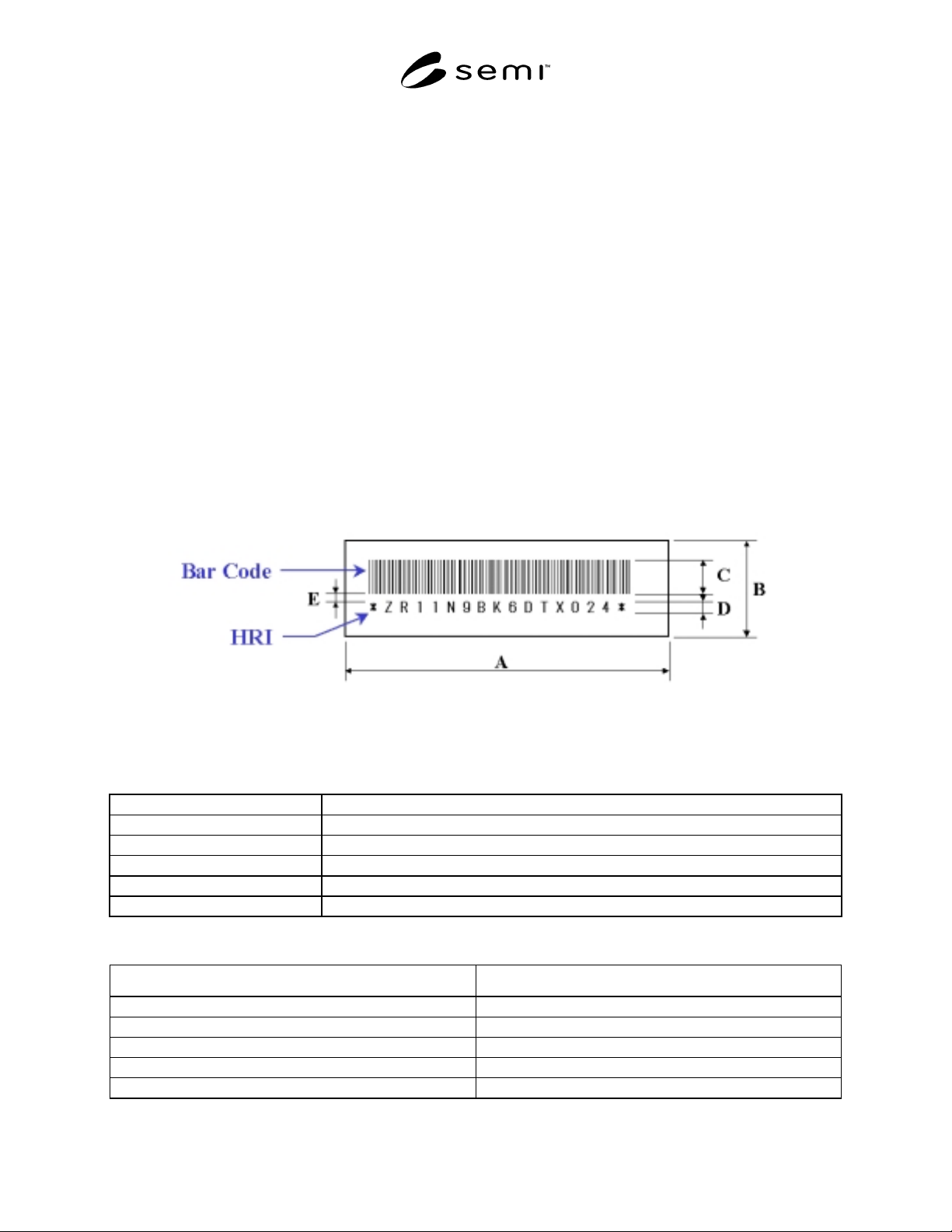
5.1.1 Length is 42 mm or greater, he ight is 15 mm or
greater (see Figure 2 and Table 2).
5.1.2 The noted content bar code is HRI.
5.2 Bar Code
5.2.1 Bar code character — Bar code characters
specified by AIM USS-39 or AIM USS-128 shall be
used.
5.2.2 Printing quality — according to ANSI X3.182
Bar code Print Quality Guidelines.
5.2.3 Code dimensions — the bar co de dimensions
will be as listed in Table 1.
5.2.4 Restrictions on use of Code 128 — use only code
set B. Also, do not use shift characters within data.
5.2.5 The data digit count will be fro m 15 to 26
(excluding start/stop characters and check characters).
5.2.6 Use check character.
5.3 HRI ( Human Readable Identification )
5.3.1 Just below the bar code located in the data field,
a field for HRI characters is noted.
5.3.2 The HRI height will be 3.0 mm or greater.
5.3.3 The space between the HRI an d bar code shall be
1.0 mm or greater (see Figure 2 and Table 2).
5.4 Data Contents
5.4.1 Includes items listed in Table 3.
5.4.2 The sequence, from left to right is as follows: the
product recognition number, manufacturing date, sub-
lot number, and lot number.
5.4.3 Product recognition number and lot number shall
be included.
5.4.4 Manufacture date and sub-lot n umber shall be
written in fixed digits. Remaining unused digits shall
be filled by minus codes “-”.
Figure 2
Data Field Dimensions and Placement
Table 1 Code Dimensions
Code 39, Code 128 Dimensions
Minimum element width 0.15 mm or greater.
Code 39 wide bar width Greater than 2 times, but less than 3 times the minimum element width.
Gap between characters Minimum element width or greater.
Character height 8.0 mm or greater.
Quiet zone 10 times or greater than the minimum element size (before and after the bar code).
Table 2 Data Field Dimensions
Item Dimensions
Data field length A ≥ 42 mm
Data field height B ≥ 15 mm
Bar code height C ≥ 8 mm
HRI character height D ≥ 3 mm
Space between bar code and HRI E ≥ 1 mm