semi合集-English.pdf - 第4796页
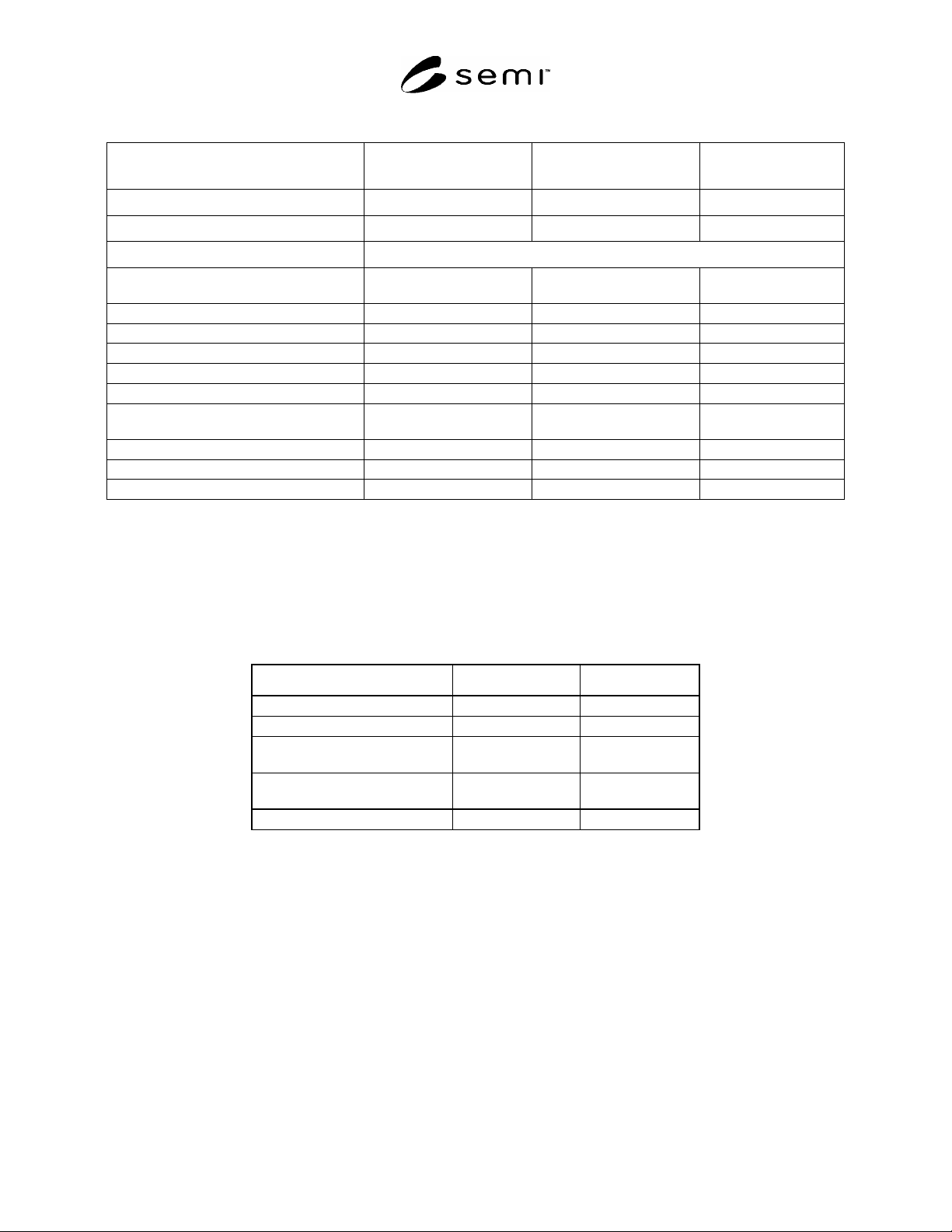
SEMI C57-0305 © SEMI 2005 2 Table 1 Impurity a nd Other Requirements for Various Grades of Argon Previous SEMI Reference # C3.1-1101 (Specification) C3.46-1102 (Specification) C3.42-90 (Guideline) Grade 4.8 5.2 6.0 Purit…

SEMI C57-0305 © SEMI 2005 1
SEMI C57-0305
SPECIFICATIONS AND GUIDELINES FOR ARGON
This specification was technically approved by the Global Gases Committee and is the direct responsibility of
the North American Gases Committee. Current edition approved by the North American Regional Standards
Committee on December 10, 2005. Initially available at www.semi.org January 2005; to be published March
2005.
NOTICE: This document replaced SEMI C3.1, SEMI C3.42, and SEMI C3.46 in 2005.
1 Purpose
1.1 The purpose of this document is to provide a series of specifications for different grades of Argon (Ar) that are
used in the semiconductor industry.
2 Scope
2.1 This document covers requirements for all grades of Argon used in the semiconductor industry.
2.2 If analytical methods are not complete, the requirements are presented as a guideline.
NOTICE: This standard does not purport to address safety issues, if any, associated with its use. It is the
responsibility of the users of this standard to establish appropriate safety and health practices and determine the
applicability of regulatory or other limitations prior to use.
3 Description
3.1 Argon is the most abundant member of the rare gas family. It is monatomic and is characterized by its extreme
chemical inactivity. Argon is a colorless, odorless and tasteless gas somewhat soluble in water. It is normally
delivered and stored as a cryogenic liquid.
4 Limitations
4.1 None.
5 Referenced Standards
5.1 SEMI Standards
SEMI C1 — Specifications for Reagents
SEMI C3 — Specifications for Gases
NOTICE: Unless otherwise indicated, all documents cited shall be the latest published versions
6 Terminology
6.1 Terminology appropriate to this standard is defined in SEMI C3.
7 Requirements
7.1 Purity and other requirements for the various grades of Argon are given in Table 1.
SEMI C57-0305 © SEMI 2005 2
Table 1 Impurity and Other Requirements for Various Grades of Argon
Previous SEMI Reference #
C3.1-1101
(Specification)
C3.46-1102
(Specification)
C3.42-90
(Guideline)
Grade 4.8 5.2 6.0
Purity 99.998% 99.9992% 99.99990%
#1
Impurities Maximum Acceptable Level (ppm)
#2
Carbon monoxide and carbon dioxide
(CO + CO
2
)
0.5 0.5 N/A
Carbon Dioxide (CO
2
) N/A N/A 0.05
Carbon Monoxide (CO) N/A N/A 0.05
Hydrogen (H
2
) 1 1 0.10
Nitrogen (N
2
) 10 5 0.5
Oxygen (O
2
) 2 0.5 0.05
Total Hydrocarbons expressed as Methane
(THC)
0.5 0.5
0.1
Water (H
2
O) (v/v) 1 0.5 0.1
TOTAL SPECIFIED IMPURITIES 15 8 0.95
Particles
#3 #3 #3
#1
A purifier is allowed to be used to meet this specification.
#2
An analysis of significant figures has not been considered. The number of significant figures is based on analytical accuracy and the precision
of the provided procedure.
#3
To be determined between supplier and user.
8 Physical Constants
8.1 The physical constants of argon are given in Table 2 (for information only).
Table 2 Physical Constants of Argon (for information only)
Metric Units US Units
Molecular weight 39.948 39.948
Boiling point at 1 atm 185.9°C 302.6°F
Density of gas at 21.1°C (70°F)
and 1 atm
1.656 kg/m
3
0.1034 lb/ft
3
Specific gravity of gas at 21.1°C
and 1 atm (air = 1)
1.38 1.38
Density of liquid at boiling point 139 kg/m
3
8.698 lb/ft
3
9 Analytical Procedures for Grade 4.8 Argon
NOTE 1: Introduce the calibration standard as many times as necessary to achieve the desired precision.
NOTE 2: All gases used in the analysis of the sample should contain no more than 10% of the sample value of the component of
interest unless otherwise specified.
9.1 Carbon Monoxide and Carbon Dioxide — This procedure is for the determination of carbon monoxide and
carbon dioxide in argon using a gas chromatograph with a flame ionization detector and methanizer.
9.1.1 Detection Limit — 100 ppb
9.1.2 Instrument Parameters
9.1.2.1 Column: Porapak T or Q, 3 m (9.8 ft) by 3.2 mm (1/8 in) OD by 2.2 mm (0.085 in) ID stainless steel; or
Chromosorb 102, 2 m (6.6 ft) by 3.2 mm (1/8 in) OD by 2.2 mm (0.085 in) ID stainless steel; or equivalent.
9.1.2.2 Carrier Flow: 30 mL/min helium
SEMI C57-0305 © SEMI 2005 3
9.1.2.3 Sample Volume: 0.5 to 2.0 mL
9.1.2.4 Temperatures:
Detector
280C
Column Oven
60C
Methanizer
350C
9.1.3 Calibration Standards — 1–5 ppm carbon monoxide, 1–5 ppm carbon dioxide, balance argon.
9.1.4 Operating Procedure
9.1.4.1 Inject the calibration standard into the column using a gas sampling valve. Record the retention times and
peak areas. The order of elution is carbon monoxide, carbon dioxide.
9.1.4.2 Inject the sample to be tested in same manner as the calibration standard. Record the retention times and
peak areas.
9.1.4.3 Repeat ¶9.1.4.1.
9.1.4.4 Compare the average peak areas of the calibration standard to that of the argon sample being tested.
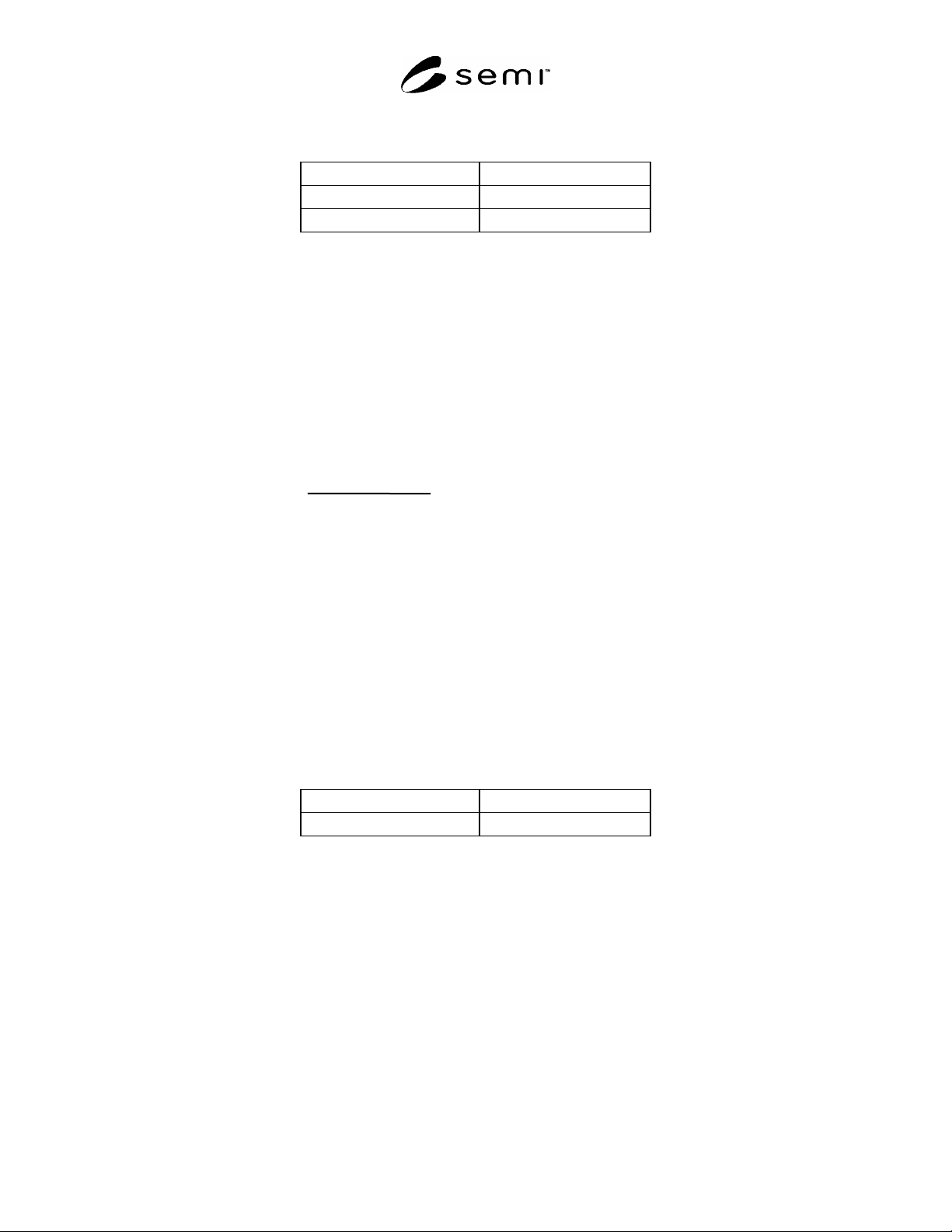
Calculate the concentrations of carbon monoxide and carbon dioxide, using the formula below.
9.1.4.5 The result may not exceed the specification in Table 1.
9.2 Hydrogen and Nitrogen — This procedure is for the determination of hydrogen and nitrogen in argon using a
gas chromatograph with a helium ionization detector.
9.2.1 Detection Limit — 0.5 ppm
9.2.2 Instrument Parameters
9.2.2.1 Column: 5A molecular sieve, 65.6 m (20 ft) by 3.2 mm (1/8 in) OD by 2.2 mm (0.085 in) ID stainless steel
or equivalent.
9.2.2.2 Carrier Flow: 30 mL/min helium.
9.2.2.3 Sample Volume: 1.0 to 3.0 mL
9.2.2.4 Temperatures:
Detector
125C
Column Oven
25C
9.2.3 Calibration Standard — 1–5 ppm hydrogen in argon, 10–30 ppm nitrogen in argon.
9.2.4 Operating Procedure
9.2.4.1 Inject the calibration standard into the column using a gas sampling valve. Record the retention times and
peak areas.
9.2.4.2 Inject the sample to be tested in same manner as the calibration standard. Record the retention times and
peak areas.
9.2.4.3 Repeat ¶9.2.4.1. (See Note 1.)
Sample Peak
Area
Standard Peak Area
Concentration
of standard
Concentration
of sample