semi合集-English.pdf - 第694页
SEMI E89-1104 E © SEMI 1999, 2004 21 RELATED INFORMATION 6 EXAMPLE ILLUSTRATING THE DI FFERENCES BETWEEN NESTED AND CROSSED EFFECTS NOTICE: This related information is not an of f ici al part of SE MI E89 . It w as deriv…
SEMI E89-1104
E
© SEMI 1999, 2004 20
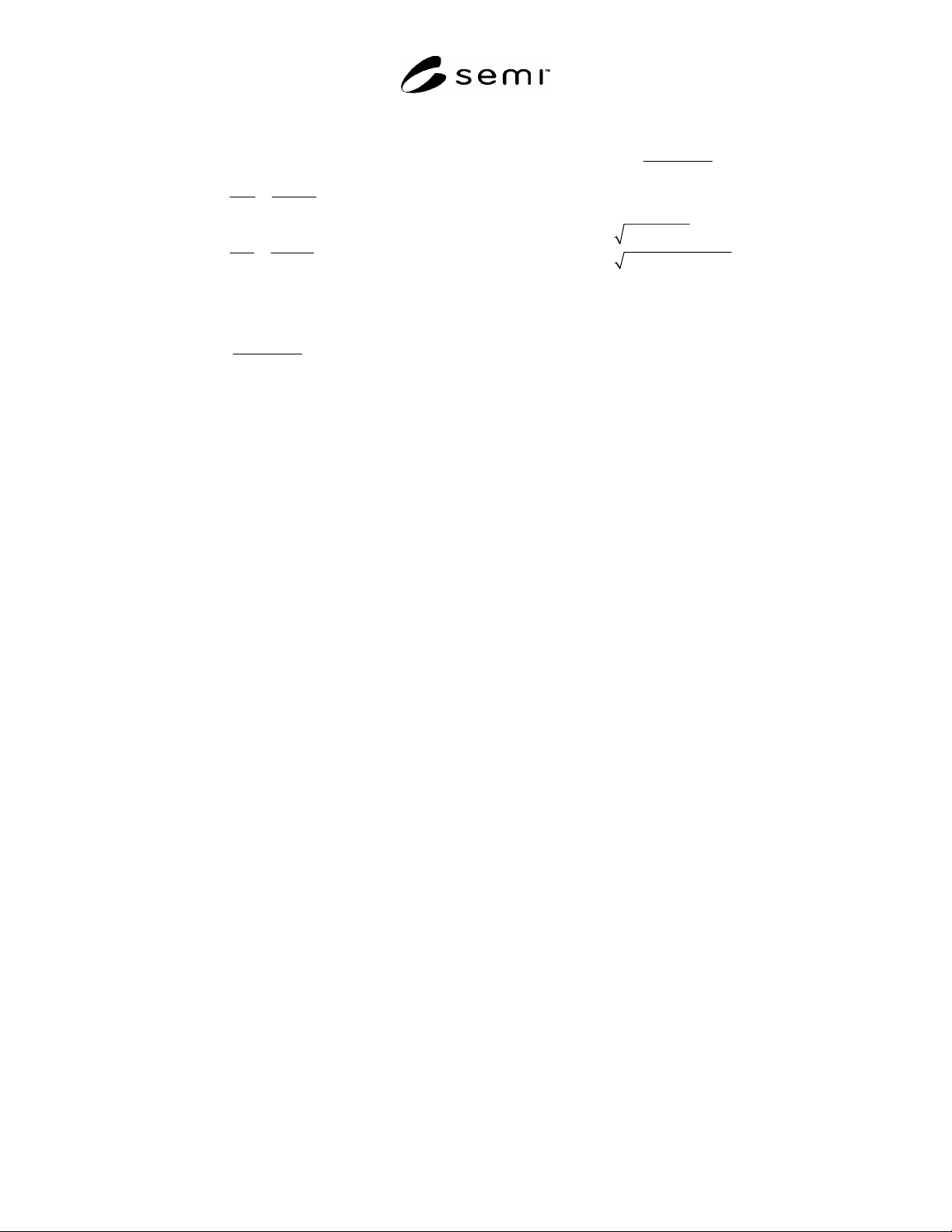
R5-2.5 Calculate the Mean Squares for both Load
(MS
L
) and Repeat (MS
r
) as the Sum of Squares divided
by degrees of freedom:
0.6830
0.3415
2
L
L
L
SS
MS
df
(R5-6)
5.2911
0.1603
33
r
r
r
SS
MS
df
(R5-7)
R5-2.6 The variance component for Repeatability
(VC
r
) is MS
r
. The variance component for Load is
0.01510
12
Lr
L
MS VC
VC
(R5-8)
R5-2.6.1 In general, the formula for VC
L
is
L
r
L
M
SVC
VC
n
(R5-9)
R5-2.7
Reproducibility is
0.1603 0.01510
0.4188
rrL
VC VC
(R5-10)
SEMI E89-1104
E
© SEMI 1999, 2004 21
RELATED INFORMATION 6
EXAMPLE ILLUSTRATING THE DIFFERENCES BETWEEN NESTED
AND CROSSED EFFECTS
NOTICE: This related information is not an official part of SEMI E89. It was derived from task force deliberations
during the revision of SEMI E89-0999 in 2001-2003. This related information was approved by full letter ballot
procedures and was approved for publication by the NA RSC on August 16, 2004.
R6-1 Introduction
R6-1.1 The following example illustrates the
differences between an MSA where all effects are
nested versus the same data when one of the factors is
treated as crossed. It is performed on a hypothetical
measurement instrument. Hand calculations are
provided and possible because the data are balanced.
Rounding of value may cause results may vary slightly.
R6-1.2
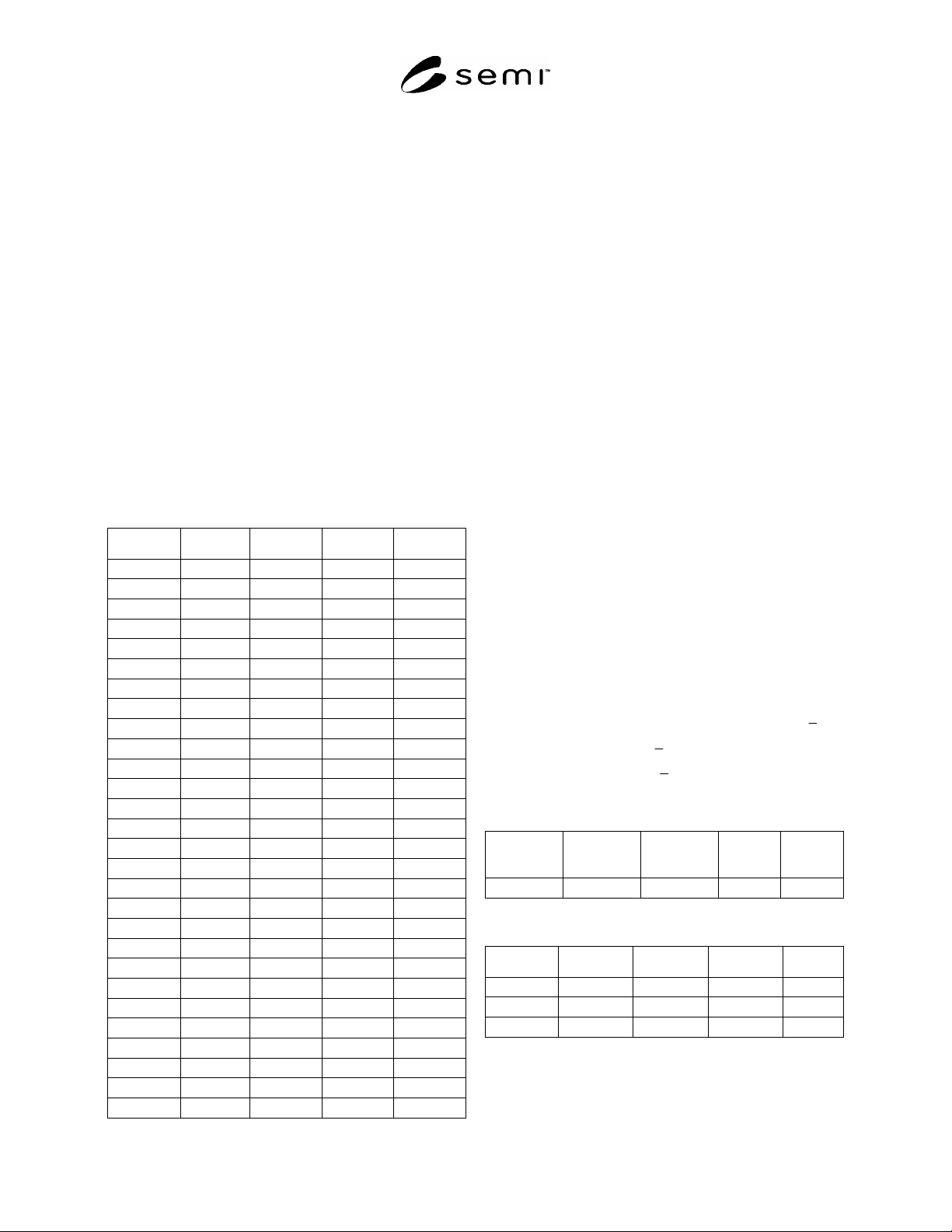
The data, shown in Table R6-1, consists of
seven repeated measurements per load and three loads
per sample. There are four samples.
Table R6-1 Data for Example
Sample Repeat Load 1 Load 2 Load 3
1 1 493.72 493.79 492.92
1 2 492.91 493.77 492.78
1 3 493.08 494.07 492.57
1 4 493.78 491.28 493.52
1 5 492.69 492.19 493.79
1 6 492.57 491.82 493.46
1 7 491.21 492.95 493.33
2 1 516.27 514.21 515.20
2 2 516.26 514.54 515.55
2 3 516.35 514.93 515.28
2 4 515.68 515.14 515.47
2 5 515.46 515.21 515.28
2 6 515.67 515.07 514.87
2 7 514.87 515.00 514.77
3 1 541.30 541.84 541.57
3 2 541.38 541.92 541.59
3 3 541.48 542.33 541.71
3 4 541.53 540.61 541.02
3 5 541.31 541.37 540.76
3 6 541.41 541.21 540.85
3 7 540.85 540.80 541.73
4 1 551.00 551.03 552.02
4 2 550.83 551.02 552.23
4 3 551.01 550.98 551.78
4 4 551.60 551.38 550.12
4 5 550.90 551.13 550.58
4 6 551.29 550.74 550.27
4 7 551.91 549.06 550.98
R6-2 Nested Effects
R6-2.1 Assume that each sample represents
measurements made on different days. Load would be
nested in day and repeat in Load and Day. Repeats
cannot be randomized among Loads or Days. A given
Repeat must occur in a specific Load and Day. It is
nested in both Load and Day. Likewise, Loads cannot
be randomized among Days. Load is nested in Day.
R6-2.2
The model for the MSA is
Y
ijk
=
+ d
i
+ l
ij
+ r
ijk
(R6-1)
Y
ijk
= measurement on the i
th
day, j
th
load, and k
th
repeat,
= true value of the measurand,
d
i
= error term associated with the i
th
day,
l
ij
= error term associated with the i
th
day, j
th
load,
and
r
ijk
= error term associated with the i
th
day, j
th
load,
and k
th
repeat.
R6-2.3 Day, Load, and repeatability are treated as
random effects. Load is nested in Day. Repeat is
nested within Day and Load.
R6-2.4 Calculate the mean over all observations (
Y
),
the mean for each day (
i
Y
), and the mean for each
load-by-day combination (
ij
Y
).
Table R6-2 Means for Each Day
Day 1 Day 2 Day 3 Day 4 Grand
Mean
492.96 515.29 541.36 551.04 525.16
Table R6-3 Means for Each Load by Day
Day 1 Day 2 Day 3 Day 4
Load 1 492.85 515.79 541.32 551.22
Load 2 492.84 514.87 541.44 550.76
Load 3 493.20 515.20 541.32 551.14
SEMI E89-1104
E
© SEMI 1999, 2004 22
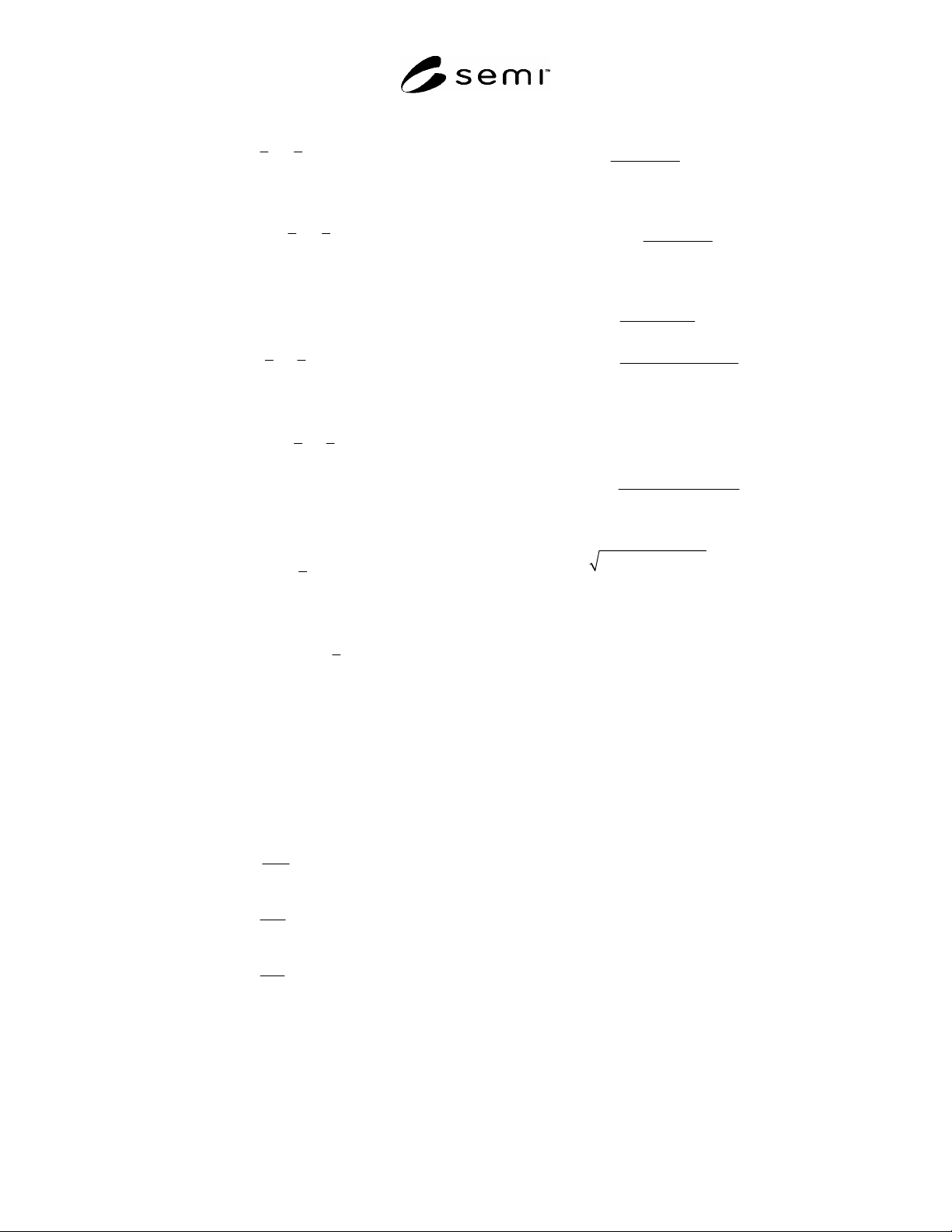
R6-2.5 Calculate the Sum of Squares for Day (SS
D
) as
4
2
1
21 43395
Di
i
SS Y Y
(R6-2)
R6-2.5.1 In general, the formula for SS
D
is
2
1
D
Dd i
i
SS n Y Y
(R6-3)
where n
d
is the number of observations per day and D
the number of days.
R6-2.6 Calculate the Sum of Squares for Load (SS
r
):
34
2
11
7 4.5352
Liji
ji
SS Y Y
(R6-4)
R6-2.6.1 In general, the formula for SS
L
is
2
11
LD
Liji
ji
SS n Y Y
(R6-5)
where n is the number of repeats per load and L the
number of loads.
R6-2.7 Calculate the Sum of Squares for Repeat (SS
r
):
734
2
111
28.6925
r ijk ij
kji
SS Y Y
(R6-6)
R6-2.7.1 In general, the formula for SS
r
is
2
111
nLD
r ijk ij
kji
SS Y Y
(R6-7)
R6-2.8 Calculate the degrees of freedom for Day (df
D
)
as D – 1. Calculate the degrees of freedom for Load
(df
L
) as D(L – 1). Calculate the degrees of freedom for
Repeat (df
r
) as DL(n – 1).
R6-2.9 Calculate the Mean Squares for Day (MS
D
),
Load (MS
L
), and Repeat (MS
r
) as the Sum of Squares
divided by degrees of freedom
14465
D
D
D
SS
MS
df
(R6-8)
0.5669
L
L
L
SS
MS
df
(R6-9)
0.3985
r
r
r
SS
MS
df
(R6-10)
R6-2.10 The variance component for Repeatability
(VC
r
) is MS
r
.
R6-2.11 The variance component for Load is
0.02241
7
Lr
L
MS VC
VC
(R6-11)
R6-2.11.1
In general, the formula for VC
L
is
L
r
L
M
SVC
VC
n
(R6-12)
R6-2.12 The variance component for Day is
21
7
21
688.7806
DL
D
D
Lr
MS MS
VC
M
SVCVC
(R6-13)
R6-2.12.1 In general, the formula for VC
D
is
D
Lr
D
M
S LVC VC
VC
nL
(R6-14)
R6-2.13 Reproducibility is
26.25
rrLD
VC VC VC
(R6-15)
R6-3 Crossed Effects
R6-3.1 Assume, instead, that each sample represents
measurements made on different wafers randomly
sampled from a population of wafers.
R6-3.2 The model for the MSA is
Y
ijk
=
+ w
i
+ l
ij
+ r
ijk
+ w
i
*l
ij
+ w
i
*r
ijk
(R6-16)
Y
ijk
= measurement on the i
th
wafer, j
th
load, and k
th
repeat,
= true value of the measurand,
w
i
= error term associated with the i
th
wafer,
l
ij
= error term associated with the i
th
wafer, j
th
load,
r
ijk
= error term associated with the i
th
wafer, j
th
load, k
th
repeat,
w
i
*l
ij
= interaction between wafer and load, and
w
i
*r
ijk
= interaction between wafer and repeat.
R6-3.3 In this case, Load would be crossed with Wafer
because it is possible to randomize the wafer in which a
load is observed. Repeat (when treated as nested in
Load) is also crossed with Wafer for the same reason.
R6-3.4 Calculate the Sum of Squares for Wafer (SS
W
),
Load (SS
L
), Repeat (SS
r
), Load by Wafer (SS
LxW
), and
Repeat by Wafer (SS
rxW
)
R6-3.4.1 The calculation of SS
W
is identical to the
calculation of SS
D
shown in Equation 2.