semi合集-English.pdf - 第6655页
HYDROFLUORIC ACID SEMI C28-0705 © SEMI 1978, 2005 1 SEMI C28-0705 SPEC IFICAT IONS FOR HYDROFLUORIC ACID This specification was technically approved by the gl obal Liquid Chem icals Committee. This edition w as approved …
HYDROCHLORIC ACID SEMI C27-0301 © SEMI 1978, 20015
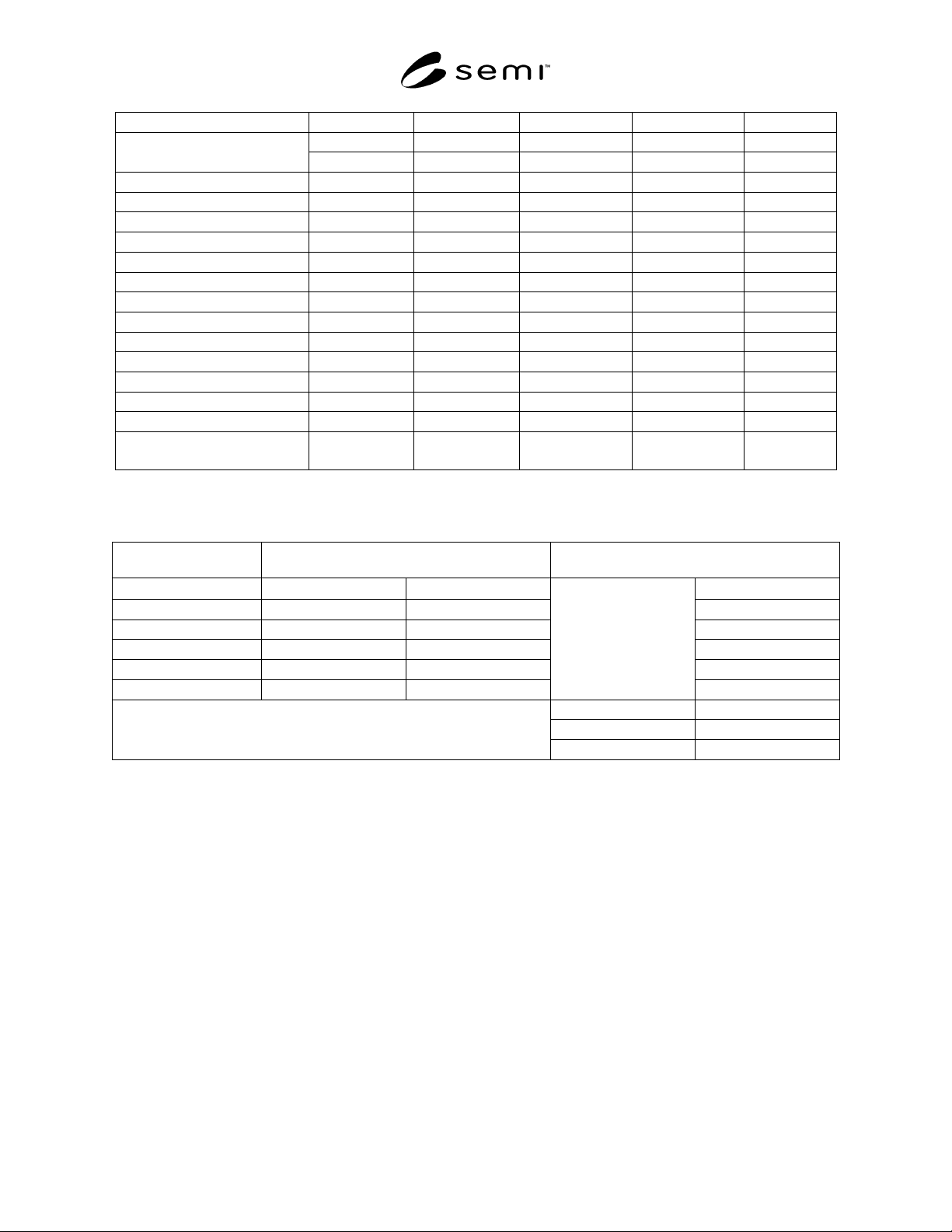
Previous SEMI Reference # C1.7-95 C7.2-94 C11.6-1296 C8.2-92 C12.2-96
Grade 1 Grade 2 VLSI Grade Tier B Tier C
(Specification) (Specification) (Guideline) (Guideline) (Guideline)
Platinum (Pt) -- -- 0.02 ppm max -- --
Potassium (K) 0.3 ppm max 10 ppb max 0.05 ppm max 1 ppb max 100 ppt max
Silicon (Si) -- -- -- 1 ppb max --
Silver (Ag) -- 5 ppb max 0.02 ppm max 1 ppb max --
Sodium (Na) 0.3 ppm max 10 ppb max 0.1 ppm max 1 ppb max 100 ppt max
Strontium (Sr) -- 10 ppb max 0.02 ppm max 1 ppb max --
Tantalum (Ta) -- 10 ppb max -- 1 ppb max 100 ppt max
Thallium (Tl) -- 10 ppb max 0.02 ppm max 1 ppb max --
Tin (Sn) 0.3 ppm max 10 ppb max 0.02 ppm max 1 ppb max 100 ppt max
Titanium (Ti) 0.3 ppm max 10 ppb max 0.05 ppm max 1 ppb max 100 ppt max
Vanadium (V) -- 10 ppb max 0.02 ppm max 1 ppb max --
Zinc (Zn) 0.3 ppm max 10 ppb max 0.05 ppm max 1 ppb max 100 ppt max
Zirconium (Zr) -- 10 ppb max 0.02 ppm max 1 ppb max --
Particles in bottles
(size, #/mL)
≥ 1.0 µm, 25 max ≥ 0.5 µm, 25 max ≥ 0.5 µm, 250 max ≥ 0.5 µm, 10 max
≥ 0.2 µm, TBD
(See NOTE 1.)
NOTE 1: Due to the limitations of current particle counters, particle size and number are to be agreed upon between supplier and user. See SEMI
C1, Section 3.9 for particle counting methodology.
Table 2 Composition of Standard
Substance Amount in 500 mL of 2,2,4-trimethylpentane
solution
Concentration in ppm for 5 mL of standard in 100
mL (120 g) of HCl
µL
mg
Benzene 6.8 6 0.5
Chlorobenzene 5.5 6 0.5
1,2-Dichloroethane 20 25 2.0
Chloroform 34 50 4.0
DDT (see NOTE 1) 25 2.0
Total 9.0
Allowance for CCl
4
1.0
Total 10.0
NOTE 1: 1,1,1-Trichloro-2,2-bis (p-chlorophenyl) ethane, dichlorodiphenyltrichloroethane.
NOTICE: SEMI makes no warranties or representations as to the suitability of the specifications and guidelines set
forth herein for any particular application. The determination of the suitability of the specifications and guidelines is
solely the responsibility of the user. Users are cautioned to refer to manufacturer’s instructions, product labels,
product data sheets, and other relevant literature respecting any materials mentioned herein. These specifications
and guidelines are subject to change without notice.
The user’s attention is called to the possibility that compliance with these specifications and guidelines may require
use of copyrighted material or of an invention covered by patent rights. By publication of these specifications and
guidelines, SEMI takes no position respecting the validity of any patent rights or copyrights asserted in connection
with any item mentioned in these specifications and guidelines. Users of these specifications and guidelines are
expressly advised that determination of any such patent rights or copyrights, and the risk of infringement of such
rights, are entirely their own responsibility.
Copyright by SEMI® (Semiconductor Equipment and Materials
International), 3081 Zanker Road, San Jose, CA 95134. Reproduction o
f
the contents in whole or in part is forbidden without express written
consent of SEMI.
HYDROFLUORIC ACID SEMI C28-0705 © SEMI 1978, 2005 1
SEMI C28-0705
SPECIFICATIONS FOR HYDROFLUORIC ACID
This specification was technically approved by the global Liquid Chemicals Committee. This edition was
approved for publication by the global Audits and Reviews Subcommittee on May 20, 2005. It was available
at www.semi.org in June 2005 and on CD-ROM in July 2005. Originally published in 1978; previously
published July 2004.
NOTICE: This document was completely rewritten in 2005.
1 Purpose
1.1 The purpose of this document is to standardize requirements for hydrofluoric acid used in the semiconductor
industry and testing procedures to support those standards. Test methods have been shown to give statistically valid
results.
2 Scope
2.1 The scope of this document is all grades of hydrofluoric acid used in the semiconductor industry.
NOTICE: This standard does not purport to address safety issues, if any, associated with its use. It is the
responsibility of the users of this standard to establish appropriate safety and health practices and determine the
applicability of regulatory or other limitations prior to use.
3 Limitations
3.1 None.
4 Referenced Standards and Documents
4.1 SEMI Standards
SEMI C1 — Guide for the Analysis of Liquid Chemicals
4.2 ASTM Standards
1
ASTM D5127 — Standard Guide for Ultra Pure Water Used in the Electronics and Semiconductor Industry
4.3 Other Documents
Dionex Technical Note 45 — Determination of Trace Anions in Concentrated Hydrofluoric Acid
NOTICE: Unless otherwise indicated, all documents cited shall be the latest published versions.
5 Terminology
5.1 None.
6 Physical Property (for information only)
Density at 25C 1.15 g/mL
7 Requirements
7.1 The requirements for hydrofluoric acid for Grades 1, 2, 3 and 4 are listed in Table 1.
8 Grade 1 Procedures
NOTE 1: Each laboratory is responsible for verifying the validity of the method within its own operation.
1 American Society for Testing and Materials, 100 Barr Harbor Drive, West Conshohocken, Pennsylvania 19428-2959, USA. Telephone:
610.832.9585, Fax: 610.832.9555. Website: www.astm.org

SEMI C28-0705 © SEMI 1997, 2005 HYDROFLUORIC ACID 2
8.1 Assay — Accurately weigh 1.4–1.5 mL of sample in polyethylene weighing bottle, sample, stopper
immediately, and reweigh. To 50 mL of water in a plastic vessel, add the sample (loosen the stopper of the
polyethylene bottle, and add both the container and the stopper with the sample). Add 0.1 mL of phenolphthalein
indicator solution, and titrate with standardized 1 N sodium hydroxide to a slight, pink color.
%Assay
mL
N
of NaOH
2.00
1
Weight of sample g
8.1.1 Alternately, potentiometric end point detection can be used.
8.2 Chloride — Add 1.7 mL (2.0 g) of sample to 45 mL of water. Filter, if necessary, through a chloride-free filter.
Add 1 mL of nitric acid and 1 mL of silver nitrate reagent solution. Any turbidity produced should be no greater
than that produced when 0.01 mg of chloride ion (Cl) is treated as the sample.
8.3 Nitrate — Weigh 3.3 g of sample in a white plastic 50 mL beaker and dilute with 4.5 mL of water. To another
50 mL plastic beaker, add 6.5 mL of water and 1 mL of standard nitrate solution containing 0.01 mg of nitrate (NO
3
)
per mL. To each solution, add 2.5 mL of brucine sulfate reagent solution and cautiously add with stirring 20 mL of
sulfuric acid. Allow to stand for 10 minutes. The yellow color in the sample solution should be no greater than that
in the standard solution.
8.4 Phosphate — Evaporate 9 mL (10 g) of sample to dryness in a platinum or other suitable dish on a steam bath
in a hood. Dissolve the residue in 25 mL of 0.5 N sulfuric acid. Add 1 mL of ammonium molybdate reagent solution
and 1 mL of p-(methylamino)phenol sulfate reagent solution. Allow to stand for 2 hours at room temperature. Any
blue color should be no greater than that produced when 0.01 mg of phosphate ion (PO
4
) is treated like the sample.
8.5 Sulfate and Sulfite (as SO
4
) — To 18 mL (20 g) of sample in a platinum or other suitable evaporating dish, add
about 10 mg of sodium carbonate and 1 mL of 30 hydrogen peroxide. Evaporate to dryness on a steam bath in a
hood, wash down the sides of the dish with a small volume of water, and add 3 mL of perchloric acid. Evaporate to
about 1 mL, dilute with about 15 mL of water, and add 0.01 mL of phenolphthalein indicator solution. Neutralize
with ammonium hydroxide, dilute with water to 20 mL, and add 2 mL of dilute hydrochloric acid (1 + 19) and 2 mL
of barium chloride reagent solution. Any turbidity should not exceed that produced by 0.1 mg of sulfate ion (SO
4
) in
an equal volume of solution containing the quantities of reagents used in the test. Compare 10 minutes after adding
the barium chloride to the sample and standard solutions.
NOTE 2: For anion determination, alternate method based upon ion chromatography may be used, see ¶10.2.
8.6 Trace Metal Analysis — The following method has given satisfactory results in determining trace metal
impurities at the value specified for each of the following trace metals: aluminum (Al), antimony (Sb), arsenic (As),
barium (Ba), boron (B), cadmium, (Cd), calcium (Ca), chromium (Cr), copper (Cu), iron (Fe), lead (Pb), lithium
(Li), magnesium (Mg), manganese (Mn), nickel (Ni), potassium (K), sodium (Na), tin (Sn), titanium (Ti), vanadium
(V) and zinc (Zn). An alternate method is described in ¶9.2. Any other alternate methods may be used as long as
method validation according to SEMI C1 can be demonstrated.
8.6.1 Special Reagents
8.6.1.1 Nitric Acid, Ultra Pure — Use nitric acid specified for ultra low metal ion content.
8.6.1.2 2% Nitric Acid Solution — Dilute 20 mL of ultra pure nitric acid to 1 L using water meeting the criteria for
Type E1.1 in ASTM D5127.
8.6.2 Sample Preparation
8.6.2.1 In a clean environment, place 250 g of sample in a PTFE evaporating dish. Slowly evaporate on a hot plate,
avoiding loss of sample by effervescence or spattering until approximately 2 mL of liquid remains.
NOTE 3: Evaporation typically requires 2 1/2 to 4 hours.
Cool. Add 1 mL of ultra pure, 70% nitric acid. While maintaining volume, carefully warm several minutes to
dissolve any residue. Cool. Transfer quantitatively to a 50 mL volumetric flask using 2% nitric acid for rinsing and
dilution to volume. Run a reagent blank.