semi合集-English.pdf - 第572页
SEMI E79-0304 © SEMI 1999, 2004 6 A vailability E f ficien cy L osses (Supplier and Use r Do m ain) N on-Scheduled Time Scheduled Downtim e Unsched uled Down time Engineering Standby Production Time E 10 States Theo reti…
SEMI E79-0304 © SEMI 1999, 2004 5
5.2.2.3 Theoretical Production Time (for Actual Units
or for Effective Units) — Production time (for actual
units or for effective units) during a period of
observation that is earned at strictly theoretically
efficient rates and assumes no efficiency losses.
Theoretical Production Time for Actual Units =
∑
i
(Actual Units of Recipe i × THT
i
)
Theoretical Production Time for Effective Units =
∑
i
(Effective Units of Recipe i × THT
i
)
where
THT
i
= theoretical production time per unit of recipe
i
NOTE 4: Theoretical Production Time (for actual units or for
effective units) may be calculated in terms of theoretical unit
throughput by recipe.
Theoretical Production Time for Actual Units =
∑
i
(Actual Units of Recipe i/UPH
i
)
Theoretical Production Time for Effective Units =
∑
i
(Effective Units of Recipe i/UPH
i
)
where
UPH
i
= theoretical unit throughput by recipe
of recipe i
5.2.3 Quality Efficiency — The theoretical production
time for Effective Units divided by the theoretical
production time for Actual Units.
Quality Efficiency =
(Theoretical Production Time for Effective Units)
/(Theoretical Production Time for Actual Units)
Total Time
Operations Time
Engineering Time
Uptime
Manufacturing Time
•Process experiments
•Equipment experiments
Productive Time Standby Time
•Regular production
•Work for 3rd party
•Engineering runs
•Rework
•Scrap
•No operator
•No product
•No support tool
•Associated cluster
module down
Operational
Efficiency
Quality Efficiency
Non-Scheduled Time
•Unworked shifts, days
•Installation, modification
rebuild or upgrade
•Off-line training
•Shutdown/startup
Downtime
Unscheduled Downtime Scheduled Downtime
•Maintenance delay
•Repair time
•Change of consumables
•Out of spec input
•Facilities related
•Maintenance delay
•Production tests
•Preventive maintenance
•Change of consumables
•Setup
•Facilities related
Availability
Efficiency
Rate Efficiency
Not specified in
SEMI E10 but occurs
during Productive Time
Figure 1
The Relationship Between SEMI E10 and OEE
SEMI E79-0304 © SEMI 1999, 2004 6
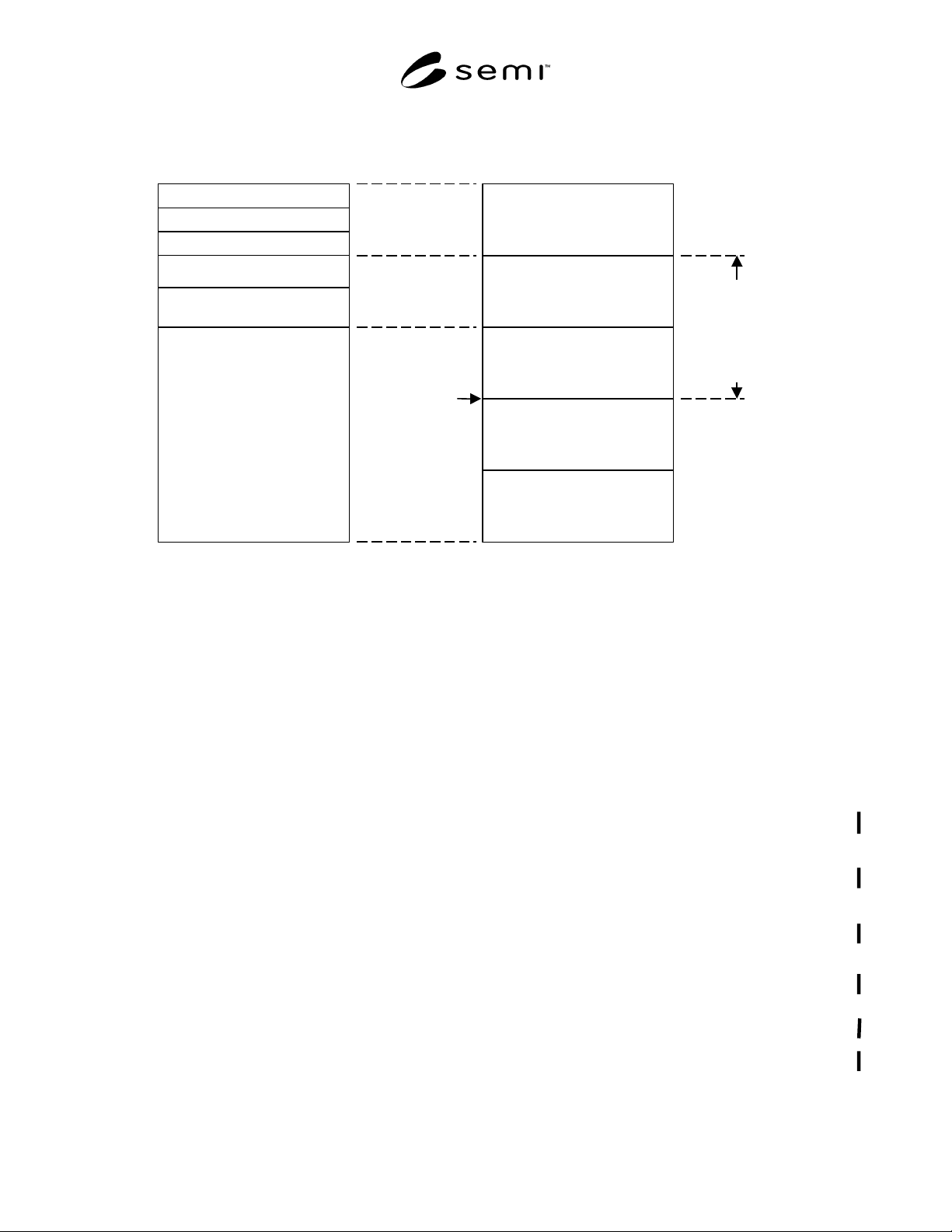
A
vailability Efficiency
L
osses
(Supplier and User Domain)
N
on-Scheduled Time
Scheduled Downtime
Unscheduled Downtime
Engineering
Standby
Production
Time
E
10 States
Theoretical
Production
Time for
Actual Units
Operational
E
fficiency Losses
(User Domain)
R
ate Efficiency
Losses
(Supplier and User Domain)
P
erformance
E
fficiency
L
osses
(Supplier and
User Domain)
A
ssignable Quality
E
fficiency Losses
(Supplier and User Domain)
Theoretical
Production Time
for Effective Units
E
79 Productivity Losses and
Improvement Domains
Figure 2
Stack Chart of Productivity Losses and Improvement Domains
6 Flexible-Sequence Cluster Tools
6.1 This section provides definitions and formulas
applicable to flexible-sequence cluster tools for
computing the following fundamental quantities:
theoretical production time, production time, equipment
uptime and total time. These quantities serve as inputs
to the formulas of Section 5 for efficiency
measurement.
6.1.1 Flexible-sequence cluster tool productivity is
measured at the individual processing module level of
detail according to a virtual machine model described in
this section. Productivity performance for the entire
flexible-sequence cluster tool is then calculated as the
aggregate productivity performance of its individual
processing modules.
NOTE 5: Evaluation of flexible-sequence cluster tool
productivity does not necessarily apply to the evaluation of
flexible-sequence cluster tool RAM.
6.2 Virtual Machine Model
6.2.1 A virtual machine is an individual processing
module in combination with the transport mechanisms
that serve that processing module. When a transport
mechanism is engaged in a material handling operation
that does not involve a particular processing module, it
is not considered to be operating as part of the virtual
machine defined for that processing module.
6.2.2 Theoretical production time per unit for a recipe
is the sum of theoretical times for all required
operational elements:
• Wafer loading,
• Elements occurring within a process module, and
• Wafer unloading.
6.2.2.1 Where appropriate, a combined loading and
unloading time may be replaced with a single
theoretical value for a wafer exchange.
6.3 Fundamental Quantities for Virtual Machines and
Flexible-Sequence Cluster Tools — This section defines
fundamental quantities that are evaluated for individual
virtual machines and flexible-sequence cluster tools as
inputs to the formulas presented in Section 5. In each
case, the fundamental quantity is determined for each
individual virtual machine within a flexible-sequence
cluster tool. The equivalent fundamental quantity for
the flexible-sequence cluster tool is the sum of the
quantities for the individual virtual machine.
NOTE 6: It is recognized that application-specific
interactions between virtual machines within flexible-
sequence cluster tools may impose varying amounts of
standby time on the individual virtual machines. This
approach treats these interactions as standby losses for the
flexible-sequence cluster tool and does not make any
SEMI E79-0304 © SEMI 1999, 2004 7
allowances for them in either production time or theoretical
production time.
6.3.1 Theoretical Production Time (for Actual Units
and for Effective Units)
6.3.1.1 Virtual Machine Theoretical Production Time
(for Actual Units and for Effective Units) — Theoretical
production time earned by an individual virtual
machine according to the virtual machine model.
Virtual Machine
Theoretical Production Time for Actual Units =
Σ
i
[(Theoretical Production Time Per Unit
for Virtual Machine Recipe i)
× (Actual Units of Virtual Machine Recipe i)]
Virtual Machine
Theoretical Production Time for Effective Units
= Σ
i
[(Theoretical Production Time Per Unit
for Virtual Machine Recipe i)
× (Effective Units of Virtual Machine Recipe i)]
6.3.1.2 Flexible-Sequence Cluster Tool Theoretical
Production Time (for Actual Units and for Effective
Units) — Aggregate theoretical production time earned
by all virtual machines according to the virtual machine
model.
Flexible-Sequence Cluster Tool
Theoretical Production Time for Actual Units
= Σ
j
(Theoretical Production Time
for Actual Units for Virtual Machine j)
Flexible-Sequence Cluster Tool
Theoretical Production Time for Effective Units
= Σ
j
(Theoretical Production Time
for Effective Units for Virtual Machine j)
6.3.2 Production Time
6.3.2.1 Virtual Machine Production Time — The sum
of all periods of manufacturing time in which a virtual
machine is performing operations according to the
virtual machine model. When SEMI E10 equipment
states are tracked at the virtual machine level,
processing module production time is equivalent to E10
productive time. Automated tracking is required for
accurate results.
6.3.2.2 Flexible-Sequence Cluster Tool Production
Time — Aggregate production time for all virtual
machines tracked according to the virtual machine
model.
Flexible-Sequence Cluster Tool Production Time =
=Σ
j
(Production Time for Virtual Machine j)
NOTE 7: In this quantity, elapsed times for transport
operations that reposition units from one virtual machine to
another are intentionally credited to both modules. Also note
that this aggregate measure may be larger than the elapsed
time observed and can only be compared with similar
aggregate flexible-sequence cluster tool metrics.
6.3.3 Equipment Uptime
6.3.3.1 Equipment uptime is defined to measure the
total time, during a period of observation, that a virtual
machine or a flexible-sequence cluster tool is in a
condition to perform processing in some form.
6.3.3.2 SEMI E10 defines equipment uptime as
including E10 productive time, engineering time, and
standby time. This definition applies to individual
virtual machines of a flexible-sequence cluster tool.
For the flexible sequence cluster tool as a whole,
production time is the sum of production times for the
individual virtual machines. This production time is
used in lieu of productive time.
6.3.3.3 Virtual Machine Equipment Uptime
Virtual Machine Equipment Uptime =
Virtual Machine Production Time
+ Virtual Machine Engineering Time
+ Virtual Machine Standby Time
6.3.3.3.1 Virtual Machine Engineering Time — The
sum of all periods of time in which a virtual machine is
user-selected for the exclusive use of engineering
product, process, and/or equipment experiments.
Engineering time may be declared for one virtual
machine without having to declare engineering time for
all virtual machines.
6.3.3.3.2 Virtual Machine Standby Time — The sum of
all periods of manufacturing time not counted in
production time, when the virtual machine is capable of
starting new work.
6.3.3.4 Flexible-Sequence Cluster Tool Equipment
Uptime
Flexible-Sequence Cluster Tool Equipment Uptime =
Σ
j
(Virtual Machine Equipment Uptime
for Virtual Machine j)
6.3.4 Total Time
6.3.4.1 Virtual Machine Total Time — For individual
virtual machines, virtual machine total time is trivially
defined as all time observed (at the rate of 24 hours per
day and seven days per week).
6.3.4.2 Flexible-Sequence Cluster Tool Total Time
Flexible-Sequence Cluster Tool Total Time =
Σ
j
(Virtual Machine Total Time
for Virtual Machine j) =
(Total Time Observed) × (Number of Virtual Machines)