semi合集-English.pdf - 第2287页
SEMI E81-0600 © 1999, 2 000 24 Compo nentManag er Sensor Mac hineRes ource Produ ction Machi ne Proces sReso urce 0..* Supp ortReso urce Dur able Material Consum able Transp ort M achine Storag eMachine any Own e dEnti t…
SEMI E81-0600 © 1999, 200023
• Manufacturing operators and other factory
personnel are important resources to facilitate and
supervise material processing and handling,
preventive maintenance, and in some cases,
perform manufacturing steps such as moving
material or performing a visual inspection.
• Other factory resources include durables (reticles,
cassettes, pods, etc.) and consumables (gases,
utilities, etc.).
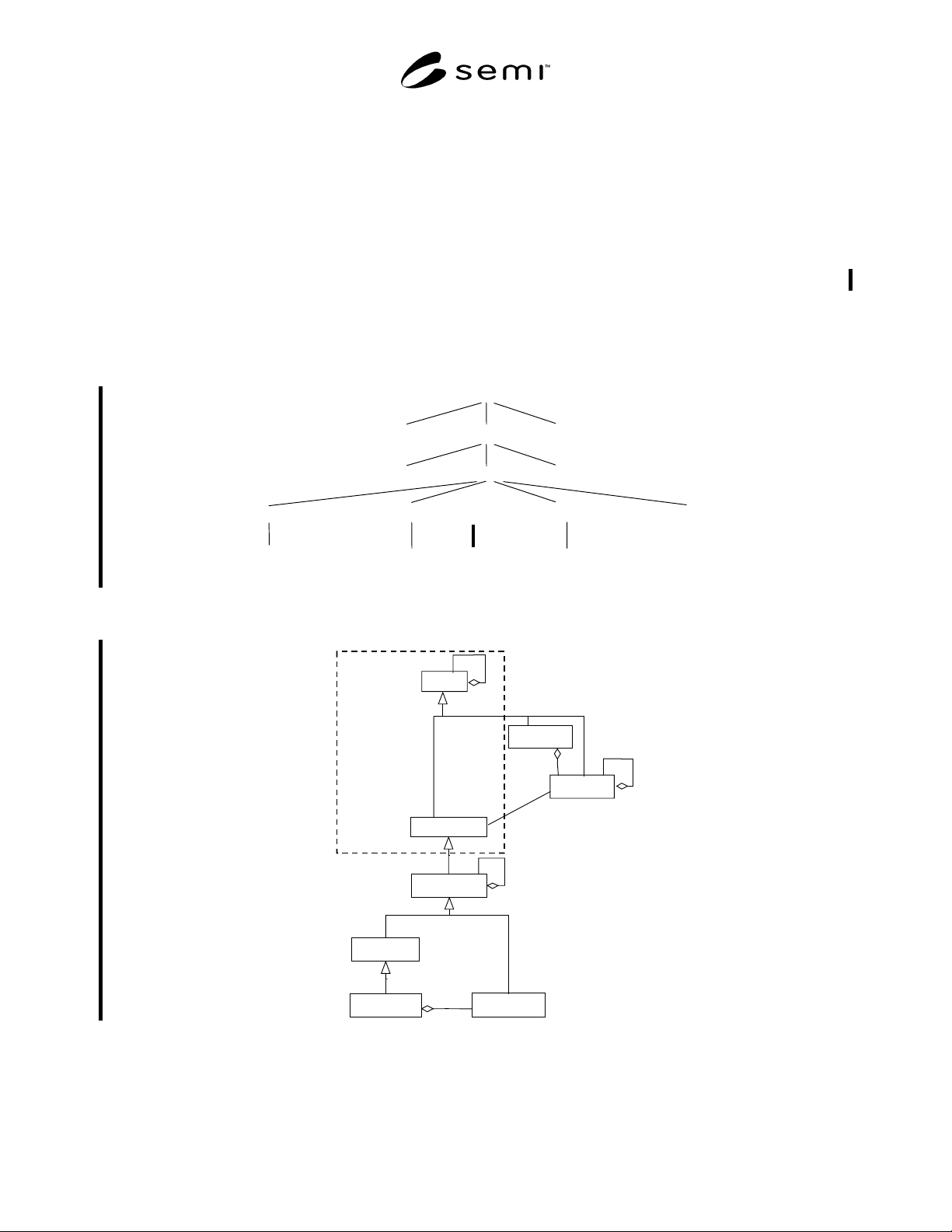
• The information model in Figure 8 shows the CIM
Framework Resource Composition Architecture.
The interfaces in the box labeled Resource Abstract
Interface Group define the generic resource
architecture. In general, resources can be composed
of other resources. In particular, at the factory and
area levels, Factory can be composed of Areas and
an Area can be composed of other Areas. Areas
group Support Resources, such as machines and
persons. This is not a strict composition so that
support resources can be in more than one Area
grouping. At the machine level, Machine
Resources are composed of other Machine
Resources, in general. In particular, Production
Machines are composed of Process Resources.
Production Machine
Transport Machine Storage Machine
Transport Resource Storage Resource
Enterprise
A
rea
Factory
Process Resource
Person
... ...
... ...
Figure 7
Factory Resource Hierarchy Model
Resource
MachineResource
Machine
ProductionMachine
ProcessResource
0..*0..*
0..*0..*
MESFactory
SupportResource
Area
0..*0..*
0..*0..*
groups
0..*
0..*
0..*0..*
Generic
Resource
Architecture
(part)
Figure 8
Resource Composition Architecture
SEMI E81-0600 © 1999, 2000 24
ComponentManager
Sensor
MachineResource
Production Machine
ProcessResource
0..*
SupportResource
Durable
Material
Consumable
TransportMachineStorageMachine
any
OwnedEntity
is owned by
another
HistoryCollection
NamedEntity
0..1
is associated
with
Port
Machine
Person
0..*
0..*
0..*
0..*
assigned to
Capability
Resource
0..*
0..*
0..*
0..*
possible
0..*
0..*
assigned
0..*
0..*
Resource
Abstract
Interface Group
(part)
Area
MESFactory
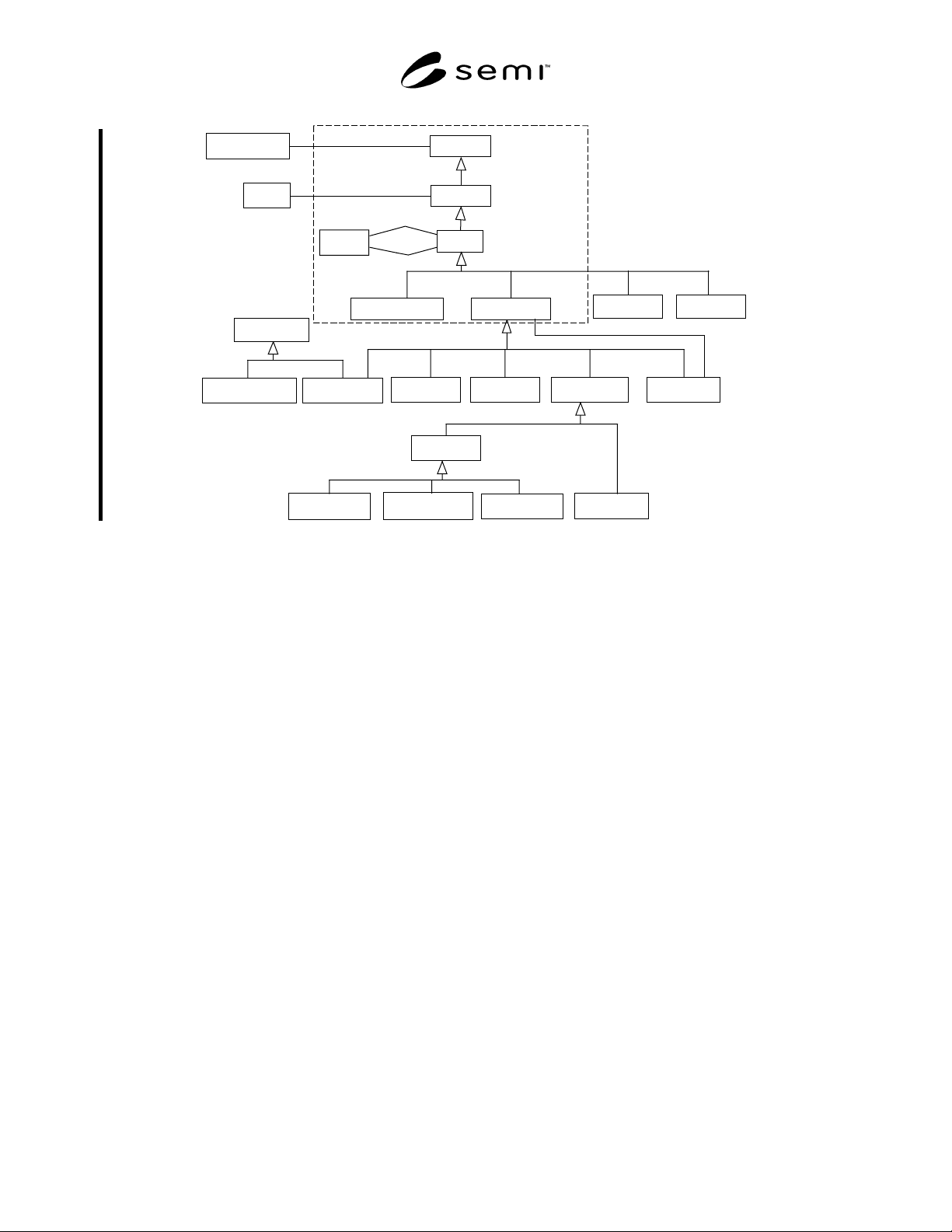
Figure 9
Resource Type Architecture
7.3.3.3.2 Figure 9 shows the CIM Framework
Resource Type Architecture. Specializations of these
interfaces, such as Machine Resource and Durable,
provide component-specific details that extend the
generic resource architecture. The functions added at
each level of type specialization are discussed next.
7.3.3.3.3 Named Entity
7.3.3.3.3.1 The CIM Framework Named Entity
interface provides for names and histories to be
associated with any CIM Framework entity, including
resources.
7.3.3.3.4 Owned Entity
7.3.3.3.4.1 The Owned Entity interface provides for
resources to be organized into hierarchies.
7.3.3.3.5 Resource
7.3.3.3.5.1 The Resource interface provides for
• composition of subresources into complex
resources,
• representing resource capabilities (such as capacity
or process capability) (See Section 7.3.3),
• a simple state model (available, not available) and
services to startup and shutdown the resource, and
• modeling of resource levels as in Figure 7 and
Figure 8.
7.3.3.3.5.2 Each Resource has an attribute called
resourceLevel to support the factory resource
composition hierarchy of Figure 8. The CIM
Framework defines the following resource levels:
Factory (called MESFactory so as not to be confused
with the OMA’s object Factory type), Area, Machine
and Machine Resource. The Area level is optional, or it
may have multiple levels (such as an area called
LithoBay with sub-areas called Zone1 and Zone2).
Other levels can be defined. The resourceLevel concept,
combined with the Named Entity and Owned Entity,
also provide a name scoping facility.
7.3.3.3.6 Support Resource
7.3.3.3.6.1 The Support Resource interface provides
services for reserving resources (to support scheduling,
for example) and to track resource utilization and
effectiveness and associate maintenance tasks with
resources (see Figure 10 and Section 7.3.3.5). The
support resources include machine resources, material
load ports, sensors, durables and people.
7.3.3.3.7 Machine Resource
7.3.3.3.7.1 The Machine Resource interface provides
attributes for machine description, serial number, model
number, vendor, software version, etc. The interface

SEMI E81-0600 © 1999, 200025
extends resource composition to provide machine
resources as composites of machine (sub)resources and
specialized process resources with associated process
capabilities. The Machine Resource interface also
extends the resource state model to include the states
and substates of SEMI E10 and SEMI E58. Specific
subtypes of Machine Resource and Machine are
possible. The CIM Framework defines the subtypes for
Production Machine and Process Resource. Additional
subtypes to support Transport Machine and Storage
Machine interfaces are also possible if there are
additional attributes or behaviors required that Machine
and Machine Resource interfaces do not already
provide.
7.3.3.3.8 Port, Sensor, Durable, Consumable, Person,
etc.
7.3.3.3.8.1 The other support resource subtypes
provide additional, resource-specific, attributes and
behavior. Note that durables are also subtypes of
Material so they can be moved and tracked as material.
Consumables are not currently considered as resources,
but a given implementation of the CIM Framework
could have consumables be support resources to track
their consumption and replenish them as regular
maintenance. Persons are considered support resources
to schedule them and associate them with machines and
other resources and to have associated “maintenance”
schedules for training and certification.
7.3.3.4 Resource Capabilities
7.3.3.4.1 Resources have associated capabilities, as
Figure 9 shows. Factory operations and scheduling use
capabilities to identify resources with the capability to
perform a specific task. A CIM Framework capability is
represented as a text string, providing flexibility to
define types of capabilities appropriate for a variety of
resources. For example, an MESFactory resource may
have capabilities defined in terms of its capacity and the
product families it can produce, and a Process Resource
may have capabilities that define its C
pk
process
capability and its throughput.
7.3.3.4.2 The Capability interface maintains a list of
Resources which have that specific capability, and the
associated Resource interface maintains a list of its
overall possible capabilities and the subset of possible
capabilities that resource is assigned to perform.
7.3.3.4.3 The Capability interface is specialized for
Process Capabilities associated with Process Resources.
This provides an association to the Process Operation
Specifications a Process Resource can perform and the
Process Durables and the person Skills needed to
support the Process Capability. Other Resources can
specialize the Capability interface.
7.3.3.5 Resource Tracking and Maintenance
7.3.3.5.1 Support Resources have an associated
resource tracking and maintenance management
function, as Figure 10 shows. A Resource Tracking
Supervisor for a Resource monitors and records
resource usage and status and creates Maintenance Jobs
according to Maintenance Specifications. Factory
Operations, with the aid of a scheduler or dispatcher,
assigns Persons and other support resources defined in
the Maintenance Specification and initiates
Maintenance Job execution. The Resource Tracking
Supervisor then supervises Maintenance Job execution.
The Maintenance Job and Resource Tracking
Supervisor specialize the Job/Job Supervisor pair as
Section 7.3.4.6 describes. The Resource Tracking
Supervisor also records appropriate history, such as
maintenance logs and resource utilization and state, in
the Named History Collection for the Resource
(inherited from Named Entity). Resource type-specific
specializations of the resource tracking and
maintenance interfaces are possible.
7.3.4 Job Architecture
7.3.4.1 This section describes the job management and
control architecture of the CIM Framework. It defines a
hierarchical job supervision and control structure that
manages factory-level jobs (create product material to
fill enterprise product requests) and implements these
factory-level jobs by creating and managing machine-
level process jobs and transport jobs, coordinated with
maintenance jobs and other support jobs. The job
control architecture defines and manages relationships
between manufacturing resources (process equipment,
transport equipment, people), material groups (lots,
product groups, process groups, transport groups) and
specifications (product specifications, process flows
and recipes). This is the central functional architecture
which integrates the CIM Framework components into
a coherent manufacturing execution system
architecture. The concepts are derived from existing
standards and related standards efforts [ANSI],
[ALBUS], [OMA], [WfMC].