semi合集-English.pdf - 第3191页
SEMI E125.1-0305 © SEMI 2005 45 Table 95 SEMI E125 RevisionNotice Revision Trans lation Table Attribute or Role Name UML Name/Type XML Element or Attribu te XML Name/Type equipment One and only on e element of a type d…
SEMI E125.1-0305 © SEMI 2005 44
provided dynamically to the equipment during SEMI E132 Session establishment, using the EstablishSession
message.
7.3.6 MetadataRevised
7.3.6.1 WSDL Operation Binding
7.3.6.1.1 See the operation binding for “MetadataRevised” in E125-1-V0305-MetadataClient-Binding.wsdl. Key
information is shown for convenience in the following table.
Table 91 MetadataRevised Operation Binding
SOAPAction
urn:semi-org:ws.E125-1.V0305.esdMetaEqp-
binding:MetadataRevised
Input Headers (WSDL Message, Required) E132HashHeaderMessage, required
Output Headers (WSDL Message, Required) E132HashHeaderMessage, required
7.3.6.2 WSDL PortType Operation
7.3.6.2.1 See the portType operation definition for “MetadataRevised” in SEMI E125- MetadataClient -
PortType.wsdl. Key information is shown for convenience in the following table.
Table 92 MetadataRevised PortType Operation
Input Message Name MetadataRevisedNotificationMessage
7.3.6.3 WSDL Message(s)
7.3.6.3.1 See the message definitions for “E132HashHeaderMessage” and “MetadataRevisedNotificationMessage”
in E125-1-V0305-MetadataClient-PortType.wsdl. Key information is shown for convenience in the following table.
Table 93 EquipmentMetadataManager Binding
Message Name
Schema
Element Name
E132HashHeaderMessage auth:E132HashHeader
NotifyOnRevisionsRequestMessage esd: MetadataRevisedNotification
7.3.6.4 XML Schema Types
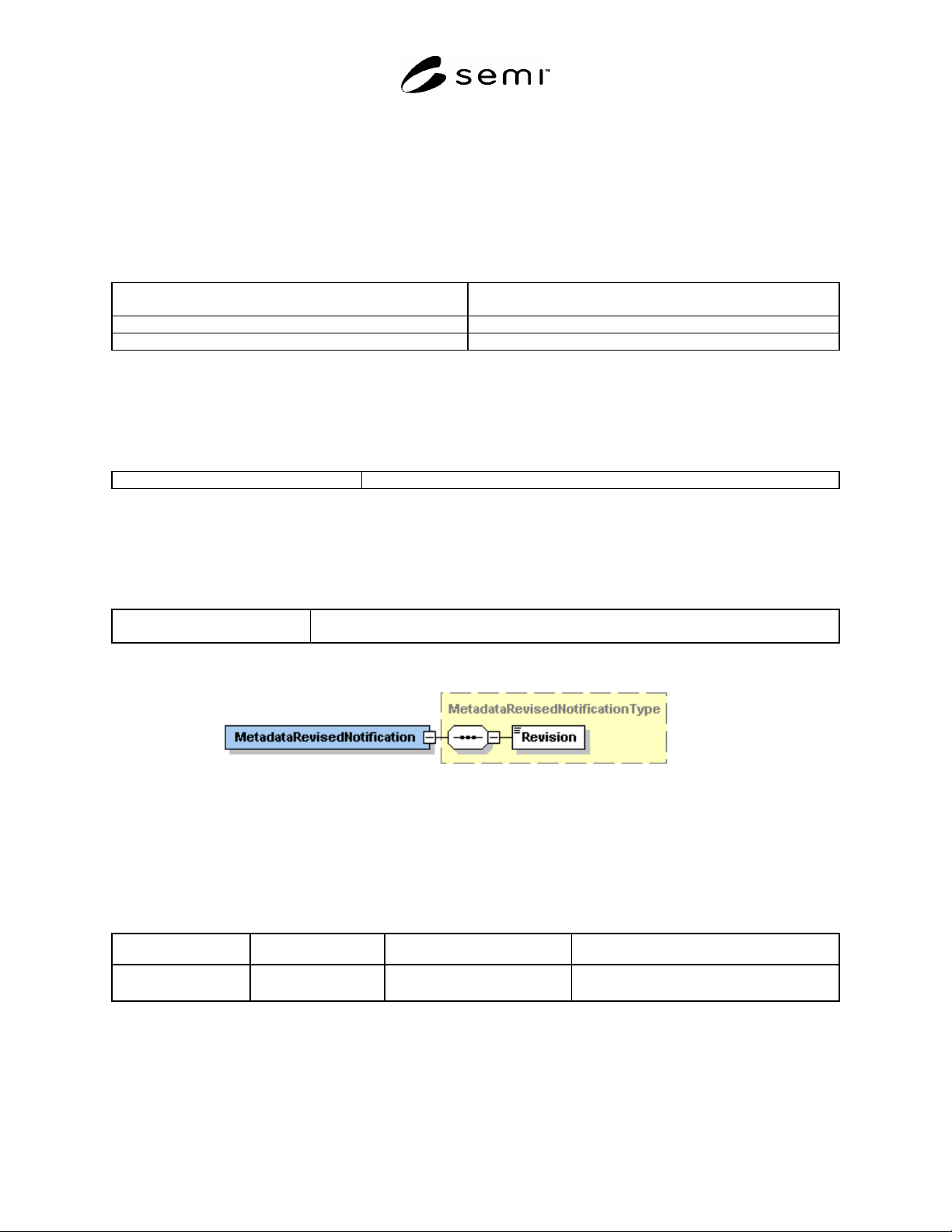
Figure 33
MetadataRevisedNotification Global Element
7.3.6.4.1 MetadataRevisedNotification — This global element acts as a top-level container entity representing the
SOAP body of a MetadataRevised notification. As defined in SEMI E125, this operation has one input argument:
the current revision of the equipment metadata. This argument is modeled as a single element named “Revision” of
built-in type “xsd:dateTime”.
Table 94 Translation Table for Input Arguments for the NotifyOnRevisions Operation
Argument Name Format XML Element or Attribute XML Name/Type
revision Structured data of type
RevisionNotice
element Revision: xsd:dateTime.
7.3.6.4.2 Revision — This global element is the XML Schema representation of the SEMI E125 RevisionNotice
class.

SEMI E125.1-0305 © SEMI 2005 45
Table 95 SEMI E125 RevisionNotice Revision Translation Table
Attribute or Role Name UML Name/Type XML Element or Attribute XML Name/Type
equipment One and only one element
of a type derived from the
SEMI E120 type
EquipmentElement
n/a No SEMI E120 equipment node is
provided. Clients determine which
equipment has been updated via
information provided in the SEMI
E132 header.
newRevision Structured data, of type
MetadataRevision
element Revision: xsd:dateTime
NOTICE: SEMI makes no warranties or representations as to the suitability of the standards set forth herein for any
particular application. The determination of the suitability of the standard is solely the responsibility of the user.
Users are cautioned to refer to manufacturer's instructions, product labels, product data sheets, and other relevant
literature, respecting any materials or equipment mentioned herein. These standards are subject to change without
notice.
By publication of this standard, Semiconductor Equipment and Materials International (SEMI) takes no position
respecting the validity of any patent rights or copyrights asserted in connection with any items mentioned in this
standard. Users of this standard are expressly advised that determination of any such patent rights or copyrights, and
the risk of infringement of such rights are entirely their own responsibility.
Copyright by SEMI® (Semiconductor Equipment and Materials
International), 3081 Zanker Road, San Jose, CA 95134. Reproduction of
the contents in whole or in part is forbidden without express written
consent of SEMI.

SEMI E126-0305 © SEMI 2003, 2005 1
SEMI E126-0305
SPECIFICATION FOR EQUIPMENT QUALITY INFORMATION
PARAMETERS (EQIP)
This specification was technically approved by the Global Information & Control Committee and is the direct
responsibility of the Japanese Information & Control Committee. Current edition approved by the Japanese
Regional Standards Committee on January 11, 2005. Initially available at www.semi.org February 2005; to
be published March 2005. Originally published July 2003; last published July 2004.
1 Purpose
1.1 This standard identifies key equipment quality information parameters, or EQIPs, for equipment process types
or groups. The identification of these quality parameters is intended to help equipment users and suppliers specify
and utilize capabilities for process control.
1.2 This standard is designed to be updated as EQIPs are identified for new and/or existing equipment process types
in this standard.
1.3 Intended Audience — This standard is intended for use by OEMs, users, and third party equipment and process
control system suppliers who need to achieve equipment and process control of select process quality parameters,
utilizing standardized methods for actuation of process control parameters.
2 Scope
2.1 The scope of this standard is limited to identifying key EQIPs for select equipment process types, specifying
that the equipment shall indicate a non-null list of settable process program parameters that impact each of these
EQIPs, and specifying that the equipment shall allow individual actuation of each of these parameters using SEMI
standard methods. The standard is not intended to identify all quality parameters. It is not intended to specify a
complete set of equipment types.
2.2 While this standard requires that a capability shall exist for actuation of process program parameters to
influence key EQIPs, the standard does not specify how this actuation will take place. For example, it does not
define the communication protocol for actuation or the equipment or host models that will support and enable this
actuation capability. The scope is limited to defining the key EQIPs and their linking to process program
parameters.
2.3 The standard is structured so that EQIPs for equipment types may be added to an existing set, as the community
reaches consensus on these additions. Further, EQIPs may be defined for a new equipment type not previously
addressed in this standard. Additions to the standard are made utilizing the SEMI standards balloting process.
NOTICE: This standard does not purport to address safety issues, if any, associated with its use. It is the
responsibility of the users of this standard to establish appropriate safety and health practices and determine the
applicability of regulatory or other limitations prior to use.
3 Limitations
3.1 The standard is structured so that EQIPs for equipment types may be added to an existing set, as the community
reaches consensus on these additions. Further, EQIPs may be defined for a new equipment type not previously
addressed in this standard. Thus, this standard does not necessarily specify a complete EQIP set for an equipment
type, and does not necessarily address all equipment types.
3.2 This standard does not specify how actuation of equipment settable process program parameters associated with
these EQIPs will take place. It is limited to referencing other SEMI standards as examples of standardized methods
for providing this capability.