semi合集-English.pdf - 第1699页
SEMI E40-0705 © SEMI 1995, 2005 11 8.2.3.2 PR Job Abort — The supervi sor may command the processing resource t o abort a p rocess job at any tim e. The goal of the abort comma nd is to end the process job ac tiv ities a…

SEMI E40-0705 © SEMI 1995, 2005 10
PROCESSING AGENT
SUPERVISOR
PR JOB CREATE
PR JOB CREATE ACK
PR JOB SETUP
PR JOB PROCESSING
PR JOB PROC COMPLETE
PR JOB COMPLETE
pre-conditioning,
material arrival
processing
the material
material departure,
post-conditioning
queued
Figure 2
Process Job Message Flow
8.2.1.5 PR Job Processing — The processing resource reports that material processing has commenced.
8.2.1.6 PR Job Processing Complete — The processing resource reports that material processing is completed and
that the material is available for removal.
8.2.1.7 PR Job Complete — The processing resource declares the process job to be complete once it has completed
processing the material, the material has departed, and any required processing resource post-conditioning has
completed. This message is also used when a process job ends abnormally. The message provides information on the
success or failure of the processing and, if failed, supplies error codes and textual reasons for the failure.
8.2.2 Process Job Informational Events — There are process job related events which may be of significance to the
service-user. These are designated as “collection events” and shall be available for event reporting. This section
describes those collection events and shows how they fit into the chronology of a process job. These collection
events, as specified by the PRJobEvent service, shall be implemented per definition of one of the following
standards, SEMI E30, SEMI E40, SEMI E53 or similar style events, as required by the service-user. The equipment
may also optionally implement the collection events per the remaining standards. However, the service-user shall
only utilize one of the standards for collection event implementations. The selection mechanism by the service-user
is equipment specific. For example, it may be part of an equipment power-on process or via an equipment specific
equipment constant.
8.2.2.1 If SEMI E30, SEMI E53 or similar style collection events are used for PRJobEvent, the equipment may also
implement equivalent events for the process job milestones as defined by the PRJobAlert service.
8.2.2.2 Collection event messages provide valuable information but are not strictly required to perform material
processing. Therefore, it is expected that some message protocol implementations will provide a method by which
the service-user may disable those events which are not needed in a particular implementation. For SEMI E40 style
events, the activation for disabling the events is user specific. For SEMI E30, SEMI E53 or similar style events, the
activation is as defined in those standards.
8.2.2.3 PR Job Waiting for Material — The processing resource reports that all required pre-conditioning has
completed and that it cannot proceed until the process job material arrives. It is considered to be awaiting material
arrival if it is not aware of activities in progress with the aim of receiving all or part of the material. This event may
be generated only during process job setup. This event requires, at a minimum, PRJobID and Timestamp as its data.
8.2.2.4 PR Job State Change — The processing resource reports that it has changed state. All state transitions in the
state model Figure 4 shall trigger this collection event. These events require, at a minimum, variables PRJobID,
PRJobState, and TimeStamp (SEMI E30).
8.2.3 Process Job Extended Messaging — In this section, the extended messaging of Abort/Stop/Cancel,
Pause/Resume and manual Start Process is added to the normal messaging described above. The only extended
functionality required to be supported in processing management is Abort.
8.2.3.1 A detailed description of each message used in extended operation follows.

SEMI E40-0705 © SEMI 1995, 2005 11
8.2.3.2 PR Job Abort — The supervisor may command the processing resource to abort a process job at any time.
The goal of the abort command is to end the process job activities as quickly as possible. This includes halting all
processing of material in progress, which may result in an unknown material condition. Abort is intended for use
when serious problems are detected and further damage needs to be prevented. The abort command terminates the
process job. In many cases, error recovery may be required before normal operation may continue and subsequent
jobs can be executed. For processing equipment a part of the error recovery procedure may require the removal of
substrates belonging to the aborted process job that still reside in the equipment. This is determined by the
processing agent, which may use applicable service standards to handle the exception.
8.2.3.2.1 The abort command takes precedence over the stop, cancel, and pause commands. If the specified process
job is queued, the abort command acts identically to a cancel command.
8.2.3.3 PR Job Stop — The supervisor may command the processing resource to stop a process job at any time. The
stop command terminates the job in an orderly manner. The object of the stop command is to cease the current
activity at the next safe, convenient point, preserving material integrity. In the situation of processing equipment,
this convenient point may require that all related substrates are sent to their output destination. This implies that each
material is either processed as specified in the recipe or not at all. As stop terminates the job, a new process job is
needed to continue processing the material in the processing resource. If restart of the same job is needed, pause and
resume should be used instead of stop. A new job is required if additional processing is needed after a job is stopped.
8.2.3.3.1 If the specified process job is queued, the stop command acts identically to a cancel command.
8.2.3.4 PR Job Cancel — The supervisor may cancel a process job which has not yet become active (e.g., a job
which is queued). Cancel is used when the supervisor would like to remove a process job — to reschedule, for
example — but does not want to affect process job activities already in-progress. A cancelled job is removed from
the queue and ceases to exist. No physical action is associated with canceling a process job. If the specified process
job is active, the processing resource shall reject this command.
8.2.3.5 PR Job Pause — The supervisor may issue a command to pause a process job at any time. A pause
command shall cause the processing resource to continue to the first safe, continual, pausing place and then cease
activity. The activity may cease only at points that allow for resumption of the activity (see the resume command)
such that material integrity is maintained and the processing goals are accomplished. Note that a paused process job
may be aborted or stopped as an alternative to the resume command. In this case, the stop command may cause the
equivalent of a resume in order to ensure material integrity (either fully processed or not processed at all) upon
termination of the process job.
8.2.3.6 PR Job Resume — The resume command is used to continue a previously paused process job activity.
8.2.3.7 PR Job Create — The PR Job Create request as previously described is for normal automatic process job
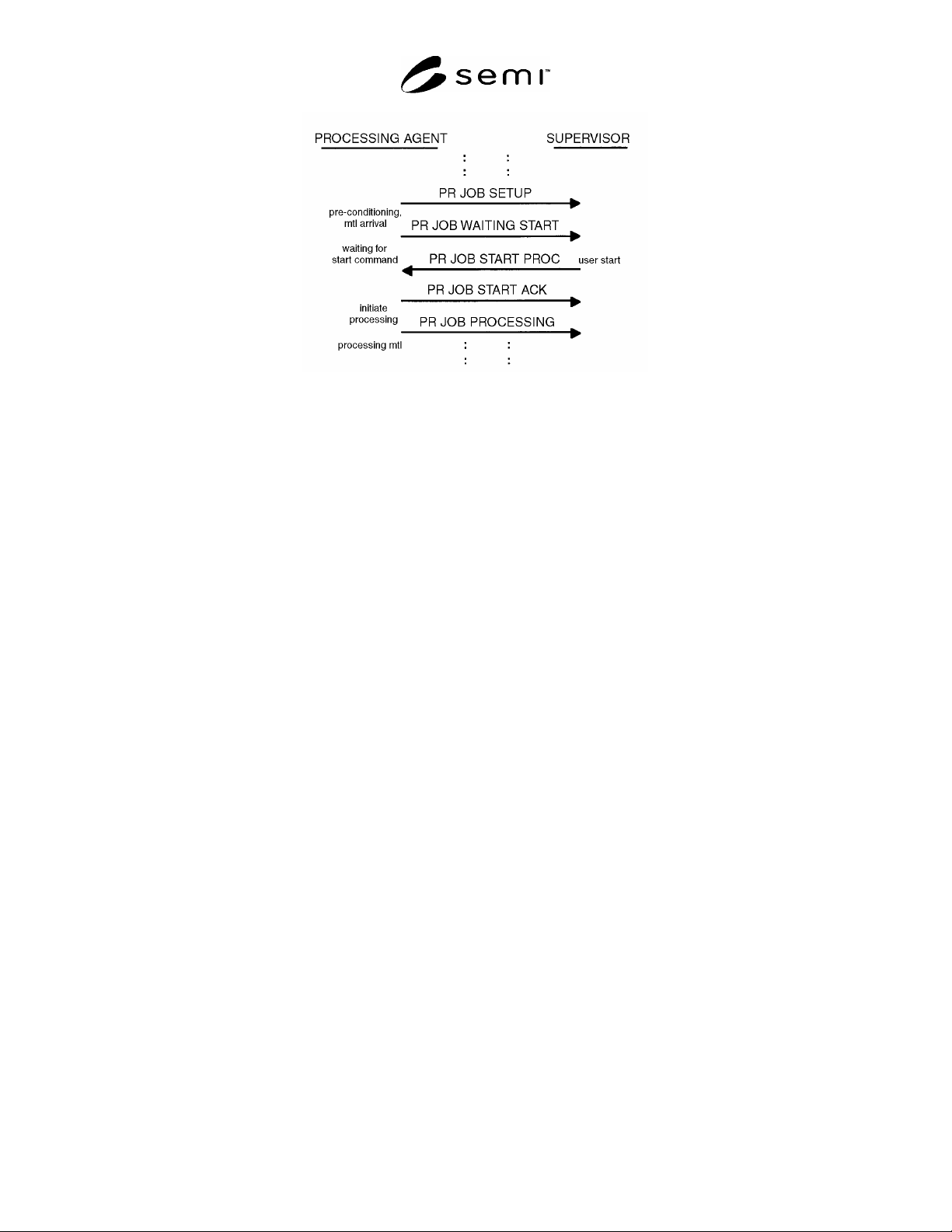
operation. If the process start attribute is not set, the processing resource waits for a manual start from the supervisor
before processing the material. The control message flow for manual start is presented in Figure 3.
8.2.3.8 PR Job Waiting for Start — The processing resource is ready to process once the material has arrived and
has been prepared for processing. The processing resource reports that it is ready to process and is waiting for start,
if the process job PRProcessStart attribute is not set. The PRProcessStart attribute is not set if the job is defined to
start manually and the start command has not yet been received. The WAITING FOR START state shall be a safe
condition which maintains material integrity. If the process job is stopped or aborted while in this state, the material
will not have been altered.
8.2.3.9 PR Job Start Process — The supervisor which has defined a process job to start manually issues a PR Job
Start Process to allow processing of the material to proceed when the processing resource is ready. The start may be
issued at any time after process job creation. On receiving the start command, the processing resource sets the
process start attribute and starts processing if it is already in the WAITING FOR START state.
SEMI E40-0705 © SEMI 1995, 2005 12
Figure 3
Manual Start Message Flow
8.2.3.10 PR Job Start Acknowledge — The processing resource responds to the supervisor that the requested start
process is accepted or rejected and, if rejected, supplies errorcodes and textual reasons for failure.
8.3 Process Job State Model — The process job is a transient entity. It is created on request of the supervisor,
executes, and then is deleted by the processing resource. The job usually spans the time period from shortly before
material is physically delivered to the processing resource, through the processing, and until shortly after material is
taken away.
8.3.1 Process Job State Model Diagram — Figure 4 shows the Process Job State Model diagram.
8.3.2 Process Job State Descriptions — The detailed state definitions follow.
8.3.2.1 ABORTING (ACTIVE Substate) — While the PR Job is in the ABORTING substate, the processing resource
is performing an abort or an optional error recovery procedure. The abort procedure will cause immediate
termination of the processing. It is the responsibility of the processing resource to cease physical activity as quickly
as possible, having achieved a safe condition.
NOTE 1: For processing equipment the termination may have to be followed by an error recovery procedure with which
remaining substrates can be brought to the output destination.
8.3.2.2 ACTIVE — ACTIVE is the parent state of all substates where the context of an active process job execution
exists.
8.3.2.3 EXECUTING (ACTIVE Substate) — EXECUTING is the parent state of those substates that refer to the
preparation and execution of a process job.
8.3.2.4 SETTING UP (EXECUTING Substate) — While the PR Job is in the SETTING UP substate, the processing
resource performs pre-conditioning, awaits material arrival, and prepares for material processing. Pre-conditioning
includes all operations in the processing resource, which are required by the recipe in advance of material arrival.
8.3.2.4.1 In cases where the material is already present, it is simply prepared for processing. If pre-conditioning
(without material present) is required to achieve the processing goals specified by the recipe, the job fails and
terminates.
8.3.2.5 PAUSE (ACTIVE Substate) — While the PR Job is in the PAUSE substate the processing resource is
suspending or has suspended activity.