semi合集-English.pdf - 第2759页
SEMI E98-1102 © SEMI 2000, 2002 24 10.5.1 As shown in Figure 15, an AbstractEquipment - Module is a type of A bstractEquipm entSubsystem that represents a highe r level of complexity and i s of greater importance to the …
SEMI E98-1102 © SEMI 2000, 2002 23
10.4.8.1.2 A typical kind of AbstractEquipmentElement that the user may want to add is an “add-on sensor”, a
SensorActuatorDevice on a Sensor/Actuator Network. If the Equipment knows the properties, it is possible for it to
read an added I/O device and to reference it within recipes.
10.4.8.2 Remove Element — The user may instruct the equipment to remove an AbstractEquipmentElement that
was added earlier. This service is required wherever the Add Element service is supported.
10.4.9 EquipmentSubsystem Object
10.4.9.1 The EquipmentSubsystem is a concrete subtype of AbstractEquipmentSubsystem. It inherits all of the
attributes, state models, and services of the AbstractEquipmentSubsystem and in addition defines the rules for
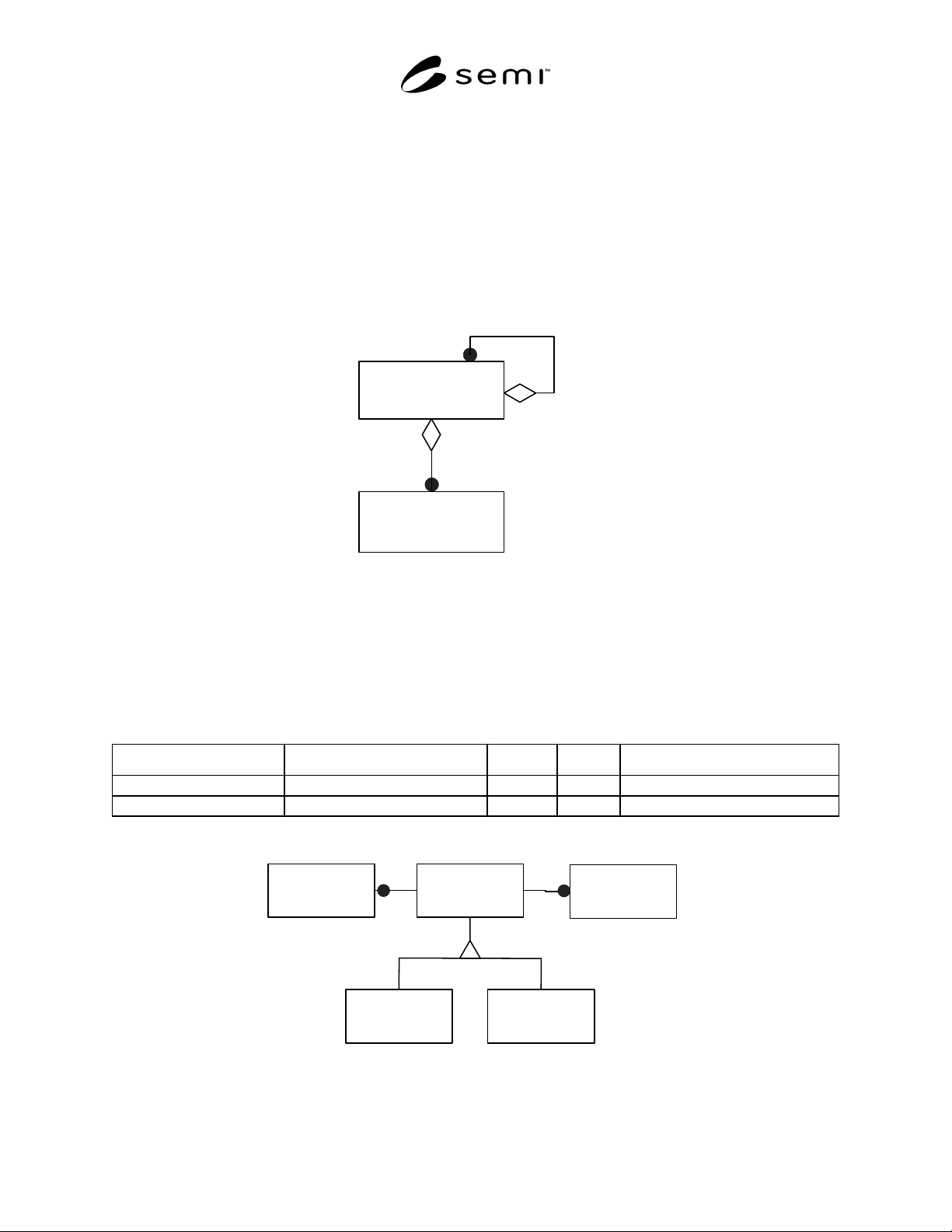
aggregation. These rules are illustrated in Figure 14.
M + N >= 1
Equipment
IODevice
Equipment
Subsystem
M
N
Figure 14
EquipmentSubsystem Aggregation
10.4.9.2 As shown in Figure 14, the EquipmentSubsystem may be made up of other, smaller EquipmentSubsystems
and/or EquipmentIODevices. It is required to have at least one of these two components.
Table 10 EquipmentSubsystem Attribute Definition
Attribute Name Definition Access Reqd Form
ObjType Object type RO Y Text = “EqpSubsystem”
ObjID Object identifier RO Y Text.
10.5 AbstractEquipmentModule Object
Equipment
Module
Recipe
Executor
Process
Matching
Abstract
Equipment
Module
Equipment
Figure 15
AbstractEquipmentModule Types
SEMI E98-1102 © SEMI 2000, 2002 24
10.5.1 As shown in Figure 15, an AbstractEquipment-
Module is a type of AbstractEquipmentSubsystem that
represents a higher level of complexity and is of greater
importance to the factory. It is mainly intended to
represent process modules but may be used for other
major intelligent subsystems capable of supporting the
requirements for the AbstractEquipmentModule. It may
be possible in some cases for the physical module to
operate independently from the equipment.
10.5.2 The AbstractEquipmentModule has two
subtypes, Equipment and EquipmentModule.
10.5.3 ProcessMatching
10.5.3.1 ProcessMatching provides one or more
mechanisms for managing process differences between
two or more identically configured subsystems of the
same type to ensure that a generic recipe run on both
subsystems will achieve the same process result.
ProcessMatching may be either internal or external or
both.
10.5.3.2 An example of an external method would be
through provision of a ProcessMatching object that
allows a user to manipulate offsets to process
parameters. This can be done through setting parameter
offsets for each subsystem so that, within specified
constraints, all subsystems of the same type give the
same process results. More sophisticated systems may
use algorithms to determine process offsets based on
mathematical models and module history.
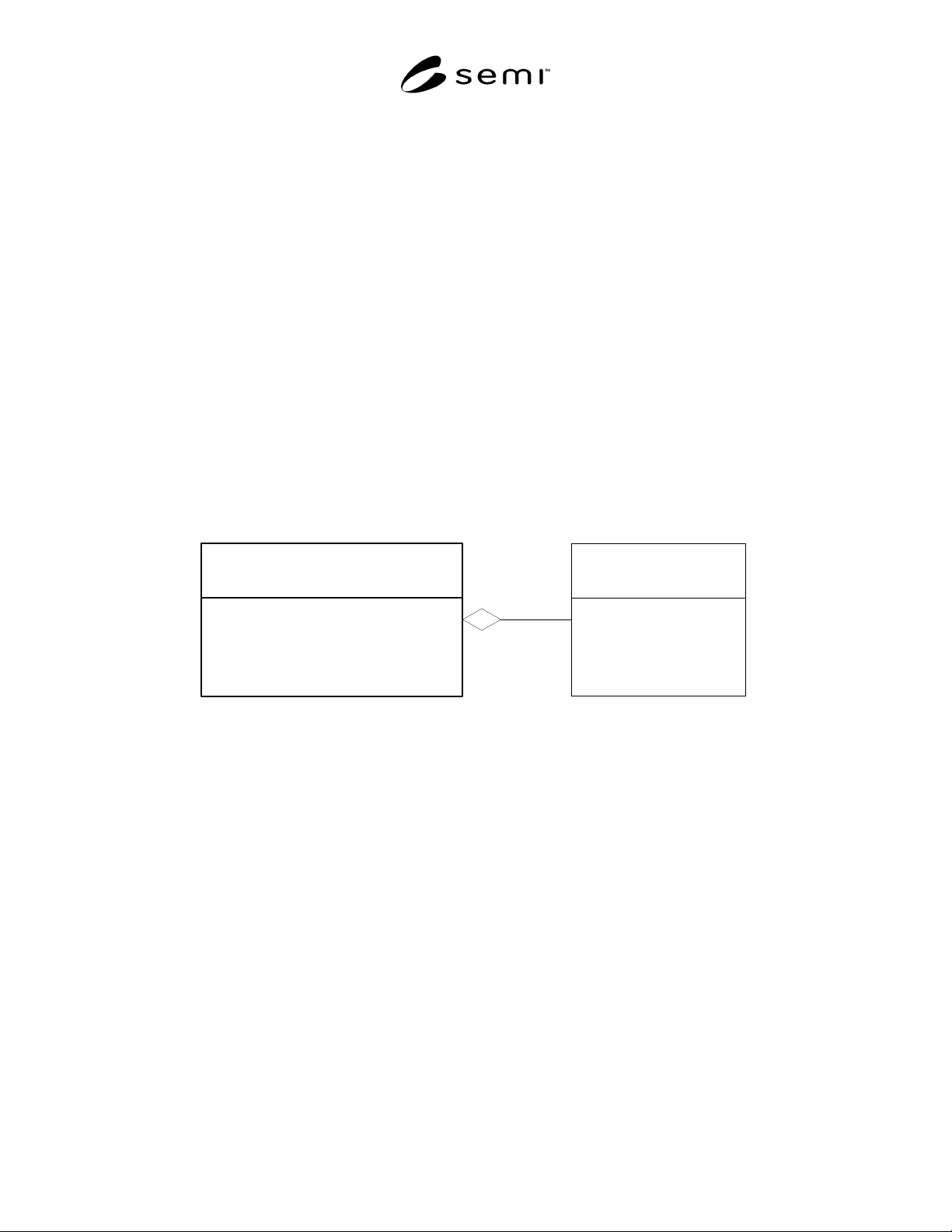
10.5.3.3 As a simple example of process matching,
three different individual hotplates may be matched for
the temperature range 225–275° C by modifying their
temperature offset by 1° C, 1.75° C, and –2.1° C
respectively. This approach is illustrated in Figure 16.
10.5.3.4 The equipment supplier is responsible for
determining the set of parameters to which offsets may
be applied as well as the range of values that are valid.
ProcessMatching
- Name
- Description
- ParameterList
- ProcessGoal
1+
Parameter
Maximum
Minimum
Name
Offset
Units
Figure 16
ProcessMatching and Parameter Objects

SEMI E98-1102 © SEMI 2000, 2002 25
10.5.3.5 These parameters may be the same as those
referenced within recipes for Recipe Variable Para-
meters.
6
In this case, Recipe Variable Parameters are
given as setpoints that can be based on characteristics
of the incoming substrate and are hardware indepen-
dent, while Parameters used in Process-Matching are
relative (applied to an existing setpoint) and are used to
compensate for hardware differences. Support of both
Recipe Variable Parameters and ProcessMatching para-
meters allows the user to compensate for hardware-
specific differences separately from product-specific
differences. The number of cycles since the last pre-
ventive maintenance performed on a process module
affects its performance in a certain way, while the effect
of too thin a film on the wafer will affect requirements
in a different way.
10.5.3.6 The ProcessMatching object here is shown as
an example. This is not a standardized object.
10.5.3.7 Internal methods of process matching may use
other techniques, such as special types of recipes.
10.5.4 AbstractEquipmentModule Requirements
10.5.4.1 The AbstractEquipmentModule inherits the
attributes, state models, and services of both the
AbstractEquipmentElement and the AbstractEquip-
mentSubsystem. As a type of AbstractEquipmentSub-
system, the AbstractEquipmentModule is also able to
hold one or more units of material.
10.5.4.2 The AbstractEquipmentModule represents
major subsystems, such as process chambers. It
supports basic operational commands: start, stop, pause,
resume, and abort.
10.5.4.3 ARAMS
10.5.4.3.1 When implementing SEMI E58, the
AbstractEquipmentModule shall provide compliance
except as qualified in this section. The Abstract-
EquipmentModule is the smallest component of
equipment for which SEMI E58 (ARAMS) states
should be maintained.
10.5.4.3.2 An AbstractEquipmentModule that can not
be powered off separately from Equipment is not
required to provide its own powerdown estimate or time
of last powerdown.
10.5.4.3.3 Otherwise, an AbstractEquipmentModule
implementing SEMI E58 shall comply with the
requirements of Section 13, Object Services
Compliance, in SEMI E58, including all of the
attributes defined in Table 6, ARAMS Object Attribute
Definitions in that document. These attributes are not
repeated in OBEM. The user may change the ARAMS
6 Variable Parameters are defined in SEMI E42.
state. In some cases, a change in the ARAMS state of a
module may cause an ARAMS state change for the
equipment. The supplier shall document any
relationships between the ARAMS state of the
Equipment and the ARAMS states of its modules.
10.5.4.4 AbstractEquipmentModule Service States —
For implementations of ARAMS, to be consistent with
SEMI E10, the AbstractEquip-mentModule is IN
SERVICE whenever it is in an uptime state. Otherwise,
it is OUT OF SERVICE, as it can not be scheduled for
manufacturing. To change the service state of an
AbstractEquipmentModule, the user must change its
SEMI E10 (RAM) state. Note that the service state of
some modules will affect the service state of Equipment
as well.
10.5.4.5 Clock — For modules able to operate
independently of the equipment (e.g., modules with a
dedicated CPU), AbstractEquipmentModules are
required to have individual clocks. It is the responsi-
bility of the Equipment to synchronize multiple internal
clocks.
10.5.4.6 Process Type
10.5.4.6.1 An AbstractEquipmentModule has a Process
Type that indicates its primary functionality as one of
the following: Process, Measurement, Transport, or
Storage. This is represented as a text string that may
specialized further as needed.
10.5.4.6.2 The AbstractEquipmentModule has one or
more ProcessCapabilities. ProcessType and Process-
Capability are used for high-level and detailed process
characterization. The user may add and remove
ProcessCapability descriptions through operations Add
Process Capability and Remove Process Capability.
10.5.4.7 Process Matching
10.5.4.7.1 All AbstractEquipmentModules supporting
Recipe Execution shall provide one or more methods
for process matching.
10.5.4.7.2 ProcessMatching allows the AbstractEquip-
mentModule to be tuned for a specific set of conditions
in order to achieve the same results as other Abstract-
EquipmentModules with the same process capability.
10.5.4.8 Process Setup
10.5.4.8.1 AbstractEquipmentModules capable of per-
forming different processes may need to be re-
configured following one process before a process of a
different type can be executed. Examples of setup
requirements include: a new reticle for a stepper, a
source change for an ion implanter, or a significant
change in temperature for a furnace.