semi合集-English.pdf - 第868页
SEMI E115-0302 E © SEMI 2002 14 RF out R A B Port 2 Port 1 Port 1 Port 2 Perform Calibrations at End of A dditional Test Cables Load Simulator Input Connection Outpu t Connec tion C2 C1 Netw ork An a l yz e r NOTE 1: Bot…
SEMI E115-0302
E
© SEMI 2002 13
0.0
10.0
20.0
30.0
40.0
50.0
0 500 1000 1500
Real Impedance (ohms)
C1 Capacitance (pF)
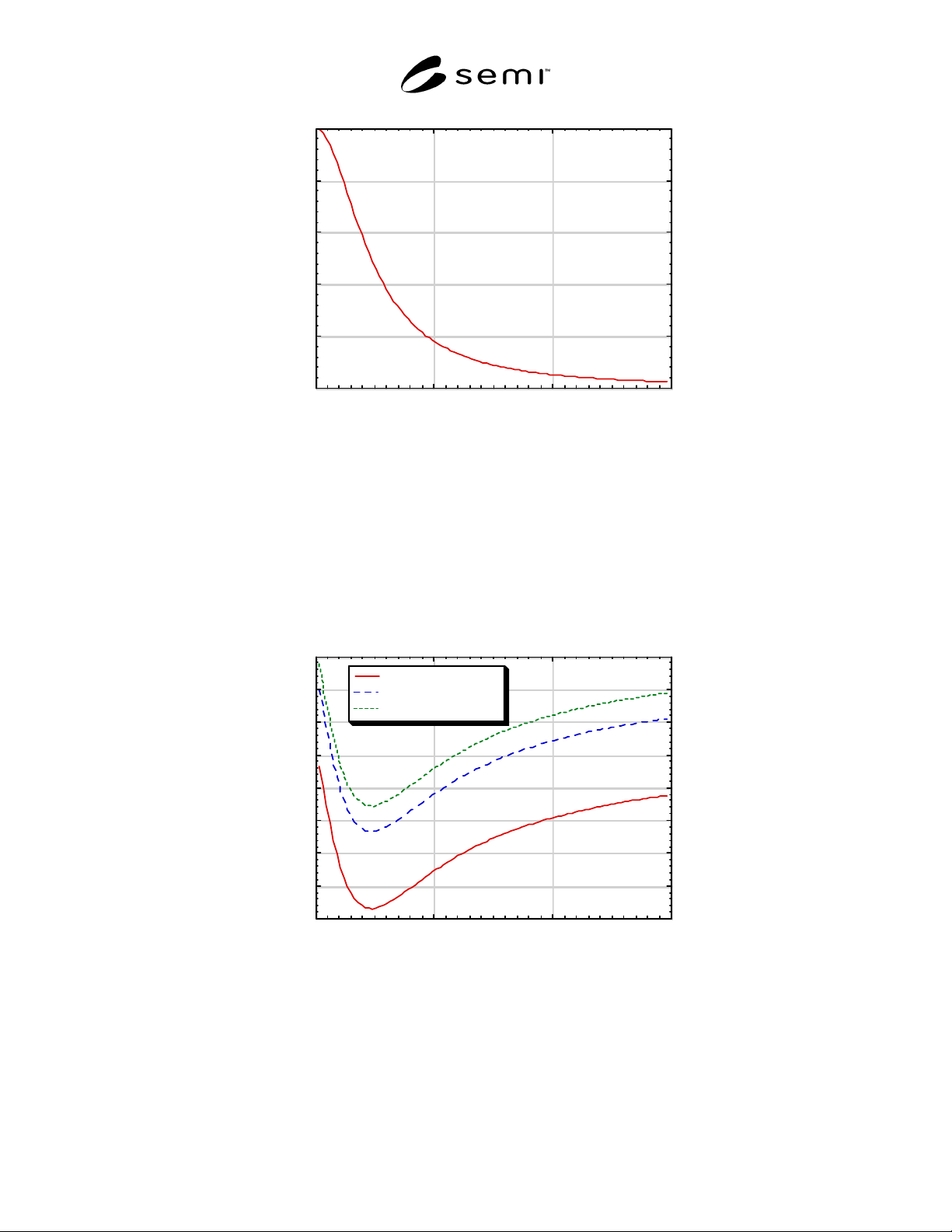
NOTE 1: The real impedance varies from 1.2 ohms to close to 50 ohms.
Figure R1-3
Example Plot of the Real Part of the Load Impedance as a Function of the C1 Shunt Capacitor in the Load
Simulator
-40.0
-35.0
-30.0
-25.0
-20.0
-15.0
-10.0
-5.0
0.0
0 500 1000 1500
C2 = 500 pF
C2 = 1000 pF
C2 = 1500 pF
Reactive Impedance (ohms)
C1 Capacitance (pF)
NOTE 1: The C2 capacitance is at the indicated fixed value for each set of data. For this example, the reactive impedance varies
from around –40 ohms to –5 ohms. Decreasing C2 to 100 pF reduces the reactance to less than –100 ohms.
Figure R1-4
Example Plot of the Reactive Part of the Load Impedance as a Function of the C1 Shunt Capacitance in the
Load Simulator
SEMI E115-0302
E
© SEMI 2002 14
RF out R
A
B
Port 2Port 1
Port 1
Port 2
Perform Calibrations
at End of Additional
Test Cables
Load Simulator
Input Connection
Output Connection
C2
C1
Network
Analyzer
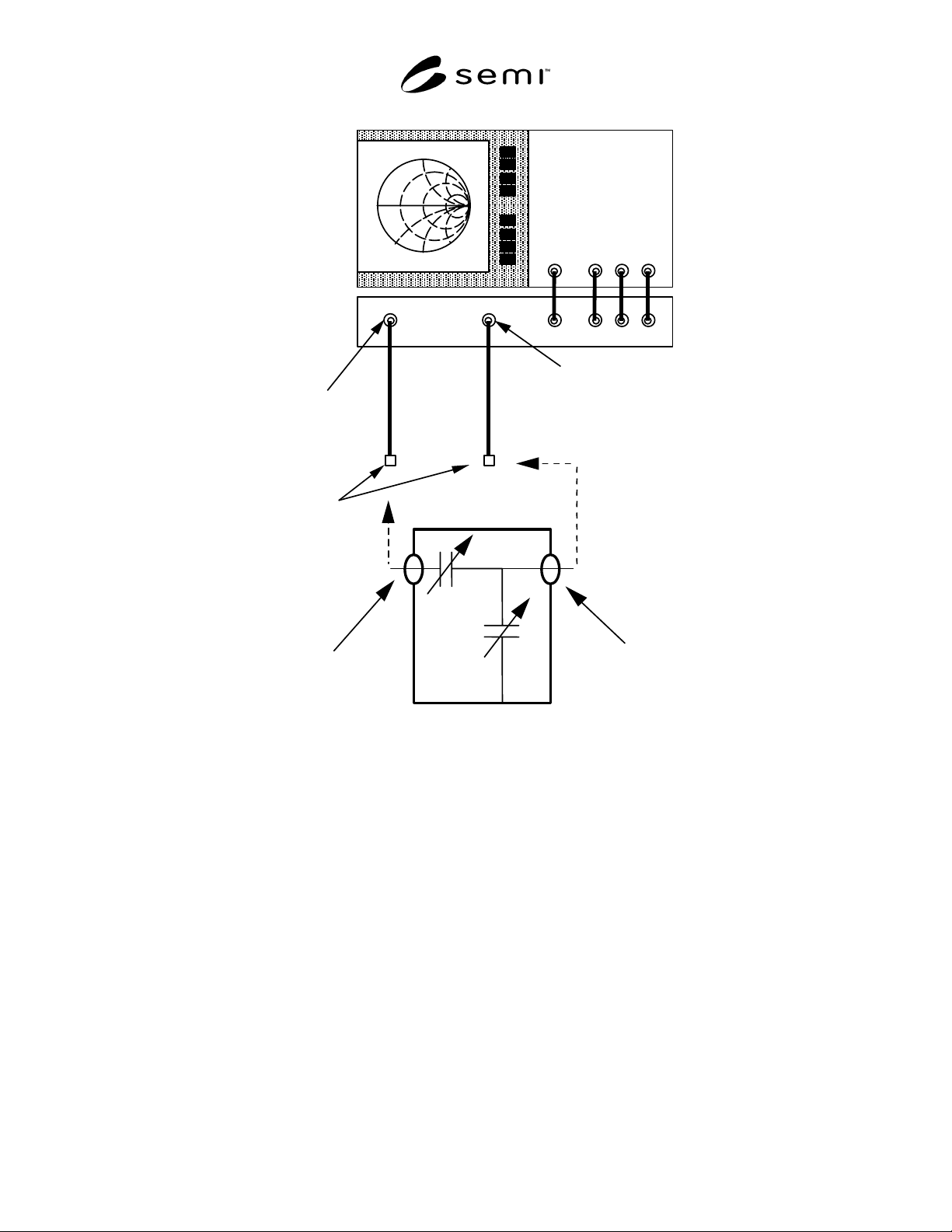
NOTE 1: Both the Port 1 and Port 2 outputs need to be used for the measurement. Additional test cables are needed for the
transmission calibration between the two ports. The input connection of the Load Simulator attaches to Port 1 of the Network
Analyzer. The output connection of Load Simulator attaches to Port 2 of the Network Analyzer.
Figure R1-5
Schematic of a Load Simulator Test Setup for the Load Impedance and Efficiency Measurement
NOTICE: SEMI makes no warranties or representations as to the suitability of the standards set forth herein for any
particular application. The determination of the suitability of the standard is solely the responsibility of the user.
Users are cautioned to refer to manufacturer' s instructions, product labels, product data sheets, and other relevant
literature, respecting any materials or equipment mentioned herein. These standards are subject to change without
notice.
By publication of this standard, Semiconductor Equipment and Materials International (SEMI) takes no position
respecting the validity of any patent rights or copyrights asserted in connection with any items mentioned in this
standard. Users of this standard are expressly advised that determination of any such patent rights or copyrights, and
the risk of infringement of such rights are entirely their own responsibility.
Copyright by SEMI® (Semiconductor Equipment and Materials
International), 3081 Zanker Road, San Jose, CA 95134. Reproduction o
f
the contents in whole or in part is forbidden, without express written
consent of SEMI.

SEMI E116-0705 © SEMI 2002, 2005 1
SEMI E116-0705
PROVISIONAL SPECIFICATION FOR EQUIPMENT PERFORMANCE
TRACKING
This specification was technically approved by the global Information & Control Committee. This edition
was approved for publication by the global Audits and Reviews Subcommittee on April 7, 2005. It was
available at www.semi.org in June 2005 and on CD-ROM in July 2005. Originally published July 2002;
previously published November 2004.
1 Purpose
1.1 This document provides specification for implementing basic equipment performance tracking for production
equipment. Provisions in this document enable the host computer to track basic equipment performance in an
automated and consistent matter, without operator or host input. This document provides specification for
equipment suppliers to:
Track basic equipment states (no operator or host input required).
Track basic equipment states in a modular manner, for both major modules and the overall equipment.
Report basic equipment state changes to a host computer, at both module and equipment level.
Report equipment’s time in state to a host computer, at both module and equipment level.
Report reasons to a host computer for why equipment is blocked from performing its task, at both module and
equipment level.
1.2 Equipment users require the ability to track equipment performance without dependence on user input to
eliminate inaccuracies due to incorrect or untimely input from the user. The ability to track equipment performance
without user input is essential in 300 mm wafer factories where operational scenarios require minimal manual
interaction. EPT defines concepts, behavior, and message services that enable the host computer to obtain the
equipment data required for equipment performance tracking in an automated and consistent matter without operator
or host input.
1.3 EPT enables factory managers to identify the current states of factory equipment, both at the equipment level
and at the module level (e.g., processing chambers), without dependence on user input. EPT enables factory
engineers to evaluate the time that equipment and modules spent in different states and identify areas for
improvement. EPT enables factory engineers to obtain directly from the equipment the reasons why the equipment
or module is prevented from performing. EPT provides industrial engineers the equipment data which, when
combined with external data from the Manufacturing Execution System (MES), will enable accurate calculation of
SEMI E10 states and SEMI E79 metrics at the equipment-level and the module-level. EPT enables automation
engineers to develop reusable host interfaces by using a standardized collection event and data variables to collect
equipment state data.
2 Scope
2.1 The Scope of this standard is to define equipment behavior states and the data required to track basic equipment
performance for production equipment. These requirements are intended to facilitate equipment-level and module-
level state tracking and to communicate state information to the host for simple equipment performance tracking,
without requiring host or operator input.
2.2 Specifically, this document provides:
An Equipment Performance Tracking (EPT) state model that defines triggers for state changes.
Specification of data variables required to communicate basic equipment performance data to the host
computer.
Specification of event messages used to communicate basic equipment performance data to the host computer.
Requirements for EPT compliance.