semi合集-English.pdf - 第6970页
SEMI S9-1101 © SE MI 1995, 2001 7 Table 2 Sample Blank T est Data Form Manufactur er: T est er’s Name: Name of Equipment: Model No.: Serial No.: Date: Loca tion of Test Perfor med: (Test Name) Tes t Method: Test Result: …

SEMI S9-1101 © SEMI 1995, 2001 6
Table 1 Maximum Temperature Limit
Parts of the Equipment Temperature Limit (°C)
Knife switch blade and contact jaws 55
Fuse and fuse clip 110
Rubber and thermoplastic insulated conductors See Note 1.
Field wiring terminals --
Equipment marked for 60°C or 60/75°C supply wires
75
Equipment marked for 75°C supply wires
90
Buses and connecting straps or bars 125
Capacitors See Note 2.
Power switching semiconductors See Note 3.
Printed wiring boards See Note 4.
Motors and Transformers See Note 5.
NOTE 1: The temperature as marked on the conductor.
NOTE 2: The temperature marked on the capacitor.
NOTE 3: The case temperature for the applied power dissipation recommended by the semiconductor manufacturer.
NOTE 4: The operating temperature of the board as specified by the board manufacturer.
NOTE 5: The rated temperature of the motor or transformer as specified by the manufacturer, if provided. When not provided, use appropriate
standards such as IEC 61010-1 for guidance.
10 Reporting Test Results
10.1 Include the following information on the test data form:
• Name, model, and serial number of the equipment
• Date of tests
• Name(s)/signature(s) of tester(s)
• Complete test methods and conditions
• Complete test results
• Complete test equipment information (type of test equipment, manufacturers' names, model numbers, serial
numbers, and calibration information).
10.2 The general configuration and actual operating mode that was used for the test should be clearly documented.
Where components are tested separately or only parts of the overall system are operational, this should be
documented as a condition for the test results reported. This information can be on the test data form(s), or
incorporated in the test report.
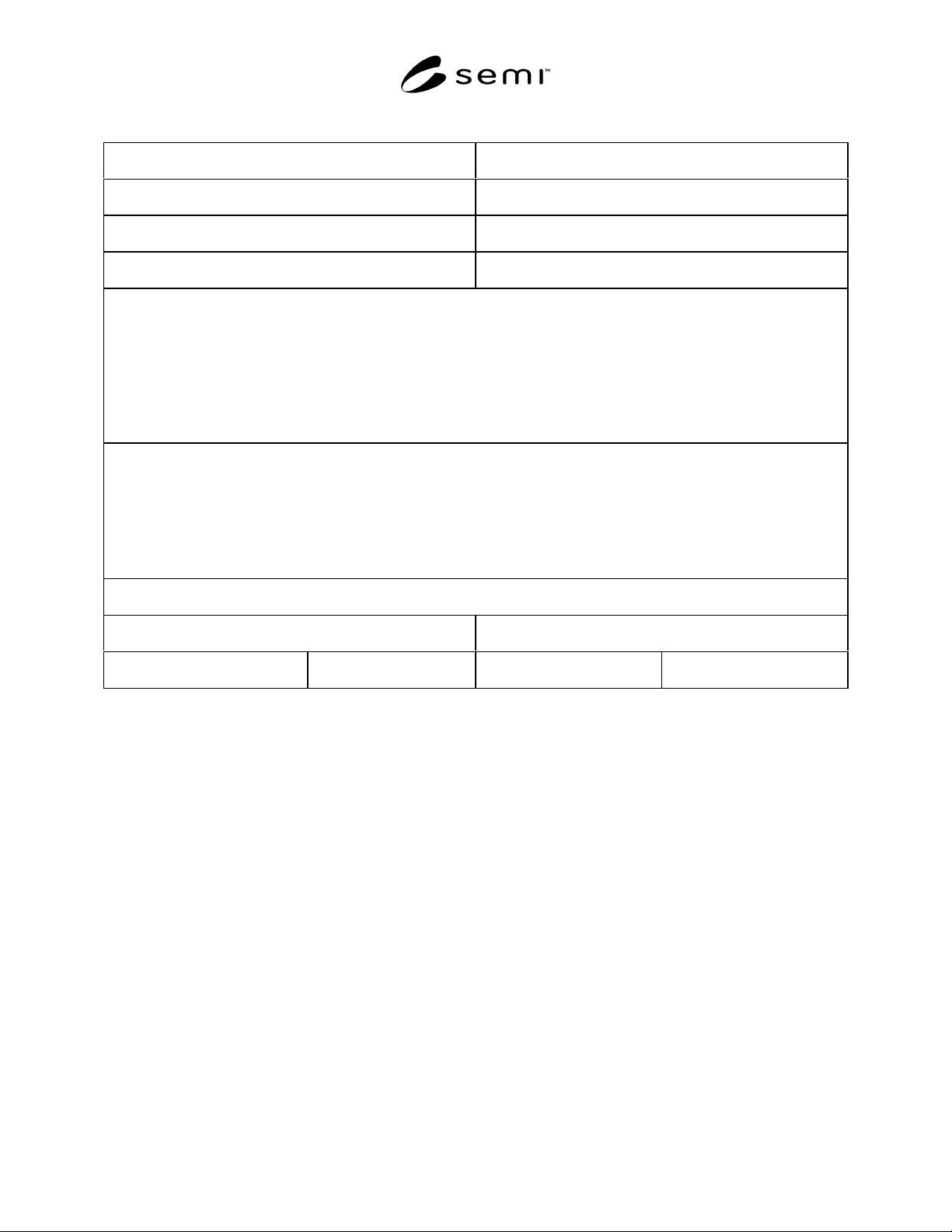
10.3 See Table 2 for a sample blank test data form.
SEMI S9-1101 © SEMI 1995, 20017
Table 2 Sample Blank Test Data Form
Manufacturer: Tester’s Name:
Name of Equipment: Model No.:
Serial No.: Date:
Location of Test Performed:
(Test Name)
Test Method:
Test Result:
Tester: Reviewed:
Equipment Used: Model No.: Serial No.: Last Date Calibrated:
11 Related Documents
11.1 SEMI Standards
SEMI S1 — Safety Guidelines for Equipment Safety Labels
11.2 IEC Documents
IEC 60204 — Safety of Machinery – Electrical equipment of Machines, Part 1: General Requirements
IEC 60950 — Safety of Information Technology Equipment
NOTICE: SEMI makes no warranties or representations as to the suitability of the guidelines set forth herein for
any particular application. The determination of the suitability of the guideline is solely the responsibility of the
user. Users are cautioned to refer to manufacturer's instructions, product labels, product data sheets, and other
relevant literature, respecting any materials or equipment mentioned herein. These guidelines are subject to change
without notice.
By publication of this guideline, Semiconductor Equipment and Materials International (SEMI) takes no position
respecting the validity of any patent rights or copyrights asserted in connection with any item mentioned in this
guideline. Users of this guideline are expressly advised that determination of any such patent rights or copyrights,
and the risk of infringement of such rights are entirely their own responsibility.
Copyright by SEMI® (Semiconductor Equipment and Materials
International), 3081 Zanker Road, San Jose, CA 95134. Reproduction o
f
the contents in whole or in part is forbidden without express written
consent of SEMI.

SEMI S10-1103 © SEMI 1996, 2003 1
SEMI S10-1103
SAFETY GUIDELINE FOR RISK ASSESSMENT AND RISK
EVALUATION PROCESS
This safety guideline was technically approved by the Environmental, Health, & Safety Committee and is the
direct responsibility of the European Environmental, Health, & Safety Committee. Current edition approved
by the European Regional Standards Committee on July 1, 2003. Initially available at www.semi.org
October 2003; to be published November 2003. Originally published December 1996.
NOTICE: This document was completely rewritten in
2003.
NOTICE: Paragraphs entitled “NOTE:” are not an
official part of this document and are not intended to
modify or supersede the official guideline.
1 Purpose
1.1 The purpose of this guideline is to establish general
principles for risk assessment to enable identification of
hazards, risk estimation and risk evaluation in a
consistent and practical manner. The document
provides a framework for carrying out risk assessments
on equipment in the semiconductor and similar
industries and is intended for use by supplier and
purchaser as a reference for EHS considerations.
1.2 Use of this safety guideline is intended to assist in
the development of a strategy to prioritize and control
risks.
2 Scope
2.1 This guideline is intended to apply to the
assessment of risks considering the lifecycle of the
equipment.
NOTE 1: It can also be applied to processes or facilities.
2.2 This guideline outlines a hazard identification, risk
estimation, and risk evaluation process.
NOTICE: This safety guideline does not purport to
address all of the safety issues associated with its use.
It is the responsibility of the users of this safety
guideline to establish appropriate safety and health
practices and determine the applicability of regulatory
or other limitations prior to use.
3 Limitations
3.1 This guideline is not intended to be used to verify
compliance with local regulatory requirements.
3.2 This guideline does not cover risk reduction,
mitigation, avoidance or transfer techniques.
3.3 This guideline is not intended to explain specific
risk assessment techniques, such as Fault Tree Analysis
(FTA), Event Tree Analysis (ETA), Hazard and
Operability Studies (HAZOP) and Failure Mode Effect
Analysis (FMEA). However, it recognizes that these
techniques exist and that they are adequately covered
elsewhere.
NOTE 2: Related Information 2 provides summary
information and references for applicable techniques.
3.4 Use SEMI S14 for fire risk assessment criteria for
equipment.
4 Referenced Standards
4.1 SEMI Standards
SEMI S2 — Environmental, Health, and Safety
Guideline for Semiconductor Manufacturing Equipment
SEMI S14 — Safety Guidelines for Fire Risk
Assessment and Mitigation for Semiconductor
Manufacturing Equipment
NOTICE: Unless otherwise indicated, all documents
cited shall be the latest published versions.
5 Terminolgy
5.1 Definitions
5.1.1 controls —
means to prevent or avoid a hazard
from causing loss.
5.1.2 exposure to a hazard — situation in which a
hazard is present which may (but does not necessarily)
result in harm.
5.1.3 frequency of exposure — how often personnel or
equipment are exposed to a hazard.
5.1.4 harm — physical injury or damage to health of
people, or damage to equipment, buildings or
environment.
5.1.5 hazard — condition that has the potential to
cause harm.
5.1.6 lifecycle — the entire life of an item of
equipment, from conceptual design through to disposal.
5.1.7 likelihood — the expected frequency with which
harm will occur. Usually expressed as a rate (e.g.,
events per year, per product, or per substrate
processed).