semi合集-English.pdf - 第2134页
SEMI E54.15-0305 © SEMI 2005 6 7.1.5 In the following sections the presen tation to the networ k of object addr essing, obj ect attributes and object services for each of the object types listed in Table 2 is desc ribed …
SEMI E54.15-0305 © SEMI 2005 5
SafetyBUS p OCS documentation. In addition the device shall comply with the object specifications defined in §7
of this document.
6.9 Network Management — The device shall comply with the SafetyBUS p and CAN network management
specifications detailed in the SafetyBUS p standard and SafetyBUS p Guide to Programmable Safety Systems
Standard Specifications (e.g., physical layer bit rate, master/slave and peer-to-peer network management, etc.). No
(additional) network management functions are specified in this document.
7 Required And Optional Object Types
7.1 The SafetyBUS p standard specification does not require any specific objects to exist in a SafetyBUS p device
in order to be a compliant SafetyBUS p device. The SafetyBUS p standard specification is extended in this standard
to identify and describe objects (i.e. classes) that shall exist in devices that are to be interoperable and
interchangeable on a SafetyBUS p SEMI compliant SAN network.
7.1.1 The Common Device Model (CDM) specification (see reference SEMI E54.1 ¶4.1) identifies two objects
(namely the Device Manager (DM) and Sensor Actuator Controller (SAC) objects) that shall exist in all SEMI
compliant SAN devices.
7.1.2 The required object types for a SEMI compliant SAN device utilizing the network communication
specification described herein necessarily comprises, at minimum, the union of the SafetyBUS p object type
requirements and the CDM specification requirements.
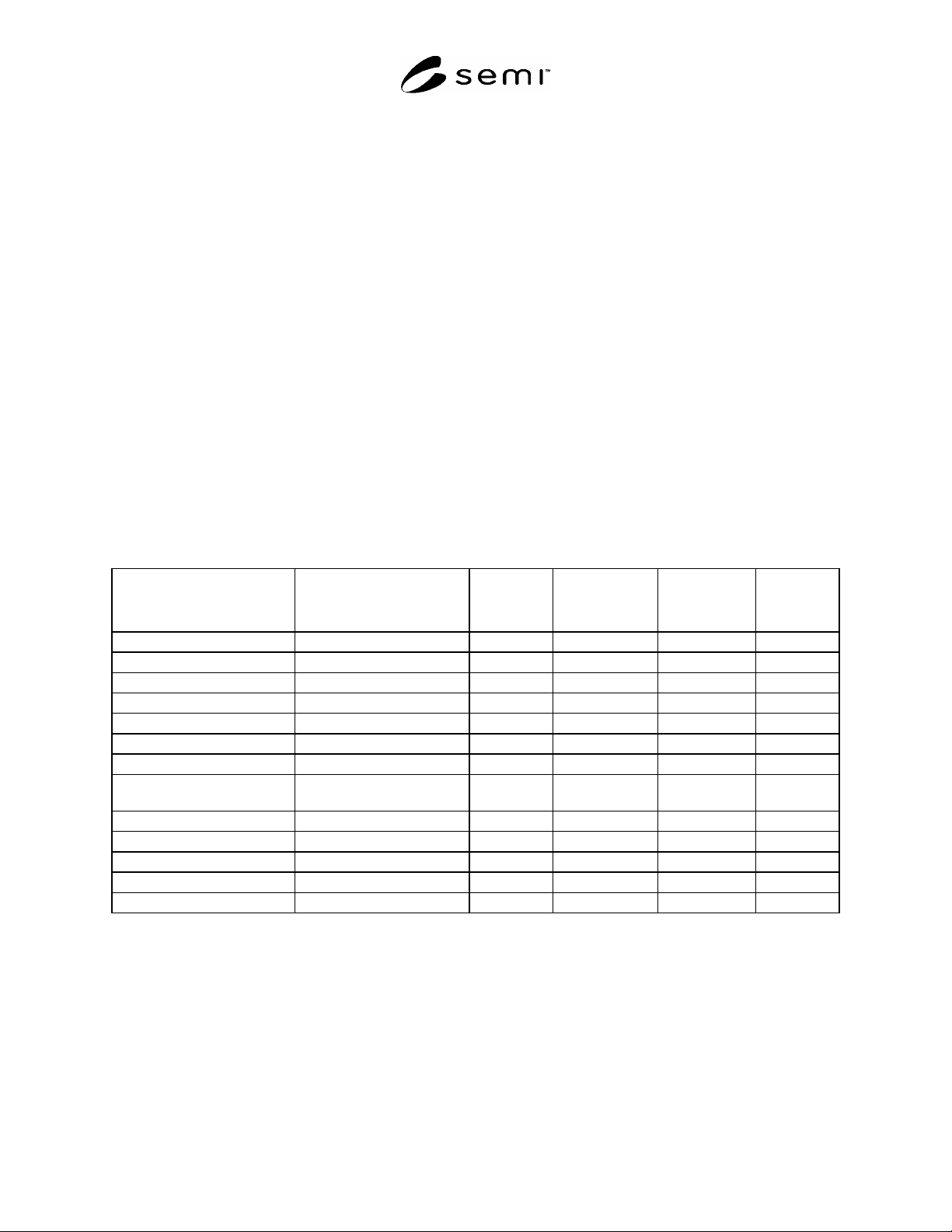
7.1.3 A list of required and optional object types is given in Table 2. Additional objects that are specified in a
particular SDM are given identifiers in that SDM specification; SafetyBUS p specific presentation information for
these identifiers is given in Section 9 of this document.
Table 2 Required and Optional Object Types
Object Name SafetyBUS p
Class ID / Instance ID
#1
CDM Tag
#2
Required by
SafetyBUS p
#1
Required by
CDM
#2
Required
by NCS
Device Manager 1/1 DmI0 No Yes Yes
Sensor/ Actuator/ Controller 2/1 SacI0 No Yes Yes
Assembly 3/1 through i Asm No No No
Local Link 4/1 through j Lnk No No No
Sensor – AI 33/1 through k Sai No No No
Sensor – EI 34/1 through l Sei No No No
Sensor – BI 35/1 through m Sbi No No No
Actuator – AO 36/1 through n Aao No No No
Actuator – EO 37/1 through o Aeo No No No
Actuator – BO 38/1 through p Abo No No No
Controller 39/1 through q C No No No
Sensor – BI-TH 40/I through s Sbith No No No
Application Objects 129 through x/1 through r (3) No No No
#1
See SafetyBUS p specification for further information; values are decimal; ‘i’, ‘j’, ‘k’, ‘l’, ‘m’, ‘n’, ‘o’, ‘p’, ‘q’, ‘r’ and ‘s’ represent arbitrary
numbers (greater than or equal to 1) indicating that more than one instance may be supported. ‘x’ is a number greater than or equal to 129
indicating that one or more application object classes may be supported.
#2
See CDM specification for further information
#3
Application Dependent objects’ tags as specified in SDM
7.1.4 An embodiment of a specific device type represented as an aggregation of the object types listed in Table 2
that is compliant with both the CDM specification and the SafetyBUS p specification, is a candidate for a SEMI
SDM as well as a SafetyBUS p device definition. Conversely, all SEMI SDMs and SafetyBUS p device definitions
specified for operation over a SEMI compliant SafetyBUS p network must be an aggregation of the object types
listed in Table 2, and be compliant with both the CDM specification and the SafetyBUS p standard specifications.

SEMI E54.15-0305 © SEMI 2005 6
7.1.5 In the following sections the presentation to the network of object addressing, object attributes and object
services for each of the object types listed in Table 2 is described in detail. Refer to the CDM standard to determine
if the object instance attribute and service is specified as required or optional. Unless otherwise noted, all attributes
and services described are instance level attributes (as opposed to class level attributes). A class level attribute and
service is accessed as instance number zero.
7.1.6 Note that the formats of object attributes and services are detailed in the CDM document; the presentation of
object attributes and services to the SafetyBUS p network is detailed in the tables contained in the following sub-
sections and in the SafetyBUS p standard specifications.
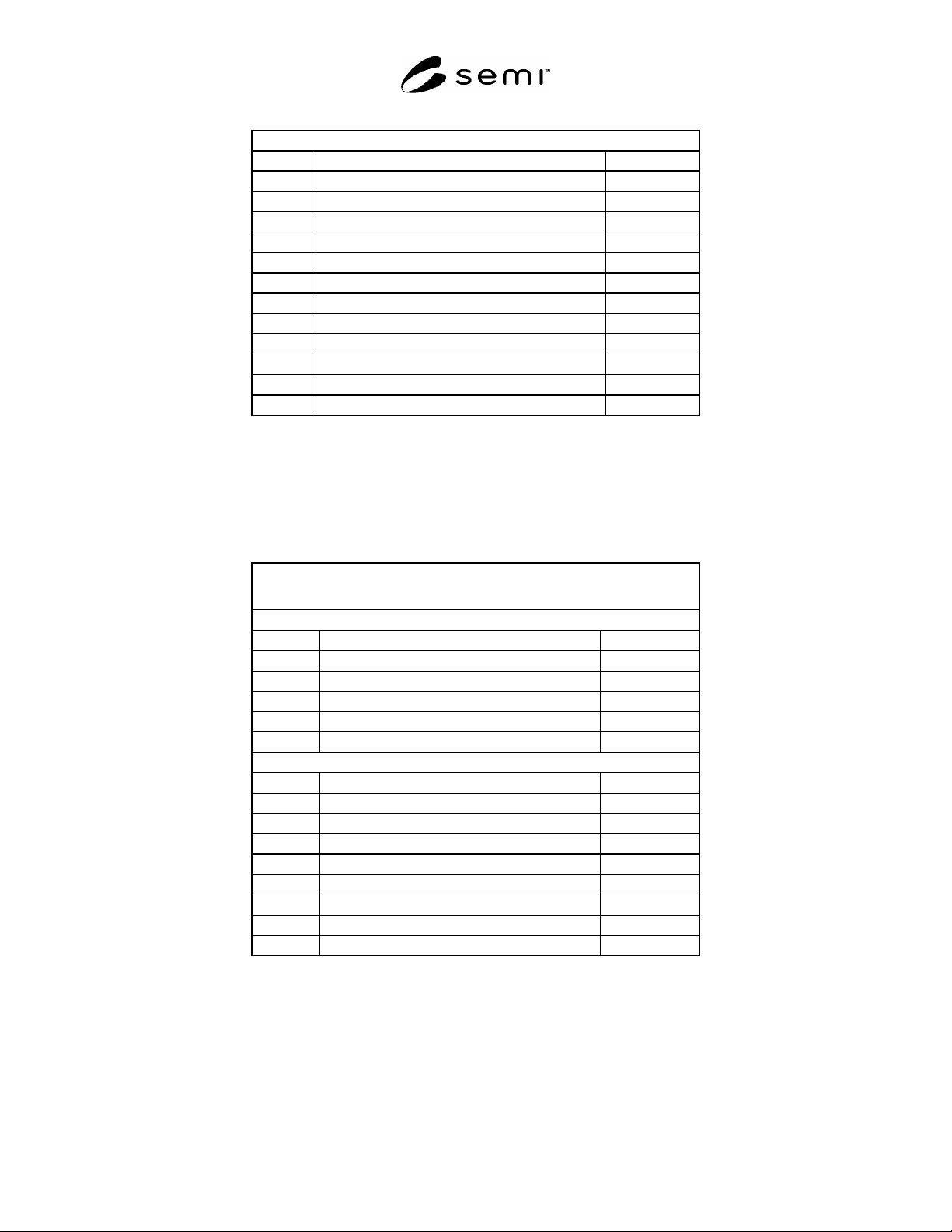
7.2 Device Manager (DM) Object –– The DM object instance is the device component responsible for managing
and consolidating the device operation. Each device must support one (and only one) DM object. The DM object as
well as its common required and optional attributes, services and behavior are described in the CDM standard. The
presentation of object instance attributes and services to the SafetyBUS p network shall be as indicated in Table 3.
Note that all service ID values identified refer to the ID of the request or notification component of that service.
Corresponding reply components to request/reply services shall have a service ID value equal to the request
component ID plus one.
Table 3 DM Object Instance Attributes and Services
Device Manager Object (DM)
Class ID = 01, Instance ID = 01
Attributes
ID Attribute Name CDM Tag
01 Device Type DmA1
02 Standard Revision Level DmA2
03 Device Manufacturer Identifier DmA3
04 Manufacturer Model Number DmA4
05 Software or Firmware Revision Level DmA5
06 Hardware Revision Level DmA6
07 Serial Number DmA7
08 Device Configuration DmA8
09 Device Status DmA9
10 Reporting Mode DmA10
11 Exception Status Report DmA11
12 Exception Status DmA12
13 Exception Detail Alarm DmA13
14 Exception Detail Warning DmA14
15 Visual Indicator DmA15
16 Alarm Enable DmA16
17 Warning Enable DmA17
18 Exception Detail Type DmA18
19 Exception Detail Alarm Queue DmA19
20 Exception Detail Warning Queue DmA20
21 Date and Time DmA21
22 Date and Time Type DmA22
SEMI E54.15-0305 © SEMI 2005 7
Services
ID Service Name CDM Tag
01 Reset DmS1
03 Abort DmS2
05 Recover DmS3
07 Get Attribute DmS4
09 Set Attribute DmS5
11 Execute DmS6
13 Perform Diagnostics DmS7
15 Publish Attribute DmS8
17 Lock DmS9
19 Unlock DmS10
21 Get Exception Queue DmS11
23 Clear Exception Queue DmS12
7.3 Sensor, Actuator, Controller (SAC) Object –– The SAC object instance is the device component responsible for
coordinating the interaction of the device with the sensory/actuation/control environment. Each device must support
one (and only one) SAC object instance. The SAC object instance as well as its common required and optional
attributes, services and behavior are described in the CDM standard. The presentation of object instance attributes
and services to the SafetyBUS p network shall be as indicated in Table 4.
Table 4 Object Instance Attributes and Services
Sensor, Actuator, Controller Object (SAC)
Class ID = 02, Instance ID = 01
Attributes
ID Attribute Name CDM Tag
01 Last Calibration Date SacA1
02 Next Calibration Date SacA2
03 Expiration Timer SacA3
04 Expiration Warning Enable SacA4
05 Run Hours SacA5
Services
ID Service Name CDM Tag
01 Reset SacS1
03 Abort SacS2
05 Recover SacS3
07 Get Attribute SacS4
09 Set Attribute SacS5
25 Operate SacS6
27 Restore Default SacS7
29 Publish Attribute SacS8