semi合集-English.pdf - 第2777页
SEMI E98-1102 © SEMI 2000, 2002 42 Equipment Modul e (Apply & Develop Track) Equipmen t Subsy stem (LoadPort ) Equipment Subsystem (Wafer Transport) Equipment Modul e (Chill Plate) Equipment Module (Vapor Prime) 1+ E…
SEMI E98-1102 © SEMI 2000, 2002 41
RELATED INFORMATION 1
MODELS
NOTE: This related information is not an official part of SEMI E98. This is Related Information for the provisional specification
and is not intended to modify or supersede the official standard. Determination of the suitability of the material is solely the
responsibility of the user.
This section provides examples of equipment models to clarify the standard.
R1-1 Linked Litho Model
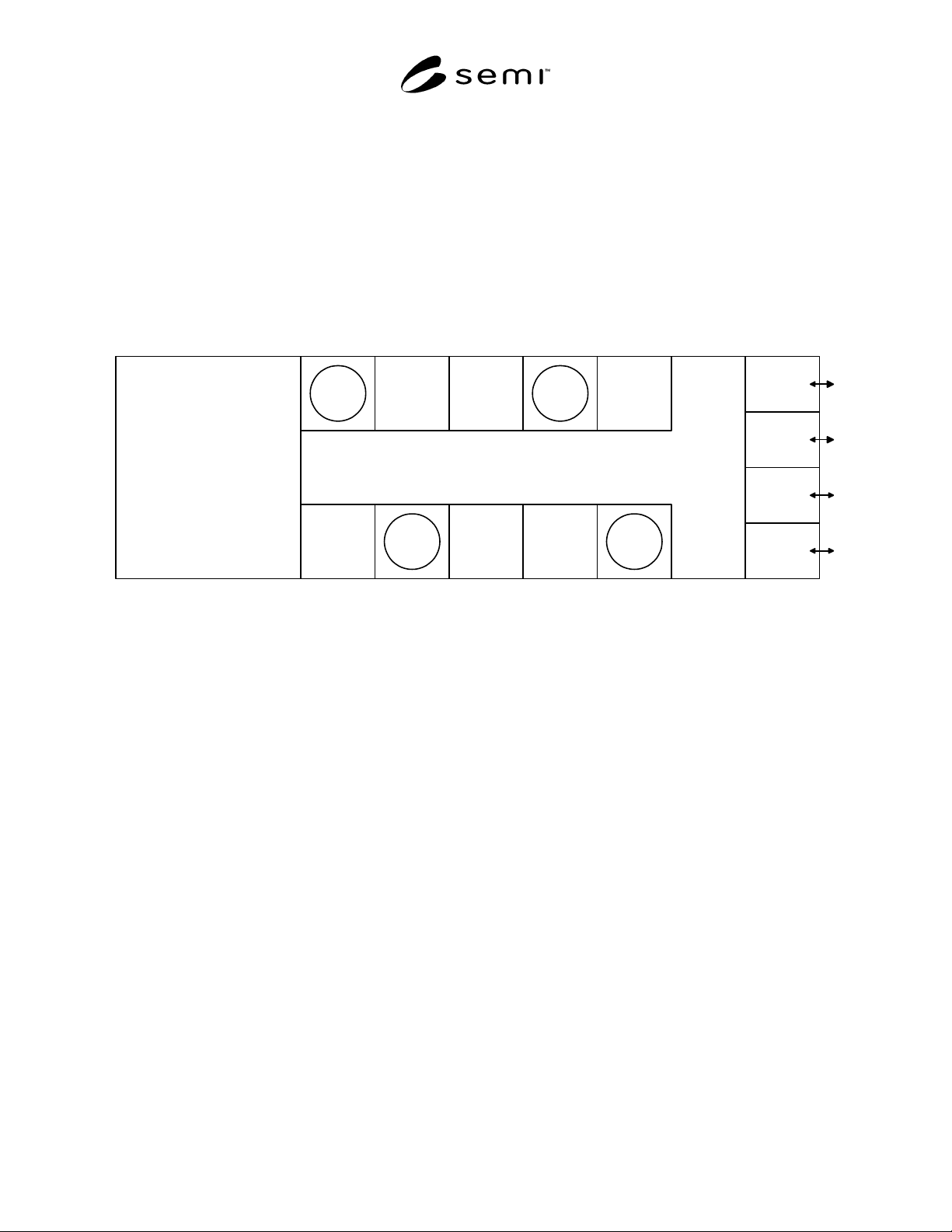
R1-1.1 This section describes the application of OBEM objects to a linked litho as illustrated in Figure R1-1.
Expose
Chill
Plate
Vacuum
Bake
Coat
Chill
Plate
Vapor
Prime
Post-
Expose
Bake
Chill
Plate
Develop Bake
Chill
Plate
Chill
Plate
Load
Port
Load
Port
Chill
Plate
Chill
Plate
Chill
Plate
Load
Port
Load
Port
Figure R1-1
Illustration of Linked Litho
R1-1.2 A linked litho is an aggregate created by physically connecting an apply/develop track to a lithography
equipment. Work enters through the track where it goes through a set of initial processing steps. Individual
substrates are passed to the lithography equipment where they are exposed and returned to another part of the track,
where they complete another set of processing steps. Both the track and the lithography equipment are capable of
acting independently. However, in the linked-litho configuration, they must perform together as a single system and
are treated as a single Equipment by the factory.
R1-1.3 Apply/Develop Track Equipment
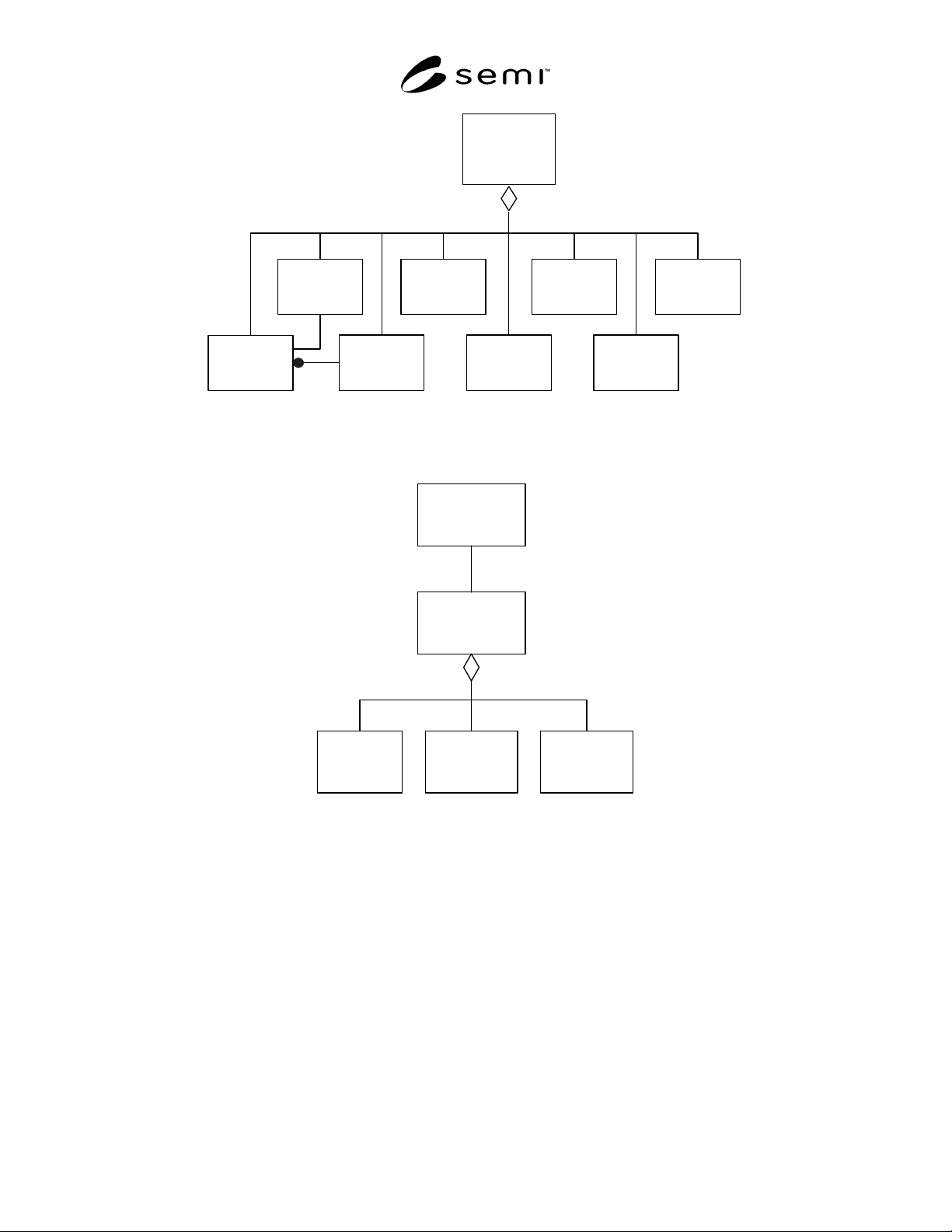
R1-1.3.1 Before considering the object model for a linked litho, it is helpful to examine the model for an
apply/develop track as a type of stand-alone equipment. This is illustrated in Figure R1-2.
SEMI E98-1102 © SEMI 2000, 2002 42
Equipment
Module
(Apply &
Develop
Track)
Equipment
Subsystem
(LoadPort)
Equipment
Subsystem
(Wafer
Transport)
Equipment
Module
(Chill Plate)
Equipment
Module
(Vapor
Prime)
1+
Equipment
Module
(Vacuum
Bake)
Equipment
Module
(Apply)
Equipment
Module
(Develop)
1+
1+
1+
1+ 1+ 1+
Equipment
Subsystem
(Temp
Control)
used by
used by
1+
Figure R1-2
Apply and Develop Track Equipment
Equipment
(Linked
Litho)
Equipment
Module
(Expose)
User
Equipment
Subsystem
(Load Port)
2+
Equipment
Module
(Track)
2+
1+
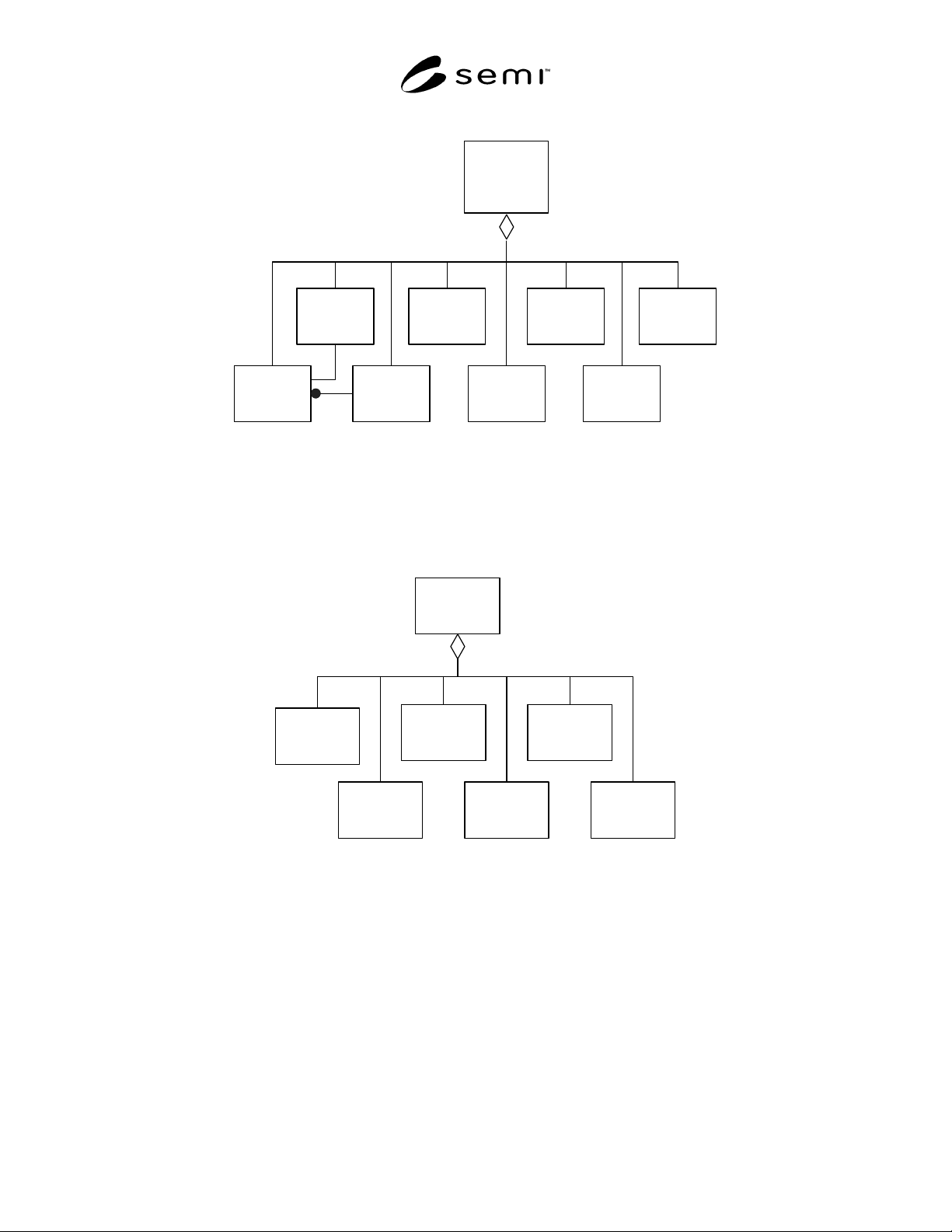
Figure R1-3
Object Model for Linked Litho Equipment
SEMI E98-1102 © SEMI 2000, 2002 43
R1-1.4 Combined Linked Litho
Equipment
Module
(Apply &
Develop
Track)
Equipment
Subsystem
(LoadPort)
Equipment
Subsystem
(Wafer
Transport)
Equipment
Module
(Chill Plate)
Equipment
Module
(Vapor
Prime)
1+
Equipment
Module
(Vacuum
Bake)
Equipment
Module
(Apply)
Equipment
Module
(Develop)
1+
1+
1+
1+ 1+ 1+
Equipment
Subsystem
(Temp
Control)
used by
used by
1+
Figure R1-4
Linked Litho Track Module
R1-1.4.1 The Linked Litho Equipment has two major EquipmentModules, the track module and the expose module
in this model. The track, in turn, is composed of various types of Sub-modules, such as the Vapor Prime module,
the Spin module, and so forth.
Equipment
Module
(Litho)
1+
Equipment
Subsystem
(Wafer
Transport)
Equipment
Subsystem
(Expose Stage)
Equipment
Resource
(Laser System)
Equipment
Subsystem
(Alignment
Stage)
Equipment
Subsystem
(Reticle
Management)
Equipment
Subsystem
(Single
WaferPort)
1+
Figure R1-5
Linked Litho Expose Module Object Model
R1-1.4.2 Figure R1-6 shows the makeup of another track module. This process may be extended as many times as
is required by the particular installation.
R1-2 300 mm Equipment
R1-2.1 Because of the size and the weight of wafers with a diameter of 300 mm or greater, a 25-wafer cassette is
too heavy for repetitive lifting by people. 300 mm factories must be able to integrate automated material handling
systems and production equipment. To achieve this, equipment loadports must be standardized for access by
different material handling technologies such as overhead tracks and rail-guided vehicles in addition to personal-
guided vehicles (PGVs) used by operators.