semi合集-English.pdf - 第4632页
SEMI C3-0699 © SEMI 19 86, 1999 13 NOTE 1: This table is intende d to identify various gases descr ibed in the SEMI sta ndards a nd the ty pical uses f or those gase s in sem iconductor proces ses. It is not a ll-inclus …
SEMI C3-0699 © SEMI 1986, 1999 12
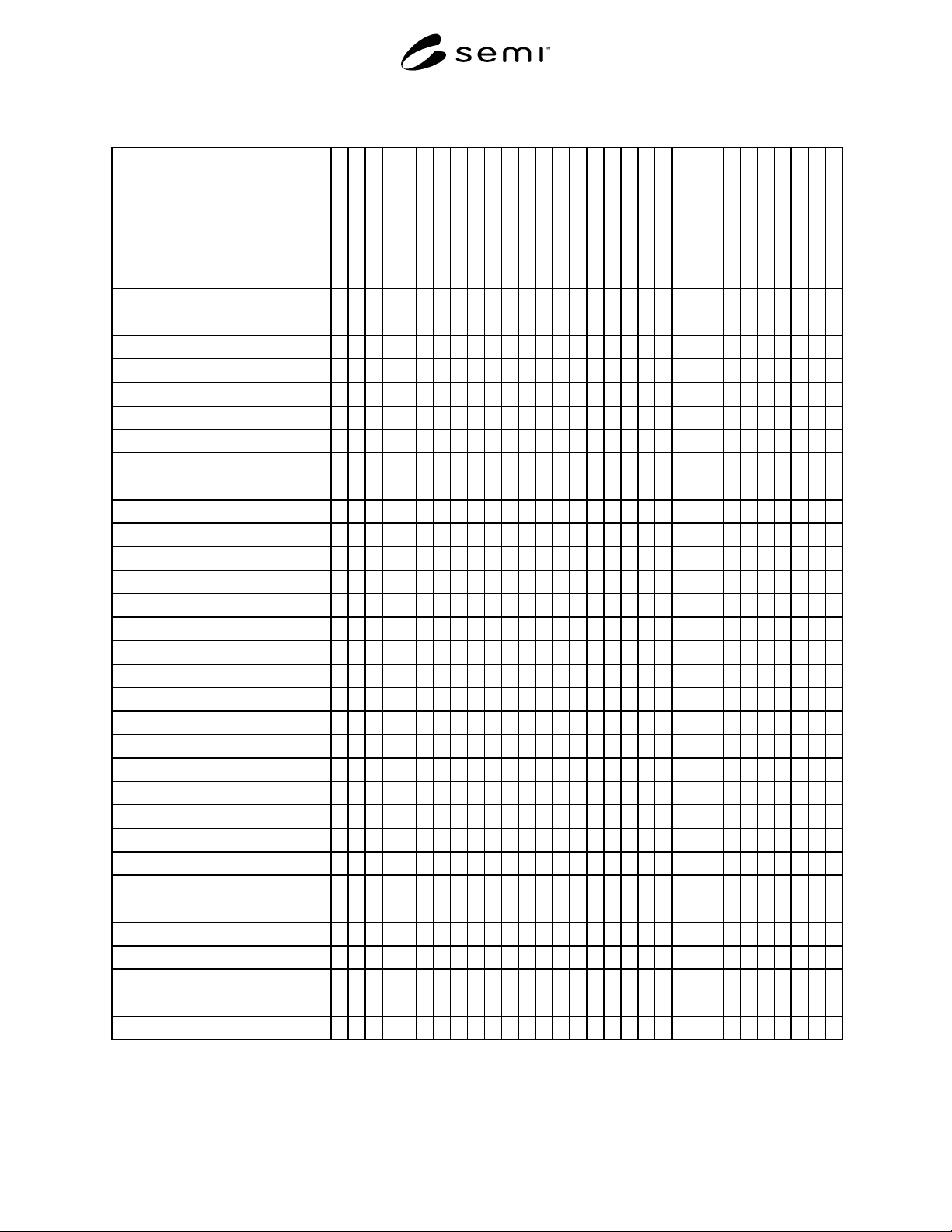
11 Gas Use Table (see Notes 1, 2)
Gas Use Table
Ammonia
Argon
Arsine
Boron Trichloride
Boron Trifluoride
Boron-11-Trifluoride
Carbon Tetrfluoride
Chlorine
Diborane
Dichlorosilane
Disilane
Heliu
m
Hexafluoroethane
Hydrogen
Hydrogen Bromide
Hydrogen Chloride
Hydrogen Fluoride
Methyl Fluoride
Nitrogen
Nitrogen Trifluoride
Nitrous Oxide
Oxygen
Perfluoropropane
Phosphine
Silane
Silicon Tetrachloride
Sulfur Hexafluoride
Trichlorosilane
Trifluoromethane
Tungsten Hexafluoride
Annealing X X
Carrier Gas for Bubblers X X
Chamber Cleans X X X X
CVD Carrier Gas X X
CVD Source X
CVD B Source X
CVD P Source X
CVD Epitaxial X
CVD Nitride X
CVD Oxides X X X X
CVD Polysilicon X X X
CVD Silicides X
Epitaxial Silicon X X X
CVD Silicon Nitride X X X X
CVD Tungsten/Silicide X
Dopants X X
Etching X X X
Metal Etching X X X X X X X X
Nitride Etching X X X X X X X X
Oxide Etching X X X X X X X X X
Silicon Etching X X X X X X X X
Ion Implant X X X X X
Metal Gettering or CVD Tube Cleans X
Nitridation X
Oxide Gettering X X
Oxynitrides X
Plasma Ashing X
Pressurizing Systems X X
Reactive Ion Etch X X
Reducing Gas X
Sputtering X
Inert Gas Blanketing/Purging X X X

SEMI C3-0699 © SEMI 1986, 199913
NOTE 1: This table is intended to identify various gases
described in the SEMI standards and the typical uses for those
gases in semiconductor processes. It is not all-inclusive. As
other uses arise, they should be brought to the attention of the
Gases Committee so that revisions can be made to this table
as needed.
NOTE 2: Performance of a gas in an application may vary
depending on the impurities in the gas. It is the responsibility
of the user to determine the appropriate gas quality for any
specific application.
NOTICE: These standards do not purport to address
safety issues, if any, associated with their use. It is the
responsibility of the user of these standards to establish
appropriate safety and health practices and determine
the applicability of regulatory limitations prior to use.
SEMI makes no warranties or representations as to the
suitability of the standards set forth herein for any
particular application. The determination of the
suitability of the standard is solely the responsibility of
the user. Users are cautioned to refer to manufacturer's
instructions, product labels, product data sheets, and
other relevant literature respecting any materials
mentioned herein. These standards are subject to
change without notice.
The user’s attention is called to the possibility that
compliance with this standard may require use of
copyrighted material or of an invention covered by
patent rights. By publication of this standard, SEMI
takes no position respecting the validity of any patent
rights or copyrights asserted in connection with any
item mentioned in this standard. Users of this standard
are expressly advised that determination of any such
patent rights or copyrights, and the risk of infringement
of such rights, are entirely their own responsibility.
Copyright by SEMI® (Semiconductor Equipment and Materials
International), 3081 Zanker Road, San Jose, CA 95134. Reproduction o
f
the contents in whole or in part is forbidden without express written
consent of SEMI.
SEMI C3.12-1102 © SEMI 1983, 2002 1
SEMI C3.12-1102
SPECIFICATION FOR AMMONIA (NH
3
) IN CYLINDERS, 99.998%
QUALITY
This specification was technically approved by the Global Gases Committee and is the direct responsibility of
the North American Gases Committee. Current edition approved by the North American Regional Standards
Committee on August 29, 2002. Initially available at www.semi.org September 2002; to be published
November 2002. Originally published in 1983, previously published in 1994.
1 Description
1.1 Ammonia is a colorless, alkaline gas having a
pungent odor. Ammonia dissolves readily in water. It is
shipped as a liquified gas under its own vapor pressure.
It is combustible.
2 Specifications
2.1 QUALITY: 99.998%
Impurities
Maximum Acceptable Level
(ppm)*
Carbon monoxide (CO) 1
Hydrocarbons C
1
– C
3
1
Nitrogen (N
2
) 5
Oxygen (O
2
) 2
Water (H
2
O) (v/v) 3
TOTAL LISTED IMPURITIES 12
*An analysis of significant figures has not been considered. The
number of significant figures will be based on analytical accuracy and
the precision of the provided procedure.
NOTE 1: This specification applies to the gas phase of the
cylinder as delivered.
3 Physical Constants (for information only)
Metric Units US Units
Molecular weight 17.031 17.031
Boiling point at 1 atm –33.4°C –28.2°F
Density of gas at 0°C (32°F)
and 1 atm
0.771 kg/m
3
0.0481 lb/ft
3
Specific gravity of gas at 0°C
and 1 atm (air = 1)
0.597 0.597
Density of liquid at 21.1°C
(70°F)
608.7 kg/m
3
38.00 lb/ft
3
4 Analytical Procedures
NOTE 2: Observe proper safety procedures for handling and
venting the ammonia sample.
NOTE 3: Introduce the calibration standard as many times as
necessary to achieve the desired precision.
NOTE 4: All the gases used in the analysis of the sample
should contain not more than 10% of the specified value of
the component of interest unless otherwise specified.
NOTE 5: All carrier lines, carrier pressure regulators and
sample containers are to be constructed of stainless steel and
cleaned. The systems must be assembled without pipe threads,
PTFE tape or polymeric seal materials.
4.1 Carbon Monoxide, Oxygen and Nitrogen — This
procedure is for the determination of carbon monoxide,
oxygen and nitrogen in ammonia using a gas
chromatograph with a helium ionization detector.
NOTE 6: Due to the extreme sensitivity of the helium
ionization detector, the system is to be helium leak tested to a
maximum of 10
–7
atm-cc/sec.
4.1.1 Detection Limits — 25 ppb (mole/mole) carbon
monoxide, 30 ppb (mole/mole) oxygen, 50 ppb
(mole/mole) nitrogen.
4.1.2 Instrument Parameters
4.1.3 Columns:
Column 1: HayeSep A or equivalent, 100/120 mesh, 3.28
m (10 ft) by 3.2 mm (1/8 in.) 0.085 ID.
Column 2: HayeSep A or equivalent, 100/120 mesh, 3.28
m (10 ft) by 3.2 mm (1/8 in.) 0.085 ID.
4.1.3.1 Carrier Flow: 30 mL/min helium, minimum of
99.9999% purity having a maximum of 40 ppb carbon
dioxide.
4.1.3.2 Sample Volume: 1.0 mL.
4.1.3.3 Temperatures:
Detector 125°C
Columns 27°C
4.1.3.4 Determine the breakdown voltage of the
detector. Set operating voltage at 10 volts below
breakdown.
4.1.4 Calibration Standards — 1–2 ppm (mole/mole)
carbon monoxide, 2–3 ppm (mole/mole) oxygen, 5–6
ppm (mole/mole) nitrogen, balance helium (having a
total of other impurities of less than 1 ppm).
4.1.5 Operating Procedure
4.1.5.1 Set timing interval on sample select valve to 10
seconds.