semi合集-English.pdf - 第2752页
SEMI E98-1102 © SEMI 2000, 2002 17 10.2.3.8 State Tran sition Table — Table 3 defines the state tran sitions of the AbstractEquipmentElement object. Table 3 AbstractEquipmentElemen t State Transitions # Previous State Tr…
SEMI E98-1102 © SEMI 2000, 2002 16
Abstract
Equipment
Element
Equipment
IODevice
Abstract
Equipment
Subsystem
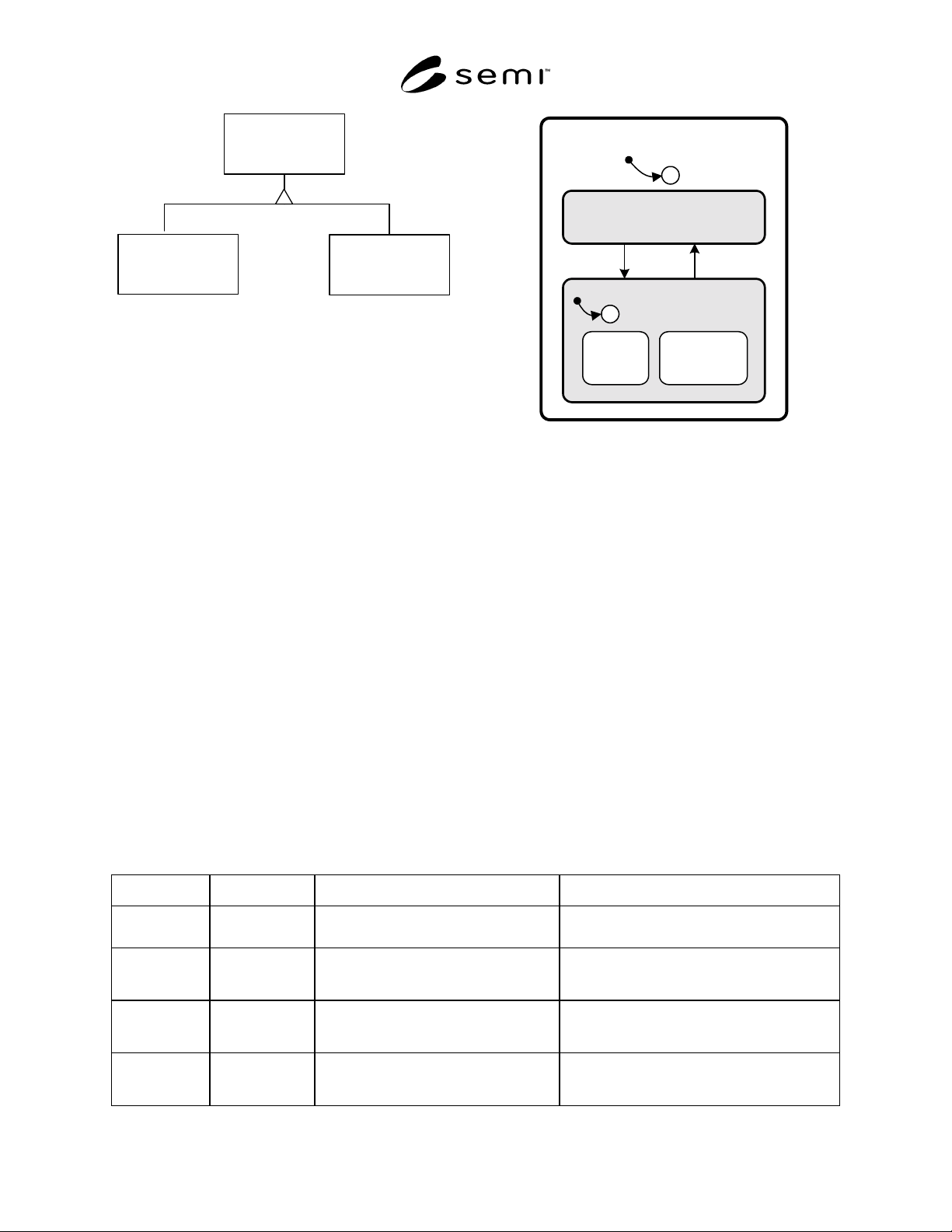
Figure 6
AbstractEquipmentElement Object Types
10.2.3 AbstractEquipmentElement State Model
10.2.3.1 The AbstractEquipmentElement is either IN
SERVICE (available for work) or OUT OF SERVICE
(unavailable for work). In some cases, the user may be
able to set the AbstractEquipmentElement’s operational
state.
10.2.3.2 The state diagram for the
AbstractEquipmentElement state model is shown in
Figure 7.
10.2.3.3 The AbstractEquipmentElement shall be fault-
free whenever it is in the IN SERVICE state.
10.2.3.4 An AbstractEquipmentElement in the OUT
OF SERVICE state shall not be used by the equipment
or the user for normal manufacturing purposes (while
the Equipment or containing EquipmentModule is in
the ARAMS superstate of MANUFACTURING).
OPERATIONAL
C
1
IN SERVICE
3
USER
SELECT
EQUIPMENT
SELECT
2
C
4
OUT OF
SERVICE
Figure 7
AbstractEquipmentElement State Model
10.2.3.5 The user may or may not be allowed to put a
certain subtype of AbstractEquipmentElement out of
service, depending upon the equipment design. This is
optional for the equipment. In general, the user
requires the ability to put major components into and
out of service but does not require this for lower level
components. In many cases, a component can not
operate without some or all of its component elements.
10.2.3.6 Substates of OUT OF SERVICE are not
required unless the user is able to put the
AbstractEquipmentElement out of service. However, if
a user places an AbstractEquipmentElement out of
service, only a user shall be able to return it back in
service. The substates are then required to retain the
source of the out of service selection through the
substates USER SELECT and EQUIPMENT SELECT.
10.2.3.7 State Model Definitions — Table 2 defines the states of the AbstractEquipmentElement object.
Table 2 AbstractEquipmentElement State Definitions
State Name Superstate Definition Comment
IN SERVICE OPERATIONAL The AbstractEquipmentElement is error-
free and may be used for work.
None
OUT OF
SERVICE
OPERATIONAL The AbstractEquipmentElement has one
or more exceptions and/or has been made
unavailable by the equipment or User.
None
USER SELECT OUT OF
SERVICE
The user requested the Abstract-
Equipment-Element be put out of service.
Stays out of service until the user returns it to
service. This substate may be omitted for low
level elements.
EQUIPMENT
SELECT
OUT OF
SERVICE
The equipment determined that the
AbstractEquipmentElement should be
placed out of service.
Stays out of service until the equipment
determines it is able to operate properly. This
substate may be omitted for low level elements.
SEMI E98-1102 © SEMI 2000, 2002 17
10.2.3.8 State Transition Table — Table 3 defines the state transitions of the AbstractEquipmentElement object.
Table 3 AbstractEquipmentElement State Transitions
# Previous State Trigger New State Action(s) Comment
1 INITIALIZATION Initialization is complete. Depends upon previous
state and current condition
None If the user made the element
unavailable, it shall remain
unavailable. If the element has a
fault, it shall be made unavailable
by the equipment.
2 IN SERVICE The user has placed the
element OUT OF
SERVICE by the user or
the equipment.
OUT OF SERVICE None The equipment should put the
element out of service whenever
a fault condition exists at the
element.
3 OUT OF SERVICE The element has been
returned to service by the
entity that placed it out of
service. All exceptions
and any user restriction
have cleared.
IN SERVICE None The original out of service
condition has cleared. The
element may be used for work.
4 IN SERVICE or
INITIALIZING
Default entry into
OUT OF SERVICE
USER SELECT or
EQUIPMENT SELECT
None
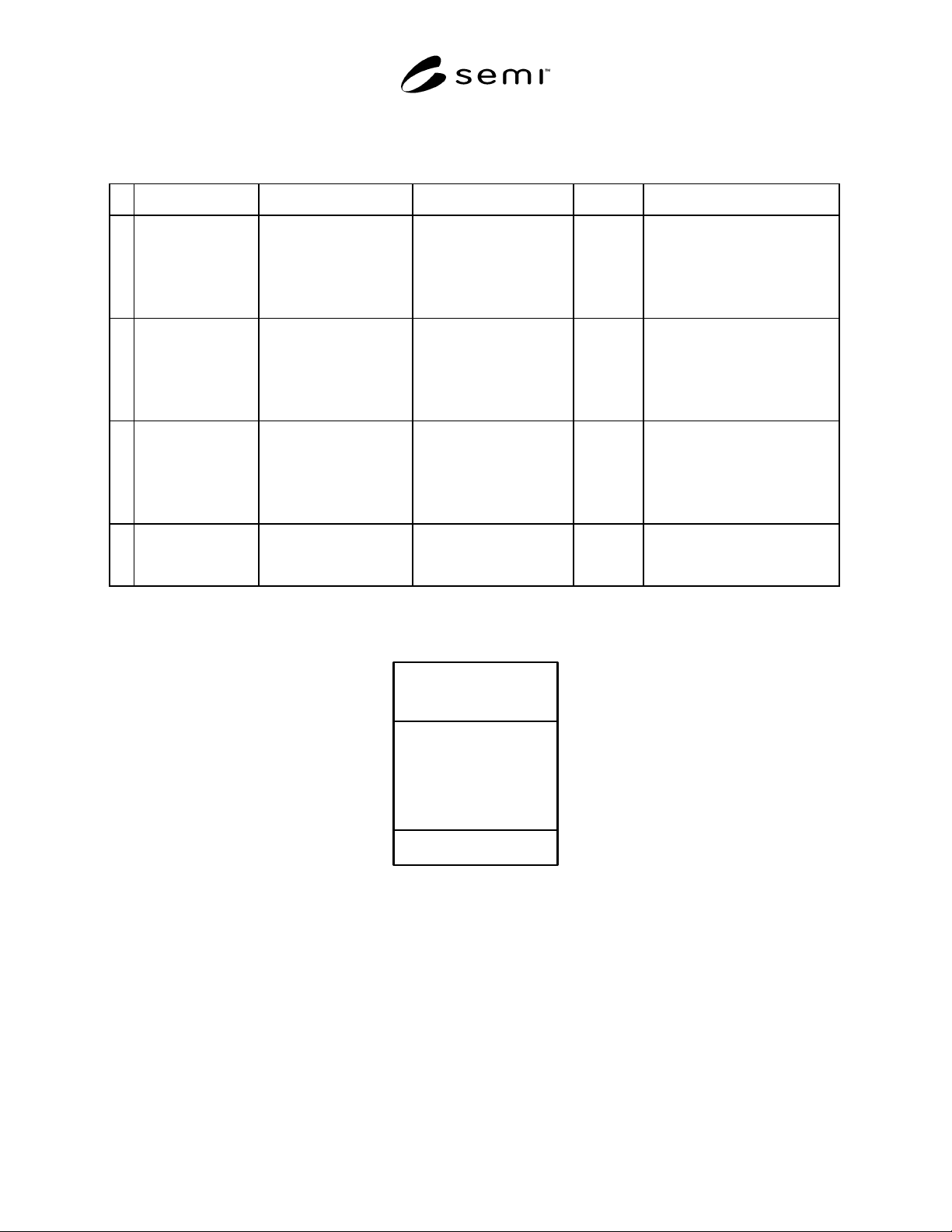
10.2.4 AbstractEquipmentElement Object — Figure 8 represents the AbstractEquipmentElement object.
Abstract Equipment
Element
ChangeService
Cycles
ResetDate
Description
Function
InService
ImmutableID
Supplier
Figure 8
AbstractEquipmentElement Object Type
SEMI E98-1102 © SEMI 2000, 2002 18
10.2.5 AbstractEquipmentElement Attributes — Table 4 defines the attributes of the AbstractEquipmentElement.
Table 4 AbstractEquipmentElement Attribute Definitions
Attribute Name Definition Access Reqd Form
ObjType Object type RO Y Text=“EqpElement”
ObjID Object identifier RO Y Text
Cycles Number of cycles (or hours) since installation or last reset. RO Y Unsigned long integer
ResetDate Date cycles set to zero. RO Y Text
Description User-definable text RW Y Text
Function Describes function of object (e.g., substrate-chuck, apply/develop track). RO Y Text
Supplier Name of manufacturer or provider RO Y Text
ImmutableID An unchangeable identifier such as serial number. RO Y Text
InService Available for work. RO Y Boolean
10.2.6 AbstractEquipmentElement Services — The user may be allowed to change the operational state of specific
AbstractEquipmentElement objects that are of significance for preventive maintenance. This is particularly
desirable for those subsystems for which preventive maintenance may be performed while the equipment is still
assigned to manufacturing operations.
10.2.6.1 ChangeService
10.2.6.1.1 The user may request that an element currently in the IN SERVICE state be placed in the OUT OF
SERVICE\ USER SELECT state. This request shall not affect any current activity for which the element is being
used. However, an element in the OUT OF SERVICE state shall not be used for any new activities.
10.2.6.1.2 The user may request that an element currently in the OUT OF SERVICE/USER SELECT state be
placed back into the IN SERVICE state.
10.3 EquipmentIODevice Object
10.3.1 An EquipmentIODevice object is a specialization of AbstractEquipmentElement used to represent the
sensors, actuators, and intelligent sensor/actuator devices that provide most of the process data sought by
manufacturing engineering. Individual I/O points are represented by individual Observables contained within the
EquipmentIODevice object.
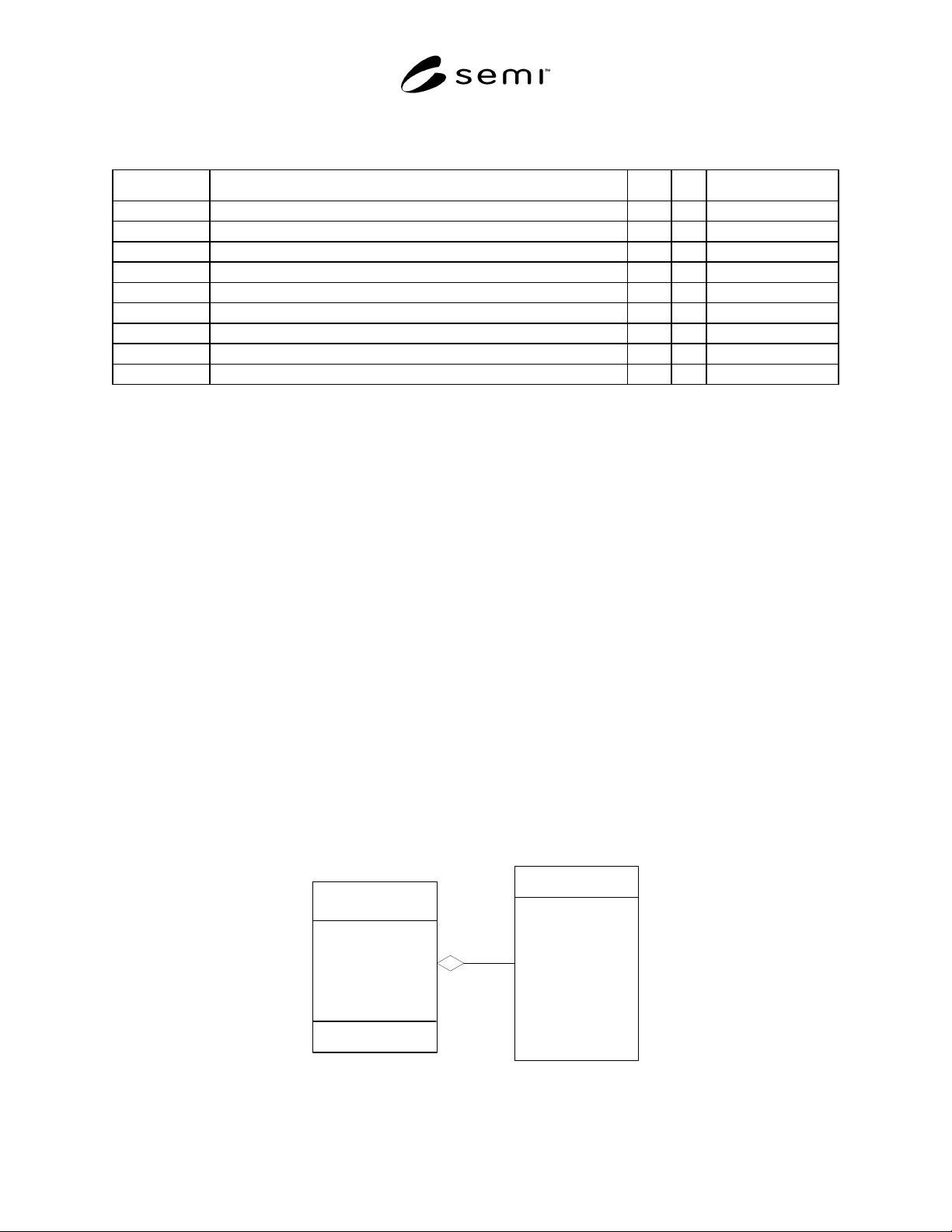
10.3.2 Observables are not formalized as standardized objects, as indicated by the thin line in Figure 9. The
EquipmentIODevice may represent a single I/O point, an aggregation of I/O points, or a virtual sensor providing
composite data.
10.3.3 Table 5 defines the attributes of the EquipmentIODevice. Attributes are in alphabetical order, with the
exception of the Observables
i
attribute, which is placed at the end with its structure members for clarity.
1+
Observable
DataDimensions
DataType
DeltaValue
InterlockStatus
Name
NominalValue
ObservableType
PossibleUnits
Range
ReadRate
ReportRate
ReportChange
Timestamp
Units
Value
AlgorithmID
Description
DeviceType
Function
HardwareRevision
ModelNumber
NumberOfObservables
Observables
SoftwareRevision
Equipment
IODevice
GetProgramDirectory
SelectProgram
Figure 9
EquipmentIODevice and Observable Object Types