semi合集-English.pdf - 第2316页
SEMI E82-0705 © SEMI 1999, 2005 12 7.5.4 Carrier State Transi tion Table Table 4 Carrier State Transition Table Transition # Previous State Trigger New State Actions Comments 1 None The carrier enters the physical domain…
SEMI E82-0705 © SEMI 1999, 2005 11
Transition # Previous State Trigger New State Actions Comment
7 ACQUIRING The carrier handoff
parallel I/O completes for
the vehicle to acquire
(load) the transfer unit and
starts for the vehicle to
deposit (unload) the
carrier.
DEPOSITING S6F11
VehicleDeposit-
Started
Carrier Replace
See scenario for an
example.
8 DEPOSITING The carrier handoff
parallel I/O completes for
the vehicle to deposit
(unload) the transfer unit
and starts for the vehicle
to acquire (load) the
carrier.
ACQUIRING S6F11
VehicleAcquire-
Started
Carrier Replace
See scenario for an
example.
9 ASSIGNED Vehicle is no longer being
utilized for the specified
command.
NOT ASSIGNED S6F11
Vehicle-Unassigned
This could be the result of
the command being
completed or aborted. It
could also be the result of
the TSC scheduling
algorithms assigning this
vehicle to another
command and/or another
vehicle being assigned to
this command.
10 NOT
ASSIGNED
Vehicle is allocated to a
TRANSFER command.
ASSIGNED S6F11
VehicleAssigned
11 INSTALLED Vehicle is removed from
use of transfer commands.
REMOVED S6F11
VehicleRemoved
12 REMOVED Vehicle is installed for use
of transfer commands.
INSTALLED S6F11
VehicleInstalled
7.5 IBSEM Carrier State Model
7.5.1 IBSEM Carrier State Model Requirements
7.5.1.1 The purpose of the carrier state model is to provide information to the host regarding carrier tracking (the
Host will not control carriers). Each carrier must comply with the carrier state model.
7.5.2 IBSEM Carrier State Model
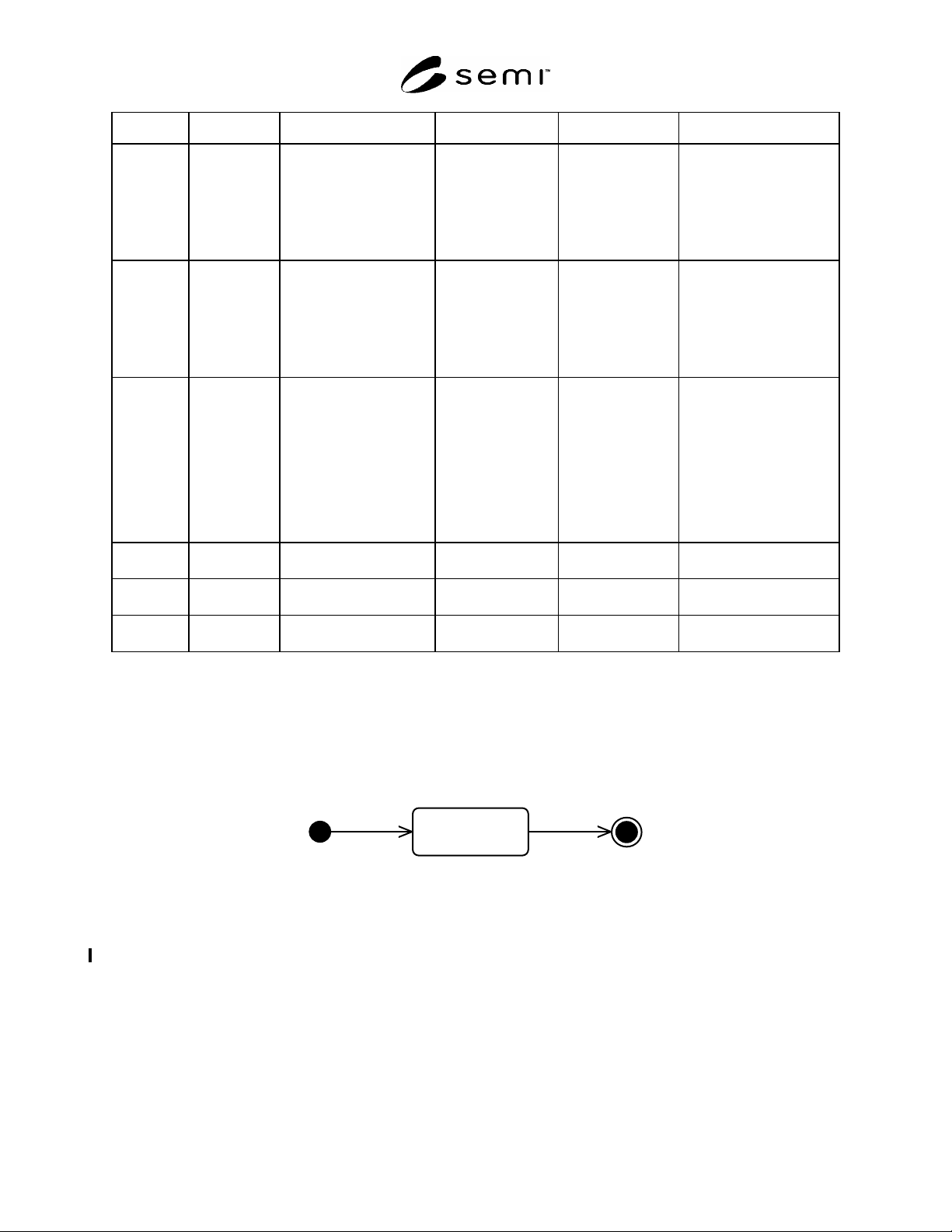
INSTALLED
12
Figure 5
Generic IBSEM Carrier State Model Diagram
7.5.3 Carrier State Definitions
7.5.3.1 INSTALLED — The carrier is in the physical domain of the TSC.
SEMI E82-0705 © SEMI 1999, 2005 12
7.5.4 Carrier State Transition Table
Table 4 Carrier State Transition Table
Transition # Previous State Trigger New State Actions Comments
1 None The carrier enters the
physical domain of the TSC.
INSTALLED S6F11 CarrierInstalled
2 INSTALLED The carrier is removed from
the physical domain of the
TSC.
None S6F11 CarrierRemoved
7.6 Port Transfer State Model
7.6.1 Port Transfer State Model Requirements
7.6.1.1 The purpose of the port transfer state model is to provided information to the host for the use in accessing
ports. This may permit the host and stocker to utilize ports that are in service while avoiding the use of ports that are
not in service.
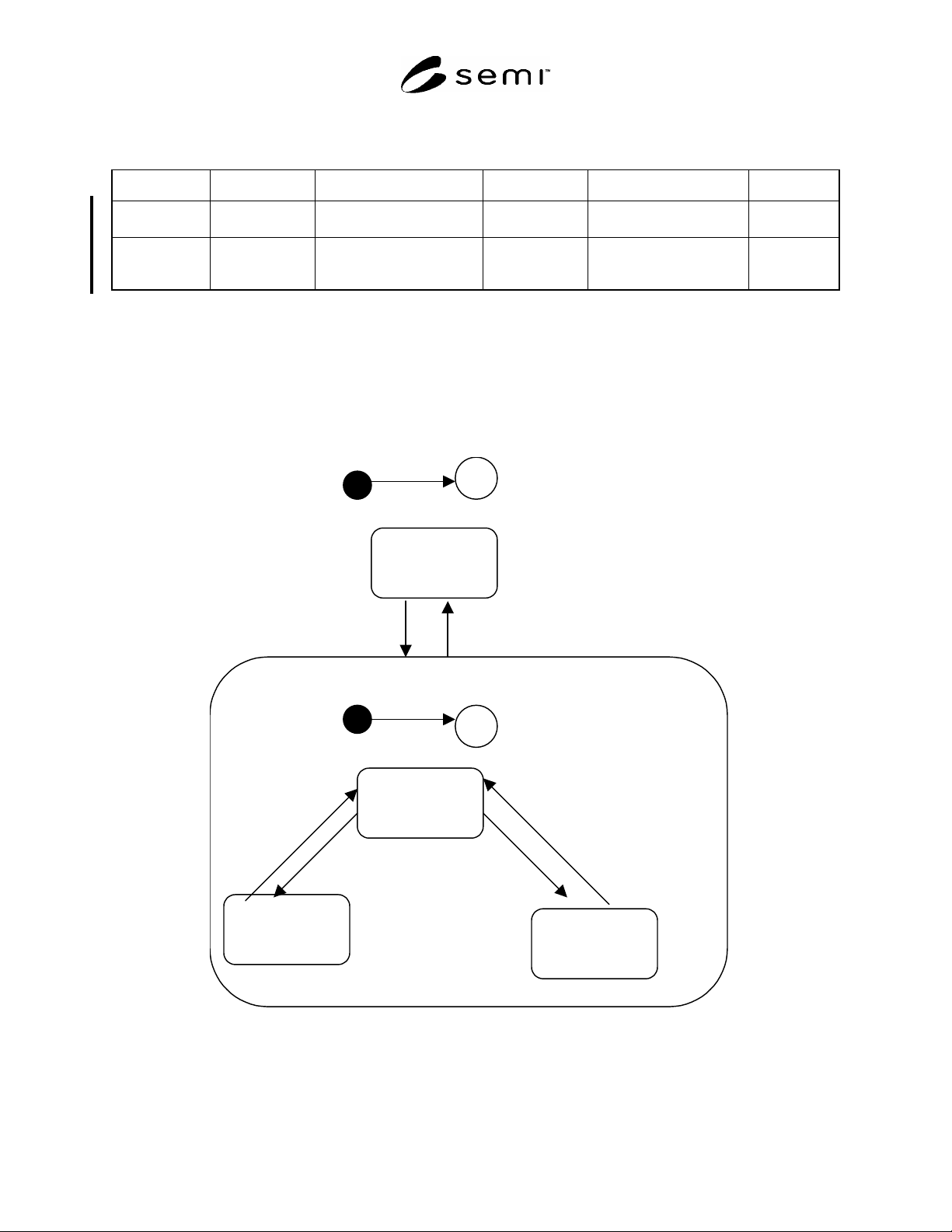
7.6.2 Port Transfer State Model
IN SERVICE
C
READY TO
LOAD
READY TO
UNLOAD
TRANSFER
BLOCKED
5
6
7
8
4
C
1
OUT OF
SERVICE
2 3
Figure 6
Port State Model Diagram

SEMI E82-0705 © SEMI 1999, 2005 13
7.6.3 Port Transfer State Definitions
7.6.3.1 OUT OF SERVICE — Transfer to/from this port is disabled and the port should not be used in any Transfer
command issued by the host. If a command is issued by the host which uses this port, it will not be rejected simply
because the port is in this state.
7.6.3.2 IN SERVICE — Transfer to/from this port is enabled.
7.6.3.3 The following are optional sub-states of the IN SERVICE state to provide information to the host for the
use in accessing ports. The information is generally obtained by the TSC via a low-level interface with the
connected equipment. The connected equipment should generally, though not required, follow the Load Port
Transfer State Model defined in SEMI E87. If these states are implemented, they are not required for every port.
7.6.3.3.1 TRANSFER BLOCKED — The state is neither READY TO LOAD nor READY TO UNLOAD.
7.6.3.3.2 READY TO LOAD — The port is able to accept (be loaded with) a carrier from the IBSEM equipment.
7.6.3.3.3 READY TO UNLOAD — The port is able to have a carrier removed (unloaded) by the IBSEM equipment.
7.6.4 Port Transfer State Transition Table
Table 5 Port Transfer State Transition Table
Transition # Previous State Trigger New State Action Comments
1 None System reset. OUT OF
SERVICE
Or
IN
SERVICE
S6F11
PortOutOfService
Or
S6F11 PortInService
The new state is based on
the current status of the
port or the state prior to
system reset.
2 OUT OF
SERVICE
The equipment has determined
that the port can be utilized for
transfers.
IN
SERVICE
S6F11 PortInService
3 IN SERVICE The equipment has determined
that the port should not be used
for transfers.
OUT OF
SERVICE
S6F11
PortOutOfService
This could be the result of
an alarm condition.
4 None System Reset. TRANSFER
BLOCKED
READY TO
LOAD
READY TO
UNLOAD
S6F11
PortTransferBlocked
S6F11
PortReadyToLoad
S6F11
PortReadyToUnload
The new state is based on
the current status of the
port.
5 TRANSFER
BLOCKED
Port ready for carrier delivery. READY TO
LOAD
S6F11
PortReadyToLoad
6 TRANSFER
BLOCKED
Port ready for carrier removal. READY TO
UNLOAD
S6F11
PortReadyToUnload
7 READY TO
LOAD
No carrier transfer allowed. TRANSFER
BLOCKED
S6F11
PortTransferBlocked
8 READY TO
UNLOAD
No carrier transfer allowed. TRANSFER
BLOCKED
S6F11
PortTransferBlocked
8 Collection Event List
8.1 This section identifies data collection events and defines (Stream 6) suggested associated variable data items.
The host can use the report definition scenario defined in SEMI E30 to define reports at IBSEM defined levels. The
intent of this section is to demonstrate that certain suggested data is available at specific events.
8.2 Requirements
8.2.1 This standard requires all collection events listed in the SEMI E30 standard (according to the GEM
capabilities required per §13).