semi合集-English.pdf - 第4677页
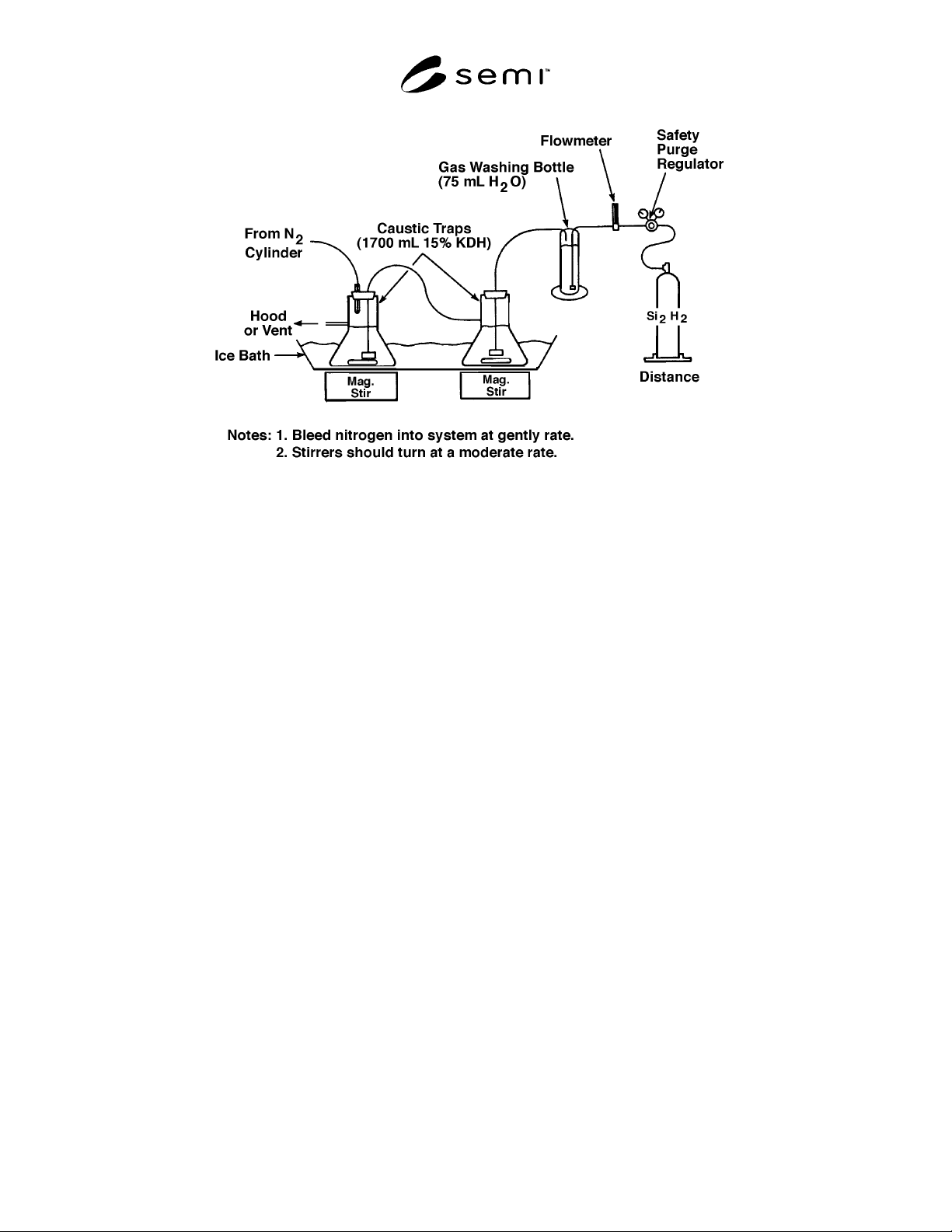
SEMI C3.34-1102 © SEMI 1989, 2002 6 Figure 2 Chloride Scrubbing Apparatus NOTICE: SEMI makes no warranties or repr esentations as to th e suitability of the standards set forth h erein for any particular application. The…
SEMI C3.34-1102 © SEMI 1989, 1102 5
8.6.4.9 Titrate with a solution of 5 g. mercuric nitrate
Hg(NO
3
)
2,
(diluted to 1000 mL in deionized water; then
50 mL diluted to 500 mL in deionized water) which has
been previously standardized to 5.0 mL of a sodium
chloride solution (approximately 165 ng NaCl,
accurately weighed, dissolved in 100 mL deionized
water).
8.6.5 Calibration
8.6.5.1 Run titration blank consisting of 150 mL
deionized water.
8.6.5.2 Calculate the concentration of chloride, using
the formula below. The result may not exceed the
specification in Section 8 of this standard.
mL sample - mL blank
mL standard - mL blank
×
wt. of NaCl g
()
100.0 mL
×
60.66% Cl
-
100% NaCl
×
1000 mL
1 L
×
.005 L
35.453 g/mole
×
0.082 atm L/mole
o
K
1 atm
×
294.26
o
K
volume of gas samples
×
1
×
10
6
ppm = ppm Cl
-
8.6.6 Final Calculation — Convert the results from
ppm to ppm-wt using the formula below. The result
may not exceed the specification in Section 7 of this
standard.
ppm- wt = ppm mole/mole()×
35.45
62.22
FIP
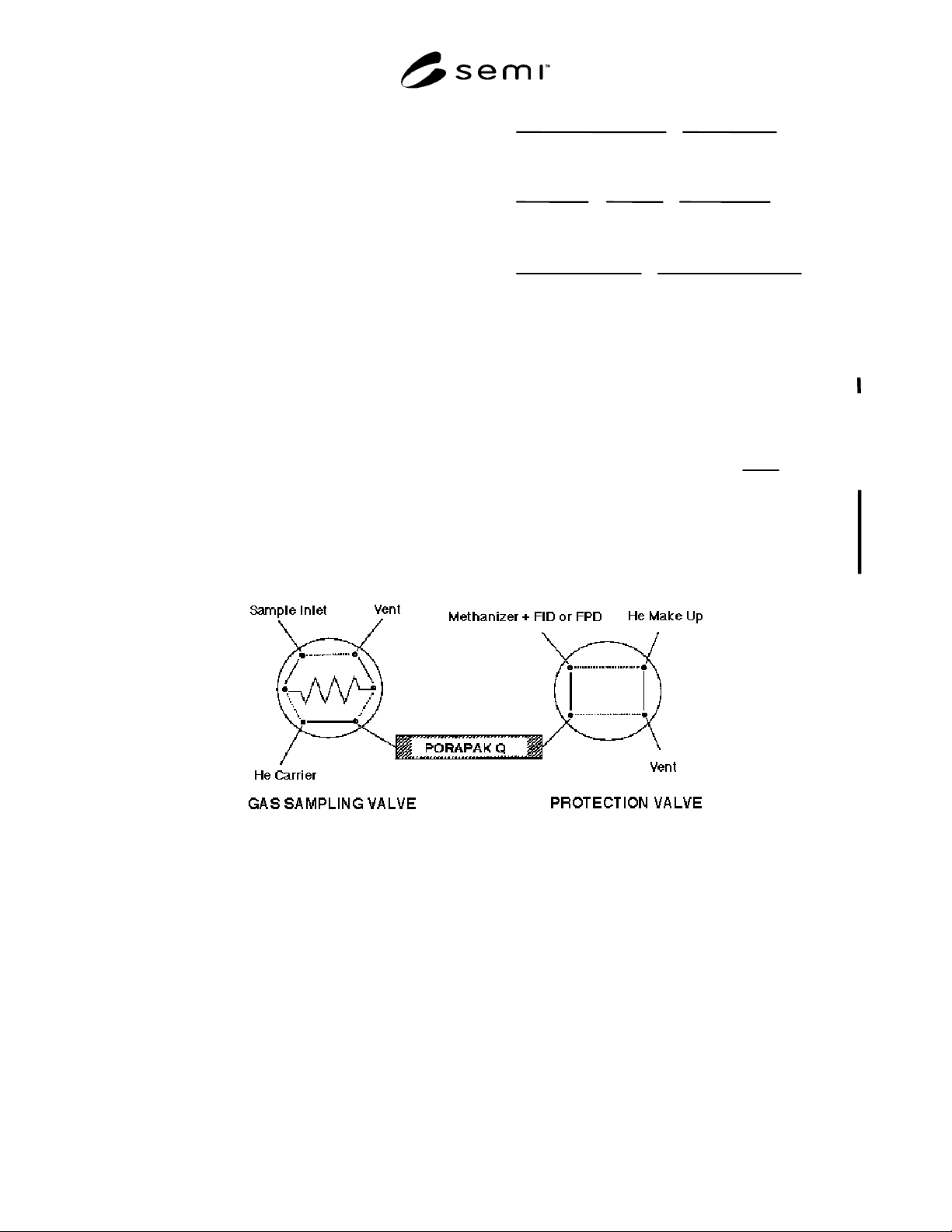
Figure 1
G.C. Configuration
SEMI C3.34-1102 © SEMI 1989, 2002 6
Figure 2
Chloride Scrubbing Apparatus
NOTICE: SEMI makes no warranties or representations as to the suitability of the standards set forth herein for
any particular application. The determination of the suitability of the standard is solely the responsibility of the user.
Users are cautioned to refer to manufacturer’s instructions, product labels, product data sheets, and other relevant
literature respecting any materials mentioned herein. These standards are subject to change without notice.
The user’s attention is called to the possibility that compliance with this standard may require use of copyrighted
material or of an invention covered by patent rights. By publication of this standard, SEMI takes no position
respecting the validity of any patent rights or copyrights asserted in connection with any item mentioned in this
standard. Users of this standard are expressly advised that determination of any such patent rights or copyrights and
the risk of infringement of such rights, are entirely their own responsibility.
Copyright by SEMI® (Semiconductor Equipment and Materials
International), 3081 Zanker Road, San Jose, CA 95134. Reproduction o
f
the contents in whole or in part is forbidden without express written
consent of SEMI.
SEMI C3.20-92 © SEMI 1982, 19991
SEMI C3.20-92 (Reapproved 0999)
STANDARD FOR HELIUM (He), IN CYLINDERS, 99.9995% QUALITY
This standard was technically reapproved by the Global Gases Committee and is the direct responsibility of
the North American Gases Committee. Current edition approved by the North American Regional Standards
Committee on April 15, 1999. Initially available at www.semi.org August 1999; to be published September
1999. Originally published in 1982; previously published in 1992.
1 Description
1.1 Helium is a rare gas or cryogenic liquid that is
inert, colorless, odorless, and tasteless.
2 Specifications
QUALITY: 99.9995%
Impurities Maximum Acceptable
Level (ppm)*
Carbon monoxide and carbon
dioxide (CO + CO
2
)
1
Nitrogen (N
2
)
2
Oxygen (O
2
)0.5
Total Hydrocarbons expressed as
Methane (THC)
0.5
Water (H
2
O) (v/v) 0.5
TOTAL SPECIFIED IMPURITIES 4.5
* An analysis of significant figures has not been considered. The
number of significant figures will be based on analytical accuracy and
the precision of the provided procedure.
3 Physical Constants (for in formation only)
Metric Units US Units
Molecular weight 4.003 4.003
Boiling point at 1 atm
-268.9°C -452.0°F
Density of gas at
21.1°C (70°F) and 1
atm
0.1656 kg/m3 0.01034 lb/ft3
Specific gravity of
gas at 21.1°C and 1
atm
(air = 1)
0.138 0.138
Density of liquid at
boiling point
124.9 kg/m3 7.798 lb/ft3
4 Analytical Procedures (Se e Notes 1, 2)
4.1 Carbon Monoxide and Carbon Dioxide — This
procedure is for the determination of carbon monoxide
and carbon dioxide in helium using a gas
chromatograph with a flame ionization detector and
methanizer.
4.1.1 Detection Limit — 100 ppb (mole/mole).
4.1.2 Instrument Parameters
4.1.2.1 Column:
Porapak T or Q, 3 m (9.8 ft) by 3 mm (1/8 in) ss;
or
Chromosorb 102, 2 m (6.6 ft) by 3 mm ss;
or equivalent.
4.1.2.2 Carrier Flow: 30 mL/min helium.
4.1.2.3 Sample Volume: 0.5 to 2.0 mL.
4.1.2.4 Temperatures:
Detector 280°C
Column Oven 60°C
Methanizer 350°C
4.1.3 Calibration Standards — 1-10 ppm (mole/mole)
carbon monoxide, 1-10 ppm (mole/mole) carbon
dioxide, balance helium.
4.1.4 Operating Procedure
4.1.4.1 Inject the calibration standard into the column
using a gas sampling valve. Record the retention times
and peak areas. Order of elution is carbon monoxide,
carbon dioxide.
4.1.4.2 Inject the sample to be tested in same manner
as the calibration standard. Record the retention times
and peak areas.
4.1.4.3 Repeat 4.1.4.1.
4.1.4.4 Compare the average peak areas of the
calibration standard to that of the helium sample being
tested. Calculate the concentrations of carbon monoxide
and carbon dioxide, using the formula below. The result
may not exceed the specification in Section 2 of this
Standard.
Sample Peak Are
a
Standard Peak Area
×
C
oncentrat
i
on
of Standard
=
C
oncentrat
i
on
of Sample
4.2 Nitrogen — This procedure is for the
determination of nitrogen in helium using a gas
chromatograph with a helium ionization detector.