semi合集-English.pdf - 第3369页
SEMI E132-0305 © SEMI 2004, 2005 22 14.2.1.2 ALLOWED — Establishment of authenticated sessions is a llowed. Upon entry to this state, all FROZEN persistent sessi ons are resumed per the sessi on state model. While i n th…
SEMI E132-0305 © SEMI 2004, 2005 21
rejected. The client’s assigned Privileges from its ACLEntry are read at the time the session is established and are
assigned to the session. Subsequent requests using the established session will use the session’s Privileges for
access verification even if the client’s Privileges have changed since then.
Table 32 EstablishSession Parameter Definitions
Parameter Description Kind Form
endpoint End point of client where the equipment will send all
notifications.
IN Structured data, of any type
derived from EndPoint,
Section 12.3.3.4.1.
sessionId Unique session identifier generated by equipment after
authentication, this identifier must be used in all subsequent
requests.
OUT Text.
error Max session limit exceeded error Text, equal to session limit
exceeded error.
error Operation not authorized. For example client might not have any
ACLentry defined.
error Structured data, of type
UnauthorizedOperationError,
Section 12.3.3.1.
13.3 Encryption of Data
13.3.1 This standard does not require data transmitted over an established session to be encrypted, encryption is only
required as specified by the authentication protocol.
14 State Model
14.1 This section defines the client’s view of the equipment’s behavior in supporting authentication, session
establishment, session management and communications over an established session. The state models represent
client’s view of the equipment’s state, not necessarily the actual equipment’s internal operations. No transitions in
these state models are to be made available for event reporting.
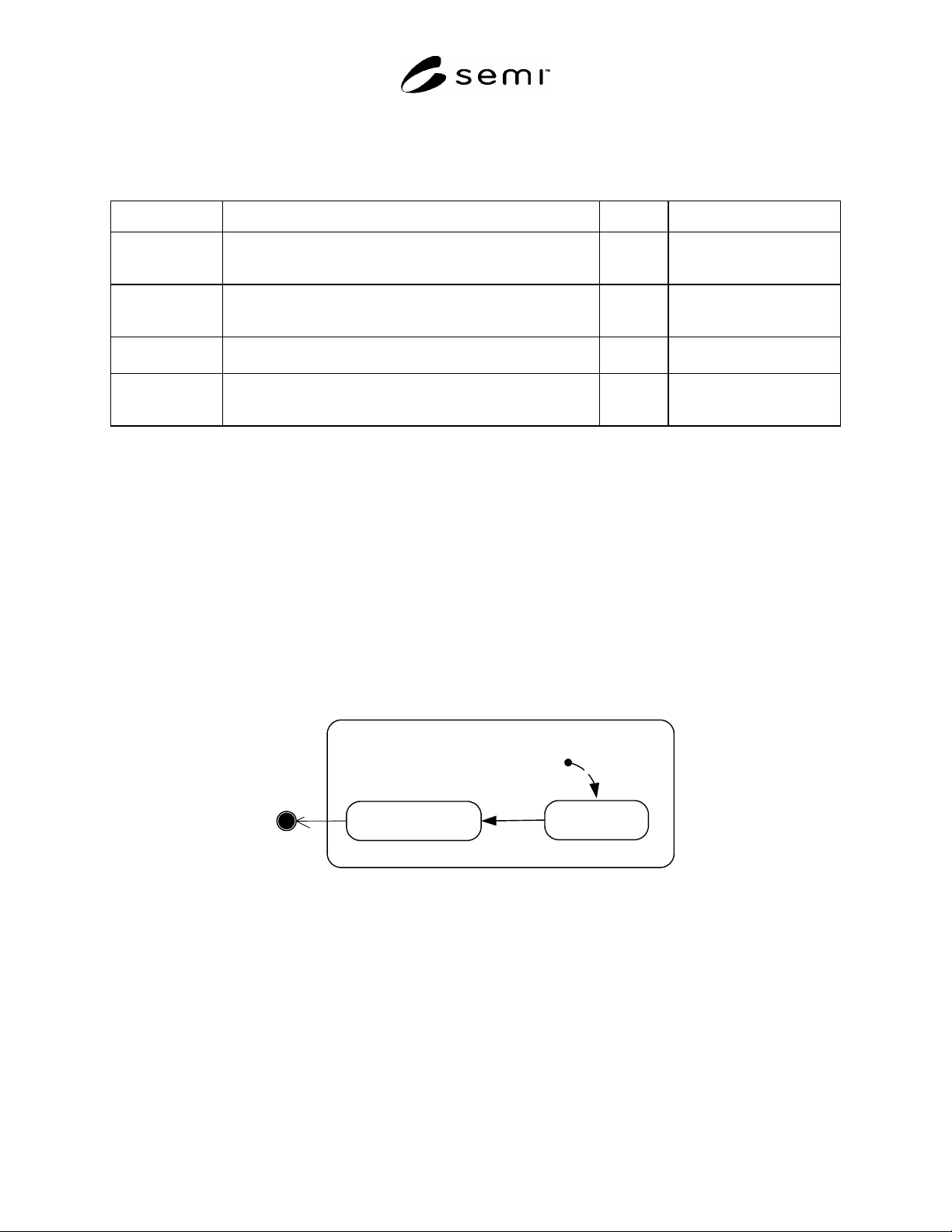
14.2 Session Establishment State Model — The session establishment state model defines the behavior of the
equipment for establishment of authenticated sessions over this interface. It defines the equipment’s management of
authenticated sessions overall during startup and shutdown. For definition of individual session behaviors, see
Section 14.3.
DISALLOWED
1
ALLOWED
2
Session Establishment
3
Figure 15
Session Establishment State Diagram
14.2.1 Session Establishment States
14.2.1.1 DISALLOWED — This state is active when the equipment is shutting down, either as part of an orderly
shutdown or an emergency power-off. While in this state, any requests for new authenticated sessions (if it is
possible to receive them) are rejected and all active sessions have been closed or FROZEN (Section 14.3.2.9). In the
case of an emergency shutdown, all active sessions may be dropped abruptly and notifications to clients may not be
possible. In this case, persistent sessions shall still be resumed on startup since their state is saved to non-volatile
storage.
SEMI E132-0305 © SEMI 2004, 2005 22
14.2.1.2 ALLOWED — Establishment of authenticated sessions is allowed. Upon entry to this state, all FROZEN
persistent sessions are resumed per the session state model. While in this state, requests for establishment of new
authenticated sessions are accepted, see Section 14.3 Session State Model for behavior on establishment of an
authenticated session.
14.2.2 Session Establishment State Transitions
Table 33 Session Establishment State Transitions Table
# Current State Trigger New State Actions Comments
1 (no state) Completion of system
initializations or the
equipment is in a state
where it can support
authenticated session
communications.
ALLOWED The equipment shall wait for
requests to establish
authenticated sessions. All
FROZEN persistent sessions are
resumed by automatic re-entry to
the ESTABLISHED state.
Any connectivity issues
encountered in attempting
to re-establish persistent
sessions shall be managed
by each session’s
Authenticated Session
state model defined in
Section 14.3 (see, for
example, Section
14.3.2.7).
2 ALLOWED The equipment is
powering down or
emergency down.
DISALLOWED If possible, the equipment shall
close all active non-persistent
sessions, notify all clients with
persistent sessions that their
session is being FROZEN, and
reject any requests for session
establishment.
3 DISALLOWED Equipment shutdown
complete.
(no state)
14.3 Session State Model
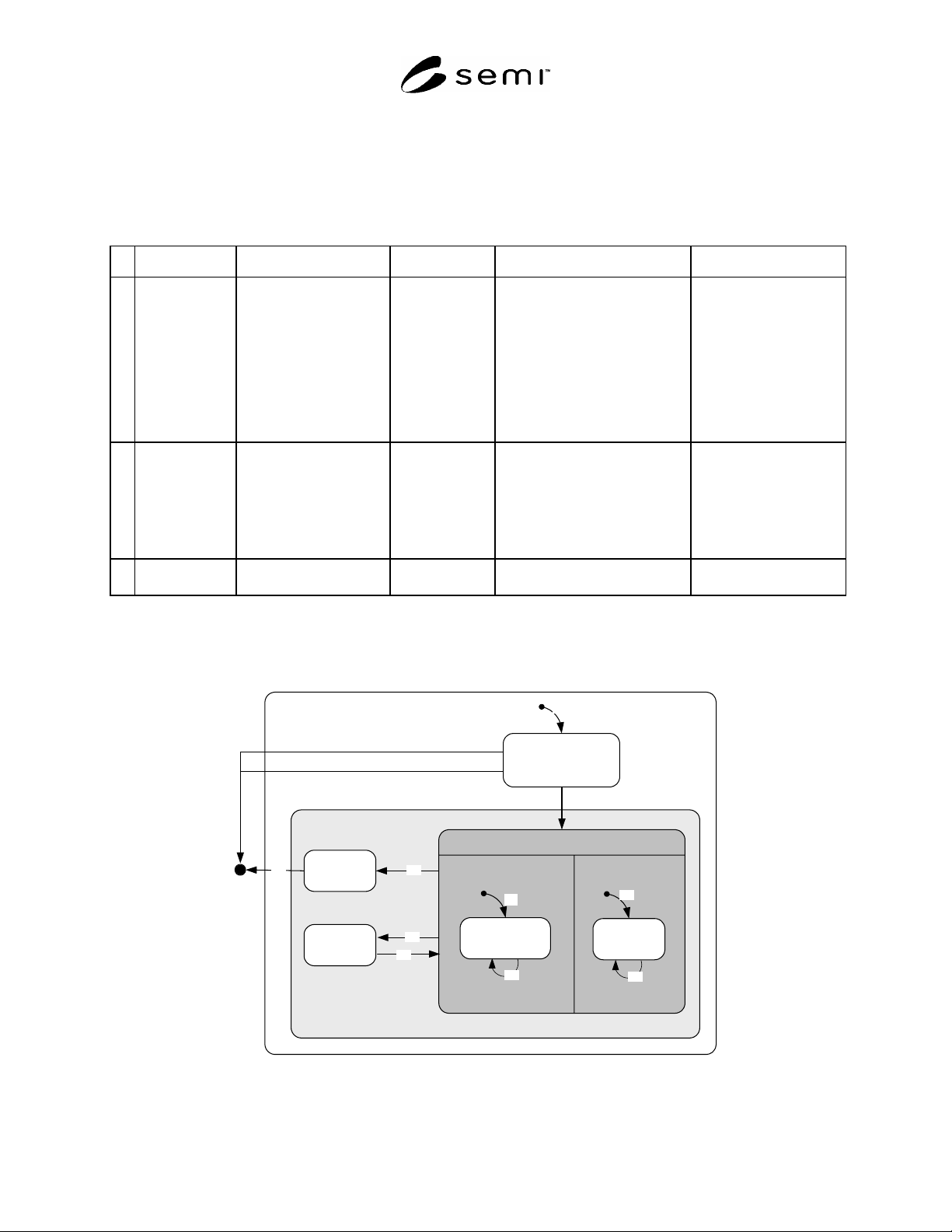
14.3.1 The session state model defines behavior of equipment related to establishing an authenticated session,
supporting the services and message exchanges over the established session and to terminating the session.
READY
AUTHENTICATING
CLOSING
1
5
ESTABLISHED
ACTIVE
SESSION
MONITOR
7
9
8
MONITORING
COMMUNICATING
FROZEN
10
11
2
6
12
Authenticated Session
4
3
Figure 16
Authenticated Session State Diagram

SEMI E132-0305 © SEMI 2004, 2005 23
14.3.2 Session States
14.3.2.1 ACTIVE — Parent state, covers entire lifecycle of an authenticated session. Session is active beginning
with a successful request to establish a new session, and is active until the session is closed.
14.3.2.2 AUTHENTICATING — This state is where the client and the equipment carry out the authentication
process and establish new authenticated sessions. Privileges are granted to the session once the client is
authenticated and the session successfully established. See Section 10 for the authentication message flow, and
Section 13.2.6 for session establishment.
14.3.2.3 ESTABLISHED — This state is the parent of all those sub-states that relate to service invocation and
communications subsequent to successful authentication and session establishment. It has two simultaneous sub-
states, COMMUNICATING and MONITORING, both of which are active whenever the session is
ESTABLISHED.
14.3.2.4 COMMUNICATING (ESTABLISHED Sub-State) — This is the ESTABLISHED sub-state where all session
communications are handled.
14.3.2.5 MONITORING (ESTABLISHED Sub-State) — This state provides a watchdog mechanism to monitor status
of the established session.
14.3.2.6 READY (COMMUNICATING Sub-State) — Initial state upon session established and COMMUNICATING
state becomes active. Both the client and the equipment have been successfully authenticated without errors. The
equipment is awaiting service requests in this state and can report relevant events to authenticated clients. Except
for the services defined in this specification, the services allowed or events reported are dependent on the
specifications that defined them.
14.3.2.7 SESSION MONITOR (MONITORING Sub-State) — Initial state upon entry to ESTABLISHED state and
when MONITORING becomes active. The equipment shall periodically check the active status of the session by
sending ping messages to the client. See Section 15.1.1for details of the SessionPing message. A ping message is
sent upon first entry to the state. When resuming persistent sessions during equipment startup, the ping message
tells client of each persistent session that the equipment is now online. The interval at which the next ping message
is sent, and the number of attempts to be made before closing a session shall be configurable, and must include a
way to disable periodic pings (such as by using a delay interval of zero). If the client does not respond after the
configured number of pings, the equipment shall terminate the session automatically. The default number of ping
attempts shall be set to 3.
14.3.2.8 CLOSING — Session is being terminated either at request of client, security admin, or equipment initiated
due to errors. Session context are cleared including established session identifier. A SessionClosed (section 15.1.3)
notification is sent to client (if possible) on transition to this state.
14.3.2.9 FROZEN — A persistent session is put on hold as the equipment is powered down or in a state where it is
not able to communicate. A SessionFrozen (section 15.1.2) notificatication is sent to client (if possible) on
transition to this state. When resuming a persistent session, behavior is governed by re-entry to the ESTABLISHED
state and its sub-states.
14.3.3 Session State Transitions
Table 34 Session State Transitions Table
# Current State Trigger New State Actions Comments
1 (no state) Client request to start
an authenticated
session
AUTHENTICATING Equipment and client
begins authentication and
session establishment
message flow (see Sections
10 and 14.3.2.2).