semi合集-English.pdf - 第5910页
SEMI P39-0304 E2 © SEMI 2004 13 12.2 PAD rec ords m ay be inserted between any other two records. 12.3 EXCEPTION HANDLING — The presence of a PAD record befo re the START record or after the END record should be treated …
SEMI P39-0304
E2
© SEMI 2004 12
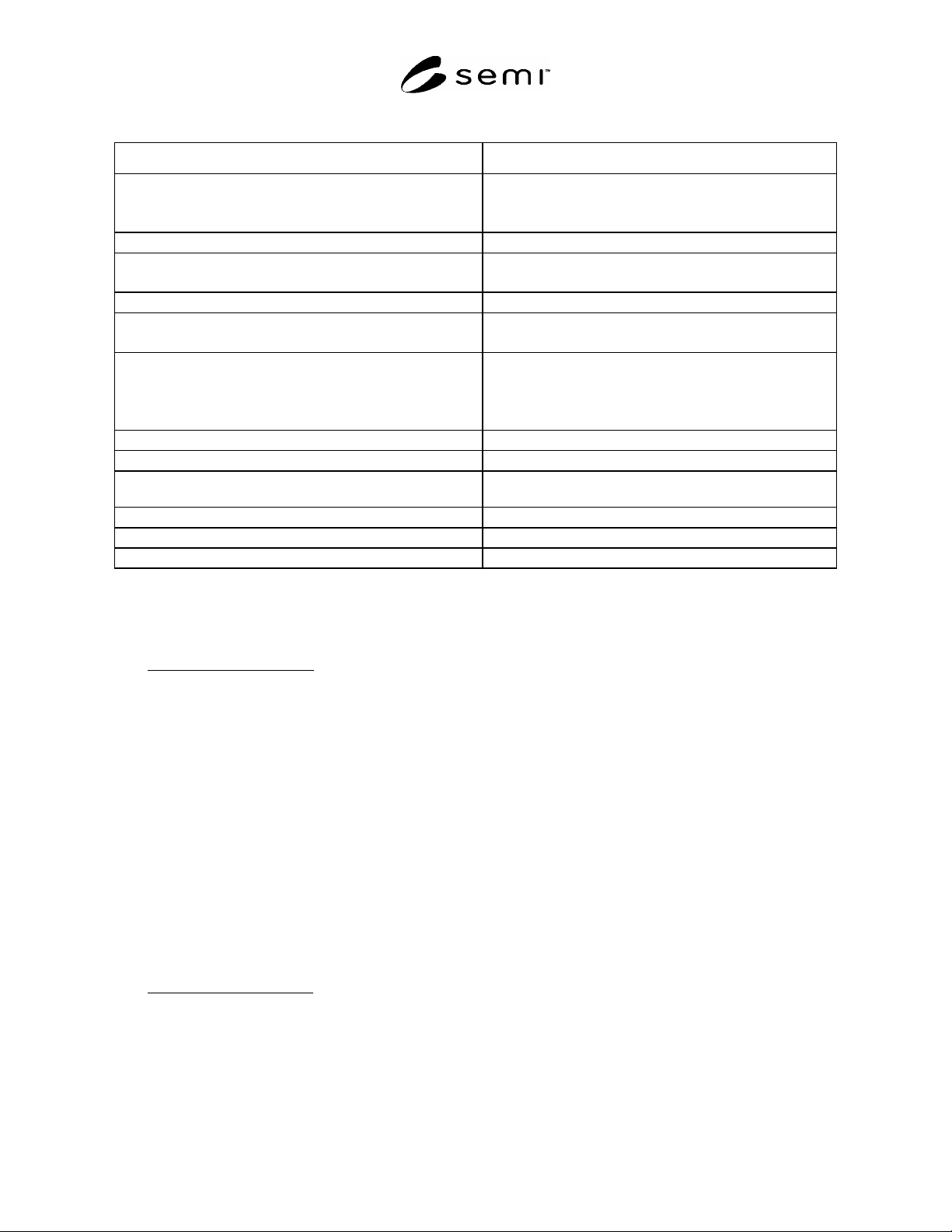
Table 10 Modal Variables
Modal Variables Related Records
repetition
PLACEMENT, TEXT, POLYGON, PATH,
RECTANGLE, TRAPEZOID, CTRAPEZOID,
CIRCLE, XGEOMETRY
placement-x, placement-y, placement-cell
PLACEMENT
layer, datatype POLYGON, PATH, RECTANGLE, TRAPEZOID,
CTRAPEZOID, CIRCLE, XGEOMETRY
textlayer, texttype, text-x, text-y, text-string
TEXT
geometry-x, geometry-y
POLYGON, PATH, RECTANGLE, TRAPEZOID
CTRAPEZOID, CIRCLE, XGEOMETRY
xy-mode
PLACEMENT, TEXT, POLYGON, PATH,
RECTANGLE, TRAPEZOID, CTRAPEZOID,
CIRCLE, XGEOMETRY, XYABSOLUTE,
XYRELATIVE
geometry-w, geometry-h
RECTANGLE, TRAPEZOID, CTRAPEZOID
polygon-point-list
POLYGON
path-halfwidth, path-point-list, path-start-extension,
path-end-extension
PATH
ctrapezoid-type
CTRAPEZOID
circle-radius
CIRCLE
last-property-name, last-value-list
PROPERTY
10.2 Modal variable xy-mode governs the interpretation of the x and y fields for those related record types indicated
in Table 10. Two interpretation modes are provided: absolute and relative. See Section 21 on page 17 for a
discussion of how these two modes work.
10.3 EXCEPTION HANDLING
— An OASIS record which implicitly references a modal variable which is in the
undefined state should be treated as a fatal error.
11 Records
11.1 The basic unit of information in an OASIS file is a record. A record consists of a single unsigned-integer
which encodes the record-ID, followed by the remainder of the record’s descriptive data. In this specification,
record-ID values are displayed as decimal numbers enclosed in apostrophes.
11.2 The CBLOCK record is a special case since it encapsulates a series of ordinary records in byte-compressed
form. When a CBLOCK record is encountered while reading an OASIS file, it is first necessary to decompress its
data, which will produce one or more ordinary records, which can in turn be decoded. For more information on
CBLOCK records refer to Section 35 on page 26.
11.3 Most records have an implicit length—the record must be parsed and decoded in order to determine its length.
The XNAME, XELEMENT, and XGEOMETRY records are exceptions to this. They encapsulate all of their user-
defined data in a single variable-length b-string, so they can be used for prototyping new record types, hiding
embedded proprietary data, supporting local non-interoperable extensions, etc. without rendering an OASIS file
illegible to older readers, which can simply note the string length and skip over the record.
11.4 EXCEPTION HANDLING
— OASIS processors should treat the nesting of a CBLOCK record within another
CBLOCK record as a fatal error.
12 PAD Record
12.1 A PAD record provides a simple way to reserve space within an OASIS file. It has the following format:
‘0’
SEMI P39-0304
E2
© SEMI 2004 13
12.2 PAD records may be inserted between any other two records.
12.3 EXCEPTION HANDLING
— The presence of a PAD record before the START record or after the END
record should be treated as a fatal error.
13 START Record
13.1 A START record identifies the beginning of an OASIS file, and immediately follows the <magic-bytes>
sequence described in Section 6.4 on page 3. It has the following format:
‘1’ version-string unit offset-flag [ table-offsets ]
13.2 The version-string is an a-string whose value is “1.0” for this version of the OASIS specification. Version
“1.0” corresponds to the OASIS format as described in this document.
13.3 The unit declaration is a positive
real number which specifies the global precision of the OASIS file’s
coordinate system in grid steps per micron. The OASIS unit value is essentially the reciprocal of the first value in
the GDSII Stream UNITS record.
13.4 offset-flag (an unsigned-integer) is 0 when the table-offsets structure is stored in the START record; offset-
flag is 1 when the table-offsets structure is instead stored in the END record. The option of storing table-offsets in
the END record is provided to make it possible to write an OASIS file sequentially, with no seek-and-update access
required, while still providing cell-level random-access capability for subsequent readers of that OASIS file.
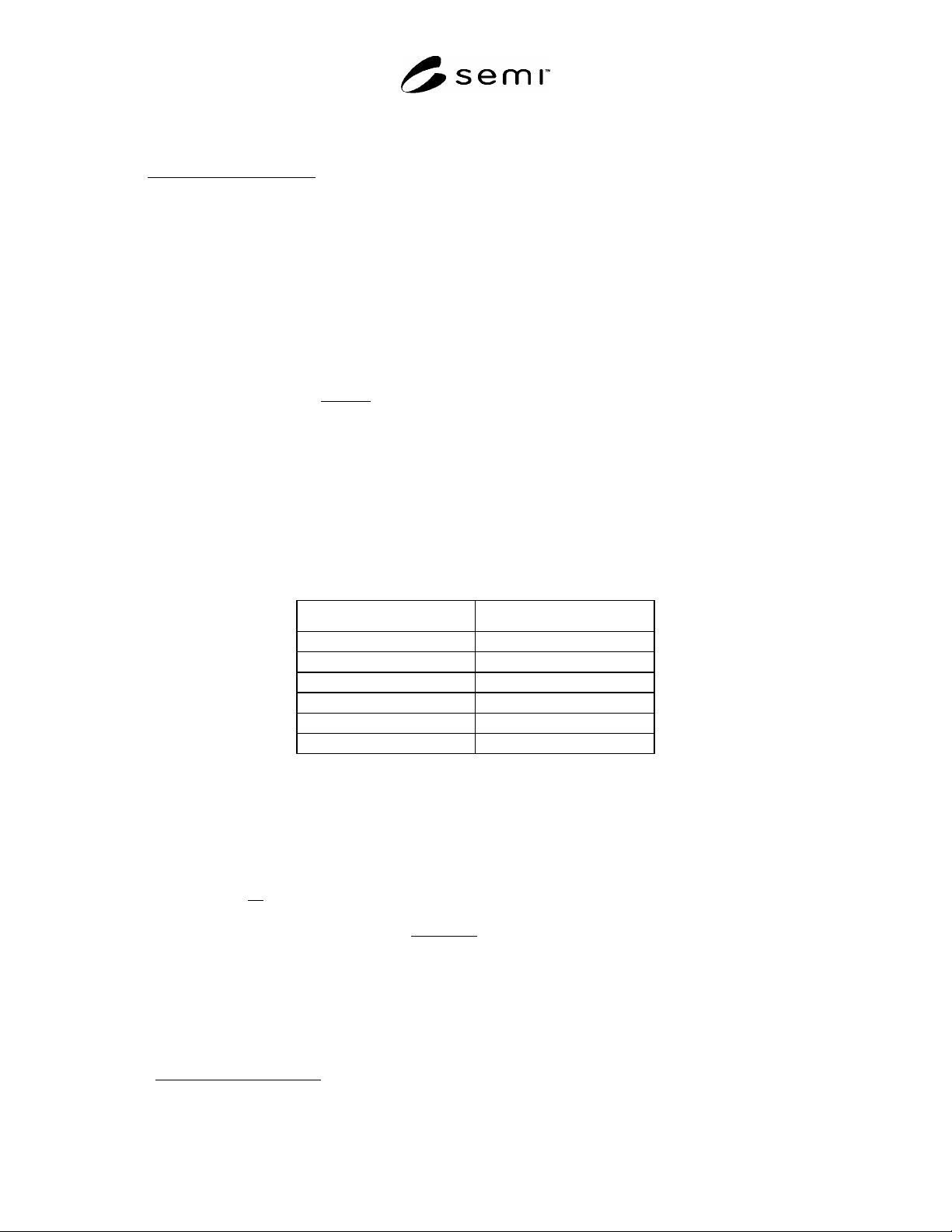
13.5 The table-offsets structure consists of 6 pairs of unsigned-integers. Each pair consists of a flag field, and a
corresponding byte-offset field, in the following order:
Table 11 Table Offset Order
Flag Byte-Offset
cellname-flag cellname-offset
textstring-flag textstring-offset
propname-flag propname-offset
propstring-flag propstring-offset
layername-flag layername-offset
xname-flag xname-offset
13.6 Each of the flag fields is either 1, indicating strict mode, or 0, indicating non-strict mode, for its respective
table. The corresponding byte-offset field indicates the position of the first record of its respective table relative to
the first byte (byte 0) of the OASIS file. A byte-offset of 0 indicates the absence of that particular table.
13.7 In non-strict mode, records of the corresponding type may occur anywhere in the file, even if some of them
have been gathered into a table pointed to by the corresponding byte-offset.
13.8 In strict mode, all
records of the corresponding type (plus any associated PROPERTY records) have been
gathered into a single contiguous table pointed to by the corresponding byte-offset. PAD records are also permitted
in strict mode tables. In addition, strict mode guarantees
that all references to the corresponding class of objects
(names, strings, or cells) are made exclusively by reference-number.
13.9 When a given strict mode table has been encapsulated within one or more CBLOCK records, the
corresponding byte-offset should point to the first byte of the first CBLOCK record containing that table, and the
first record of the table must be the first record which appears after decompression of the CBLOCK record.
Adherence to this requirement means that it is not permissible to encapsulate more than one strict mode table within
a single CBLOCK record, nor is it permissible to begin a strict mode table in the middle of a CBLOCK record.
13.10 EXCEPTION HANDLING
— The absence of a START record as the first record in an OASIS file should be
treated as a fatal error. A value of unit which is NaN, Inf, or non-positive, should also be treated as a fatal error.
When a given table offset is nonzero and the table is flagged as strict, the presence of a “stray” record of that type
SEMI P39-0304
E2
© SEMI 2004 14
located discontiguously from its tabular group should be treated as a fatal error, and any records which fail to use
reference-number access for that class of objects should be treated as a fatal error. An OASIS reader which does not
rely on any of the record grouping, reference-number, and byte-offset guarantees provided by strict mode is not
required to detect and report any exceptions related to strict mode.
14 END Record
14.1 An END record identifies the end of the OASIS file. The END record must be the last record in the file; no
trailing bytes are permitted. It has the following format:
‘2’ [ table-offsets ] padding-string validation-scheme [ validation-signature ]
14.2 The presence of the table-offsets structure is governed by offset-flag in the START record (see Section 13 on
page 13). The padding-string (a b-string) must be sized and inserted by the OASIS writer so that the total byte
length of the END record, including the record-ID, is exactly 256 bytes. This makes it possible for an OASIS reader
to find the END record (and any table-offsets and validation-signature) using a relative seek from the logical end-
of-file, avoiding the need to store a forward pointer in the START record. The contents of padding-string should
be initialized to NUL characters.
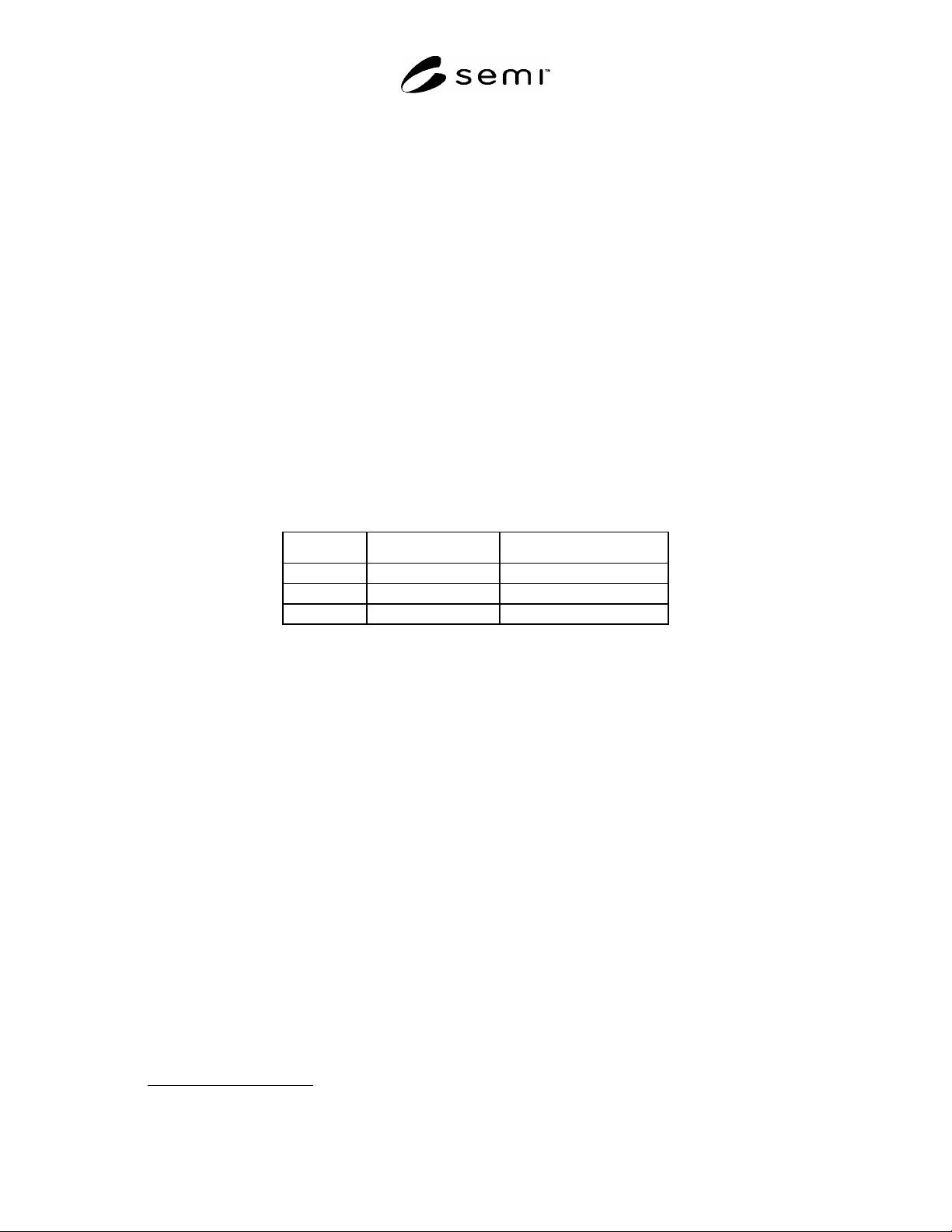
14.3 validation-scheme is an unsigned-integer which selects the validation scheme used, and validation-signature
is an optional scheme-dependent group of bytes used for validating the integrity of the OASIS file. The following
validation schemes are defined:
Table 12 END Record Validation Schemes
Scheme Description Validation Signature Length
0 No Validation 0
1 CRC32 4
2 CHECKSUM32 4
14.4 CRC32 Validation
14.4.1 The CRC32 polynomial is specified in ISO 3309:
x
32
+ x
26
+ x
23
+ x
22
+ x
16
+ x
12
+ x
11
+ x
10
+ x
8
+ x
7
+ x
5
+ x
4
+ x
2
+ x
1
+ x
0
With the left-most bit representing the most significant bit, this corresponds to a value of:
binary 1 0000 0100 1100 0001 0001 1101 1011 0111
hexadecimal 104c11db7
14.4.2 The CRC32 value is computed using all of the bytes in the OASIS file from the first byte of the START
record to the END record’s validation-scheme integer. It is byte-order dependent. The resulting 32-bit word is
stored in the last 4 bytes of the file, with the least significant byte first. This calculation is usually implemented
using a table-lookup shift/XOR method. See Appendix 1 for sample C-language source code.
14.5 CHECKSUM32 Validation
14.5.1 The CHECKSUM32 validation signature is computed as a simple unsigned arithmetic summation of all of
the bytes in the OASIS file from the first byte of the START record to the END record’s validation-scheme
integer. This value is then truncated to its least significant 32 bits and stored in the last 4 bytes of the file, with the
least significant byte first. It is not byte-order dependent, and this characteristic makes it somewhat easier to
calculate if the file is not written sequentially. It is, however, far less effective than CRC32 for detecting errors. See
Appendix 1 for sample C-language source code.
14.6 EXCEPTION HANDLING
— OASIS processors should treat the absence of an END record in an OASIS file
as a fatal error.